
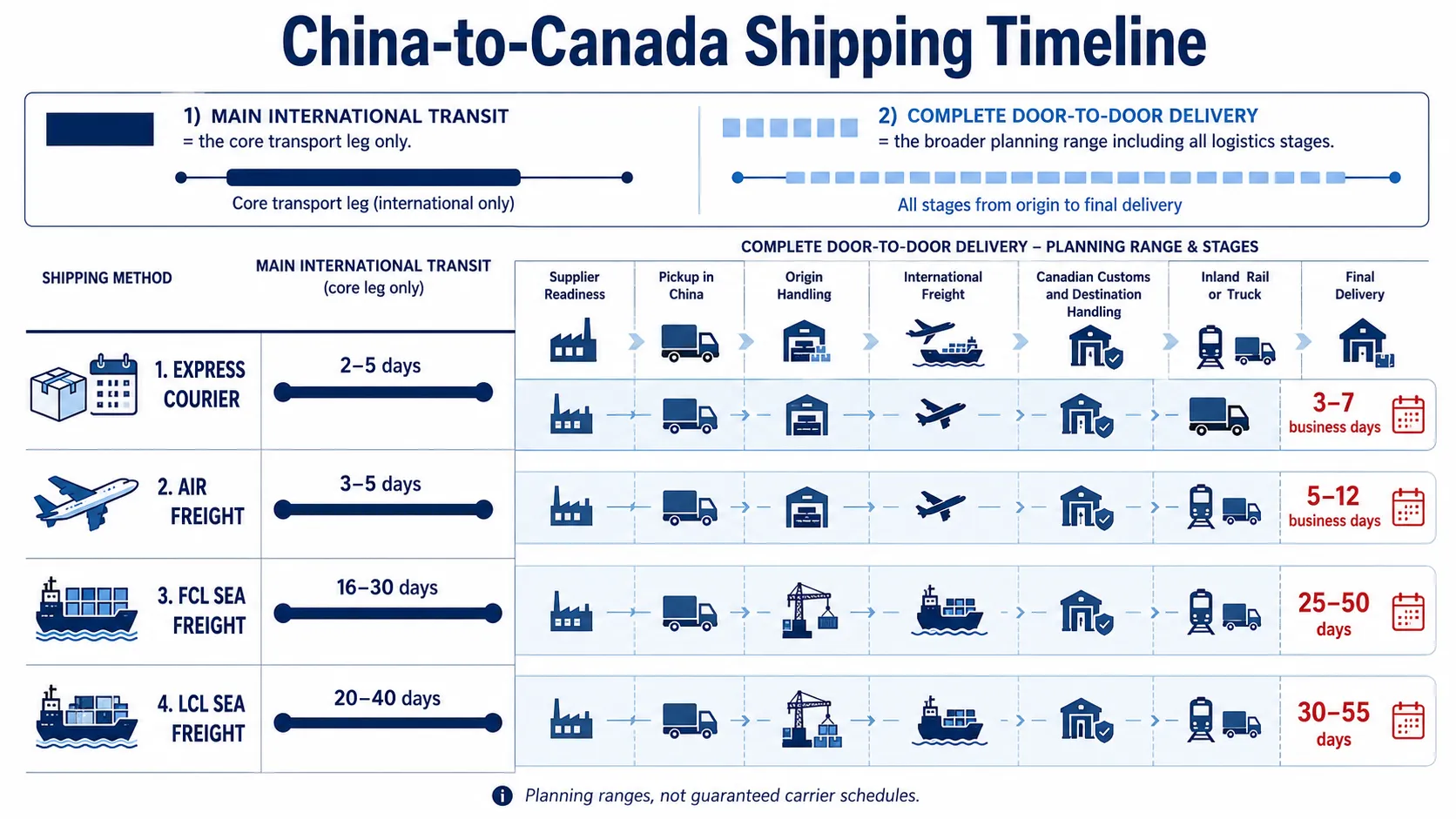
Shipping from China to Canada generally takes approximately 3–7 business days by express courier, 5–12 business days by door-to-door air freight, 25–50 days by door-to-door FCL sea freight, and 30–55 days by door-to-door LCL sea freight.
The international transportation stage alone is shorter. Standard airport-to-airport air freight commonly requires approximately 3–5 days, the main FCL ocean movement approximately 16–30 days, and the main LCL ocean movement approximately 20–40 days. Supplier preparation, pickup, export handling, customs clearance, terminal processing, inland rail or trucking and final delivery must be added when calculating the complete lead time.
These are practical commercial-freight planning ranges reviewed on August 6, 2026. They are not guaranteed carrier schedules. The actual shipping time depends on the Chinese origin, Canadian destination, cargo-ready date, selected service, carrier routing, customs requirements and delivery conditions.
For a complete overview of methods, costs, routes, import requirements and shipping decisions, begin with our shipping from China to Canada guide. This page specifically covers transit time, delivery planning, shipping milestones, customs-related delays and the difference between international transit and complete door-to-door lead time.
How Long Does Shipping from China to Canada Take?
| Shipping method | Typical main international transit | Typical door-to-door planning time | Best suited for |
|---|---|---|---|
| Express courier | 2–5 days | 3–7 business days | Documents, samples and small urgent parcels |
| Standard air freight | 3–5 days airport to airport | 5–12 business days | Urgent commercial cargo and higher-value inventory |
| Priority air freight | Route and capacity dependent | 4–8 business days | Critical components, product launches and shortage inventory |
| FCL sea freight | 16–30 days port to port | 25–50 days | Full containers, wholesale stock and planned inventory |
| LCL sea freight | 20–40 days port to port | 30–55 days | Smaller ocean shipments and consolidated cargo |
| Door-to-door sea freight | Depends on LCL or FCL routing | 25–55 days | Commercial cargo requiring coordinated final delivery |
| Sea freight to an inland or remote destination | Route dependent | 30–60+ days | Calgary, Winnipeg, Toronto, Markham, Ottawa and remote destinations |
| DDP shipping | Depends on the selected air or sea method | Selected air or sea range plus the confirmed customs and delivery scope | Eligible shipments using a defined duty-paid arrangement |
Planning note: All transit ranges are indicative rather than guaranteed carrier schedules. Ocean timelines are generally stated in calendar days, while courier and air-freight estimates are commonly stated in business days.
How Total Shipping Time Is Calculated
The complete China-to-Canada shipping time is not equal to the flight time or vessel transit alone.
Supplier readiness + pickup + origin handling + international transportation + destination handling + customs release + inland transportation + final delivery = total shipment lead time
| Timeline stage | What happens | Typical timing risk |
|---|---|---|
| Supplier readiness | Production, packing, labels, documents and export preparation are completed | The goods are not ready on the confirmed cargo-ready date |
| Pickup in China | The shipment moves from the supplier to an airport, port or consolidation warehouse | Factory access, loading, distance or incomplete pickup information |
| Origin handling | Cargo is received, measured, screened, consolidated or loaded for export | Missed warehouse cut-off or incorrect cargo measurements |
| International movement | The cargo moves by air or sea to Canada | Capacity, routing, transshipment, schedule changes or weather |
| Destination handling | The cargo is unloaded and processed at the airport, port, terminal or CFS | Terminal congestion, deconsolidation or container availability |
| Customs release | The commercial import entry is reviewed and released | Incomplete documents, examinations, permits or importer-account issues |
| Inland transportation | The shipment moves by rail, drayage or truck toward the Canadian destination | Rail availability, equipment, appointments or long-distance delivery |
| Final delivery | The cargo reaches the warehouse, business, 3PL or other agreed location | Receiving appointments, dock restrictions, unloading or waiting time |
Production time is not normally included in a freight-forwarder’s transit estimate unless it is specifically stated. The shipping clock should begin from an agreed milestone such as cargo pickup, warehouse receipt, flight departure or vessel departure.
Transit Time, Lead Time and Delivery Time Are Not the Same
Shipping quotations and tracking systems use several dates that can appear similar but describe different events.
| Term | Meaning | Why it matters |
|---|---|---|
| Cargo-ready date | The date the supplier confirms that the packed goods are available for pickup | A booking cannot be planned reliably until this date is credible |
| Warehouse received date | The date the freight warehouse physically receives the shipment | The cargo may still require measurement, screening or consolidation |
| Cut-off date | The latest time cargo and documents must be accepted for a planned flight or sailing | Missing the cut-off can move the shipment to a later departure |
| ETD | Estimated Time of Departure | A planned departure rather than confirmation that the shipment has left |
| ATD | Actual Time of Departure | Confirms that the aircraft or vessel has departed |
| ETA | Estimated Time of Arrival | Does not mean the cargo is customs-released or ready for collection |
| ATA | Actual Time of Arrival | Confirms arrival at the airport, port or terminal |
| Customs release | CBSA has authorized the goods to leave customs control | Release may still be followed by terminal or warehouse processing |
| Cargo availability | The airline, terminal, rail ramp or CFS confirms that the freight can be recovered | Availability can occur after physical arrival and customs release |
| Final delivery date | The shipment is delivered to the agreed Canadian destination | This is the most useful date for inventory and customer planning |
Importers should avoid treating ETA as the warehouse-delivery date. An ocean container may arrive in Vancouver but still require terminal discharge, customs release, rail transfer and truck delivery before reaching Toronto or Markham.
Express Shipping Time from China to Canada
Express courier commonly takes approximately 3–7 business days door to door for normal documents, samples and small parcels.
The courier network usually combines pickup, export processing, international transportation, customs-processing support and final delivery. This can make courier faster and simpler than arranging separate commercial freight stages for a small shipment.
Courier delivery can take longer when:
- The pickup city is outside a major Chinese logistics region
- The parcel has incomplete or unclear customs documents
- The destination is outside a standard Canadian service area
- The shipment contains batteries, liquids or regulated products
- Duty, tax or importer information must be confirmed
- The shipment is selected for inspection
- A weekend or statutory holiday interrupts processing
This guide focuses on commercial freight. Postal services such as China Post may follow different parcel networks and can take considerably longer than express courier.
Air Freight Time from China to Canada
Standard airport-to-airport air freight commonly requires approximately 3–5 days for the main international movement. A more realistic supplier-to-door planning range is approximately 5–12 business days.
The aircraft’s actual time in the air is measured in hours, but commercial air freight takes several days because cargo must be picked up, accepted at the export warehouse, screened, booked, loaded, transferred where required, cleared in Canada and delivered.
Typical Air Freight Timeline
| Air-freight stage | Indicative planning time |
|---|---|
| Supplier pickup and delivery to the export warehouse | 1–2 business days |
| Receiving, measurement, screening and export handling | 1–3 business days |
| Main air movement | 3–5 days |
| Canadian airport handling and customs release | 1–3 business days when routine |
| Final delivery | 1–4 business days, depending on destination |
| Typical combined planning range | 5–12 business days |
Planning note: These are indicative business-planning ranges rather than guaranteed carrier schedules. Some stages may overlap, so the total timeline should not be calculated by simply adding the maximum value of each stage.
Direct and Transshipment Air Freight
A direct flight normally reduces transfer risk, but the fastest flight is not always the fastest complete freight service. A transshipment route may depart earlier or offer better cargo capacity.
Air-freight schedules depend on:
- Origin airport
- Canadian gateway
- Available cargo capacity
- Direct or connecting service
- Warehouse cut-off
- Cargo screening
- Product restrictions
- Customs and final delivery requirements
For cargo acceptance, volumetric weight and airport-to-door options, review our air freight from China to Canada guide.
Sea Freight Time from China to Canada
Sea freight generally requires more inventory planning than air freight. The main vessel movement may take approximately 16–30 days for FCL and approximately 20–40 days for LCL.
Complete supplier-to-door delivery commonly requires approximately 25–50 days for FCL and approximately 30–55 days for LCL.
Ocean timing depends on:
- Chinese port of loading
- Canadian port or gateway
- Direct or transshipment service
- Carrier sailing frequency
- Container and equipment availability
- Export cut-off dates
- Port and terminal conditions
- Customs release
- Rail or truck transportation in Canada
- Final delivery appointments
Typical FCL Shipping Timeline
| FCL stage | Indicative planning time |
|---|---|
| Container positioning, loading and origin trucking | 2–5 days |
| Export terminal handling and sailing preparation | 2–5 days |
| Main ocean movement | 16–30 days |
| Discharge, customs and terminal availability | 3–8 days when routine |
| Rail, drayage and final delivery | 1–14+ days depending on destination |
| Typical combined planning range | 25–50 days |
Typical LCL Shipping Timeline
| LCL stage | Indicative planning time |
|---|---|
| Supplier pickup and origin warehouse receiving | 2–5 days |
| Consolidation and export preparation | 4–10 days |
| Main ocean movement | 20–40 days |
| Deconsolidation, customs and cargo availability | 3–8 days when routine |
| Final truck delivery | 1–14+ days depending on destination |
| Typical combined planning range | 30–55 days |
LCL can be slower than FCL because the shipment depends on other cargo during origin consolidation and destination deconsolidation.
For ocean routes, container options and cargo requirements, review our sea freight from China to Canada guide.
Is LCL Slower Than FCL?
LCL is often slower than FCL, even when both shipments travel on the same vessel.
| Timing factor | LCL | FCL |
|---|---|---|
| Origin receiving | Cargo must be delivered to and processed by a consolidation warehouse | The container can be loaded for one importer |
| Dependency on other cargo | May wait for compatible shipments and consolidation cut-off | Does not depend on other importers’ cargo |
| Destination handling | Container must be deconsolidated before individual shipments are available | Container moves as one shipping unit |
| Number of handling points | Usually higher | Usually lower |
| Planning range | 30–55 days door to door | Approximately 25–50 days door to door |
LCL can still be the appropriate method when cargo volume does not justify a complete container. The choice should be based on shipment volume, delivery deadline, handling risk and complete shipping cost.
Use our LCL vs FCL shipping guide for a broader operational and cost comparison.
Port-to-Port vs Door-to-Door Shipping Time
Port-to-port and airport-to-airport transit times cover only the main international movement. They do not represent the complete time required to move goods from a Chinese factory to a Canadian warehouse.
| Service scope | Commonly included stages | Commonly excluded stages |
|---|---|---|
| Airport to airport | Main air movement between the origin and destination airports | Pickup, origin handling, customs and final delivery |
| Port to port | Main ocean movement between the origin and destination ports | Factory pickup, terminals, customs, rail, trucking and delivery |
| Door to airport | Supplier pickup, origin handling and main air movement | Canadian customs and final delivery unless stated |
| Door to port | Supplier pickup, origin handling and main sea movement | Canadian destination handling, customs and inland delivery |
| Door to door | Pickup through delivery to the agreed Canadian destination | Duty, GST, examinations and special delivery services unless stated |
| DDP | Air or sea transportation under a defined duty-paid arrangement | Any charge or responsibility not confirmed in the written scope |
A shipment can be door to door without being DDP. Door-to-door describes the physical transportation scope, while DDP is an Incoterm that allocates broader seller responsibilities.
For service-boundary planning, see our door-to-door shipping from China to Canada guide.
Shipping Time by Chinese Origin
The Chinese pickup location affects the time required before the cargo reaches the export airport, port or consolidation warehouse.
| Chinese origin | Common export gateway | Typical timing consideration |
|---|---|---|
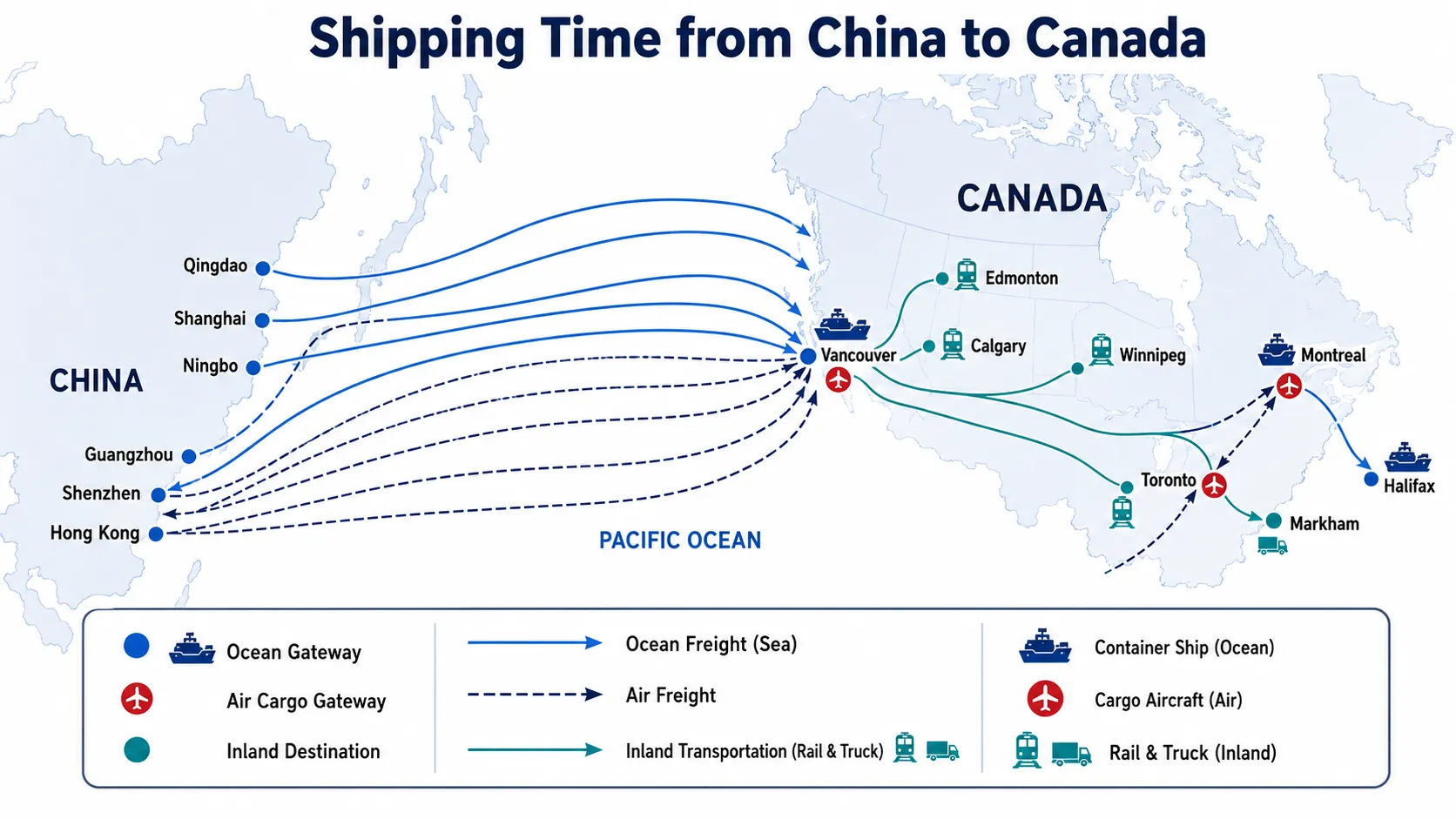
| Shenzhen and Dongguan | Shenzhen ports, Shenzhen airport or Hong Kong airport | Pickup and gateway selection commonly add approximately 1–3 days before departure |
| Hong Kong | Hong Kong airport and container terminals | Strong international connections, but cross-border cargo from mainland China requires additional coordination |
| Guangzhou and Foshan | Guangzhou, Shenzhen or nearby South China gateways | Supplier distance and selected gateway affect pickup and cut-off timing |
| Shanghai and Suzhou | Shanghai ports and airports | Factory readiness and warehouse cut-off determine whether the planned departure is met |
| Ningbo and Yiwu | Ningbo-Zhoushan port or Shanghai-area airports | Inland transfer from Yiwu may add time before air or ocean departure |
| Qingdao and North China | Qingdao or another northern gateway | Supplier distance, sailing frequency and route selection affect the origin lead time |
For detailed regional planning, review our guides to shipping from Shenzhen to Canada and shipping from Shanghai to Canada.
Shipping Time by Canadian Destination
Arrival in Canada is not the end of the shipment. Cargo may require rail or trucking from the gateway to an inland city.
The additional ranges below begin after routine customs release and terminal availability. They are planning estimates rather than guaranteed railway or truck schedules.
| Canadian destination | Typical additional inland planning time | Important timing consideration |
|---|---|---|
| Vancouver and the Lower Mainland | 1–5 business days | No long transcontinental rail movement, but terminal and local-delivery conditions still apply |
| Calgary and Edmonton | 3–8 days | Rail or long-distance trucking may follow Vancouver arrival |
| Winnipeg | 5–10 days | Rail availability, terminal processing and local delivery affect timing |
| Toronto, Brampton and Markham | 7–14 days | West Coast cargo commonly requires transcontinental rail and final trucking |
| Montreal | 8–16 days when routed through Western Canada | Eastern ocean routing may create a different international and inland schedule |
| Ottawa, Quebec City and more distant locations | 10–20+ days | Additional rail, transfer, linehaul and final-mile coordination may be required |
| Remote Canadian destinations | Route-specific estimate required | Limited schedules, long-distance trucking and special delivery conditions can extend the timeline |
The Port of Vancouver is an important Canadian gateway for Asia-Pacific container trade and provides access to inland destinations through rail and truck networks. Current railway schedules should be checked close to the container-availability date rather than treated as a fixed part of the ocean schedule.
For a destination-specific example, see our guide to shipping from China to Markham.
How Customs Clearance Affects Shipping Time
There is no universal number of days that applies to every Canadian customs release. A routine, correctly prepared commercial shipment may move through the process quickly, while an incomplete or examined shipment can require additional time.
Customs timing can be affected by:
- Importer Business Number and account readiness
- CARM registration and broker delegation
- Commercial invoice accuracy
- Packing-list consistency
- Product description
- HS tariff classification
- Country of origin
- Declared customs value
- Permits, certificates or licences
- Other government department requirements
- Customs examination
- Questions about admissibility or compliance
The CBSA rules for releasing commercial goods explain how release requests and examination referrals are processed. A shipment should not be described as available for delivery merely because it has physically arrived in Canada.
To reduce preventable customs delays:
- Confirm the Canadian importer structure before departure
- Prepare the commercial invoice and packing list early
- Use specific product descriptions
- Confirm product material and intended use
- Review the proposed HS classification
- Provide permits and technical documents before arrival
- Transmit customs information before the cargo is available where the process permits
For deeper compliance guidance, review our customs clearance from China to Canada and shipping documents from China to Canada guides.
DDP Shipping Time from China to Canada
DDP shipping does not have a separate transportation speed. Its timeline depends primarily on whether the cargo moves by air, LCL or FCL.
| DDP method | Typical planning range | Main timing risk |
|---|---|---|
| DDP air freight | 5–12 business days | Product review, customs structure and final delivery |
| DDP LCL sea freight | 30–55 days | Consolidation, deconsolidation and customs coordination |
| DDP FCL sea freight | 25–50 days | Container availability, customs and inland delivery |
A poorly defined DDP arrangement can take longer if the importer of record, HS code, declared value, duty, GST or customs documentation has not been reviewed before departure.
For duty-paid responsibilities and eligibility, review our DDP shipping from China to Canada guide.
What Causes Shipping Delays from China to Canada?
Supplier Production or Packing Delays
The shipment cannot meet its planned departure when the supplier has not completed production, packing, labels or export documents.
Missed Cargo Cut-Off
Airlines, warehouses and ocean terminals apply document and cargo cut-offs. Missing a cut-off can move the cargo to a later flight or sailing.
Limited Carrier Capacity
Airline space, vessel capacity and container equipment can become limited during busy periods.
Transshipment and Schedule Changes
Connecting air and sea services depend on more than one movement. A delay on the first leg can affect the next connection.
Chinese Holidays
Chinese New Year, Golden Week and other holiday periods can affect factory readiness, trucking, warehouses and available carrier capacity.
Weather and Operational Disruption
Storms, heavy snow, port restrictions and aircraft or vessel schedule changes can affect departure, arrival and final delivery.
Incomplete Customs Documents
Generic product descriptions, inconsistent quantities, missing values or unsupported classifications can delay review.
Customs Examination
Selected shipments may require document verification, scanning, unloading or physical examination before release.
Canadian Rail or Terminal Congestion
Ocean freight serving inland Canada may wait for container discharge, rail loading, terminal availability or final truck appointments.
Delivery Appointment Requirements
Warehouses, 3PLs, marketplace facilities and large retailers may require an appointment before accepting the shipment.
How Much Buffer Should an Importer Add?
The following buffers are business-planning recommendations rather than carrier commitments.
| Shipping method | Suggested planning buffer beyond the normal estimate |
|---|---|
| Express courier | 2–3 business days |
| Standard air freight | 3–5 business days |
| FCL sea freight | 7–10 calendar days |
| LCL sea freight | 10–14 calendar days |
| Regulated or permit-controlled cargo | Add a product-specific compliance buffer |
| Fixed launch or seasonal deadline | Use a larger buffer or divide cargo between air and sea |
The deadline used for inventory planning should normally be earlier than the customer launch date, sales campaign or production requirement.
Which Shipping Method Fits Your Deadline?
| Required availability in Canada | Recommended starting method | Planning note |
|---|---|---|
| Within 7 days | Express courier or priority air | Suitable only when cargo readiness and product acceptance are confirmed |
| Within 8–14 days | Commercial air freight | Allow time for customs and final delivery |
| Within 3–5 weeks | Compare FCL with air freight | Route and inland destination determine whether ocean is realistic |
| Within 5–8 weeks | LCL or FCL sea freight | Use a buffer for customs, terminals and inland delivery |
| Urgent shortage plus larger planned inventory | Hybrid air and sea shipping | Send critical units by air and the main order by sea |
| Fixed retail or production deadline | Work backwards from the required availability date | Do not use vessel ETA as the warehouse-ready date |
The fastest method is not always the best business decision. The selected option should balance delivery risk, stockout cost, cargo size and freight expense.
For price planning, review our shipping cost from China to Canada guide.
How to Reduce China-to-Canada Shipping Delays
- Confirm a realistic cargo-ready date with the supplier.
- Obtain final carton and pallet details before booking.
- Prepare the commercial invoice and packing list before pickup.
- Use accurate and specific product descriptions.
- Review product compliance before the goods leave China.
- Confirm the importer and customs-broker arrangement in advance.
- Select the shipping method according to the required availability date.
- Book before peak seasons and major Chinese holidays.
- Deliver cargo to the export warehouse before the cut-off.
- Use direct routing when the schedule and capacity make it practical.
- Confirm the final Canadian postal code and receiving conditions.
- Arrange warehouse or 3PL appointments before cargo availability.
- Use consolidation only when supplier orders can meet the same export schedule.
- Track operational milestones rather than relying only on ETA.
- Add a realistic contingency buffer to fixed inventory deadlines.
Shipping Milestones Importers Should Track
- Cargo-ready date confirmed
- Pickup scheduled
- Cargo collected from supplier
- Origin warehouse received
- Weight and dimensions confirmed
- Flight or vessel booking confirmed
- Export documentation completed
- Cargo accepted by airline or terminal
- Actual departure confirmed
- Estimated arrival updated
- Actual arrival confirmed
- Customs entry submitted
- Customs release received
- Cargo or container available
- Rail or trucking movement started
- Final delivery appointment confirmed
- Proof of delivery received
Tracking a shipment only as “in transit” does not provide enough information for inventory planning. Each milestone identifies the current operational stage and the next potential source of delay.
Information Needed for an Accurate Shipping-Time Estimate
A reliable transit estimate requires more than the names of the origin and destination countries.
- Supplier city and complete pickup address
- Canadian delivery city and postal code
- Product name and detailed description
- Number of cartons, pallets or crates
- Final package dimensions
- Total gross weight
- Total CBM for ocean freight
- Cargo-ready date
- Required availability or delivery date
- Preferred air, LCL or FCL method
- Incoterm and named location
- Commercial invoice and packing list
- Battery, liquid, chemical or regulated-product information
- Required permits or certificates
- Customs-broker and importer information
- Receiving hours, appointments and unloading requirements
An early estimate can be prepared using provisional cargo information, but the confirmed schedule may change after the shipment is packed, measured, reviewed and accepted by the carrier.
How TopShipping Supports Transit Planning
TopShipping supports Canadian businesses coordinating commercial freight from suppliers across China.
Available support may include:
- Supplier and cargo-ready-date coordination
- Pickup planning in China
- Air-freight routing and booking
- LCL consolidation planning
- FCL container booking
- Export handling
- Shipping-document coordination
- Customs-clearance coordination
- Milestone tracking
- Canadian rail and truck coordination
- Warehouse and delivery-appointment planning
- Final delivery to an eligible Canadian destination
The recommended timeline is based on the actual origin, cargo, carrier service, customs requirements and delivery location rather than a generic country-to-country estimate.
Request a Shipping-Time Estimate
To receive a practical China-to-Canada transit estimate, provide the supplier location, cargo-ready date, package count, dimensions, gross weight, product description, Canadian postal code and required delivery date.
TopShipping can compare express, air freight, LCL, FCL and coordinated door-to-door options based on the confirmed shipment details.