
These are indicative planning ranges rather than fixed TopShipping quotations or guaranteed airline schedules. The actual rate and timeline depend on chargeable weight, Chinese origin, Canadian destination, airline capacity, cargo type, routing, Incoterm, customs requirements and the confirmed service scope.
For businesses still comparing air, sea, courier and other transportation methods, begin with our complete shipping from China to Canada guide. This page specifically covers commercial air cargo, chargeable weight, airport and door-to-door services, cargo acceptance, air-freight routing and operational planning.
Air Freight from China to Canada: September 2026 Planning Snapshot
| Air shipping option | September 2026 planning cost | Typical main transit | Typical door-to-door planning time | Best suited for |
|---|---|---|---|---|
| Express courier | USD $12–$18+ per chargeable kg | 2–5 days | 3–7 business days | Documents, samples and small urgent parcels |
| Standard air freight | USD $6.00–$8.50 per chargeable kg | 3–5 days airport to airport | 5–12 business days | Urgent commercial cargo and regular B2B shipments |
| Door-to-door air freight | USD $7.50–$12.00 per chargeable kg | Uses the selected air service | 5–12 business days | Commercial cargo requiring coordinated pickup and delivery |
| Restricted or special air cargo | Shipment-specific quotation | Acceptance and routing dependent | Shipment-specific planning | Batteries, dangerous goods, oversized or temperature-sensitive cargo |
September 2026 planning note
Rates are shown in US dollars and are indicative September 2026 planning ranges. Published air-freight rates may exclude supplier pickup, origin handling, export services, Canadian airport charges, customs brokerage, duties, GST, examinations and final delivery.
For detailed air-freight weight breaks, per-kilogram pricing and landed-cost planning, review our China-to-Canada shipping cost guide.
When Is Air Freight the Right Shipping Method?
Air freight normally makes commercial sense when the business cost of waiting is greater than the additional transportation cost compared with ocean freight.
Urgent Inventory Replenishment
Retailers, wholesalers, distributors and e-commerce businesses may use air freight when inventory is approaching a stockout and waiting for a sea shipment could result in lost sales or delayed customer orders.
When only several SKUs are urgent, sending the critical quantity by air and the main inventory by sea can provide a better balance between transportation cost and product availability.
Higher-Value Commercial Cargo
Products with a relatively high value compared with their weight and volume can be well suited to air freight. Electronics, precision components, specialist parts and higher-margin inventory are common examples.
Product Launches and Seasonal Inventory
When inventory is required for a confirmed product launch, trade event, promotion or seasonal sales period, the required availability date may justify a faster transportation method.
Spare Parts and Production-Critical Components
A replacement component may have a relatively low physical value but a much larger operational value if machinery, production or customer service cannot continue without it.
Samples and Pre-Production Cargo
Samples, prototypes, testing units and initial production batches are commonly shipped by air when the Canadian buyer must approve the product before a larger order is released.
Compact Commercial Shipments
Air freight becomes more competitive when products have a high value-to-volume ratio and can be packed efficiently without excessive dimensional weight.
Heavy, bulky or planned inventory is normally more suitable for sea freight.
Air Freight vs Express Courier vs Sea Freight
| Method | Best suited for | Main advantage | Main limitation |
|---|---|---|---|
| Express courier | Documents, samples and small urgent parcels | Integrated parcel network and simple booking | Can become expensive for larger commercial shipments |
| Commercial air freight | Urgent B2B cargo, cartons and pallets | Faster than sea and more scalable than courier | Chargeable weight and airline capacity strongly affect cost |
| Sea freight | Heavy, bulky and planned inventory | Lower transportation cost per unit at larger volumes | Longer overall lead time |
The correct comparison should use the complete delivered cost and the required inventory date rather than the headline freight rate alone.
For a detailed decision framework, review our air vs sea freight from China to Canada guide.
How Air Freight from China to Canada Works
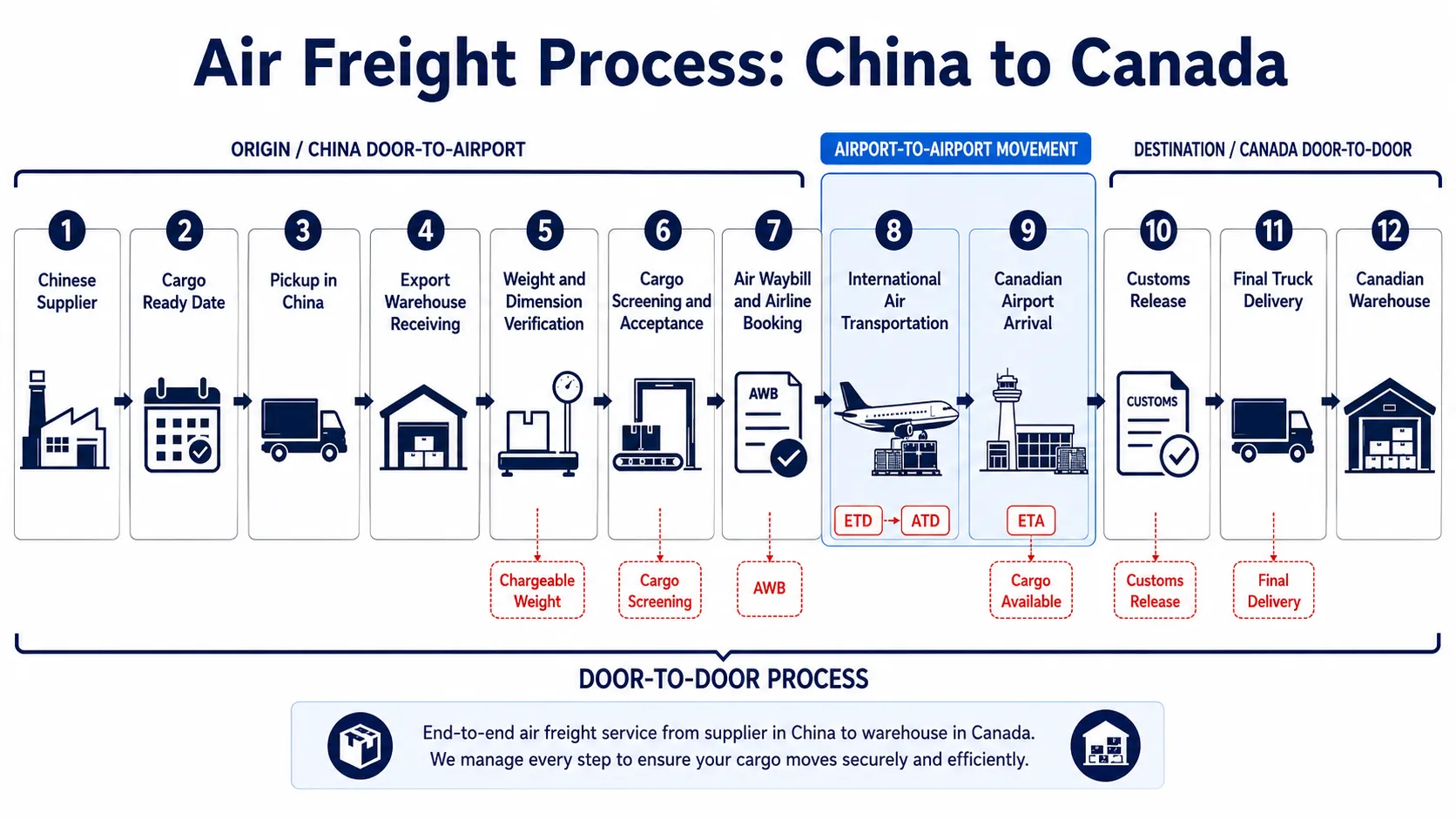
1. Confirm Cargo Readiness
The supplier confirms that production, packaging and commercial documents will be completed by a realistic cargo-ready date.
A reliable air-freight booking requires:
- Supplier pickup address
- Product description
- Number of cartons or pallets
- Final package dimensions
- Total gross weight
- Cargo-ready date
- Canadian destination
- Incoterm
- Any special cargo characteristics
2. Calculate the Estimated Chargeable Weight
The shipment’s actual gross weight is compared with its volumetric weight. The higher figure normally becomes the chargeable weight used for air-freight rating.
Using final carton dimensions is important because a lightweight but bulky shipment can have a substantially higher chargeable weight than its actual physical weight.
3. Review Cargo Acceptance Requirements
The commodity must be reviewed before booking. Batteries, liquids, powders, chemicals, magnets, oversized pieces and other sensitive products may require additional documents, tests, packaging or airline approval.
4. Select the Air-Freight Route and Service Scope
The route is selected according to cargo readiness, origin airport, Canadian destination, airline capacity, handling capability and required delivery date.
The nearest airport is not always the best routing choice. An alternative gateway may provide earlier capacity, better cargo acceptance or a more efficient Canadian delivery plan.
5. Arrange Supplier Pickup
Depending on the Incoterm, cargo may be collected from the factory, supplier warehouse or another agreed handover location.
6. Receive, Measure and Screen the Cargo
At the export facility, the shipment can be weighed, measured, checked against the booking data and prepared for the applicable air-cargo security and acceptance process.
7. Complete Export Handling and Air Waybill Data
Shipment information is prepared for the airline and the applicable air waybill. Export and transport documentation must be consistent with the physical cargo.
8. Move the Cargo Internationally
The shipment moves through a direct or connecting air-cargo service toward the selected Canadian gateway.
9. Complete Canadian Arrival and Customs Processing
After arrival, cargo information is used for the required import and customs-release process. Physical arrival does not automatically mean that the shipment is available for delivery.
10. Arrange Final Delivery
After release and airport availability, cargo can move by truck or another agreed inland service to the Canadian warehouse, business, 3PL or fulfilment facility.
Airport-to-Airport vs Door-to-Door Air Freight
| Service scope | Typical coverage | Commonly excluded unless confirmed |
|---|---|---|
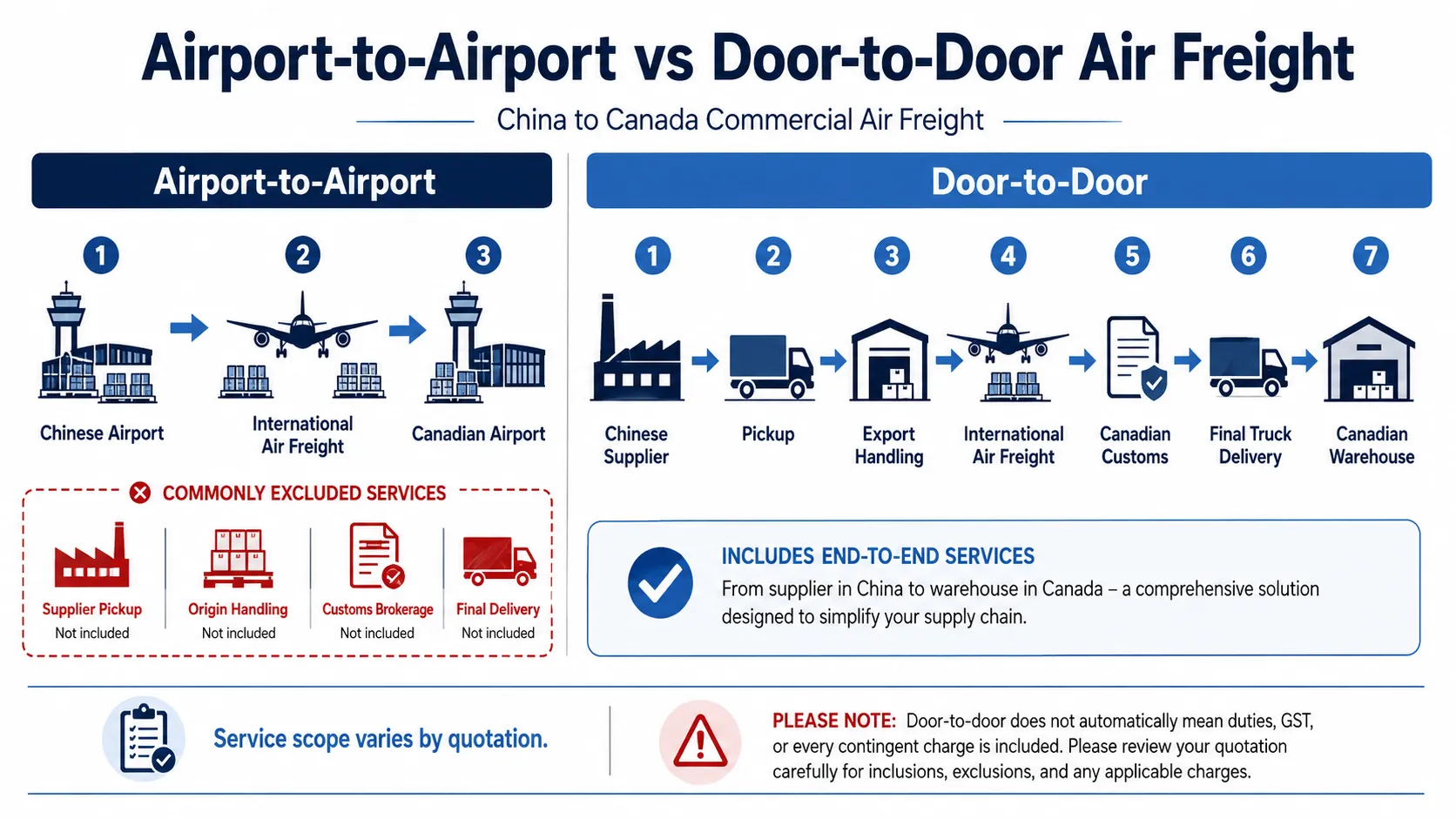
| Airport to airport | Main international air transportation | Supplier pickup, customs and final delivery |
| Door to airport | Supplier pickup, Chinese origin handling and international air freight | Canadian customs and inland delivery |
| Airport to door | Air transportation, Canadian processing and final delivery | Chinese supplier pickup and some origin services |
| Door to door | Coordinated supplier pickup through agreed Canadian delivery | Duty, GST and contingent charges unless explicitly included |
| DDP | Transportation under an agreed delivered-duty-paid arrangement | Any responsibility or charge not included in the confirmed DDP scope |
Door-to-door air freight is particularly useful for importers that do not want to coordinate separate pickup, airline, customs and final-delivery providers.
However, door-to-door does not automatically mean that duties, GST, customs examinations, storage, brokerage or every delivery charge is included.
For detailed service boundaries and delivery scope, review our door-to-door shipping from China to Canada guide.
How Chargeable Weight Works in Air Freight
Air cargo is commonly rated using the greater of actual gross weight and volumetric weight.
Actual Gross Weight
Actual gross weight is the physical weight of the products together with cartons, pallets and export packaging.
Volumetric Weight
Volumetric weight reflects the amount of aircraft space occupied by the shipment.
A commonly used metric calculation is:
Length × Width × Height in centimetres ÷ 6,000
The calculation is performed for each carton or package before the results are combined.
The applicable dimensional factor and rating method should always be confirmed for the selected airline, freight service and cargo type.
Why Packaging Matters
A shipment can weigh only 200 kg physically but occupy enough aircraft space to create a substantially higher volumetric weight.
Reducing unnecessary carton volume can lower the chargeable weight, but packaging should never be weakened solely to reduce freight cost. Product protection, stackability and cargo acceptance remain important.
The International Air Transport Association guidance on air cargo tariffs and chargeable weight explains the use of actual and volumetric weight in air-freight rating.
Air Freight Operational Terms Importers Should Know
| Term | Meaning |
|---|---|
| Chargeable weight | The weight used for freight rating, generally based on the greater of actual and volumetric weight |
| AWB | Air Waybill used to record the air-cargo shipment and transportation details |
| MAWB | Master Air Waybill associated with the carrier-level air shipment |
| HAWB | House Air Waybill used within a freight-forwarder or consolidated shipment structure |
| ULD | Unit Load Device used to load and secure cargo within suitable aircraft operations |
| ETD | Estimated Time of Departure |
| ATD | Actual Time of Departure |
| ETA | Estimated Time of Arrival |
| ATA | Actual Time of Arrival |
| Cargo-ready date | The date the supplier expects the completed and packed cargo to be available |
| Customs release | Authorization allowing the cargo to leave customs control |
| Cargo availability | The point at which released cargo is operationally available for recovery or onward delivery |
Importers should avoid treating ETA as the final warehouse-delivery date. Customs release, airport handling and inland delivery may still be required after the aircraft arrives.
Air Freight Security and Cargo Screening
Commercial air cargo moves through security and acceptance procedures before loading onto an aircraft.
Transport Canada operates an Air Cargo Security Program designed to maintain a secure cargo supply chain involving shippers, freight forwarders and air carriers.
The Transport Canada Air Cargo Security Program provides official information about Canada’s secure air-cargo supply chain.
For importers, practical preparation means providing accurate cargo information before pickup and identifying products that may require special screening or handling.
Restricted and Sensitive Air Cargo
Not every product can move as ordinary general air cargo. Some commodities require advance review because they affect safety, security, aircraft acceptance or Canadian import requirements.
| Cargo type | Typical advance review |
|---|---|
| Lithium batteries | Battery configuration, UN classification, test documentation, packaging, marks and airline acceptance |
| Liquids | Product composition, packaging, leakage risk and dangerous-goods classification |
| Chemicals | Safety Data Sheet, composition and dangerous-goods review |
| Powders | Product identity, composition, security screening and packaging |
| Magnetic goods | Magnetic properties and carrier acceptance requirements |
| Aerosols | Dangerous-goods classification, packaging and airline acceptance |
| Medical or health products | Product-specific Canadian import and regulatory requirements |
| Temperature-sensitive cargo | Temperature range, packaging, monitoring and routing |
| Oversized cargo | Piece dimensions, aircraft-door dimensions, ground equipment and loading capability |
Sensitive cargo should not be delivered to an export warehouse or airport until the acceptance requirements have been reviewed.
Lithium Batteries
Lithium batteries are regulated dangerous goods and may require UN 38.3 test documentation, specific packaging, marks, labels and airline acceptance depending on the battery type and configuration.
Transport Canada’s guidance for shipping and importing lithium batteries explains the Canadian dangerous-goods requirements that apply to lithium batteries and battery-powered devices.
Never describe battery cargo simply as “electronics” when requesting an air-freight quotation. The battery type, configuration and technical details should be declared before booking.
Air Freight Routes from China to Canada
The best air-freight route depends on the supplier location, commodity, available airline capacity, cargo acceptance requirements and final Canadian destination.
| Chinese origin region | Common gateway options | Typical Canadian gateway options |
|---|---|---|
| Shenzhen and Dongguan | Shenzhen, Hong Kong or Guangzhou | Vancouver, Toronto or Montreal |
| Guangzhou and Foshan | Guangzhou, Hong Kong or Shenzhen | Toronto, Vancouver or Montreal |
| Shanghai, Suzhou and nearby cities | Shanghai Pudong | Toronto, Vancouver or Montreal |
| Ningbo and Yiwu | Shanghai-area air gateways or other suitable regional routing | Toronto, Vancouver or Montreal |
| Hong Kong | Hong Kong International Airport | Toronto, Vancouver or Montreal |
| Beijing and North China | Beijing or another suitable northern gateway | Route dependent |
Routing note
These are gateway options rather than a list of guaranteed direct flights. A shipment may move on a direct service, through a connecting hub or through a combination of international air and Canadian ground transportation.
Why the Nearest Airport Is Not Always the Best Airport
A supplier located in Shenzhen may appear to favour Shenzhen airport, but Hong Kong or Guangzhou can sometimes provide a more suitable cargo schedule or acceptance option. The reverse can also be true.
Routing should therefore be selected according to:
- Cargo-ready date
- Available space
- Commodity acceptance
- Required arrival date
- Origin trucking time
- Canadian gateway
- Final delivery location
- Total transportation cost
Air Freight Delivery Across Canada
| Canadian destination | Typical air-cargo gateway or delivery approach |
|---|---|
| Toronto and the Greater Toronto Area | Toronto Pearson followed by local commercial delivery |
| Markham | Toronto-area arrival followed by final trucking to the consignee |
| Vancouver and the Lower Mainland | Vancouver-area arrival followed by local delivery |
| Montreal | Montreal-area air cargo arrival and regional delivery |
| Calgary and Edmonton | Direct or connecting air service combined with Canadian ground transportation where required |
| Winnipeg and Ottawa | Routing based on airline schedule, available capacity and final delivery requirements |
| Remote destinations | Major-gateway arrival followed by route-specific domestic transportation |
The Canadian arrival airport should be selected according to the complete delivery plan rather than international flight time alone.
How Long Does Air Freight from China to Canada Take?
The main airport-to-airport air movement commonly requires approximately 3–5 days. A realistic supplier-to-door planning range is approximately 5–12 business days.
| Air-freight stage | Indicative planning time |
|---|---|
| Supplier pickup and delivery to the export warehouse | 1–2 business days |
| Receiving, measurement, screening and export handling | 1–3 business days |
| Main air movement | 3–5 days |
| Canadian airport handling and customs release | 1–3 business days when routine |
| Final delivery | 1–4 business days, depending on destination |
| Typical combined planning range | 5–12 business days |
Planning note
These are indicative business-planning ranges rather than guaranteed carrier schedules. Individual stages may overlap, so the complete timeline should not be calculated by simply adding the maximum value of every stage.
For detailed deadline planning, customs delays and route-specific timing, review our shipping time from China to Canada guide.
What Can Delay an Air Freight Shipment?
Supplier Cargo Is Not Ready
A confirmed airline schedule cannot compensate for products that are still being produced, packed or labelled.
Incorrect Dimensions or Weight
Major differences between estimated and actual cargo measurements can affect the booking, chargeable weight or available aircraft capacity.
Cargo Screening or Acceptance Issues
Undeclared batteries, liquids, powders or other sensitive cargo can delay or prevent airline acceptance.
Limited Airline Capacity
Available cargo space can vary during busy periods, product-launch seasons and major Chinese holidays.
Connecting-Flight Delays
Shipments using more than one flight depend on the first movement arriving in time for the planned connection.
Incomplete Customs Information
Generic product descriptions, inconsistent values, missing importer data or product-specific compliance questions can delay release.
Final-Delivery Appointments
Warehouses, retailers, 3PL facilities and distribution centres may require confirmed receiving appointments before accepting freight.
Commercial Air Freight Documents
| Document or information | Main purpose |
|---|---|
| Commercial invoice | Records transaction parties, products, values, currency and commercial terms |
| Packing list | Shows package count, weights, dimensions and packing details |
| Air waybill | Records the air shipment and transportation information |
| HS classification | Supports Canadian customs classification |
| Country-of-origin information | Supports customs and tariff treatment |
| Importer information | Identifies the Canadian commercial importer |
| Dangerous-goods documents | Required where the commodity and applicable regulations require them |
| Product permits or certificates | Required for regulated products where applicable |
Commercial invoice, packing list, air waybill data and physical cargo should contain consistent shipment information.
Descriptions such as “parts,” “accessories,” “samples” or “electronics” may be too general for customs or cargo-acceptance purposes. Use commercially meaningful descriptions.
For a complete document checklist, use our commercial air-shipping document guide.
Canadian Customs Requirements for Air Cargo
Commercial air cargo imported into Canada must be properly reported, classified, valued and released before final delivery.
The Canada Border Services Agency guide to importing commercial goods provides the official overview of Canada’s commercial import process.
Importers should confirm:
- Business Number and applicable import-export RM account
- CARM setup and customs-broker delegation where required
- Detailed product descriptions
- HS tariff classification
- Country of origin
- Customs value
- Applicable duty and GST
- Product permits, licences or certificates where required
- Other government department requirements
The CBSA Assessment and Revenue Management system is used to account for commercial imports and applicable duties and taxes.
For detailed import and release preparation, review our Canadian customs-release workflow.
Incoterms for Air Freight from China
The Incoterm determines where the seller’s agreed delivery obligations end and where the buyer’s transportation and risk responsibilities begin.
| Incoterm | Air-freight planning implication |
|---|---|
| EXW | The buyer generally manages transportation from the supplier’s premises |
| FCA | The seller delivers the goods to the named carrier or agreed place after completing the agreed export responsibilities |
| CPT | The seller contracts carriage to the named destination while risk transfers according to the Incoterms rule |
| CIP | Similar carriage structure to CPT with seller-provided insurance under the applicable rule |
| DAP | The seller arranges transportation to the named destination while the buyer normally handles import clearance |
| DDP | The seller assumes extensive transportation and import responsibilities subject to legal and operational feasibility |
Important
FOB is a sea and inland-waterway Incoterm and should not normally be used to describe an air-freight handover. FCA is available for air and multimodal transportation.
The International Chamber of Commerce Incoterms 2020 rules are the authoritative reference for the current Incoterms framework.
The named place matters. “EXW China,” “FCA China” or “DDP Canada” is not specific enough for a reliable freight comparison.
Illustrative Air Freight Planning Scenarios
The following examples show how business priorities can affect the shipping method. They are planning scenarios rather than TopShipping quotations.
Urgent Retail Inventory
A Canadian retailer has enough stock for only two more weeks while the next full order will move by sea. Critical SKUs can be separated and sent by air while the remaining inventory continues by ocean freight.
Production-Critical Spare Part
A relatively small industrial component is required to restore equipment operation in Canada. The transportation cost may be secondary to the business cost created by additional production downtime.
Higher-Value Compact Inventory
Compact electronics or specialist components may have enough commercial value per kilogram for air freight to remain practical despite the higher transportation rate compared with sea freight.
Bulky Low-Value Inventory
Large lightweight cartons can create high volumetric weight. Even when the actual gross weight appears low, sea freight may provide a more economical option when the products are not urgently required.
How to Reduce Air Freight Cost and Operational Risk
- Obtain final packed dimensions before booking.
- Remove unnecessary carton volume without weakening cargo protection.
- Provide carton-level measurements instead of only total shipment dimensions.
- Declare batteries, liquids, chemicals and sensitive products before pickup.
- Confirm the cargo-ready date before reserving airline space.
- Compare airport-to-airport and door-to-door quotations using the same service scope.
- Use air freight selectively for critical SKUs rather than the complete order.
- Coordinate several compatible supplier orders where practical.
- Prepare customs and product documents before departure.
- Provide the exact Canadian delivery postal code.
- Confirm warehouse receiving and appointment requirements.
- Compare total landed logistics cost rather than only the rate per kilogram.
Information Needed for an Air Freight Quote
| Required information | Why it matters |
|---|---|
| Supplier pickup address | Determines Chinese origin transportation and gateway options |
| Detailed product description | Supports cargo acceptance and customs review |
| Number of cartons or pallets | Supports capacity and handling planning |
| Dimensions of each package type | Determines volumetric and chargeable weight |
| Total gross weight | Used in chargeable-weight comparison |
| Cargo value and currency | Supports customs and insurance planning |
| Incoterm and named location | Defines the transportation scope beginning in China |
| Cargo-ready date | Determines available booking options |
| Required delivery date | Supports routing and service selection |
| Canadian postal code | Determines destination handling and final delivery |
| Battery, liquid, chemical or special-cargo details | Determines acceptance and documentation requirements |
| Warehouse receiving requirements | Supports successful final delivery |
Providing estimated information is useful during early planning, but the final quotation may change after the shipment is packed, weighed, measured and reviewed for airline acceptance.
How TopShipping Supports Air Freight from China to Canada
TopShipping supports Canadian businesses coordinating commercial air cargo from suppliers and manufacturing regions across China.
Depending on the confirmed shipment scope, support may include:
- Supplier communication
- Cargo-ready-date coordination
- Factory pickup in China
- Chargeable-weight review
- Air-cargo routing
- Export handling
- Air-freight booking
- Commercial document coordination
- Sensitive-cargo review before booking
- Customs-clearance coordination
- Shipment milestone tracking
- Canadian airport handling coordination
- Final commercial delivery
The recommended air-freight plan is based on the actual cargo, required availability date, Chinese origin, Canadian destination and service scope rather than the lowest advertised rate per kilogram.
Request an Air Freight Assessment
Send the product description, supplier location, package count, final dimensions, gross weight, cargo-ready date, Canadian postal code and required delivery date.
TopShipping can review the chargeable weight, cargo acceptance, routing and airport-to-airport or door-to-door service options for the shipment.