
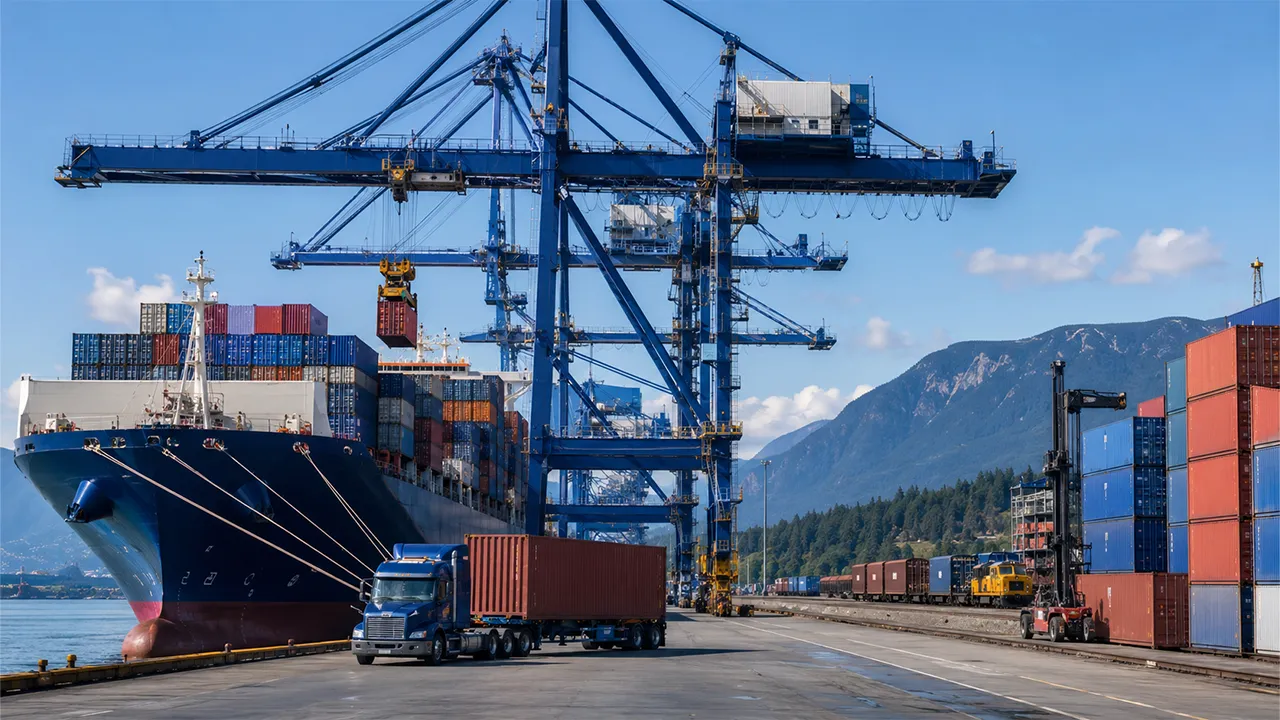
Sea freight remains a core shipping method for Canadian importers moving planned commercial cargo from China. The main decision is usually whether the shipment should move as LCL or FCL, depending on cargo volume, loading efficiency, destination charges and inventory planning.
For businesses still comparing ocean freight with air, courier or other methods, start with our China-to-Canada freight forwarding guide. This page specifically covers LCL, FCL, container shipping, ocean-freight operations, ports, loading, documentation and sea-freight risk management.
Sea Freight from China to Canada: September 2026 Planning Snapshot
| Sea freight option | September 2026 planning cost | Typical main ocean transit | Typical door-to-door planning time | Best suited for |
|---|---|---|---|---|
| LCL sea freight | USD $150–$220 per chargeable CBM or W/M | 20–40 days | 30–55 days | Smaller commercial ocean shipments |
| 20ft FCL | USD $6,500–$8,000 per container | 16–30 days | 25–50 days | Dense, heavy or medium-volume cargo |
| 40ft FCL | USD $7,200–$9,000 per container | 16–30 days | 25–50 days | Higher-volume commercial inventory |
| 40ft High Cube FCL | USD $7,200–$9,000 per container | 16–30 days | 25–50 days | Bulky and relatively lower-density cargo |
| Door-to-door sea freight | Shipment-specific quotation | Depends on LCL or FCL routing | 25–55 days | Commercial cargo requiring coordinated final delivery |
September 2026 planning note
Rates are in US dollars and represent indicative September 2026 planning ranges. Published LCL and FCL rates may exclude supplier pickup, export handling, Canadian destination charges, customs brokerage, customs examinations, duties, GST, storage, rail or truck transportation and final delivery.
For detailed rate calculations, W/M examples, container pricing and landed-cost planning, use our LCL and container freight pricing guide. For detailed transit planning, use our ocean-freight transit and delivery-time guide.
If you need to verify carton, pallet or mixed-shipment volume before requesting an LCL quote, use our CBM calculation guide for sea freight.
When Is Sea Freight the Right Shipping Method?
Sea freight is usually the stronger starting option when cargo volume and weight matter more than speed. It is particularly useful for businesses that can plan inventory several weeks before it must be available in Canada.
Sea freight may be appropriate when:
- The shipment is too heavy or bulky for economical air freight.
- The cargo contains wholesale or distributor inventory.
- Several pallets or large quantities of cartons are being shipped.
- The business imports on a recurring schedule.
- The products include machinery, equipment, furniture or industrial goods.
- Several Chinese suppliers can be consolidated before export.
- The cargo volume justifies comparing LCL with FCL.
- Inventory is planned early enough to tolerate ocean and inland transit.
Sea freight is not automatically the correct method for every shipment. Small urgent orders, replacement components and products at immediate stockout risk may be better suited to air freight for urgent commercial cargo.
Many importers use both methods: critical inventory travels by air while the main purchase order moves by sea.
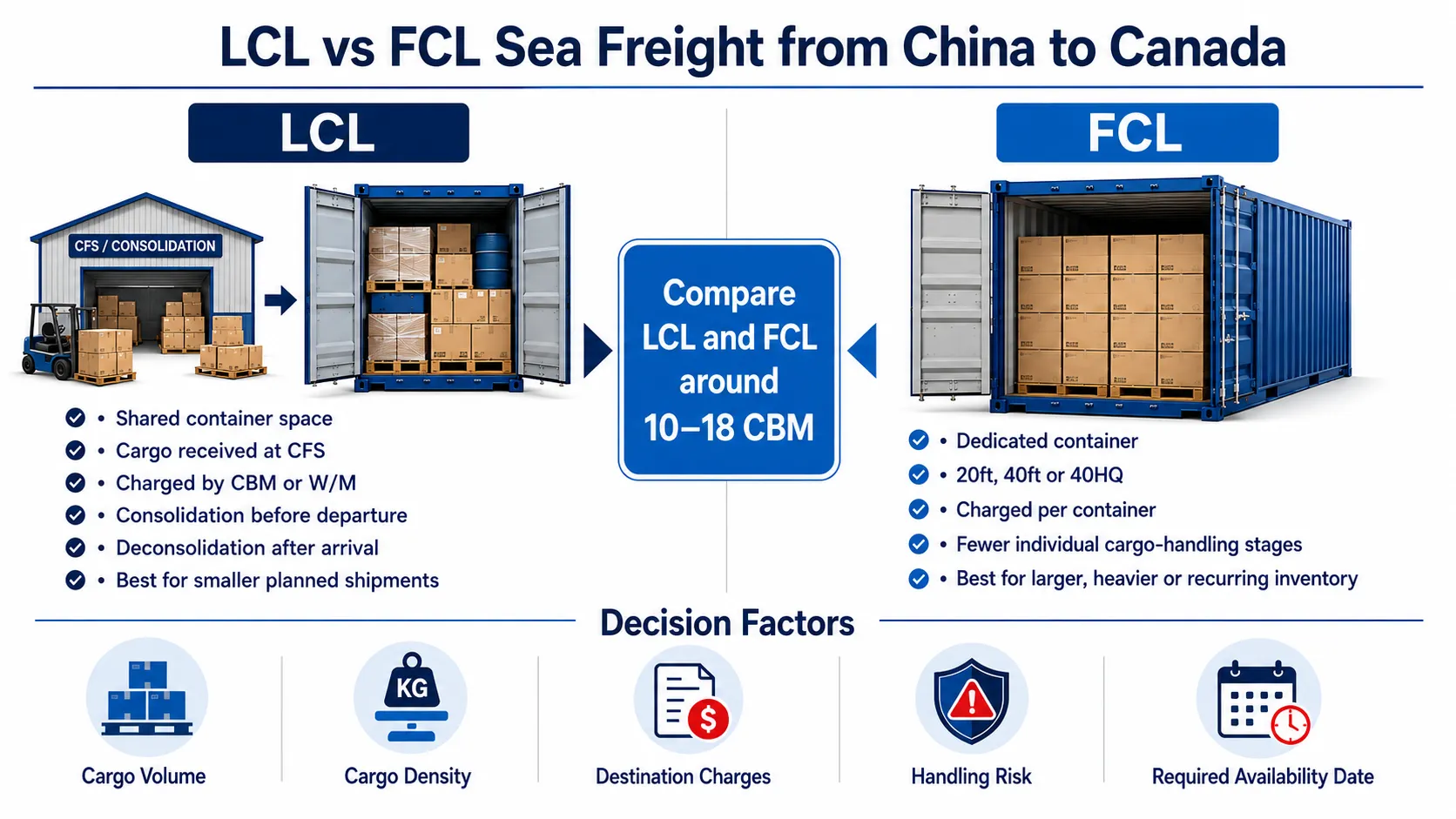
LCL vs FCL Shipping from China to Canada
Most containerized commercial sea freight moves as either Less than Container Load or Full Container Load.
| Decision factor | LCL | FCL |
|---|---|---|
| Container space | Shared with compatible shipments | Dedicated to one shipment |
| Pricing basis | Chargeable CBM or W/M | Per container |
| Origin handling | Requires CFS receiving and consolidation | Container is loaded for one shipment |
| Destination handling | Requires deconsolidation before cargo release | No LCL deconsolidation stage |
| Typical door-to-door planning time | 30–55 days | 25–50 days |
| Handling exposure | Generally more cargo-handling stages | Generally fewer cargo-handling stages |
| Best suited for | Smaller planned ocean shipments | Larger, heavier or recurring inventory |
What Is LCL Sea Freight?
LCL means Less than Container Load. The importer purchases space within a consolidated container rather than reserving the complete container.
The cargo is normally delivered to or collected for an origin Container Freight Station, commonly abbreviated as CFS. Compatible shipments are consolidated into a container for international transportation and separated again at a destination CFS after arrival.
LCL may be suitable for:
- Smaller commercial purchase orders
- One or several pallets
- Trial inventory
- Product launches
- Multi-supplier orders
- More frequent but smaller replenishment cycles
- Shipments that do not justify a complete container
LCL is commonly rated by weight or measurement, shown as W/M. The applicable tariff compares cargo volume and weight to determine the chargeable quantity.
The basic ocean rate is only one component of LCL shipping. Origin receiving, consolidation, documentation, Canadian CFS handling, deconsolidation, customs services and final delivery may be additional.
What Is FCL Sea Freight?
FCL means Full Container Load. A complete container is reserved for one shipment, although the importer does not have to use every cubic metre of available space.
FCL is commonly selected for:
- Larger commercial purchase orders
- Wholesale and distributor inventory
- Heavy or dense products
- Machinery and equipment
- Furniture and bulky products
- Recurring import programs
- Cargo that benefits from fewer handling stages
Compared with LCL, FCL eliminates the destination LCL deconsolidation stage and generally reduces handling of the individual shipment.
There is no universal volume at which FCL automatically becomes cheaper. However, once cargo reaches approximately 10–18 CBM, importers should normally request both LCL and FCL quotations because container rates, cargo density and destination charges can change the break-even point.
For a dedicated comparison, review our LCL vs FCL shipping guide.
Common Container Sizes for China-to-Canada Shipping
| Container type | Approximate nominal capacity | Typical practical loading range | Common application |
|---|---|---|---|
| 20ft Standard | 33 CBM | 25–28 CBM | Dense cargo, machinery and heavier products |
| 40ft Standard | 68 CBM | 55–60 CBM | Regular commercial and wholesale inventory |
| 40ft High Cube | 76 CBM | 65–70 CBM | Bulky and relatively lower-density cargo |
Capacity note: Nominal container capacity is not the same as usable loading capacity. Carton dimensions, pallet layout, crates, protective packaging, weight distribution and unused spaces between packages affect the actual amount that can be loaded.
A 20ft container can be appropriate for dense cargo because weight restrictions may be reached before the available cubic capacity is filled. A 40ft High Cube provides additional internal height and is often more useful for bulky products.
Equipment specifications also vary slightly between container fleets. Road weight limits, axle restrictions and inland transportation requirements must be checked separately from the container’s technical payload.
Special Container Equipment
Standard dry containers handle a large share of China-to-Canada commercial cargo, but some products require different equipment.
| Equipment | Typical application | Main planning consideration |
|---|---|---|
| Reefer container | Temperature-sensitive food, pharmaceutical or other controlled cargo | Temperature range, power supply and product requirements |
| Open-top container | Over-height cargo loaded from above | Dimensions, securing and special equipment availability |
| Flat rack | Oversized, heavy or irregular machinery | Out-of-gauge dimensions, lifting and securing requirements |
| Standard dry container | Cartons, pallets, furniture, machinery and general commercial goods | Weight distribution, packaging and loading efficiency |
Special equipment should be confirmed before the shipment is booked because availability, vessel acceptance and inland transportation restrictions can vary by route.
How Sea Freight from China to Canada Works
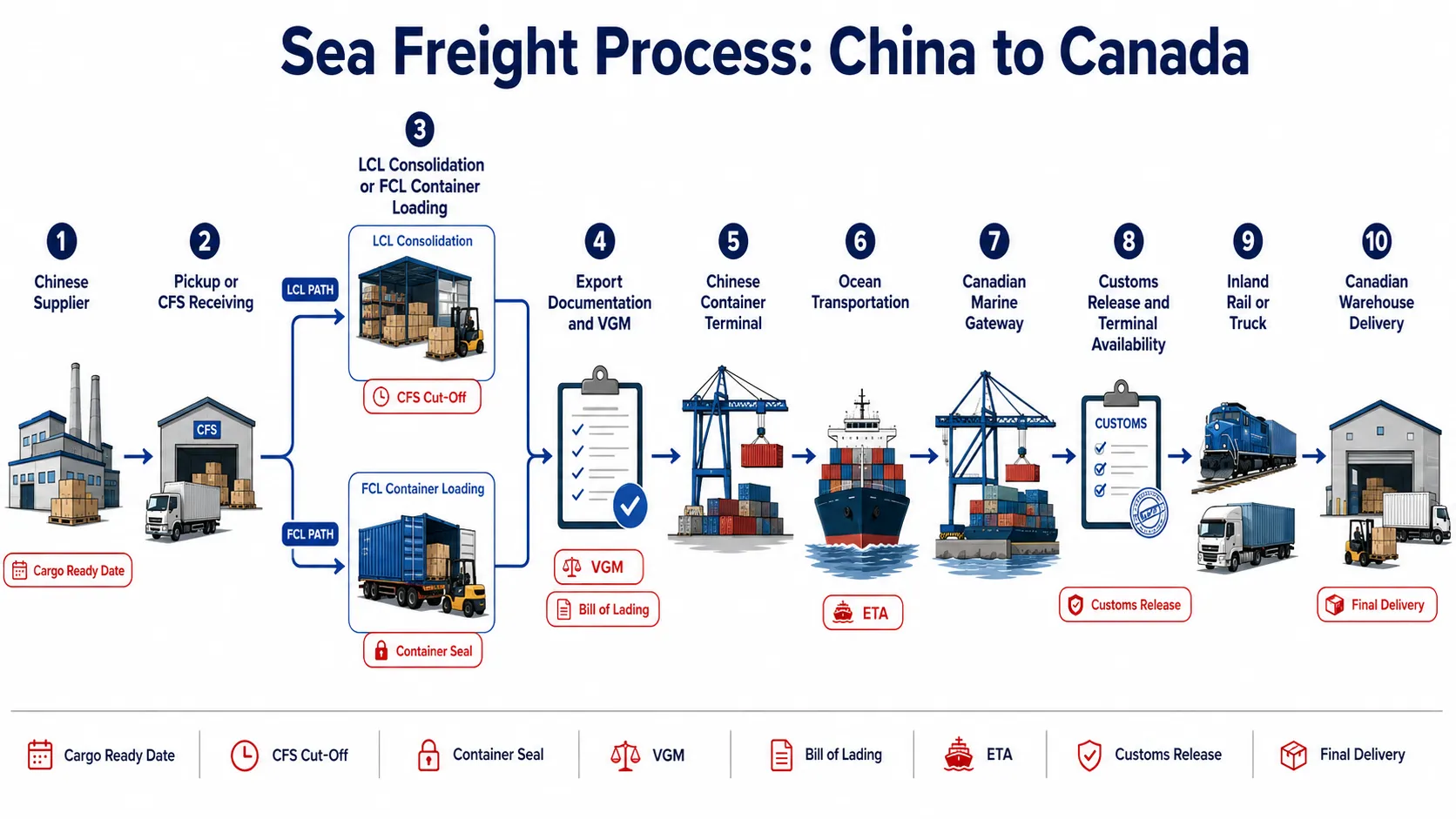
1. Confirm the Cargo and Required Availability Date
Collect the product description, supplier location, package count, dimensions, gross weight, cargo value, Incoterm, cargo-ready date and Canadian destination.
2. Choose LCL or FCL
The shipment is evaluated based on CBM, gross weight, cargo density, handling requirements, current container rates and destination charges.
3. Coordinate Supplier Pickup
The cargo may be collected from the Chinese supplier or delivered to an agreed warehouse, CFS or container-loading location.
If several factories are involved, supplier cargo-ready dates and documentation should be coordinated before the final shipment cut-off.
4. Consolidate LCL or Load the FCL Container
LCL cargo is received and consolidated with compatible shipments. For FCL, the dedicated container is loaded according to the agreed loading plan.
Package count, marks, labels, weight distribution and loading condition should be reviewed before export.
5. Complete Export and Carrier Requirements
Export documentation and carrier information are prepared before the container reaches the applicable terminal cut-off.
For packed containers subject to SOLAS requirements, a Verified Gross Mass, or VGM, must be provided before loading onto the vessel. The International Maritime Organization explains that VGM can be established by weighing the packed container or by weighing all cargo, packaging and securing materials and adding the container tare weight using an approved method.
See the International Maritime Organization guidance on Verified Gross Mass.
6. Ocean Transportation
The container moves from the selected Chinese port toward the Canadian marine gateway. The route may be direct or may involve one or more transshipment ports.
A direct service can reduce transfer risk, but it is not automatically the fastest complete option if another service has an earlier sailing, better capacity or a more efficient Canadian inland connection.
7. Canadian Arrival and Customs Release
After arrival, the cargo passes through terminal processing and the applicable customs-release process.
FCL containers can proceed toward rail, drayage or final delivery once the required release and terminal conditions have been satisfied. LCL cargo normally requires destination deconsolidation before the individual shipment becomes available.
8. Inland Transportation and Final Delivery
Sea freight may continue by rail, drayage or truck to a Canadian warehouse, distributor, 3PL, retailer or other eligible commercial destination.
The port of arrival is therefore not necessarily the final delivery point.
Key Sea Freight Terms Importers Should Understand
| Term | Meaning |
|---|---|
| LCL | Less than Container Load; cargo shares container space with other shipments |
| FCL | Full Container Load; a complete container is reserved for one shipment |
| CFS | Container Freight Station used for receiving or deconsolidating LCL cargo |
| CY | Container Yard where full containers are handled before or after vessel movement |
| TEU | Twenty-foot Equivalent Unit, commonly used to describe container capacity |
| FEU | Forty-foot Equivalent Unit |
| VGM | Verified Gross Mass of a packed container |
| B/L | Bill of Lading, the primary ocean transportation document |
| ETD | Estimated Time of Departure |
| ETA | Estimated Time of Arrival |
| Free time | Agreed period before specified demurrage or detention charges begin |
Major Sea Freight Origins in China
| Origin region | Common ocean gateway | Typical supplier profile |
|---|---|---|
| Shenzhen and Dongguan | Yantian or other Shenzhen terminals | Electronics, components, appliances and commercial goods |
| Guangzhou and Foshan | Nansha or South China gateways | Furniture, lighting, machinery and consumer products |
| Shanghai and Suzhou | Port of Shanghai | Industrial products, machinery, components and general merchandise |
| Ningbo and Yiwu | Ningbo-Zhoushan | Wholesale merchandise, hardware, textiles and mixed commercial goods |
| Qingdao and Shandong | Qingdao | Machinery, industrial products, tires and heavier cargo |
| Tianjin and North China | Tianjin/Xingang | Industrial and manufacturing cargo |
| Fujian | Xiamen | General merchandise and regional manufacturing |
The closest port is not always the best commercial choice. Supplier pickup cost, sailing frequency, carrier capacity, transshipment risk, cut-off date and the Canadian destination should be evaluated together.
For regional planning, review our guides to shipping from Shenzhen to Canada and shipping from Shanghai to Canada.
Canadian Sea Freight Gateways and Inland Destinations
| Canadian location | Role in the shipment | Typical onward movement |
|---|---|---|
| Vancouver | Major West Coast marine gateway | Local truck, drayage or inland rail |
| Prince Rupert | West Coast container and intermodal gateway | On-dock or inland rail connections |
| Montreal | Eastern Canadian marine and distribution gateway | Regional truck and inland distribution |
| Halifax | East Coast marine gateway for selected routings | Rail or regional truck |
| Calgary and Edmonton | Western inland destinations | Rail and truck from a marine gateway |
| Winnipeg | Central Canadian inland destination | Rail and final trucking |
| Toronto, Brampton and Markham | Major inland commercial and distribution markets | Rail plus local drayage or truck |
Important
Calgary, Edmonton, Winnipeg, Toronto and Markham are inland destinations rather than direct ocean gateways. A container serving these locations normally arrives at a marine port first and then continues inland by rail or truck.
The Port of Prince Rupert describes its Fairview Container Terminal as a dedicated intermodal facility for Trans-Pacific container trade, with rail connectivity supporting inland movement. Current rail and terminal schedules should still be checked when the shipment becomes available rather than treated as fixed extensions of the vessel schedule.
Port-to-Port vs Door-to-Door Sea Freight
Port-to-port sea freight covers the international ocean movement between the agreed origin and destination ports. It does not normally represent the complete supplier-to-warehouse shipment.
| Service scope | Typical coverage | Common exclusions |
|---|---|---|
| Port to port | Main ocean transportation | Factory pickup, customs, destination charges and inland delivery |
| Door to port | Supplier pickup, origin handling and ocean transportation | Canadian customs and inland delivery unless stated |
| Port to door | Ocean freight and Canadian inland delivery | Chinese supplier pickup and some origin charges unless stated |
| Door to door | Coordinated supplier pickup through agreed Canadian delivery | Duty, GST and contingent charges unless explicitly included |
Door-to-door does not automatically mean all-inclusive or DDP. Customs brokerage, duty, GST, examinations, demurrage, detention, storage and special delivery charges must be confirmed separately in the quotation.
For detailed service boundaries, review our door-to-door shipping from China to Canada guide.
Sea Freight Transit-Time Planning
The vessel schedule is only one part of complete sea-freight delivery.
| Sea freight stage | Typical planning consideration |
|---|---|
| Supplier readiness | Production, packing and cargo-ready date |
| Pickup and origin receiving | Supplier distance and warehouse cut-off |
| LCL consolidation | Additional receiving and consolidation time |
| FCL container loading | Container positioning, loading and terminal cut-off |
| Main ocean movement | 16–30 days for FCL; 20–40 days for LCL |
| Canadian destination processing | Terminal availability, customs and LCL deconsolidation where applicable |
| Inland transportation | Rail, drayage or truck based on destination |
| Complete planning range | 25–50 days for FCL; 30–55 days for LCL |
Planning note
These ranges are not guaranteed vessel or delivery schedules. Individual stages can overlap, and transshipment, customs examinations, port conditions, rail capacity or warehouse appointments can extend the timeline.
Bill of Lading and Sea Freight Documents
Ocean shipments require accurate transport and commercial information before export and Canadian customs processing.
| Document or information | Main purpose |
|---|---|
| Commercial invoice | Records the transaction parties, goods, value, currency and commercial terms |
| Packing list | Shows packages, weights, dimensions and packing details |
| Bill of lading | Records the ocean transportation and shipment information |
| HS classification | Supports Canadian tariff classification |
| Importer information | Identifies the Canadian commercial importer |
| VGM for applicable packed containers | Provides verified gross mass before vessel loading |
| Permits or certificates | Supports regulated products where required |
The commercial invoice, packing list, bill of lading data and physical cargo should be consistent. Generic cargo descriptions such as “parts,” “accessories,” “general cargo” or “miscellaneous goods” can create avoidable reporting and customs issues.
Canadian Customs Requirements for Sea Freight
Commercial goods imported into Canada must be correctly reported, classified, valued and released before they can move freely into Canadian commerce.
For tariff classification, customs duty and GST planning, review our Canadian tariff, duty and GST guide.
The Canada Border Services Agency guide to importing commercial goods provides the official overview of the commercial import process.
Canadian importers should confirm:
- Business Number and applicable import-export RM account
- CARM account and customs-broker delegation where required
- Accurate product descriptions
- HS tariff classification
- Country of origin
- Customs value
- Applicable duties and GST
- Product-specific permits or certificates
- Other government department requirements
The CBSA Assessment and Revenue Management system is the current platform used for commercial import accounting and related duty and tax management.
For deeper customs guidance, review our Canadian customs-release workflow. For document preparation, use our commercial shipping-document guide.
Wood Packaging and ISPM 15
Sea-freight shipments frequently use pallets, crates and wooden dunnage. Solid wood packaging entering Canada can be subject to phytosanitary requirements.
The Canadian Food Inspection Agency guidance on wood packaging imports explains Canada’s requirements for regulated wood packaging material and ISPM 15 compliance.
Importers should confirm that applicable pallets, crates and dunnage are compliant before the cargo leaves China. Non-compliant wood packaging can create inspection, treatment, removal, refusal or additional logistics costs.
FCL Container Loading and VGM Planning
A successful FCL shipment requires more than fitting the cartons physically inside the container.
The loading plan should consider:
- Total gross cargo weight
- Container tare weight
- Weight distribution
- Heavy items at floor level
- Carton and pallet dimensions
- Load securing and movement prevention
- Fragile or crush-sensitive cargo
- Moisture and condensation risk
- Unloading method in Canada
- Road and inland weight restrictions
Under the applicable SOLAS container-weight rules, verified gross mass is a condition for loading a packed container aboard the vessel. This should be prepared before the carrier’s VGM cut-off rather than treated as a post-loading administrative detail.
Packaging for LCL Sea Freight
LCL cargo may be handled more frequently than an FCL shipment because individual shipments pass through consolidation and deconsolidation facilities.
Packaging should account for:
- Repeated forklift or pallet handling
- Stacking pressure
- Carton compression
- Moisture exposure
- Movement inside the consolidated container
- Clear carton and pallet identification
- Fragile or upright handling requirements
Heavy cartons should be reinforced and irregular machinery or fragile products may require crates, pallets or custom protection.
Multi-Supplier Consolidation Before Sea Freight
Businesses buying from several Chinese factories can consolidate compatible orders before export.
A typical consolidation process can include:
- Confirming each supplier’s purchase order
- Coordinating individual cargo-ready dates
- Collecting goods from the suppliers
- Receiving cargo at an origin facility
- Checking carton counts and shipment references
- Measuring and weighing the combined cargo
- Preparing one coordinated LCL or FCL shipment
Consolidation can reduce duplicated logistics activity, but it should not hold an urgent shipment indefinitely while waiting for one delayed supplier.
Learn more in our multi-supplier cargo consolidation guide.
Demurrage, Detention and Storage
Ocean shipments can generate additional charges when containers or cargo remain at a terminal, warehouse or outside the terminal beyond the applicable free period.
Demurrage
Demurrage generally relates to carrier equipment remaining within a terminal beyond the applicable free time.
Detention
Detention generally relates to carrier equipment being held outside the terminal beyond the allowed period before empty return.
Storage
Storage can apply when cargo remains at a terminal, CFS or warehouse beyond the applicable free period.
Common causes include:
- Late customs documentation
- Customs examinations
- Delayed importer instructions
- Unpaid destination charges
- Rail or drayage delays
- Missed delivery appointments
- Limited receiving capacity
- Late empty-container return
Free time, release requirements, terminal availability and empty-container return procedures should be confirmed before arrival.
Cargo Insurance and Ocean Freight Risk
Carrier liability should not be treated as equivalent to comprehensive cargo insurance.
Importers should consider:
- Cargo commercial value
- Product fragility
- Packaging quality
- Route and transshipment exposure
- Water or moisture sensitivity
- Theft exposure
- Replacement lead time
- Business impact if the cargo is damaged or lost
The insured value, deductible, exclusions and claims procedure should be reviewed before shipment.
How Incoterms Affect Sea Freight
Incoterms define important responsibilities, costs and risk-transfer points between the seller and buyer.
| Incoterm | Sea-freight planning implication |
|---|---|
| EXW | Buyer generally manages transportation from the supplier’s premises |
| FCA | Seller delivers cargo to the named carrier or agreed place |
| FOB | Seller delivers the goods on board the vessel at the named port |
| CFR | Seller contracts ocean freight to the named destination port, while risk transfers earlier under the rule |
| CIF | Similar sea-transport structure to CFR with seller-provided minimum insurance under the applicable Incoterms rule |
| DAP | Seller arranges transportation to the named destination while the buyer normally handles import clearance |
| DDP | Seller assumes extensive transport and import responsibilities subject to legal and operational feasibility |
The official ICC Incoterms 2020 rules are the authoritative reference for the allocation of delivery responsibilities, costs and risks.
The named location matters. “FOB China” or “DDP Canada” is not sufficiently precise for comparing commercial freight quotations. For a deeper comparison of common ocean-shipping terms, review our FOB and CIF responsibility comparison.
How to Reduce Sea Freight Cost and Operational Risk
- Use final packed dimensions rather than supplier estimates.
- Compare LCL and FCL once cargo reaches approximately 10–18 CBM.
- Consolidate compatible orders from multiple suppliers.
- Plan inventory early enough to avoid unnecessary emergency air freight.
- Confirm destination charges before choosing LCL.
- Provide the exact Canadian delivery postal code.
- Review warehouse appointments and unloading requirements before arrival.
- Confirm the Incoterm and named place in writing.
- Use compliant packaging and wood materials.
- Prepare customs information before cargo arrival.
- Confirm VGM and terminal cut-offs for FCL shipments.
- Track free-time and empty-container return deadlines.
- Evaluate cargo insurance before departure.
Which Sea Freight Option Fits Your Shipment?
| Cargo situation | Recommended starting option |
|---|---|
| One to several pallets with flexible timing | LCL |
| Small wholesale or trial order | LCL |
| 10–18 CBM | Compare LCL and 20ft FCL |
| Dense or heavy commercial cargo | 20ft FCL |
| Large regular inventory | 40ft or 40HQ FCL |
| Bulky but relatively lightweight products | 40HQ FCL |
| Several suppliers in China | Consolidation followed by LCL or FCL |
| Only part of the inventory is urgent | Sea freight for the main order plus air freight for critical SKUs |
| Oversized machinery | Review open-top or flat-rack equipment |
| Temperature-sensitive products | Review reefer-container requirements |
Information Needed for a Sea Freight Quote
- Chinese supplier address or pickup city
- Canadian delivery address and postal code
- Product description
- Number of suppliers
- Number of cartons, pallets or crates
- Final package dimensions
- Total gross weight
- Total CBM
- Cargo value and currency
- Incoterm and named place
- Cargo-ready date
- Required inventory or delivery date
- Commercial invoice and packing list
- HS code when confirmed
- Details of batteries, liquids, chemicals or regulated goods
- Special equipment requirements
- Canadian receiving and unloading requirements
For FCL cargo, also provide the proposed loading arrangement and any known container-weight or unloading constraints. For LCL, identify fragile, non-stackable, oversized or unusually dense cargo before booking.
How TopShipping Supports Sea Freight from China to Canada
TopShipping supports Canadian businesses coordinating commercial ocean freight from suppliers across China.
Depending on the confirmed shipment scope, support may include:
- Supplier communication
- Factory pickup coordination
- Multi-supplier consolidation
- LCL sea freight
- 20ft, 40ft and 40HQ FCL shipping
- Special-equipment planning
- Export handling
- Shipping-document coordination
- Customs-clearance coordination
- Shipment milestone tracking
- Rail and truck coordination in Canada
- Warehouse or commercial final delivery
The recommended ocean-freight plan is based on cargo volume, weight, origin, required availability date, Canadian destination and complete logistics scope rather than container price alone.
Request a Sea Freight Assessment
Send your supplier location, product description, carton or pallet count, final dimensions, gross weight, CBM, cargo-ready date and Canadian delivery postal code.
TopShipping can review LCL, FCL, consolidation and door-to-door options based on the actual shipment requirements.