CIF vs FOB Shipping at a Glance
| Comparison Point | FOB | CIF |
|---|---|---|
| Full Meaning | Free on Board | Cost, Insurance and Freight |
| Permitted Transport Mode | Sea or inland waterway transport | Sea or inland waterway transport |
| Seller’s Delivery Point | Goods loaded on board the vessel at the named Chinese port | Goods loaded on board the vessel at the named Chinese port |
| Risk Transfers to Buyer | When the goods are loaded on board in China | When the goods are loaded on board in China |
| Main Ocean Freight | Booked and paid by the buyer | Booked and paid by the seller to the named destination port |
| Cargo Insurance | Arranged by the buyer when required | Minimum coverage arranged by the seller |
| Export Clearance in China | Seller | Seller |
| Canadian Import Clearance | Buyer | Buyer |
| Canadian Duties and Taxes | Buyer | Buyer |
| Final Delivery in Canada | Buyer unless separately arranged | Buyer unless separately arranged |
| Freight Provider Control | Primarily controlled by the buyer | Primarily controlled by the seller |
| Cost Transparency | Usually higher when the buyer receives a complete forwarder quotation | Depends on the supplier’s cost breakdown and destination-agent terms |
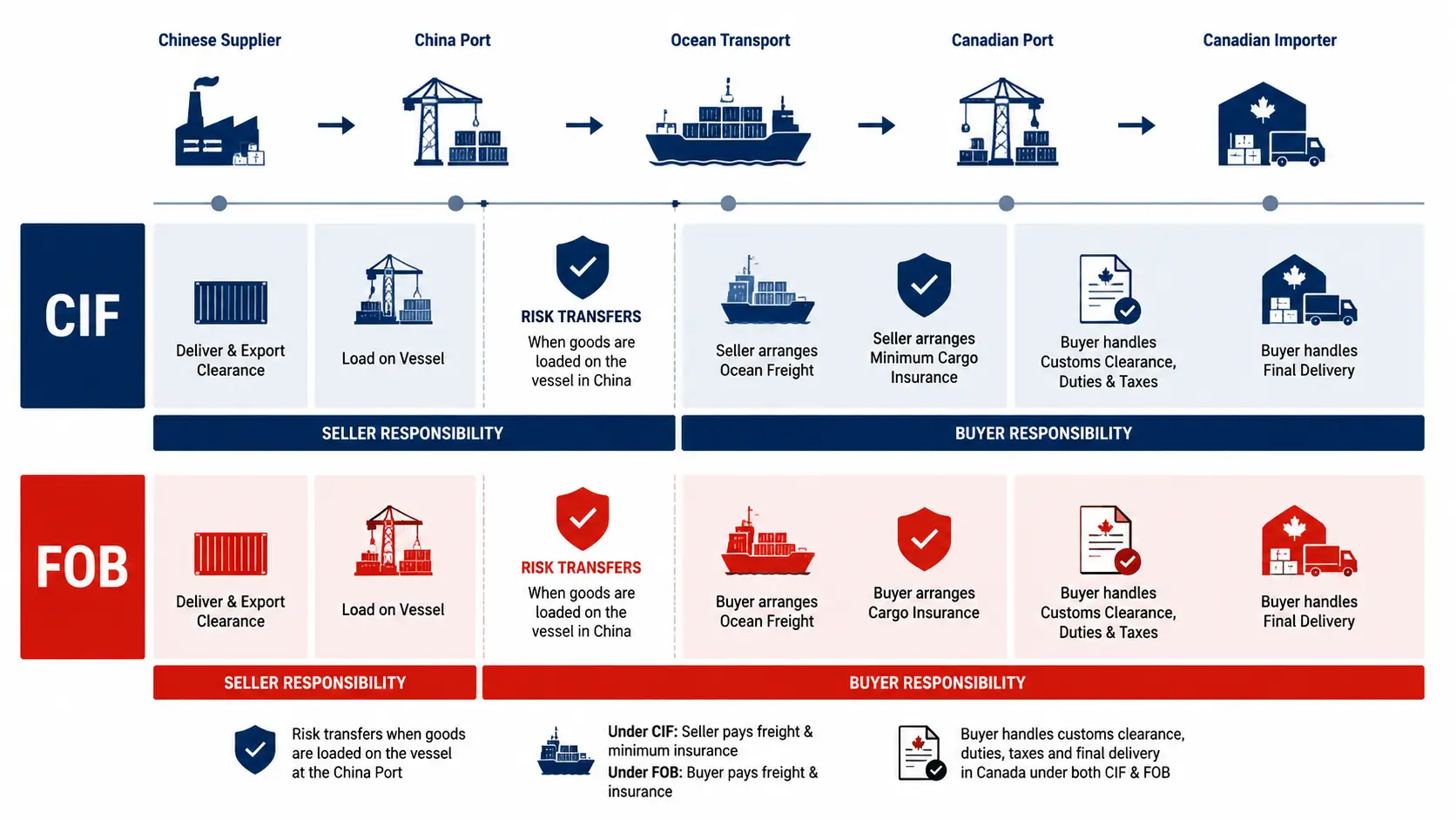
Key point: Under the official Incoterms® 2020 rules, CIF changes who arranges and initially pays for freight and insurance. It does not move the risk-transfer point to Canada, and it does not automatically include customs clearance, duties, taxes or delivery to the buyer’s warehouse.
What Does FOB Mean When Shipping from China?
FOB means Free on Board. A complete sales term should identify the named port and the applicable Incoterms version, such as FOB Yantian, China, Incoterms 2020.
Under FOB, the Chinese seller is generally responsible for preparing the goods, moving them through the agreed origin process, completing export formalities and loading them on board the nominated vessel. Once the cargo is on board, risk transfers to the buyer.
The Canadian buyer or its freight forwarder normally controls the ocean booking, main freight rate, carrier selection, cargo insurance and Canada-side logistics. This structure is commonly preferred by established importers because it provides greater visibility over the transportation chain.
FOB does not mean the buyer receives a door-to-door service. The importer must still plan ocean freight, insurance, Canadian destination charges, customs clearance and inland delivery. A managed sea freight solution from China to Canada can combine these stages into a more complete quotation.
What Does CIF Mean When Shipping to Canada?
CIF means Cost, Insurance and Freight. A complete CIF term should identify the destination port, such as CIF Vancouver, Canada, Incoterms 2020.
Under CIF, the seller has the same basic delivery obligation at the Chinese port as under FOB. The seller must also arrange and pay for ocean carriage and minimum cargo insurance to the named port of destination.
The Canadian importer remains responsible for import clearance, applicable duties and taxes, and the movement of the cargo beyond the agreed destination-port scope. Unloading, terminal handling, deconsolidation, document release and inland delivery depend on the carrier contract and the specific inclusions stated in the quotation.
This is why “CIF Vancouver” should not be interpreted as “delivered to a warehouse in Vancouver.” CIF is a port-based shipping term, not a door-to-door or duty-paid delivery term.
The Most Misunderstood Difference: Cost and Risk Do Not Transfer Together
Many importers assume the seller carries the cargo risk until it reaches Canada under CIF because the seller pays the freight and insurance to the destination port. That assumption is incorrect.
Under both FOB and CIF, risk normally transfers from the seller to the buyer when the goods are loaded on board the vessel at the named port of shipment in China. Under CIF, the seller continues paying for the main carriage and minimum insurance even though the buyer already bears the transit risk.
This separation between cost and risk matters when cargo is damaged, lost or delayed. The buyer may have to manage an insurance claim using a policy selected by the seller, even though the buyer did not negotiate the insurer, coverage conditions or claims process.
Hidden Cost Difference 1: Supplier-Controlled Freight Pricing
A CIF quotation allows the supplier to select the carrier, freight forwarder or consolidator. The supplier may have a competitive contract rate, but the buyer may not see the actual freight amount, surcharge structure or commercial margin included in the CIF price.
Under FOB, the buyer can request quotations from its own freight providers and compare:
- Ocean freight rates
- Carrier and routing options
- Direct versus transshipment service
- Origin and destination charges
- Free-time conditions
- Insurance coverage
- Final delivery costs
FOB is not automatically cheaper. However, it normally gives the importer more information for evaluating whether a freight rate is competitive and whether the complete route fits the required delivery schedule.
Hidden Cost Difference 2: Destination Charges in Canada
The word “freight” in CIF does not guarantee that every charge at the Canadian destination is included. Depending on the ocean carrier, consolidator, bill of lading and seller’s contract, the consignee may still receive invoices for local handling and cargo release.
Potential Canada-side charges include:
- Terminal handling charges
- Delivery order or document-release fees
- Port and security charges
- CFS handling and deconsolidation for LCL cargo
- Container examination or inspection costs
- Storage charges
- Demurrage and detention
- Rail, drayage or trucking charges
- Customs brokerage
- Final delivery and unloading
Under FOB, these charges also exist, but the buyer’s forwarder can often provide the origin, ocean, destination and delivery components in one quotation before booking. Under CIF, the destination agent may not be known until the shipment has already departed.
Before accepting either quotation, compare it against a complete China-to-Canada shipping cost breakdown rather than comparing only the international freight line.
Hidden Cost Difference 3: Minimum CIF Insurance
CIF requires the seller to arrange cargo insurance, but the required insurance is generally minimum coverage. That protection may not match the buyer’s product value, cargo sensitivity, commercial risk or preferred deductible.
A Canadian importer should request the insurance certificate before shipment and confirm:
- The insured value
- The named beneficiary
- The insurer and claims contact
- The coverage clauses
- The deductible
- Excluded risks
- The start and end points of coverage
- The required documents and time limits for a claim
Under FOB, the buyer can arrange broader cargo insurance directly through its forwarder, broker or insurer. This may provide better control over coverage and claims, especially for high-value, fragile, theft-sensitive or recurring cargo.
Hidden Cost Difference 4: LCL Destination Fees
The difference between CIF and FOB can become more noticeable for LCL shipments. LCL cargo must pass through consolidation and deconsolidation facilities, creating additional handling and document charges.
A supplier may offer an attractive CIF LCL rate because the ocean-freight portion is low. However, the nominated consolidator may recover part of the cost through destination CFS, deconsolidation, handling or release fees charged to the Canadian consignee.
Before booking an LCL shipment, ask for the complete destination tariff in writing. Importers should also compare whether the cargo volume is approaching the point where a full container may provide a better total result. The LCL versus FCL shipping guide explains how volume, handling and destination costs affect that decision.
Hidden Cost Difference 5: Inland Delivery Is Usually Separate
Neither FOB nor CIF automatically includes delivery from the Canadian port to the importer’s warehouse.
For cargo arriving in Vancouver, additional transportation may be required to reach Toronto, Montreal, Calgary, Markham or another inland destination. Depending on the shipment, the inland movement may include port drayage, intermodal rail, container delivery, chassis use, warehouse handling and final-mile trucking.
The quotation should identify:
- The exact Canadian delivery address
- Whether delivery is live unload or container drop
- Whether the consignee has a dock or forklift
- Appointment requirements
- Waiting-time allowances
- Tailgate or inside-delivery requirements
- Container return conditions
- Remote-area or residential restrictions
A port-to-port CIF quotation can therefore appear inexpensive while producing a much higher total cost once inland transportation is added.
Hidden Cost Difference 6: Demurrage, Detention and Storage Exposure
Unexpected delays can create significant costs under both terms. Cargo may remain at a terminal or warehouse because of customs review, missing documents, bill-of-lading issues, payment delays, delivery appointments or equipment shortages.
The buyer should confirm the available free time and the applicable daily charges for:
- Port or terminal storage
- Container demurrage
- Container detention
- LCL warehouse storage
- Rail storage
- Chassis use
With FOB, the importer’s forwarder normally has direct access to the booking and arrival information. With CIF, communication may pass through the supplier, origin forwarder and destination agent, which can make urgent release problems harder to resolve if responsibilities were not established before departure.
Hidden Cost Difference 7: Customs Value and Invoice Breakdown
The Incoterm does not determine the customs duty rate. Canadian import charges depend on factors such as product classification, origin, value for duty and applicable tax or trade measures.
For a CIF purchase, the commercial invoice should clearly separate the value of the goods, ocean freight and insurance whenever possible. A single combined amount can make customs valuation review and landed-cost analysis more difficult. Importers can review the CBSA memorandum covering the treatment of transportation and associated costs when evaluating which freight-related amounts may affect the declared value.
Canadian customs valuation follows specific rules and adjustments rather than a simple assumption that every amount on a CIF invoice is treated identically. The CBSA customs valuation guidance explains the methods used to establish the value for duty of goods imported into Canada. Importers should retain the sales contract, commercial invoice, freight breakdown, insurance documents and proof of payment. For shipment-specific support, use professional customs clearance services for China-to-Canada imports.
Illustrative CIF vs FOB Cost Comparison
The following example shows why the lowest supplier quotation may not produce the lowest landed cost. The amounts are illustrative in USD and are not current freight rates.
| Cost Component | FOB Example | CIF Example |
|---|---|---|
| Supplier Invoice | $25,700 FOB | $29,100 CIF |
| Buyer-Booked Ocean Freight | $2,700 | Included in supplier invoice |
| Cargo Insurance | $180 | Minimum coverage included |
| Canadian Destination Charges | $1,250 | $1,650 |
| Customs Brokerage | $250 | $250 |
| Inland Delivery | $1,900 | $1,900 |
| Total Before Duties and Taxes | $31,980 | $32,900 |
At first glance, the CIF supplier invoice is $3,400 higher than the FOB invoice. Once the buyer-booked freight and insurance are added to the FOB option, most of that difference disappears. In this example, the remaining difference comes from the supplier’s combined freight pricing and higher destination charges from the nominated agent.
This does not prove that FOB is always cheaper. A supplier with a strong carrier contract may provide a competitive CIF rate. The example shows why both offers must be compared using the same origin-to-destination cost scope.
When FOB Is Usually the Better Option
FOB is often more practical for Canadian importers that:
- Already work with a trusted freight forwarder
- Import regularly from China
- Want to compare carriers and routes
- Need visibility over freight and destination charges
- Want to arrange their own cargo insurance
- Buy from several suppliers
- Need coordinated LCL consolidation or FCL planning
- Require predictable Canada-side delivery arrangements
FOB can provide better operational control, but the buyer must have a capable logistics partner to manage the shipment after loading.
When CIF May Be a Practical Option
CIF may be suitable when:
- The buyer makes occasional ocean shipments
- The supplier has a verified and competitive carrier contract
- The destination agent and local charges are disclosed in advance
- The cargo-insurance certificate is reviewed before shipment
- The buyer has its own Canadian customs broker and delivery provider
- The named origin and destination ports are clearly written into the contract
CIF should not be accepted only because the supplier describes it as an “all-inclusive” option. The quotation should identify every included and excluded charge.
CIF and FOB Are Not Alternatives to DDP
Both CIF and FOB normally leave Canadian customs clearance, duties, taxes and final delivery with the buyer. Importers seeking one clearly defined delivery arrangement to a Canadian business address may need to compare these port-based terms with DDP shipping from China to Canada.
DDP has a much broader seller-side obligation, but it also requires careful confirmation of the importer-of-record structure, HS code, value for duty, included taxes, delivery conditions and exception charges. For a broader Incoterms decision, review the existing FOB, EXW and DDP comparison.
Questions to Ask Before Accepting a CIF or FOB Quote
- What is the exact named port under the Incoterm?
- Does the contract state Incoterms 2020?
- Are export clearance and origin terminal charges included?
- Which carrier, route and destination agent will be used?
- Is the service direct or transshipment?
- Which ocean surcharges are included or excluded?
- What Canadian destination charges will the consignee pay?
- What insurance coverage, deductible and claims process apply?
- Who controls the original bill of lading or electronic release?
- How much free time is available at the destination?
- Who handles customs clearance and pays duties and taxes?
- What is the cost of delivery to the final Canadian address?
A quotation that cannot answer these questions is not ready for a reliable landed-cost comparison.
How TopShipping Helps Compare CIF and FOB
TopShipping helps Canadian businesses evaluate CIF and FOB offers based on the complete logistics route rather than the supplier’s headline freight price. We can review the supplier location, named port, cargo volume, weight, Incoterm, destination charges, customs requirements and Canadian delivery address.
Depending on the shipment, support can include supplier coordination, LCL or FCL booking, ocean freight, cargo consolidation, document review, customs-clearance coordination and delivery to warehouses, businesses, 3PLs and fulfillment centres across Canada.
To compare a supplier’s CIF and FOB quotations, provide both offers along with the commercial invoice, packing details, cargo-ready date and final delivery address. Request a freight quote for a shipment-specific cost review.