
Shipping commercial goods from China to Canada involves more than booking a flight or container. A successful import requires the Canadian importer, Chinese supplier, freight forwarder, carrier and customs broker to work from the same product, document and delivery information. Errors in the HS code, commercial invoice, Incoterm, importer setup or package dimensions can change the freight cost, delay customs release and create storage or delivery charges.
This guide explains how to ship commercial goods from China to Canada step by step, from checking the product and supplier to arranging freight, completing customs clearance and delivering the cargo to its final Canadian destination. It is written for Canadian businesses importing wholesale inventory, machinery, components, e-commerce stock, retail products and other legitimate commercial cargo. For a broader service overview, visit our main shipping from China to Canada page.
China to Canada Commercial Shipping Process at a Glance
| Step | Import Task | Main Decision or Document |
|---|---|---|
| 1 | Confirm the Canadian importer | Business Number, CARM access and customs broker authorization |
| 2 | Check the product | Admissibility, HS code, duties, taxes, permits and compliance |
| 3 | Verify the supplier and order | Product specifications, quantity, quality and cargo-ready date |
| 4 | Choose the Incoterm | EXW, FOB, DAP or DDP responsibility split |
| 5 | Prepare cargo data | Carton count, dimensions, gross weight, volume and cargo value |
| 6 | Select the shipping method | Air freight, LCL sea freight, FCL or a combined strategy |
| 7 | Arrange pickup and consolidation | Factory pickup, warehouse receiving, inspection and export packing |
| 8 | Prepare shipping documents | Commercial invoice, packing list, bill of lading or air waybill |
| 9 | Book freight and complete export handling | Carrier booking, export declaration, screening and loading |
| 10 | Prepare Canadian customs clearance | Broker file, classification, value, origin and release data |
| 11 | Pay applicable charges and obtain release | Duties, GST/HST, brokerage and government requirements |
| 12 | Arrange final delivery and close the shipment | Rail, drayage, truck delivery, receiving and landed-cost review |
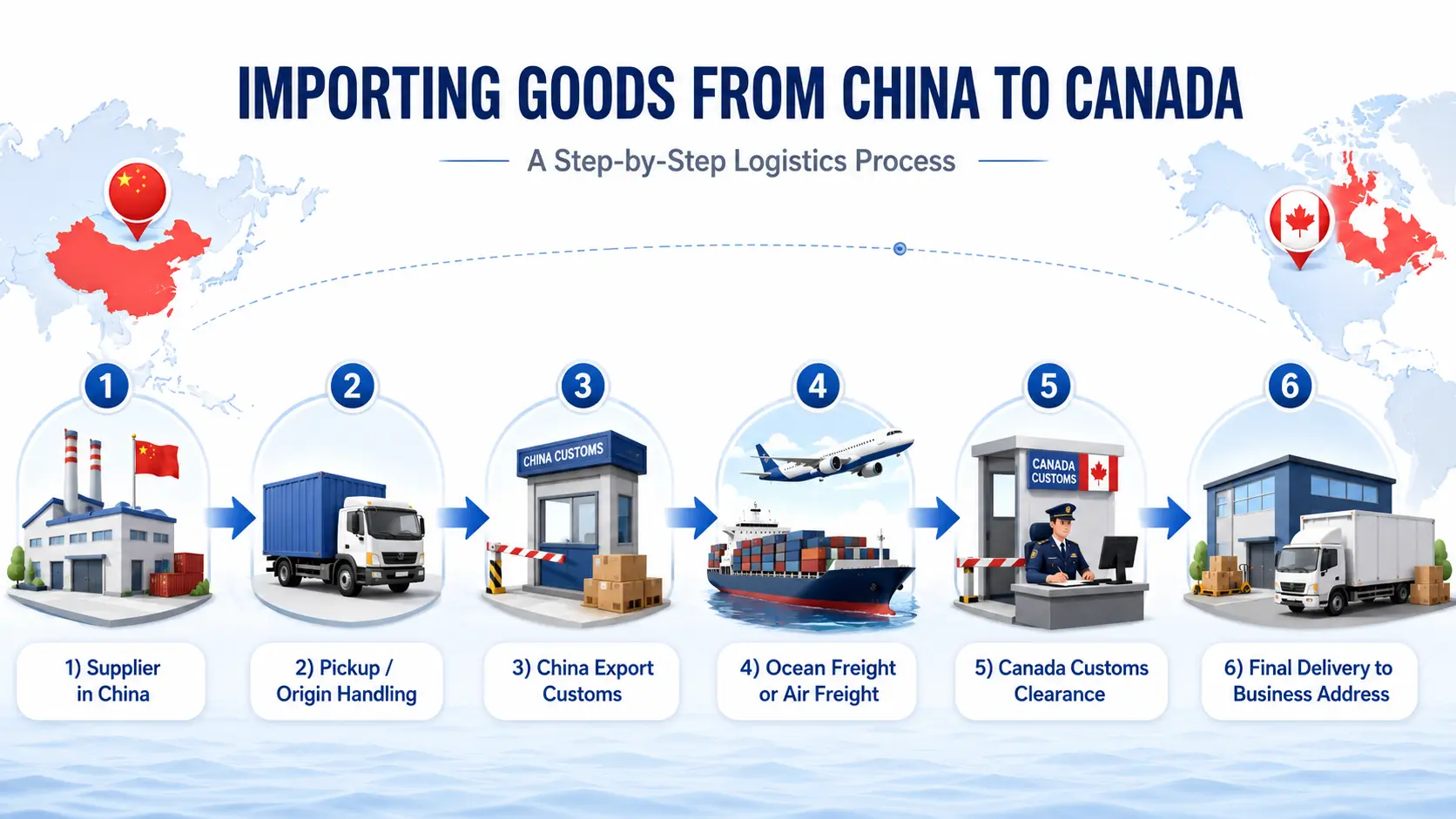
Step 1: Confirm Who Will Be the Importer of Record in Canada
Before cargo leaves China, identify the legal entity that will import the goods into Canada. The importer of record is responsible for the accuracy of the customs declaration, tariff classification, origin, customs value, duties, taxes and post-entry corrections. Hiring a customs broker does not transfer this legal responsibility away from the importer.
A Canadian commercial importer will generally need a Canada Revenue Agency Business Number and the appropriate import setup through the CBSA Assessment and Revenue Management system, known as CARM. The importer should also confirm how its customs broker will be authorized in the CARM Client Portal. Businesses that want goods released before duties and taxes are paid should review the current financial-security requirements for the Release Prior to Payment program.
- Confirm the importer’s exact legal name and business address.
- Confirm the Business Number and commercial import account information.
- Register for or access the CARM Client Portal as applicable.
- Delegate authority to the selected customs broker before the shipment arrives.
- Confirm how duties, taxes and brokerage charges will be paid.
The official CBSA guide to importing commercial goods into Canada should be reviewed when establishing a new import operation.
Step 2: Confirm the Goods Can Be Imported into Canada
Do not assume that a product can enter Canada simply because the supplier can export it from China. Import requirements depend on the product, material, intended use, composition, country of origin and the Canadian agency responsible for that category.
Start with a detailed product description. Generic descriptions such as “parts,” “accessories,” “samples” or “electronics” are not sufficient for accurate freight or customs planning. Record what the product is, what it is made from, how it is used, whether it contains batteries, liquids, powders, chemicals, magnets, food ingredients, wood or medical components, and whether it carries a brand or trademark.
Products that commonly require additional review include:
- Food, supplements, plants, animal products and agricultural goods
- Cosmetics, medical devices, pharmaceuticals and health products
- Lithium batteries, power banks and battery-powered equipment
- Chemicals, adhesives, coatings, liquids, powders and aerosols
- Children’s products, electrical products and regulated consumer goods
- Wood products and shipments using solid-wood packaging
- Vehicles, machinery and equipment subject to technical standards
- Branded goods requiring proof of authorization or authenticity
Regulated cargo may require licences, permits, test reports, Safety Data Sheets, UN38.3 documentation, dangerous-goods declarations, bilingual labels or other product-specific evidence. These requirements should be checked before production is completed, not after the cargo reaches the export warehouse.
Step 3: Determine the HS Code, Duty Rate and Import Taxes
The Harmonized System code identifies the product for customs purposes. It affects the duty rate, statistical reporting, admissibility requirements and the information required on the import declaration. Classification should be based on the product’s objective characteristics rather than the supplier’s preferred wording.
To classify commercial goods correctly, collect:
- Detailed product name and commercial use
- Material composition and component breakdown
- Technical specifications, model and function
- Photos, catalogues, manuals or product samples
- Manufacturing process when relevant
- Country of manufacture and origin
The duty calculation may depend on the HS code, customs value, country of origin and applicable Canadian tariff treatment. GST or other applicable taxes may also be collected at import. Review our guide to HS codes, duties and taxes for Canadian imports before confirming the landed cost.
Do not understate the invoice value or use an inaccurate HS code to reduce import charges. Customs authorities may request supporting payment records, purchase orders, catalogues, contracts or proof of the transaction value.
Step 4: Verify the Chinese Supplier and Purchase Order
The freight process starts with the purchase terms. Confirm that the Chinese supplier can manufacture, package and document the goods according to Canadian requirements. A low product price does not compensate for incorrect labels, unstable packaging, missing certificates or a supplier that cannot provide accurate export documents.
The purchase order should clearly state:
- Product specifications, model, materials and tolerances
- Quantity, unit price, total value and currency
- Packaging method and carton or pallet requirements
- Required labels, marks, barcodes and country-of-origin information
- Inspection standard and acceptable quality level when applicable
- Agreed Incoterm and named place or port
- Production completion and cargo-ready date
- Required certificates, test reports and compliance documents
For new factories, high-value orders or technically sensitive products, consider supplier verification, sample approval and a pre-shipment inspection. TopShipping can also coordinate supplier and product sourcing support when the shipment requires China-side supplier assistance.
Step 5: Choose the Correct Incoterm
The Incoterm determines where the supplier’s responsibility ends and where the buyer’s logistics responsibility begins. It affects pickup, Chinese export handling, port charges, international freight, Canadian customs clearance, duties, taxes and final delivery. It does not by itself determine ownership, payment terms or product quality.
| Incoterm | Supplier Usually Handles | Canadian Buyer Usually Handles | Practical Use |
|---|---|---|---|
| EXW | Makes the goods available at the factory or warehouse | Pickup, export handling, freight, import clearance and delivery | Useful when the buyer wants control from the supplier’s location |
| FOB | Origin transport and export clearance to the named Chinese port | Main freight, Canadian import clearance and final delivery | Common for sea freight when the supplier can export properly |
| DAP | Transport to the named Canadian destination | Import clearance, duties, taxes and unloading unless agreed otherwise | Useful when transport is delivered but the buyer remains importer |
| DDP | Broad delivery and import-related obligations under the agreed quotation | Receives the cargo and completes agreed receiving obligations | Can simplify coordination, but the importer structure and cost inclusions must be verified |
EXW may appear cheaper on the supplier quotation but can create additional pickup and export costs. FOB often gives a Canadian importer better control of the international freight while allowing the supplier to manage Chinese export procedures. DDP can be convenient, but the quotation must state who acts as importer, how duties and taxes are handled, what products are eligible and which charges are excluded.
For a detailed responsibility comparison, read FOB vs EXW vs DDP from China to Canada. Importers considering an inclusive delivery arrangement can also review our DDP shipping from China to Canada service.
Step 6: Prepare Accurate Cargo Details for the Freight Quote
A freight quote is only as reliable as the cargo data supplied. The forwarder needs enough information to calculate chargeable weight, cargo volume, origin costs, destination charges, customs requirements and final delivery.
| Required Detail | What to Provide | Why It Matters |
|---|---|---|
| Pickup location | Supplier city, postcode and full factory or warehouse address | Determines China-side pickup and export routing |
| Canadian destination | City, postal code and delivery-site type | Determines port, airport, rail and final-mile options |
| Product information | Accurate name, material, use, HS code and special contents | Affects customs, carrier acceptance and handling |
| Package count | Number of cartons, pallets, crates or machines | Used for booking, handling and document checks |
| Dimensions | Length, width and height of each package | Used to calculate CBM and volumetric weight |
| Gross weight | Weight per package and total shipment weight | Used for air chargeable weight, LCL W/M and vehicle planning |
| Cargo value | Commercial transaction value and currency | Supports customs valuation and insurance decisions |
| Ready date | Date the packed cargo can be collected | Determines available flight, sailing and consolidation schedule |
| Incoterm | EXW, FOB, DAP, DDP or another agreed term and named place | Defines the service scope and cost responsibility |
| Special conditions | Batteries, liquids, magnets, chemicals, wood, oversized or fragile cargo | May require approval, certificates or special handling |
Estimated dimensions can result in a revised invoice after the cargo is measured. Ask the supplier to provide final packed dimensions and gross weights rather than product-only measurements.
Step 7: Select Air Freight, LCL or FCL Sea Freight
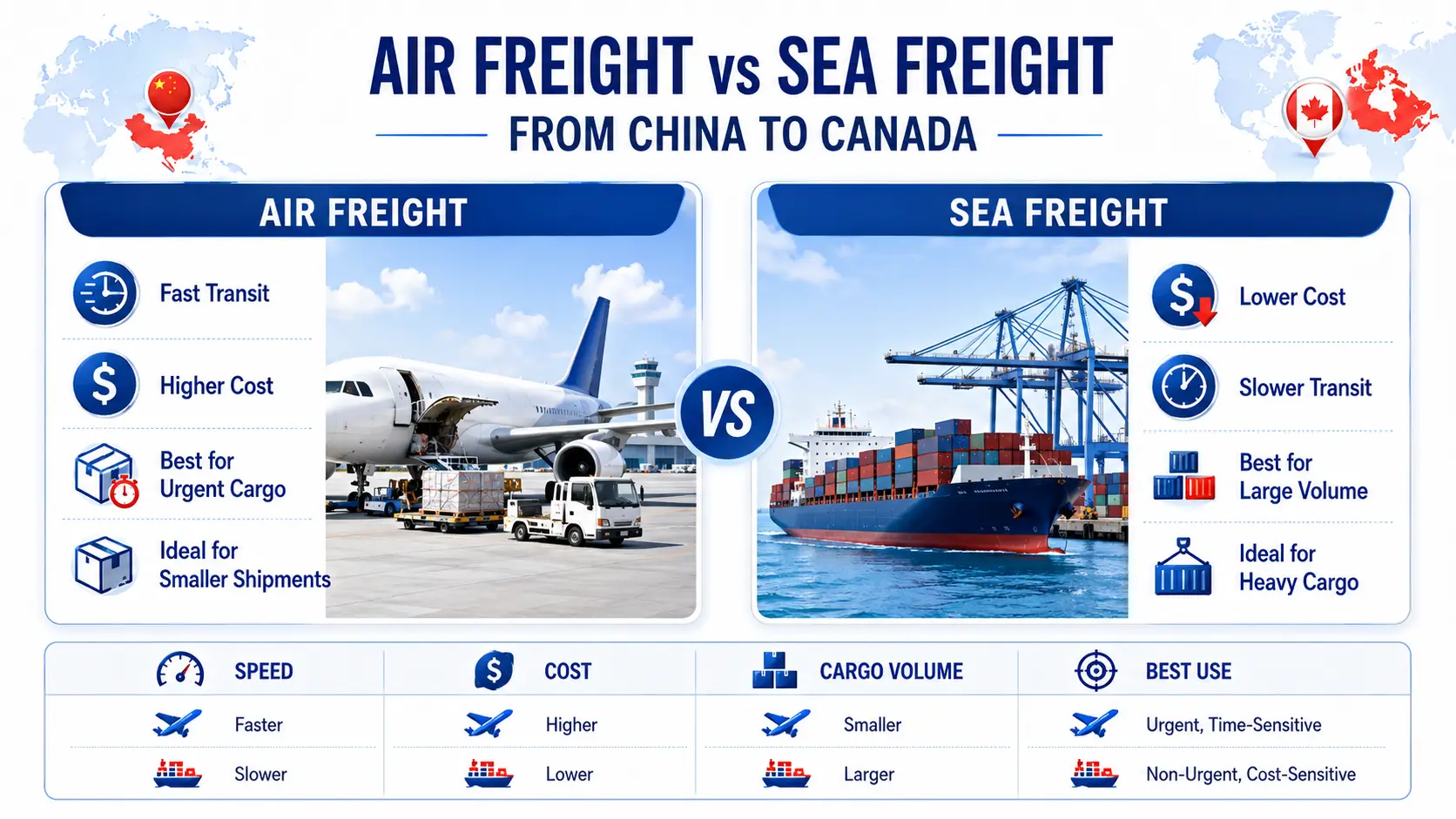
The best method for shipping commercial goods from China to Canada depends on urgency, cargo volume, density, value, handling sensitivity, inventory planning and delivery destination. The lowest freight rate is not always the lowest landed cost. A slower method can cause stockouts, while a faster method can consume the product margin.
| Shipping Method | Best For | Typical Pricing Basis | Planning Transit Range | Main Consideration |
|---|---|---|---|---|
| Air Freight | Urgent, compact, higher-value or time-sensitive cargo | Chargeable kilogram | Often 3–10 days depending on service and route | Volumetric weight can increase the billable weight |
| LCL Sea Freight | Smaller ocean shipments that do not fill a container | Weight or measurement, commonly W/M | Often 25–55 days door to door | Consolidation, deconsolidation and destination charges |
| FCL Sea Freight | Larger, heavier or recurring commercial shipments | Per 20ft, 40ft or 40ft High Cube container | Often 20–45 days port or terminal transit, plus inland delivery | Container utilization, demurrage, detention and delivery planning |
| Split Shipment | Businesses balancing urgency and cost | Part air and part sea | Separate timelines | Urgent stock moves by air while core inventory moves by sea |
Use air freight from China to Canada when delivery speed is critical. For larger shipments, review sea freight from China to Canada and compare LCL vs FCL shipping.
Transit time is not limited to the aircraft flight or vessel voyage. A realistic schedule includes production completion, supplier pickup, warehouse receiving, consolidation, export handling, carrier departure, customs clearance and final delivery. Review the full shipping time from China to Canada guide when planning inventory.
Step 8: Arrange Pickup, Consolidation, Inspection and Export Packaging
Under EXW or other pickup-based arrangements, the forwarder collects the cargo from the supplier. Under FOB, the supplier may deliver the goods to the nominated port, terminal or forwarder location. The handover point should be documented so that neither party assumes the other has arranged the origin movement.
If products are purchased from several Chinese suppliers, consolidation can reduce repeated export movements and create one organized shipment. The consolidation warehouse can receive each order, count cartons, record measurements, inspect external packaging and combine the cargo for air freight, LCL or FCL loading.
Our China freight consolidation service is suitable for importers buying multiple SKUs or orders from different factories.
Before export, verify that packaging is suitable for the selected mode:
- Use strong export cartons with adequate internal protection.
- Protect machinery and heavy cargo with properly designed crates or skids.
- Confirm pallet dimensions, stackability and total height.
- Use moisture protection for ocean freight when required.
- Secure liquids, fragile products and irregular items against movement.
- Check whether solid-wood packaging requires compliant treatment and marking.
- Apply carton marks, SKU labels, warehouse labels and handling instructions correctly.
Cargo insurance should be considered separately from carrier liability. The carrier’s legal liability may be limited and may not cover the full commercial loss.
Step 9: Prepare the Required Shipping Documents
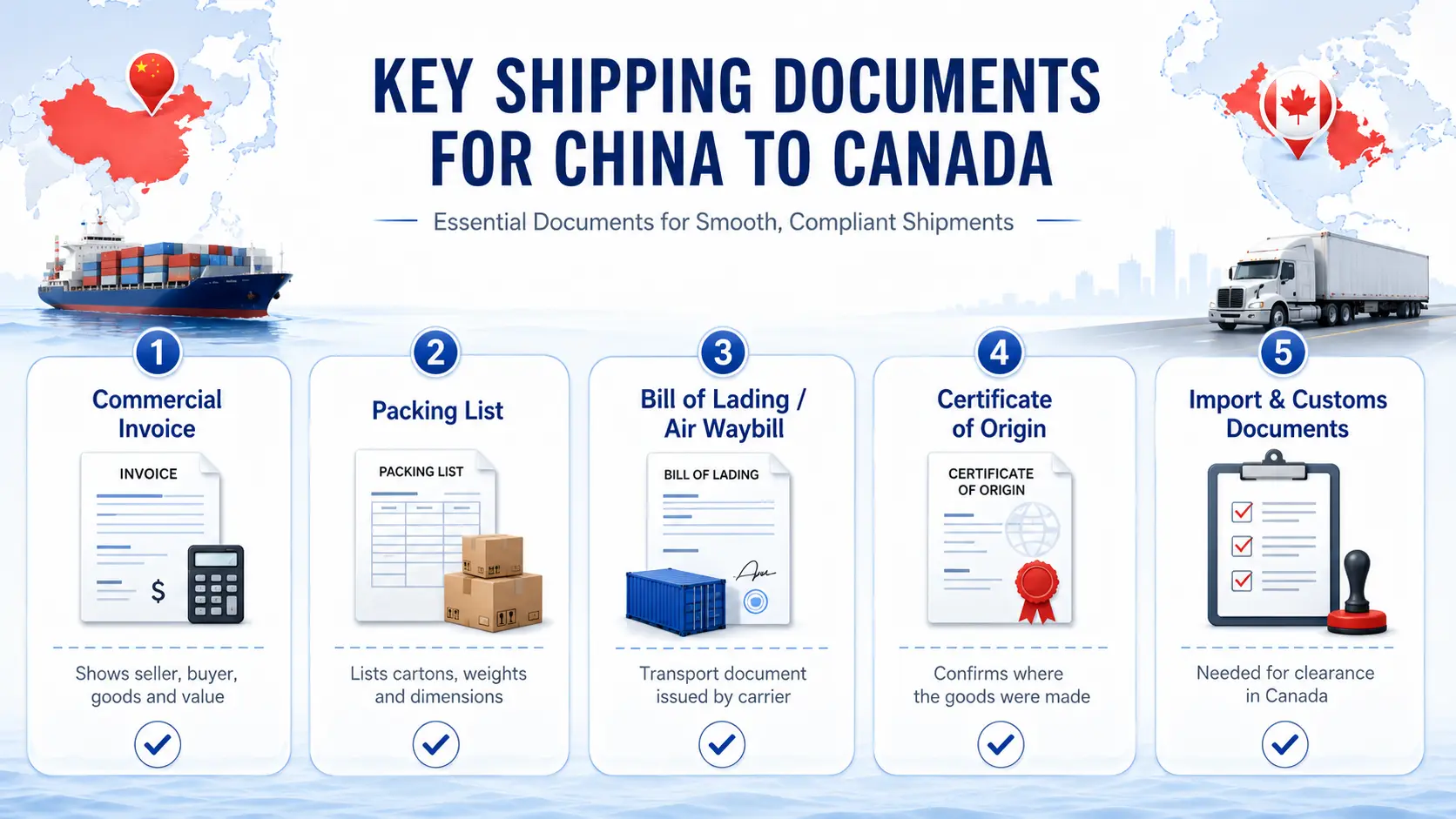
Document consistency is one of the most important parts of the China to Canada shipping process. Product names, quantities, weights, package counts, values, Incoterms and parties should match across the purchase order, commercial invoice, packing list and transport document.
| Document | Main Information | Operational Purpose |
|---|---|---|
| Commercial Invoice | Seller, buyer, product description, quantity, unit price, total value, currency, origin and Incoterm | Supports customs valuation, classification and accounting |
| Packing List | Carton or pallet count, package contents, dimensions, net weight and gross weight | Supports carrier handling, customs checks and warehouse receiving |
| Bill of Lading | Shipper, consignee, notify party, vessel, ports, container and cargo details | Main ocean transport and cargo-release document |
| Air Waybill | Shipper, consignee, airports, routing, packages, weight and cargo description | Main air transport document |
| HS Classification Data | Product-specific HS code and supporting technical description | Determines customs treatment and import requirements |
| Certificates and Permits | Test reports, licences, SDS, UN38.3, origin or agency approvals | Required for regulated or special cargo |
| Importer Information | Legal name, address, Business Number and broker authorization | Identifies the party responsible for the Canadian import entry |
Read the complete shipping documents from China to Canada checklist before the cargo departs. Correcting documents before departure is usually easier and less expensive than correcting them during customs clearance.
Step 10: Book the Shipment and Complete Chinese Export Handling
Once the cargo data and documents are confirmed, the freight forwarder selects a carrier, route and service level. The booking should identify the cargo-ready date, cut-off times, airport or port, planned departure, transshipment status and expected arrival.
Origin handling may include:
- Factory pickup or supplier delivery to the nominated warehouse
- Cargo measurement, weighing and receiving checks
- Air security screening or dangerous-goods review
- LCL consolidation or FCL container loading
- Chinese export declaration and export customs procedures
- Terminal handling and handover to the airline or ocean carrier
- Issuance or confirmation of the air waybill or bill of lading
For FCL shipments, loading time, container condition, seal number and verified gross mass should be controlled. For LCL, confirm the warehouse cut-off and whether the quotation includes origin CFS charges. For air freight, confirm chargeable weight after final measurement.
Step 11: Prepare Canadian Customs Clearance Before Arrival
Customs preparation should begin before the aircraft or vessel reaches Canada. The importer or customs broker should receive the commercial invoice, packing list, transport document, HS codes, origin information, permits and importer details early enough to review the entry.
The broker may need clarification if the product description is too general, the invoice value does not match the purchase transaction, the origin is unclear or the importer’s CARM delegation is incomplete. Delaying these decisions until arrival can create airline storage, terminal storage, demurrage, detention or warehouse charges.
TopShipping can coordinate the freight documentation and work with the importer and broker through our customs clearance from China to Canada service.
What Canadian Customs May Review
- Importer identity and account status
- Accurate product classification
- Country of origin and tariff treatment
- Transaction value and additions to the value for duty
- Commercial invoice and packing-list consistency
- Licences, permits, certificates and agency requirements
- Product marking, labelling and admissibility
- Whether the shipment is selected for document review or physical examination
A customs broker can prepare and transmit the entry, but the importer should retain product records and understand the classification and valuation used.
Step 12: Pay Duties and Taxes and Obtain Cargo Release
Import charges may include customs duty, GST or other applicable taxes, customs brokerage, government fees and product-specific charges. The amount depends on the classification, origin, customs value and importer circumstances. These charges are separate from international freight unless the written quotation explicitly includes them.
The difference between freight cost and landed cost is important:
- Freight cost is the transportation and related logistics charge.
- Landed cost includes the product cost, origin charges, freight, insurance, duties, taxes, brokerage, destination handling and delivery to the final location.
Use our shipping cost from China to Canada guide to identify the main cost drivers. A quote should state whether supplier pickup, export handling, terminal charges, customs clearance, duties, taxes and final delivery are included or excluded.
Step 13: Arrange Final Delivery in Canada
After customs release, the shipment moves to its final destination. Air cargo may be collected from an airport terminal or transferred to a local delivery truck. LCL cargo is normally deconsolidated at a bonded or destination warehouse before individual shipments are released. FCL containers may move by truck or rail from Vancouver, Prince Rupert, Montreal or another gateway to inland destinations such as Toronto, Markham, Calgary or Edmonton.
Final delivery planning should confirm:
- Complete delivery address and Canadian postal code
- Business hours and receiving contact
- Loading dock, forklift or tailgate requirement
- Pallet count, cargo weight and package dimensions
- Warehouse appointment or 3PL receiving rules
- Amazon, marketplace or fulfillment-centre labels
- Residential, limited-access or remote-location restrictions
- Container unloading time and empty-return arrangements for FCL
Importers that prefer one coordinated service from the supplier to the Canadian destination can use door-to-door shipping from China to Canada.
Step 14: Check the Shipment, Records and Final Landed Cost
When the cargo is delivered, inspect the external condition, count the packages and note visible damage or shortages on the delivery record before signing. Photograph damaged cartons, seals, pallets or products and notify the freight and insurance parties promptly.
Close the shipment by reconciling:
- Supplier invoice and actual goods received
- Freight quotation and final logistics invoice
- Customs declaration, duties and taxes
- Brokerage and destination charges
- Warehouse, rail, drayage or final delivery charges
- Damage, shortage or insurance claims
- Actual landed cost per SKU or unit
Commercial import records should be retained for the period required by Canadian law. The importer should be able to support the declared classification, origin, value and tax treatment if the shipment is reviewed later.
Common Mistakes When Shipping Commercial Goods from China to Canada
- Choosing freight before checking import compliance: Regulated products may require permits, tests or labels that affect whether the cargo can ship.
- Using vague product descriptions: “Parts” or “accessories” can delay classification and customs review.
- Accepting the supplier’s HS code without verification: China export classification and Canadian import classification may not be identical.
- Comparing quotes with different service scopes: A low port-to-port quote cannot be compared directly with a door-to-door quotation.
- Ignoring volumetric weight: Bulky air cargo may be billed at a much higher chargeable weight than its scale weight.
- Booking LCL based only on the ocean rate: Origin and destination CFS charges can materially affect the total cost.
- Leaving CARM and broker authorization until arrival: Incomplete importer setup can delay release and create storage charges.
- Using incorrect invoice values: Customs may request payment records and reassess the entry.
- Failing to plan final delivery: Warehouse appointments, tailgate service, forklift access and container unloading can affect cost and timing.
- Shipping without suitable insurance: Carrier liability may not equal the commercial value of the goods.
Commercial Shipping Cost Drivers
| Cost Driver | How It Affects the Shipment |
|---|---|
| Shipping method | Air, LCL and FCL use different pricing structures and service levels |
| Weight and dimensions | Determine air chargeable weight, LCL W/M and container utilization |
| Supplier location | Affects pickup distance, origin handling and the best Chinese gateway |
| Canadian destination | Affects port or airport choice, rail movement, drayage and final delivery |
| Incoterm | Determines which origin, freight, import and delivery charges are in the buyer’s scope |
| Product classification | Determines duties, taxes, permits and special handling requirements |
| Season and capacity | Peak periods, holidays and carrier space can change rates and schedules |
| Customs and inspection | Document issues or examinations may create brokerage, storage and delay costs |
| Delivery conditions | Appointments, tailgate service, remote areas and limited access can add charges |
Information to Send for a China to Canada Commercial Freight Quote
To receive a useful quotation rather than a broad estimate, provide:
- Chinese supplier address or pickup city
- Canadian delivery address and postal code
- Detailed product description and intended use
- HS code if already confirmed
- Number and type of packages
- Dimensions and gross weight of each package
- Total cargo volume in CBM when available
- Commercial value and currency
- Incoterm and named place
- Cargo-ready date
- Battery, liquid, powder, magnet, chemical or wood details
- Required air, LCL, FCL, DDP or door-to-door service
- Customs clearance and final delivery requirements