
Shipping cost from China to Canada in September 2026 typically ranges from USD $6.00–$8.50 per chargeable kilogram for standard commercial air freight, USD $7.50–$12.00 per chargeable kilogram for coordinated door-to-door air freight, USD $150–$220 per chargeable CBM or W/M for port-to-port LCL sea freight, USD $6,500–$8,000 for a 20ft container, and USD $7,200–$9,000 for a 40ft or 40HQ container.
Express courier commonly starts around USD $12–$18 or more per chargeable kilogram. Door-to-door sea freight and DDP shipping cannot be priced accurately using one universal rate because the final amount depends on the supplier location, Canadian delivery postal code, cargo characteristics, customs requirements and the services included in the quotation.
These amounts are indicative planning ranges in US dollars reviewed on September 1, 2026 using the latest available market data. They are not fixed TopShipping rates, guaranteed carrier prices or complete landed-cost quotations. Current capacity, cargo dimensions, route, Incoterm, origin charges, Canadian destination fees and final delivery requirements can change the actual price.
For the complete shipping process, method selection, customs documents and route planning, begin with our complete China-to-Canada shipping guide. This page is specifically responsible for freight rates, price-per-kilogram calculations, LCL and container costs, quotation comparison and landed-cost planning.
Shipping Cost from China to Canada in September 2026
| Freight option | September 2026 planning cost | Main pricing basis | Typical rate scope |
|---|---|---|---|
| Express courier | USD $12–$18+ per chargeable kg | Higher of actual and dimensional weight | Usually door to door |
| Standard air freight | USD $6.00–$8.50 per chargeable kg | Higher of actual and volumetric weight | Airport to airport |
| Door-to-door air freight | USD $7.50–$12.00 per chargeable kg | Chargeable weight and confirmed delivery scope | Shipment-specific door to door |
| LCL sea freight | USD $150–$220 per chargeable CBM or W/M | Greater of cubic metres or metric tons | Port to port |
| 20ft FCL container | USD $6,500–$8,000 per container | Port pair and container booking | Port to port |
| 40ft standard container | USD $7,200–$9,000 per container | Port pair and container booking | Port to port |
| 40ft High Cube container | USD $7,200–$9,000 per container | Port pair, equipment and cargo requirements | Port to port |
| Door-to-door sea freight | Shipment-specific quotation | Origin, ocean, destination and delivery scope | Supplier to agreed Canadian destination |
| DDP shipping | Shipment-specific quotation | Confirmed delivered-duty-paid responsibilities | Named destination under an eligible DDP structure |
Rate-review date: September 1, 2026
Currency: US dollars unless a quotation states otherwise.
September 2026 planning note
These figures are planning ranges rather than live quotations. Airport-to-airport and port-to-port rates do not normally represent the complete amount required to move cargo from a Chinese factory to a Canadian warehouse. Final pricing depends on the confirmed cargo details, route, service scope, origin and destination charges, customs requirements and Canadian delivery conditions.
What Is Included in a Shipping Rate?
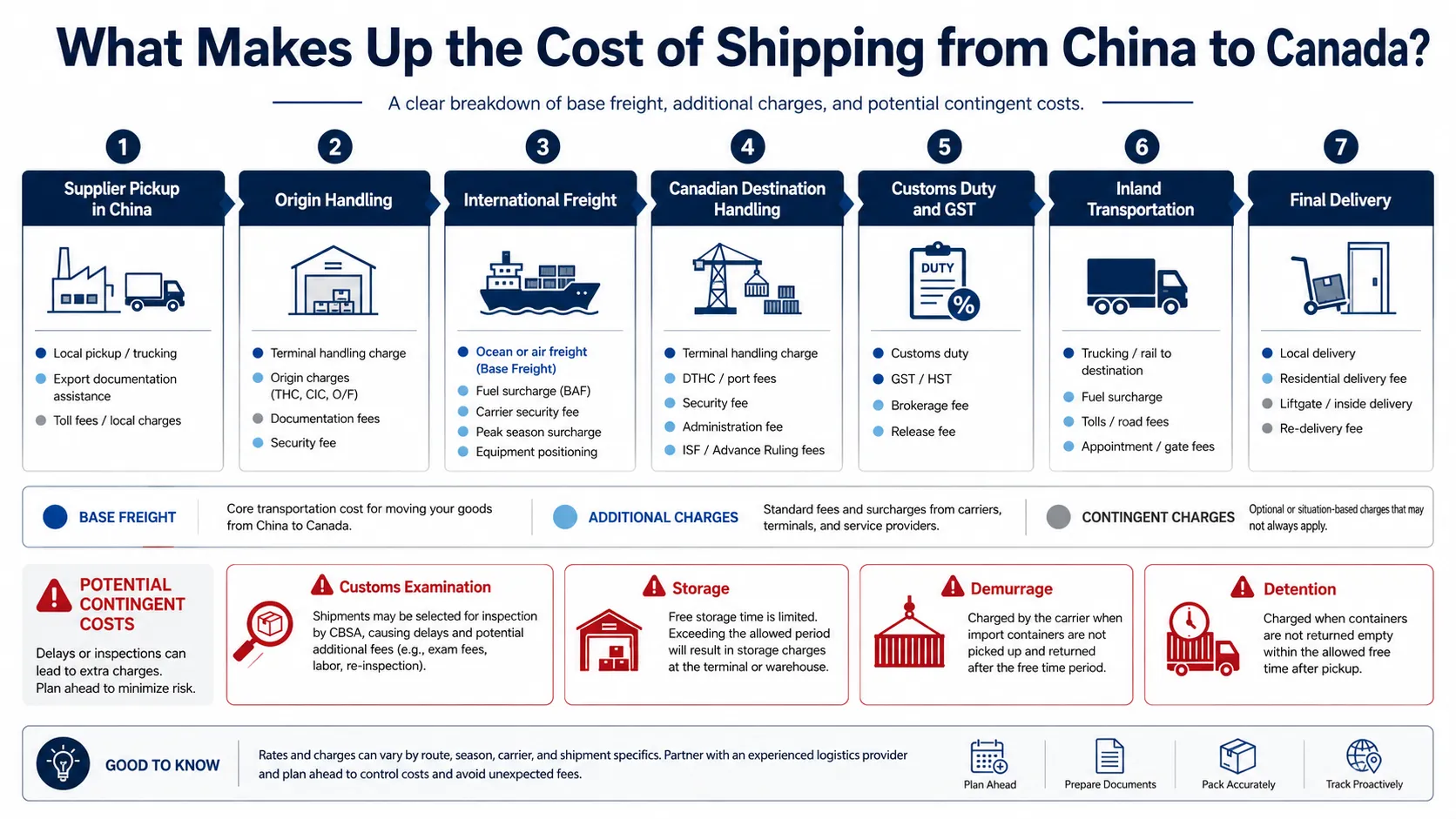
Two China-to-Canada freight quotations can display very different totals because they may not cover the same logistics stages. Before comparing rates, identify exactly where each service begins and ends.
| Cost component | What it may cover | Common quotation issue |
|---|---|---|
| Supplier pickup | Collection from the factory or supplier warehouse | Often excluded from FOB quotations and required for EXW cargo |
| Origin handling | Receiving, weighing, measuring, documentation and export processing | May be separated into several warehouse or terminal charges |
| International freight | Main air, LCL or FCL transportation | The advertised rate may cover only this component |
| Carrier surcharges | Fuel, security, peak-season, equipment and emergency surcharges | May change after the initial quotation |
| Destination handling | Airport, terminal, port, CFS or deconsolidation charges in Canada | Can materially affect LCL and FCL delivered cost |
| Customs-clearance services | Brokerage or coordination with customs parties | Freight forwarding and licensed customs brokerage are separate functions |
| Duty and GST | Government import charges | Normally excluded unless explicitly estimated or included |
| Inland transportation | Rail, drayage or trucking to the Canadian destination | Depends on the postal code and delivery conditions |
| Final delivery | Delivery to a warehouse, business address or eligible facility | Appointments, liftgate service or waiting time may cost extra |
| Contingent charges | Examinations, storage, demurrage, detention and re-delivery | Cannot always be confirmed before the event occurs |
A professional quotation should specify whether the service is airport to airport, port to port, door to airport, door to port, door to door, DAP or DDP.
The lowest base freight rate is not necessarily the lowest total delivered cost.
September 2026 Freight Rate Market Update
Global and regional indices do not provide a direct quotation for a specific shipment to Canada, but they provide useful context for understanding current pricing conditions.
In the latest assessment available entering September, the Drewry World Container Index decreased by 1% to USD $4,473 per 40ft container on August 27, 2026.
The Shanghai-to-Los Angeles benchmark was USD $6,818 per 40ft container, while Shanghai-to-New York was USD $9,333. These levels were materially higher than the August 6 benchmarks of USD $5,894 for Shanghai-to-Los Angeles and USD $7,893 for Shanghai-to-New York.
These United States trade-lane benchmarks are not direct China-to-Canada container quotations, but they indicate that Trans-Pacific ocean freight entered September at a higher pricing level than at the time of the previous TopShipping rate review.
For air cargo, recent Freightos market reporting showed Far East-to-North America rates around USD $6.45 per kilogram in late August, with daily rates moving back toward approximately USD $6.00 per kilogram after temporarily rising above USD $7.00 earlier in the month.
The Freightos Air Index for Greater China to North America remains useful as a regional benchmark for current general-cargo pricing conditions.
A Canada-specific air quote can be higher than the regional benchmark because of the origin airport, Canadian gateway, weight break, cargo density, available airline capacity, transfer requirements and final service scope.
Based on the latest available market data reviewed on September 1, 2026, the planning ranges shown on this page remain appropriate for September budgeting. Published indices should be used as market references rather than added directly to a shipment budget. The applicable rate must be confirmed using final cargo data and a current cargo-ready date.
Shipping from China to Canada Price per Kg
Businesses searching for a shipping price per kilogram are normally comparing express courier, standard air freight and door-to-door air freight.
Ocean freight is not usually quoted as a simple price per kilogram. LCL is commonly charged by CBM or W/M, while FCL is quoted per container.
Air Freight Rates from China to Canada
| Chargeable weight | Indicative airport-to-airport rate | Common shipment profile |
|---|---|---|
| 45–100 kg | USD $8.50–$12.00/kg | Small commercial orders, prototypes and urgent components |
| 100–300 kg | USD $7.00–$10.00/kg | E-commerce restocking, accessories and compact inventory |
| 300–500 kg | USD $6.00–$8.50/kg | Standard commercial air shipments |
| 500–1,000 kg | USD $5.50–$8.00/kg | Larger urgent or recurring inventory movements |
| More than 1,000 kg | Live route-specific quotation | Dense, recurring or higher-volume commercial cargo |
The headline range of USD $6.00–$8.50 per kilogram is most representative of ordinary midweight commercial air cargo. Smaller shipments can have a higher price per kilogram because minimum airway-bill, handling and screening charges are distributed across less weight.
Cargo containing lithium batteries, liquids, powders, magnets, chemicals, medical products, oversized pieces or dangerous goods may require additional documentation, airline approval and special handling.
For cargo acceptance, service options and the complete process, see our commercial air freight guide.
Express Courier Cost per Kg
Express courier commonly falls around USD $12–$18 or more per chargeable kilogram for small China-to-Canada shipments.
The price may be higher when:
- The parcel has high dimensional weight
- The delivery postal code is remote
- The shipment contains batteries or restricted products
- Several cartons are booked separately
- Residential or special delivery services are required
- Duty, GST, brokerage or disbursement fees are added
Courier may still provide better value for documents, samples and small urgent parcels because pickup, transportation, customs processing support and final delivery are normally combined into one network.
How Air Freight Chargeable Weight Is Calculated
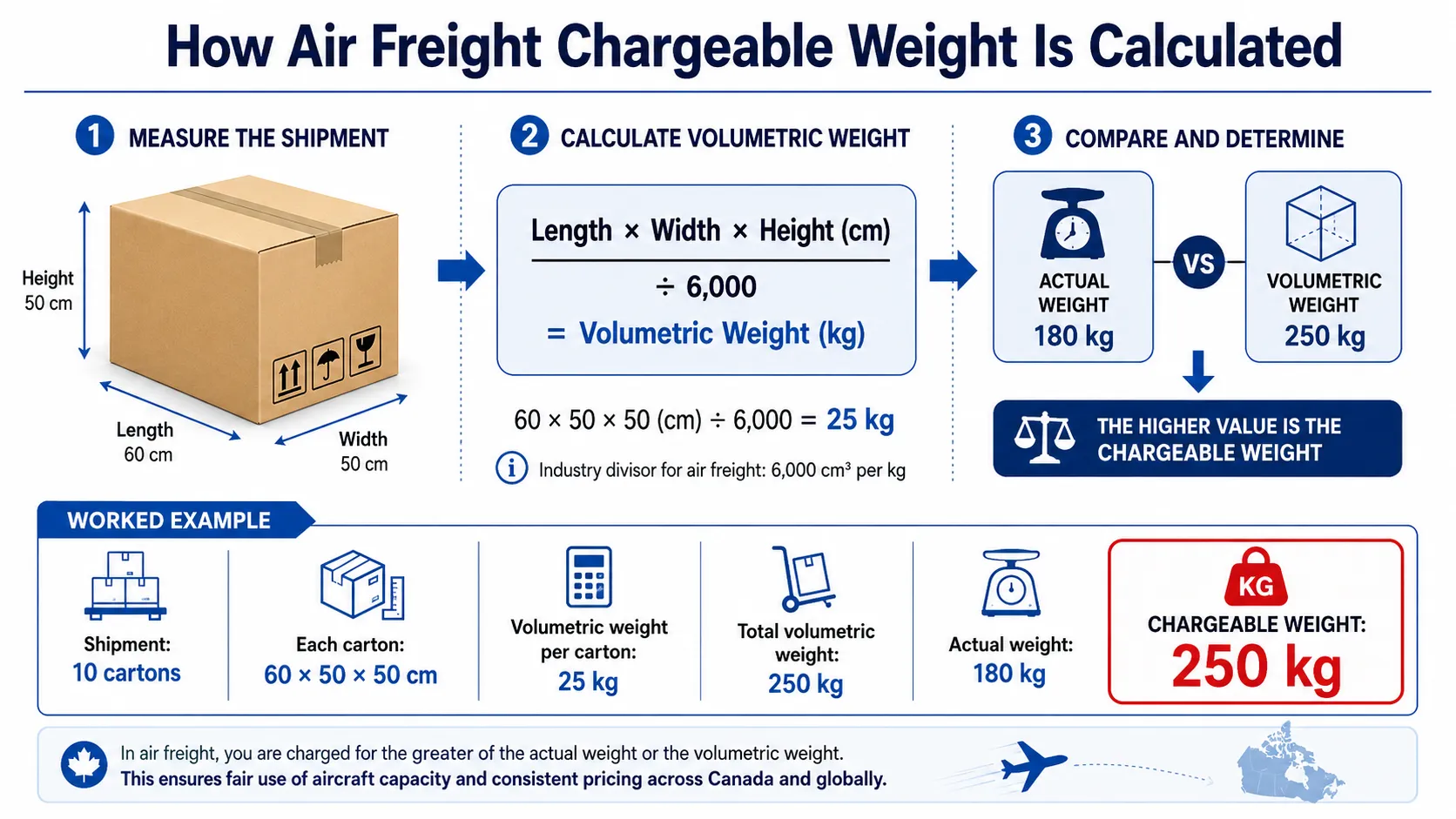
Air freight is normally charged using the higher of:
- Actual gross weight
- Volumetric weight
A commonly used metric volumetric-weight formula is:
Length × width × height in centimetres ÷ 6,000
The formula must be applied to every carton before the results are added together. The selected carrier or service may apply different dimensional rules, so the divisor should always be confirmed.
The International Air Transport Association explains that air cargo may be rated according to actual or volumetric weight and that the higher result is generally used.
Air Freight Cost Example
Assume a shipment contains 10 cartons measuring 60 × 50 × 50 centimetres each.
| Calculation item | Result |
|---|---|
| Volumetric weight per carton | 60 × 50 × 50 ÷ 6,000 = 25 kg |
| Total volumetric weight | 10 × 25 kg = 250 kg |
| Actual gross weight | 180 kg |
| Estimated chargeable weight | 250 kg |
| Indicative main air freight at USD $6.00/kg | USD $1,500 |
| Indicative main air freight at USD $8.50/kg | USD $2,125 |
The indicative USD $1,500–$2,125 result represents the main air freight calculation only. Supplier pickup, export handling, Canadian airport fees, customs services and final delivery may be additional.
Reducing unnecessary packaging volume may lower chargeable weight, provided the packaging remains strong enough to protect the cargo.
LCL Shipping Cost from China to Canada
Indicative September 2026 port-to-port LCL freight from China to Canada is approximately USD $150–$220 per chargeable CBM or W/M.
LCL, or Less than Container Load, allows a shipment to share container space with cargo belonging to other importers. It can be suitable for smaller planned ocean shipments that do not require a complete container.
A quoted LCL rate per CBM normally represents only part of the final shipping cost.
Common LCL Cost Components
- Supplier pickup in China
- Origin CFS receiving
- Warehouse handling
- Measurement and weighing
- Export documentation
- Consolidation charges
- Ocean freight
- Canadian CFS handling
- Deconsolidation charges
- Customs brokerage
- Customs examinations when applicable
- Storage when applicable
- Final truck delivery
Very small LCL shipments may have a high effective cost per CBM because minimum origin, documentation and destination charges still apply.
How LCL Weight or Measurement Works
LCL cargo is commonly charged by weight or measurement, shown as W/M.
The chargeable quantity is generally based on the greater of:
- The cargo volume in cubic metres
- The cargo gross weight expressed in metric tons
A consolidator’s tariff can apply additional density or minimum-charge rules. The exact rating method should therefore be shown in the quotation.
LCL Shipping Cost Example
Assume a shipment measures 3.2 CBM and weighs 1,400 kilograms.
| Calculation item | Result |
|---|---|
| Cargo volume | 3.2 CBM |
| Weight expressed in metric tons | 1.4 metric tons |
| Chargeable W/M | 3.2 |
| Main ocean freight at USD $150/W/M | USD $480 |
| Main ocean freight at USD $220/W/M | USD $704 |
The estimated USD $480–$704 amount is the main port-to-port LCL freight component. It is not a complete door-to-door shipping cost.
China pickup, CFS handling, Canadian destination fees, customs clearance and delivery must be added or separately confirmed.
20ft Container Shipping Cost from China to Canada
The indicative September 2026 port-to-port cost of shipping a 20ft standard container from China to Canada is approximately USD $6,500–$8,000 per container.
A 20ft container is commonly considered for:
- Dense commercial cargo
- Machinery and industrial equipment
- Metal, rubber or automotive components
- Heavy palletized goods
- Medium-volume inventory
- Shipments where LCL weight charges become expensive
FCL pricing applies to the complete container booking. The importer does not need to fill every cubic metre for the shipment to be considered FCL.
The container rate may not include factory pickup, loading, origin terminal charges, Canadian terminal handling, customs brokerage, rail transportation, drayage, chassis, delivery, unloading or empty-container return.
40ft and 40HQ Container Shipping Cost from China to Canada
The indicative September 2026 port-to-port cost of a 40ft standard or 40ft High Cube container is approximately USD $7,200–$9,000 per container.
| Container type | Indicative September 2026 rate | Common cargo profile |
|---|---|---|
| 20ft standard | USD $6,500–$8,000 | Heavy or dense commercial cargo |
| 40ft standard | USD $7,200–$9,000 | Higher-volume cartons, pallets and wholesale inventory |
| 40ft High Cube | USD $7,200–$9,000 | Bulky, lower-density and high-volume cargo |
A 40ft container does not normally cost twice as much as a 20ft container. For suitable cargo, this can reduce the main ocean freight cost per unit.
The actual quote depends on:
- Chinese port of loading
- Canadian port of arrival
- Carrier and service schedule
- Direct or transshipment routing
- Container and equipment availability
- Peak-season conditions
- Fuel and emergency surcharges
- Cargo gross weight
- Canadian rail or truck requirements
- Final delivery postal code
A Shanghai-to-Vancouver port rate cannot automatically be applied to Shenzhen-to-Montreal, Ningbo-to-Toronto or another origin-destination combination.
For container capacity, loading options, ports and FCL planning, see our ocean freight guide.
When Does FCL Become Cheaper Than LCL?
There is no universal shipment volume at which FCL automatically becomes cheaper than LCL. The break-even point depends on cargo density, port pair, container rates, LCL destination charges and Canadian delivery requirements.
| Shipment profile | Recommended pricing action |
|---|---|
| Under 5 CBM | Quote LCL first and check minimum charges |
| 5–10 CBM | Review LCL origin and destination charges carefully |
| 10–15 CBM | Request both LCL and 20ft FCL quotations |
| 15–20 CBM | FCL may become financially and operationally competitive |
| More than 20 CBM | Evaluate FCL as the primary ocean option |
| Heavy cargo at a lower CBM | Compare weight-rated LCL with 20ft FCL |
| Fragile or handling-sensitive cargo | Consider FCL before the normal volume threshold |
Importers should compare complete quotations rather than multiplying an advertised LCL rate by the cargo CBM and comparing that result with a complete container quote.
Door-to-Door Shipping Cost from China to Canada
Door-to-door shipping does not have one reliable universal price per kilogram or CBM because the service combines several shipment stages.
A coordinated door-to-door quotation may include:
- Supplier pickup in China
- Origin warehouse or terminal handling
- Export-document coordination
- Air or ocean freight
- Canadian airport, port or CFS handling
- Customs-clearance coordination
- Rail or truck transportation
- Final delivery to the agreed location
Door-to-door does not automatically mean all-inclusive.
The quotation should confirm whether it includes or excludes:
- Customs brokerage
- Customs duty
- GST
- Customs examinations
- Terminal storage
- Delivery appointments
- Tailgate or liftgate service
- Residential or limited-access delivery
- Inside delivery
- Unloading
- Truck waiting time
- Remote-area surcharges
Canadian delivery pricing depends on the destination postal code, distance from the gateway, shipment size, commercial dock access, appointment requirements and unloading conditions.
DDP Shipping Cost from China to Canada
DDP shipping must be priced case by case because the seller assumes extensive transportation and import responsibilities to the named destination.
A DDP quotation may appear more expensive than an airport-to-airport or port-to-port quotation because it can include a wider logistics and import scope.
Before accepting a DDP price, confirm:
- The named delivery destination
- The importer-of-record structure
- The party responsible for customs representation
- The HS tariff classification
- The declared customs value
- The party responsible for duty and GST
- Product admissibility and compliance
- Customs examination and storage costs
- Final delivery and unloading responsibilities
- Canadian import and recordkeeping obligations
DDP should not be marketed or interpreted as a generic shipping package in which every possible expense is automatically included.
How Incoterms Change the Shipping Cost
The Incoterm determines which logistics costs are included in the supplier’s price and which expenses become the buyer’s responsibility.
| Incoterm | Main cost implication |
|---|---|
| EXW | The buyer generally assumes pickup, export handling, international freight, import clearance and delivery from the supplier’s premises. |
| FCA | The seller delivers the cargo to the named carrier or place and completes the agreed export obligations. |
| FOB | The seller places the goods on board the vessel at the named port. FOB applies to sea or inland-waterway transportation. |
| DAP | The seller arranges transportation to the named destination, while the buyer normally handles import clearance, duty and taxes. |
| DDP | The seller assumes extensive transportation and import responsibilities, subject to legal and operational feasibility. |
A low EXW product price may create additional factory pickup, export and origin-handling costs.
A quotation described only as “EXW China,” “FOB China” or “DDP Canada” is incomplete. The factory, port or destination must be identified.
Freight Cost vs Landed Cost in Canada
Freight cost is the amount charged for transportation and related logistics services. Landed cost represents the total amount required to make the imported products available at the Canadian destination.
A simplified planning formula is:
Product cost + supplier pickup + origin charges + international freight + insurance + customs duty + GST + customs brokerage + destination charges + final delivery = estimated landed cost
This is a budgeting framework rather than a substitute for formal customs valuation or accounting advice.
Customs Duty
Canadian customs duty depends on:
- The product’s 10-digit tariff classification
- Country of origin
- Customs value
- Applicable tariff treatment
- Product-specific surtaxes or trade measures
Duty should not be estimated from a broad description such as “parts,” “accessories,” “clothing” or “equipment.” Material composition and intended use can affect the classification.
GST
The Canada Border Services Agency states that 5% GST is payable on most goods at the time of commercial importation, although exemptions apply to certain categories.
The value for duty must be established in Canadian funds. When a commercial invoice uses another currency, the value must be converted using the exchange rate recognized by the CBSA for the applicable date.
GST is generally calculated using the duty-paid value rather than applying 5% only to the foreign supplier invoice without considering the customs calculation.
Review the official CBSA guide to determining duties and taxes when preparing a landed-cost estimate.
Cost per Unit
To calculate an estimated logistics cost per unit:
Total freight and logistics cost ÷ number of saleable units = estimated logistics cost per unit
To calculate estimated landed cost per unit:
Total estimated landed cost ÷ number of saleable units = estimated landed cost per unit
Include a reasonable allowance for damaged, unsellable or sample units when calculating the commercial cost per saleable product.
Why Is Shipping from China to Canada Expensive?
Shipping can appear expensive when the quoted price combines international transportation with several origin, destination and delivery charges.
The main cost drivers include:
Cargo Weight and Dimensions
Bulky air shipments can be charged by volumetric weight. Dense LCL cargo can be affected by weight-based W/M pricing.
Origin and Destination
Pickup from Shenzhen, Dongguan, Guangzhou, Shanghai, Ningbo, Yiwu or another Chinese city creates different inland costs. Delivery to Vancouver, Calgary, Toronto, Markham, Montreal, Ottawa or a remote destination also creates different rail and trucking requirements.
Carrier Capacity
Limited airline space, blank sailings, container shortages and carrier capacity controls can increase spot rates.
Fuel and Security Surcharges
Airlines, ocean carriers and terminals may adjust surcharges separately from the base freight rate.
Peak Seasons and Chinese Holidays
Chinese New Year, Golden Week, product-launch periods and seasonal retail demand can reduce available capacity and increase urgency.
Canadian Destination Charges
LCL deconsolidation, terminal handling, rail transport, drayage, customs services and delivery can create a substantial portion of the complete cost.
Special Cargo
Batteries, liquids, powders, chemicals, dangerous goods, medical products, oversized cargo and temperature-sensitive products may require special packaging, documentation, carrier approval or handling.
Urgent Delivery Requirements
Direct air services, premium routings and last-minute bookings can cost more than planned ocean or standard air options.
What Is the Cheapest Way to Ship from China to Canada?
Sea freight normally provides the lowest transportation cost per unit for heavy, bulky and planned commercial cargo. The cheapest method for a specific shipment still depends on cargo size, urgency and all-in destination cost.
| Shipment profile | Cost-effective starting option | Main cost consideration |
|---|---|---|
| Documents or very small urgent parcel | Express courier | Minimum freight and handling charges |
| Several cartons of urgent commercial cargo | Standard air freight | Chargeable weight and stockout risk |
| Small planned ocean shipment | LCL | CBM, minimums and destination charges |
| Approximately 10–18 CBM | Compare LCL and FCL | All-in LCL fees versus a complete container |
| Heavy or high-volume inventory | FCL | Container price and freight cost per unit |
| Orders from multiple suppliers | Consolidation | Duplicated pickup, documentation and handling charges |
| Urgent shortage plus larger planned order | Hybrid air and sea | Stockout cost versus transport cost |
The cheapest freight method can become the most expensive business decision when it causes a stockout, production interruption, missed retail season or excessive inventory carrying cost.
How to Reduce Shipping Costs from China to Canada
- Obtain final packed dimensions before requesting a quotation.
- Reduce unnecessary packaging volume without weakening cargo protection.
- Compare quotations using the same Incoterm and delivery scope.
- Request both LCL and FCL rates when cargo approaches 10–18 CBM.
- Consolidate compatible orders from multiple suppliers.
- Plan inventory early enough to use sea freight where appropriate.
- Use air freight only for urgent SKUs or shortage quantities.
- Provide the exact Canadian delivery postal code.
- Confirm dock, appointment, liftgate and unloading requirements.
- Check product compliance before booking transportation.
- Avoid last-minute bookings when possible.
- Compare destination charges, not only base freight.
- Confirm the rate-validity date and cargo-ready date.
- Ask whether the quote is based on estimated or final measurements.
- Calculate transportation cost per saleable unit.
How to Compare China-to-Canada Freight Quotes
| Question | Why it matters |
|---|---|
| What currency is being used? | USD and CAD totals cannot be compared without conversion. |
| How long is the rate valid? | Carrier and surcharge levels may change before booking. |
| Is the quote port to port or door to door? | The included logistics scope may be substantially different. |
| Is supplier pickup included? | EXW cargo may require additional Chinese inland transportation. |
| Are export and origin charges included? | Warehouse, documentation and terminal charges may be separate. |
| Are Canadian destination charges included? | LCL and container destination fees can materially affect the total. |
| Is customs brokerage included? | Freight forwarding and customs brokerage are separate services. |
| Are duty and GST included? | Government import charges are commonly excluded. |
| Is final Canadian delivery included? | Rail, drayage and trucking can materially change the total cost. |
| Is the rate based on final cargo measurements? | Remeasurement or reweighing can change the chargeable amount. |
| Which charges are contingent? | Examinations, storage, demurrage and waiting time may not be predictable. |
| What assumptions were used? | Incorrect cargo or delivery assumptions can invalidate the comparison. |
A reliable quotation should identify the origin, destination, freight method, cargo details, chargeable weight or CBM, currency, service scope, validity date, inclusions, exclusions and important assumptions.
Information Needed for an Accurate Shipping Quote
Prepare the following information before requesting a China-to-Canada freight rate:
- Chinese supplier address or pickup city
- Canadian delivery address and postal code
- Detailed product description
- Product material and intended use
- Number of cartons, pallets or crates
- Dimensions of each package type
- Total gross weight
- Total CBM, if known
- Commercial value and currency
- Incoterm and named place
- Cargo-ready date
- Required delivery date
- Preferred freight method, if known
- HS code, if confirmed
- Details of batteries, liquids, powders, chemicals or magnets
- Dangerous-goods status
- Temperature or special-handling requirements
- Delivery appointment, dock or liftgate requirements
A commercial invoice and final packing list allow the shipment to be reviewed more accurately.
Estimated carton information may be used for early budgeting, but the final quotation can change after the cargo is packed, weighed and measured.
Request a China-to-Canada Freight Quote
TopShipping helps Canadian businesses compare air freight, LCL, FCL, consolidation and coordinated door-to-door options for commercial imports from China.
Operating since 2012, TopShipping supports supplier communication, cargo pickup coordination, freight planning, shipment tracking, customs-clearance coordination and final delivery planning through operational support in Shenzhen and Canada.
For commercial China-to-Canada freight forwarding support, send the product description, package count, final dimensions, gross weight, supplier location, Canadian delivery postal code, Incoterm, cargo-ready date and required timeline.