
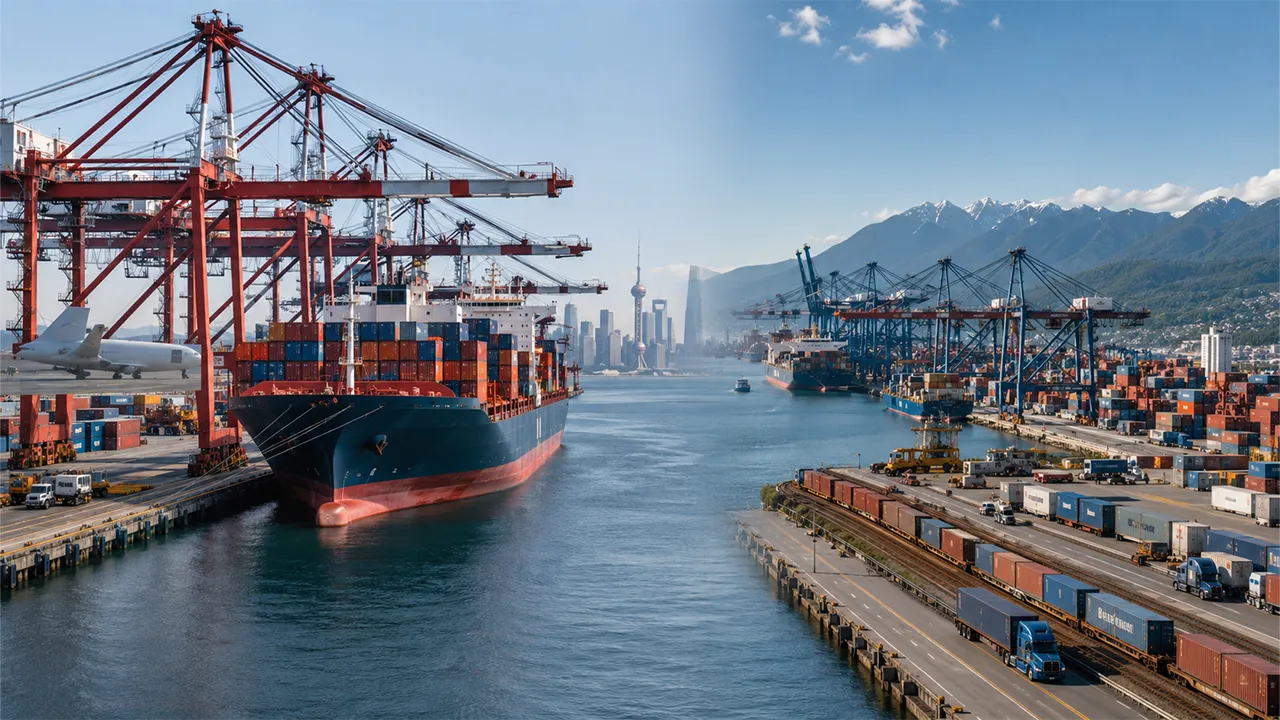
Shipping from Shanghai to Canada can be arranged by commercial air freight, LCL sea freight, FCL container shipping or a coordinated door-to-door service. Shanghai is particularly important for businesses sourcing from Shanghai itself and the wider Yangtze River Delta, including major manufacturing areas in Jiangsu and parts of northern Zhejiang.
For September 2026 planning, standard commercial air freight is approximately USD $6.00–$8.50 per chargeable kilogram, door-to-door air freight approximately USD $7.50–$12.00 per chargeable kilogram, LCL sea freight approximately USD $150–$220 per chargeable CBM or W/M, a 20ft container approximately USD $6,500–$8,000, and a 40ft or 40HQ container approximately USD $7,200–$9,000.
Typical door-to-door planning time is approximately 5–12 business days by air, 25–50 days by FCL sea freight and 30–55 days by LCL. These are planning ranges rather than fixed TopShipping quotations or guaranteed carrier schedules. Actual cost and delivery time depend on the supplier location, cargo-ready date, weight and dimensions, Shanghai gateway, Canadian destination, carrier capacity, customs requirements and final delivery scope.
For businesses still deciding between different origins and freight methods, our complete China-to-Canada freight planning guide provides the broader framework. This page focuses specifically on cargo originating in Shanghai and the surrounding East China manufacturing region.
Shanghai to Canada Shipping: September 2026 Planning Snapshot
| Shipping option | September 2026 planning cost | Typical main transit | Typical door-to-door planning time | Best suited for |
|---|---|---|---|---|
| Express courier | USD $12–$18+ per chargeable kg | 2–5 days | 3–7 business days | Samples, documents and small urgent parcels |
| Standard air freight | USD $6.00–$8.50 per chargeable kg | 3–5 days airport to airport | 5–12 business days | Urgent commercial inventory and higher-value cargo |
| Door-to-door air freight | USD $7.50–$12.00 per chargeable kg | Uses the selected air service | 5–12 business days | Commercial cargo requiring coordinated pickup and delivery |
| LCL sea freight | USD $150–$220 per chargeable CBM or W/M | 20–40 days | 30–55 days | Smaller planned ocean shipments |
| 20ft FCL container | USD $6,500–$8,000 | 16–30 days | 25–50 days | Dense, heavy or medium-volume commercial cargo |
| 40ft or 40HQ FCL | USD $7,200–$9,000 | 16–30 days | 25–50 days | Bulky, wholesale and high-volume inventory |
| Door-to-door sea freight | Shipment-specific quotation | Depends on LCL or FCL routing | 25–55 days | Commercial cargo requiring coordinated Canadian delivery |
September 2026 planning note
These figures are indicative September 2026 planning ranges rather than guaranteed carrier rates or schedules. Airport-to-airport and port-to-port prices may exclude supplier pickup, Chinese origin handling, Canadian destination charges, customs brokerage, duties, GST, examinations, storage, inland transportation and final delivery.
For detailed rate calculations, chargeable-weight examples, container pricing and landed-cost planning, review our current freight-rate and landed-cost guide. For detailed lead-time analysis, see our door-to-door transit planning guide.
Why Shanghai Is an Important Freight Origin for Canadian Importers
Shanghai is a major manufacturing, trading and logistics centre serving the wider Yangtze River Delta. It provides access to both large-scale container terminals and a major international air-cargo gateway, making it suitable for businesses that need to combine supplier pickup, consolidation, air freight and ocean freight within the same regional logistics plan.
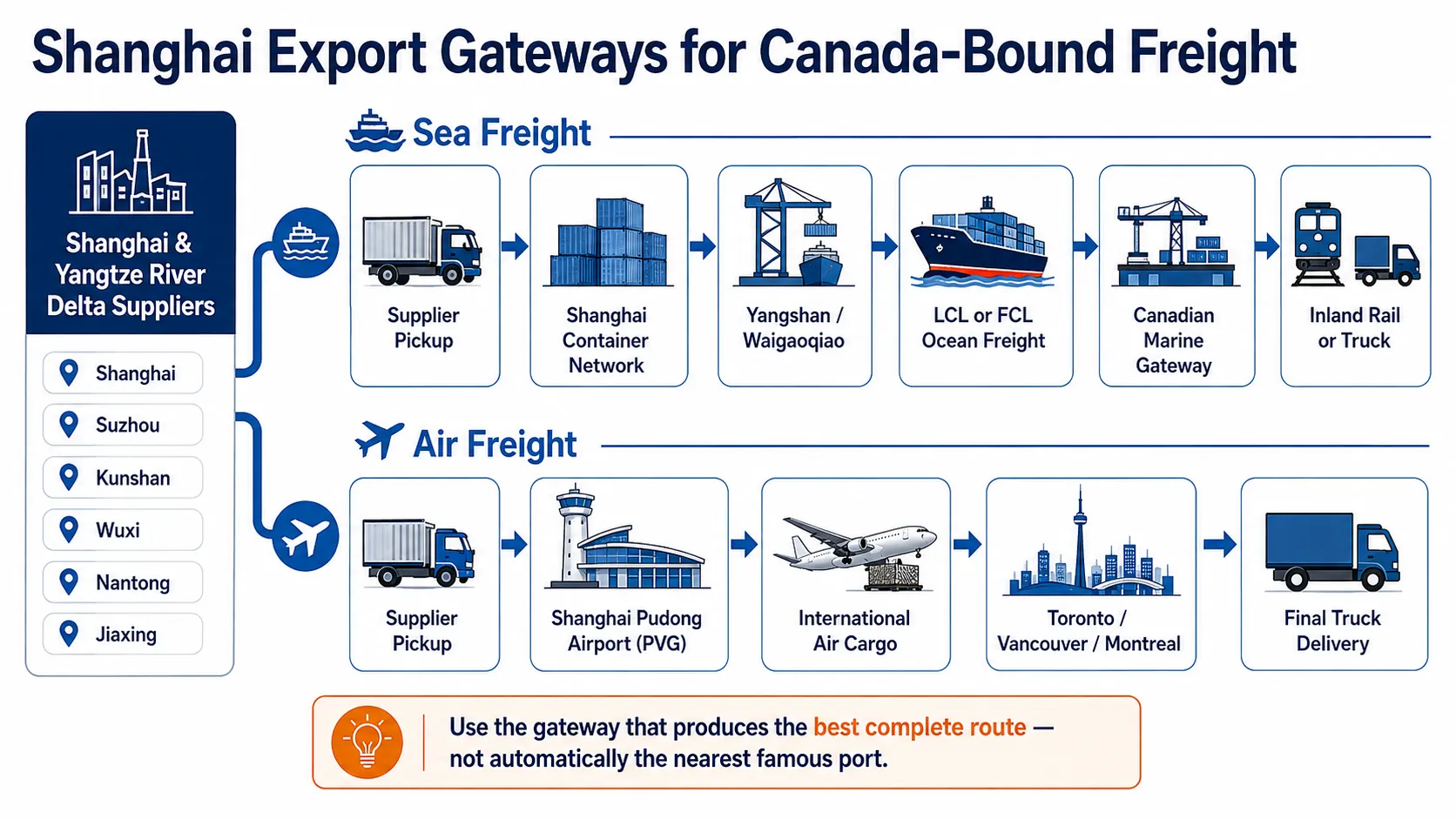
Shanghai can be particularly practical for suppliers located in:
- Shanghai municipality
- Suzhou
- Kunshan
- Wuxi
- Changzhou
- Nantong
- Taicang
- Jiaxing and nearby areas where Shanghai routing is operationally suitable
The correct export gateway should still be selected according to the actual factory location. A supplier in Ningbo, Yiwu or another part of Zhejiang may sometimes be better served through Ningbo-Zhoushan or another regional gateway rather than moving the cargo unnecessarily through Shanghai.
Likewise, suppliers in Shenzhen, Dongguan or Guangzhou normally belong to a different South China routing strategy. For that region, see our South China shipping route guide.
Shanghai Port for Sea Freight to Canada
The Port of Shanghai provides extensive container-handling infrastructure through major port areas including Yangshan, Waigaoqiao and Wusong.
The Shanghai International Port Group identifies these areas as part of Shanghai’s container-terminal network. For Canadian importers, the actual terminal used depends on the shipping line, service, container booking and port-pair routing.
Yangshan Deep-Water Port
Yangshan is a major deep-water container complex connected to the Shanghai logistics network. It handles large international container services and is an important gateway for export cargo moving from East China.
Waigaoqiao
Waigaoqiao is another major Shanghai container area and can be used depending on carrier service and terminal allocation.
Why the Terminal Matters
The terminal affects more than the vessel departure. It can also influence:
- Container pickup and positioning
- Factory trucking distance
- CY cut-off
- VGM submission timing
- Container-gate procedures
- Carrier documentation
- Empty-container return
For FCL shipments, the final container terminal should be confirmed before factory loading and trucking are arranged.
Shanghai Pudong Airport for Air Freight to Canada
Shanghai Pudong International Airport, commonly identified by the airport code PVG, is Shanghai’s principal international air-cargo gateway.
The airport supports extensive international freight operations and serves cargo originating not only in Shanghai but throughout the surrounding Yangtze River Delta manufacturing region.
The Shanghai Airport Authority identifies Pudong as one of China’s major international air-cargo hubs.
PVG can be appropriate for:
- Urgent commercial inventory
- Electronics and components
- Automotive and industrial parts
- Higher-value products
- Samples and prototypes
- Product-launch inventory
- E-commerce and wholesale replenishment
- Production-critical parts
For chargeable weight, airline acceptance, AWB terminology and sensitive cargo requirements, use our commercial air-cargo guide.
Air Freight from Shanghai to Canada
Commercial air freight is normally selected when inventory availability matters more than achieving the lowest transportation cost per unit.
A realistic supplier-to-door air-freight plan should include:
- Supplier cargo readiness
- Pickup in Shanghai or the surrounding region
- Delivery to the export facility
- Weight and dimension verification
- Security screening and cargo acceptance
- Airline booking and export handling
- International air transportation
- Canadian airport handling
- Customs release
- Final truck delivery
Typical Shanghai Air-Freight Timeline
| Air-freight stage | Indicative planning time |
|---|---|
| Supplier pickup and export-warehouse delivery | 1–2 business days |
| Receiving, measurement, screening and export handling | 1–3 business days |
| Main international air movement | 3–5 days |
| Canadian airport handling and routine customs release | 1–3 business days |
| Final commercial delivery | 1–4 business days, depending on destination |
| Typical combined planning range | 5–12 business days |
Planning note
Individual stages may overlap. The combined timeline should not be calculated by simply adding the maximum duration of every stage.
When Air Freight Is Usually the Better Choice
- The business is approaching a stockout.
- A buyer order has a fixed delivery deadline.
- The products have high commercial value relative to weight.
- Only a limited quantity is urgently required.
- A product launch cannot wait for ocean freight.
- Production depends on replacement parts or components.
- The main order is already travelling by sea and shortage inventory is required first.
When only certain SKUs are urgent, businesses can split the purchase order: critical quantities move by air while the main inventory travels by sea.
Sea Freight from Shanghai to Canada
Sea freight is normally the primary transportation method for larger, heavier or regularly planned commercial shipments from Shanghai.
Containerized shipments can move as LCL or FCL depending on cargo volume, density, handling requirements and inventory timing.
For complete ocean-freight operations, container terminology and marine-gateway planning, review our ocean container and LCL shipping guide.
LCL Shipping from Shanghai
LCL allows the importer to use part of a consolidated container rather than reserving the entire unit.
It can be suitable for:
- One or several pallets
- Trial orders
- Smaller wholesale inventory
- Product launches
- Multi-supplier cargo
- Recurring replenishment that does not fill a complete container
Shanghai LCL cargo is normally received at a Container Freight Station, or CFS, where it is measured, processed and consolidated with compatible shipments before export.
After arrival in Canada, the consolidated container must be deconsolidated before the individual LCL shipment becomes available.
FCL Container Shipping from Shanghai
FCL reserves a complete container for one shipment. It is commonly selected for heavier, larger, palletized or recurring commercial inventory.
| Container type | Approximate nominal capacity | Typical practical loading range | Common application |
|---|---|---|---|
| 20ft Standard | 33 CBM | 25–28 CBM | Dense cargo, machinery and heavier goods |
| 40ft Standard | 68 CBM | 55–60 CBM | General commercial and wholesale inventory |
| 40ft High Cube | 76 CBM | 65–70 CBM | Bulky and relatively lower-density cargo |
Capacity note: Practical loading volume depends on carton dimensions, pallet configuration, crates, weight distribution and loading efficiency. Nominal container capacity should not be treated as guaranteed usable cargo space.
When Should Shanghai Importers Compare LCL and FCL?
There is no fixed volume where FCL automatically becomes cheaper than LCL. Destination charges, cargo density, current container pricing and Canadian inland transportation can materially change the comparison.
| Cargo profile | Recommended starting approach |
|---|---|
| Under 5 CBM | Review LCL first and check minimum charges |
| 5–10 CBM | Review complete LCL origin and destination costs |
| 10–18 CBM | Request both LCL and FCL quotations |
| Higher-volume or recurring cargo | Evaluate FCL as the primary ocean option |
| Heavy cargo at relatively low CBM | Compare weight-rated LCL with 20ft FCL |
| Fragile or handling-sensitive products | Consider FCL earlier because it normally involves fewer individual cargo-handling stages |
Our guide to choosing between shared and dedicated container space provides a deeper comparison of LCL and FCL.
Multi-Supplier Consolidation in Shanghai
Shanghai can serve as a consolidation point when a Canadian importer is purchasing from several compatible suppliers across the surrounding East China region.
A typical consolidation workflow may include:
- Confirm each purchase order.
- Record each supplier’s cargo-ready date.
- Collect compatible orders from the factories.
- Receive cartons or pallets at the consolidation facility.
- Verify supplier and purchase-order references.
- Confirm carton counts, gross weight and dimensions.
- Review commercial documents.
- Prepare the combined shipment for air, LCL or FCL transportation.
When Shanghai Consolidation Makes Sense
Consolidation can be useful when suppliers are geographically close enough and their cargo-ready dates fall within a compatible shipment window.
It should not be used automatically. Moving goods away from a more efficient regional port or holding the entire shipment for one delayed supplier can increase the total cost or create inventory problems.
For detailed supplier coordination and warehouse receiving logic, see our multi-supplier freight consolidation guide.
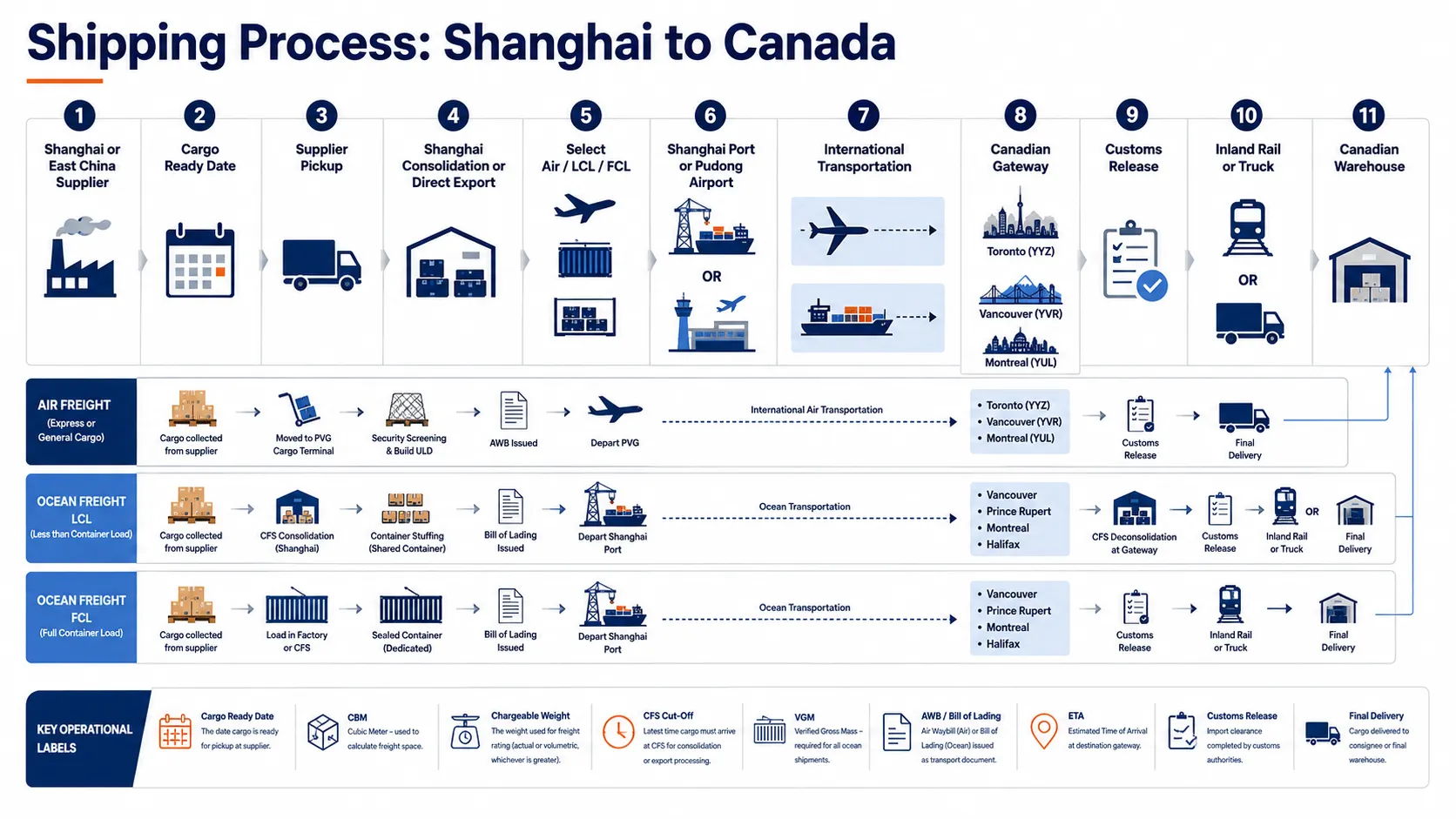
Shanghai to Canada Sea Freight Workflow
| Stage | Operational requirement |
|---|---|
| Cargo ready | Production, packing and supplier documentation completed |
| Supplier pickup | Factory address, loading requirements and Incoterm confirmed |
| LCL receiving or FCL loading | Cartons, pallets, CBM and gross weight verified |
| Export preparation | Carrier booking, documentation and applicable VGM completed |
| Shanghai terminal | Cargo or container delivered before the applicable cut-off |
| Ocean transportation | Direct or transshipment routing according to carrier service |
| Canadian marine gateway | Container discharge and destination processing |
| Customs release | Commercial import information reviewed and released |
| Inland transportation | Rail, drayage or truck depending on destination |
| Final delivery | Cargo delivered to the agreed warehouse or business location |
Canadian Gateways for Cargo from Shanghai
The final Canadian destination should be considered before selecting the international gateway.
Vancouver
Vancouver is a major West Coast marine gateway for containerized cargo arriving from Asia. Shipments serving Western Canada or moving inland by rail can enter through the Vancouver gateway before continuing to the final destination.
Prince Rupert
Prince Rupert may also be relevant for selected container services and inland intermodal routings. Availability depends on the carrier and current service structure.
Montreal and Halifax
Eastern Canadian marine gateways can be considered where the selected carrier service and transshipment routing make them operationally appropriate.
Toronto and Markham
Toronto and Markham are important commercial destinations but are not direct trans-Pacific marine ports. Containerized cargo may arrive through a Canadian marine gateway and then continue inland by rail and truck.
For importers located in the Greater Toronto Area, our GTA and Markham delivery guide explains the final inland movement in more detail.
Air Cargo Gateways in Canada
Shanghai air cargo can be routed through major Canadian air-cargo gateways depending on airline capacity, commodity acceptance and final destination.
| Canadian gateway | Common planning use |
|---|---|
| Toronto Pearson | Ontario, GTA, Markham and Eastern Canadian commercial destinations |
| Vancouver | British Columbia and Western Canadian cargo |
| Montreal | Quebec and selected Eastern Canadian destinations |
Gateway selection should be based on the complete supplier-to-destination plan rather than international flight time alone.
Shipping from Shanghai to Vancouver
For ocean cargo, Shanghai-to-Vancouver routing is particularly relevant because it connects a major East China container origin with Canada’s West Coast marine network.
The complete delivery plan should distinguish:
- Supplier pickup in Shanghai or nearby East China
- Origin terminal and carrier cut-off
- Main ocean movement
- Container discharge in Canada
- Customs release
- Terminal availability
- Local drayage or inland rail
- Final warehouse delivery
The vessel ETA should not be treated as the final inventory-availability date.
Shipping from Shanghai to Toronto and Markham
For sea freight, cargo serving Toronto or Markham normally requires an additional Canadian inland stage after arrival at a marine gateway.
That inland movement may include rail transportation to an inland terminal followed by local drayage or truck delivery.
For air cargo, Toronto Pearson can function as the Canadian air gateway before final trucking to Toronto, Markham or another GTA destination.
When requesting a quotation, provide the exact Canadian postal code because the destination can materially affect trucking, appointment and final-delivery costs.
Door-to-Door Shipping from Shanghai to Canada
Door-to-door freight coordinates the connected logistics stages between the Chinese supplier and an agreed Canadian delivery location.
The confirmed service may include:
- Supplier pickup in Shanghai or the surrounding region
- Origin warehouse or terminal handling
- Export documentation
- Air or ocean freight
- Canadian destination handling
- Customs-clearance coordination
- Rail or truck transportation
- Final warehouse or business delivery
Door-to-door does not automatically mean that customs duty, GST, examinations, storage, delivery appointments or every contingent charge is included.
For detailed service boundaries, review our door-to-door shipping from China to Canada guide.
DDP Shipping from Shanghai to Canada
DDP may be considered where the seller or agreed logistics structure can legally and operationally assume the responsibilities required under Delivered Duty Paid terms.
A DDP quotation should identify:
- The named Canadian destination
- The importer-of-record structure
- HS tariff classification
- Declared customs value
- Country of origin
- Responsibility for duty and GST
- Customs representation
- Final delivery requirements
- Potential customs examinations or storage charges
DDP should not be treated as a generic “all-inclusive” label without confirming the underlying customs and tax structure.
For a detailed responsibility review, see our delivered-duty-paid shipping guide.
Customs Clearance for Shanghai-Origin Cargo
Goods shipped from Shanghai must meet the same Canadian commercial-import requirements as goods arriving from other Chinese origins.
Canadian importers should prepare:
- Business Number and applicable RM account
- CARM access where required
- Commercial invoice
- Packing list
- Air waybill or bill of lading
- Detailed product description
- HS tariff classification
- Country-of-origin information
- Customs value
- Applicable permits or certificates
The Canada Border Services Agency commercial importing guidance explains the official Canadian import process and importer responsibilities.
For operational release preparation, review our Canadian customs-release preparation guide. For classification, duty and GST planning, use our tariff classification, duty and GST guide.
Documents for Shipping from Shanghai to Canada
| Document or information | Main purpose |
|---|---|
| Commercial invoice | Product, parties, value, currency and commercial terms |
| Packing list | Cartons, pallets, dimensions, weights and packing details |
| Air waybill | Transportation record for air cargo |
| Bill of lading | Transportation document for ocean freight |
| HS classification | Canadian customs classification and duty planning |
| Country-of-origin information | Tariff and trade-measure review |
| Importer details | Canadian commercial-import reporting |
| Product-specific certificates | Required where regulated goods are involved |
Descriptions such as “parts,” “samples,” “accessories” or “general merchandise” may not provide enough information for customs or carrier review.
For a broader checklist, see our commercial shipping-document guide.
EXW, FCA, FOB and DDP for Shanghai Shipments
| Incoterm | Shanghai shipping implication |
|---|---|
| EXW | The buyer generally coordinates transportation beginning at the supplier’s premises |
| FCA | The supplier delivers goods to the named carrier or agreed Shanghai-area location |
| FOB | For sea freight, the seller delivers the goods on board the vessel at the named port |
| DAP | The seller arranges transportation to the named Canadian destination while the buyer normally handles import clearance |
| DDP | The seller assumes extensive transportation and import obligations subject to legal and operational feasibility |
The named location matters. “FOB Shanghai” is more useful than simply “FOB China,” but the exact port and commercial terms should still be confirmed. For FCA and EXW, the actual supplier or handover location should be identified.
When Shanghai May Not Be the Best Export Gateway
A high-quality freight plan should not route every East China supplier through Shanghai automatically.
An alternative gateway should be evaluated when:
- The supplier is significantly closer to Ningbo-Zhoushan.
- The cargo is located in South China near Shenzhen or Guangzhou.
- A different airport has materially better cargo acceptance or capacity.
- A carrier offers a more suitable sailing from another regional port.
- Moving the cargo to Shanghai creates unnecessary trucking or handling.
- A consolidation plan would delay critical inventory.
The correct origin gateway is the one that produces the best complete logistics result, not necessarily the best-known port or airport.
How to Reduce Shanghai-to-Canada Shipping Cost and Delay
- Confirm the supplier’s exact pickup address before selecting the gateway.
- Obtain final carton dimensions and gross weight before booking.
- Compare LCL and FCL around 10–18 CBM.
- Consolidate compatible East China suppliers when it improves the complete plan.
- Do not hold urgent inventory indefinitely for one delayed supplier.
- Use air freight selectively for critical SKUs.
- Plan regular inventory early enough for ocean freight.
- Confirm the Incoterm and named location in writing.
- Prepare customs and product documentation before departure.
- Confirm container cut-offs and VGM requirements for FCL shipments.
- Provide the exact Canadian delivery postal code.
- Confirm warehouse receiving hours and appointments before cargo availability.
- Compare complete delivered cost rather than the international freight rate alone.
Information Needed for a Shanghai-to-Canada Freight Quote
- Supplier name and complete pickup address
- Number of suppliers
- Product name and detailed description
- Number of cartons, pallets or crates
- Final dimensions of each package type
- Total gross weight
- Total CBM for ocean freight
- Cargo value and currency
- HS code when confirmed
- Incoterm and named location
- Cargo-ready date
- Required delivery or inventory-availability date
- Canadian delivery city and postal code
- Commercial invoice and packing list
- Battery, liquid, chemical or special-cargo information
- Warehouse appointment, dock or unloading requirements
If several suppliers are involved, provide the cargo-ready date and shipment details for each supplier separately. This allows the consolidation plan to be evaluated without automatically delaying the complete shipment.
How TopShipping Supports Shanghai-to-Canada Freight
TopShipping coordinates commercial freight between Chinese suppliers and Canadian businesses, including shipments originating in Shanghai and the surrounding East China region.
Depending on the confirmed shipment scope, support may include:
- Supplier communication
- Shanghai-area pickup coordination
- Multi-supplier consolidation
- Commercial air freight
- LCL sea freight
- 20ft, 40ft and 40HQ container shipping
- Export handling
- Shipping-document coordination
- Canadian customs-clearance coordination
- Milestone tracking
- Rail or truck planning in Canada
- Final warehouse or commercial delivery
The recommended route is based on the supplier location, cargo profile, required inventory date, Canadian destination and complete logistics scope rather than automatically routing every East China shipment through the same gateway.
Request a Shanghai-to-Canada Freight Assessment
Send your supplier address, product description, carton or pallet count, dimensions, gross weight, CBM, cargo-ready date and Canadian delivery postal code.
TopShipping can review air, LCL, FCL, consolidation and door-to-door options based on the actual Shanghai-origin shipment requirements.