
Door-to-door shipping does not automatically mean that duties, taxes, customs brokerage, examinations, storage, unloading, or every destination charge is included. The exact service scope, Incoterm, named delivery location, inclusions, and exclusions should be confirmed in writing before the shipment is booked.
Door-to-Door Shipping at a Glance
| Decision factor | Practical guidance |
|---|---|
| Service scope | Coordinated transportation from an agreed pickup point in China to a named Canadian delivery address |
| Available freight methods | Air freight, LCL sea freight, or FCL sea freight |
| Best suited for | Commercial importers that prefer one coordinated logistics process |
| Common destinations | Warehouses, businesses, distributors, 3PLs, and fulfilment centres |
| Customs responsibility | Depends on the Incoterm, importer structure, and agreed quotation |
| Main documents | Commercial invoice, packing list, air waybill or bill of lading, and product-specific records |
| Main cost variables | Cargo weight and volume, origin, destination, freight method, customs requirements, and delivery conditions |
| Main delay risks | Supplier readiness, document errors, carrier capacity, customs review, terminal handling, and delivery appointments |
What Is Door-to-Door Shipping from China to Canada?
Door-to-door shipping is a logistics service scope rather than a separate transportation mode.
The shipment may travel internationally by:
- Air freight
- LCL sea freight
- FCL container shipping
- A combination of international freight and domestic truck or rail transportation
What makes the service “door to door” is that the connected stages between the agreed collection point and final delivery destination are coordinated as one shipment plan.
Depending on the quotation, these stages may include:
- Supplier communication
- Cargo pickup in China
- Origin warehouse handling
- Export documentation and declaration
- Cargo consolidation
- Air or ocean transportation
- Canadian customs-clearance coordination
- Destination terminal or warehouse handling
- Final delivery in Canada
The exact starting point may be a factory, supplier warehouse, consolidation facility, airport, or seaport. The final destination may be a commercial warehouse, business address, 3PL, fulfilment centre, distributor, or another approved receiving location.
What Does Door-to-Door Shipping Include?
A properly prepared quotation should state which services are included rather than relying only on the phrase “door to door.”
| Shipment stage | Services that may be included | Details to confirm |
|---|---|---|
| Supplier coordination | Cargo-ready confirmation and pickup planning | Supplier address, contact, operating hours, and Incoterm |
| Pickup in China | Collection from a factory or warehouse | Truck type, access, loading, waiting time, and local charges |
| Origin handling | Receiving, measuring, weighing, labelling, and storage | Packaging, palletizing, consolidation, and handling fees |
| Export process | Export documentation and customs coordination | Exporter information, product restrictions, and declarations |
| Main freight | Air, LCL, or FCL transportation | Route, service type, schedule, and cargo acceptance |
| Customs coordination | Document transfer and communication with customs parties | Importer of record, broker, CARM, classification, duties, and taxes |
| Destination handling | Airport, terminal, rail, container, or deconsolidation handling | Terminal fees, storage, examinations, demurrage, and detention |
| Final delivery | Transportation to the named Canadian destination | Appointment, dock, tailgate, unloading, access, and waiting time |
A door-to-door quotation may exclude customs duties, GST, customs-broker fees, customs examinations, cargo insurance, storage, demurrage, detention, tailgate service, inside delivery, unloading, or remote-area delivery.
Importers should request a written breakdown of all inclusions and exclusions before comparing quotations.
Door-to-Door Shipping Is Not the Same as DDP
Door-to-door and DDP are related concepts, but they do not mean the same thing.
Door-to-door describes the physical transportation scope between the pickup and delivery locations. DDP, or Delivered Duty Paid, is an Incoterm that assigns extensive delivery and import-related responsibilities to the seller.
A shipment can therefore be door to door without being DDP.
| Arrangement | Transportation scope | Typical Canadian import responsibility |
|---|---|---|
| Door to door under EXW | Collection begins at or near the supplier’s premises | The buyer normally controls most transportation and import arrangements |
| Door to door under FOB | The supplier handles agreed origin and export obligations to the named port | The buyer normally arranges main freight, Canadian customs, and delivery |
| Door to door under DAP | Transportation continues to the named Canadian destination | The buyer normally handles import clearance, duties, and taxes |
| Door to door under DDP | Transportation and agreed duty-paid responsibilities extend to the named destination | The seller assumes broader obligations under a correctly structured arrangement |
DDP should not be treated as a generic “all-inclusive shipping” label. The importer-of-record structure, customs representation, product eligibility, duties, taxes, examinations, and delivery limitations must be confirmed before booking.
Businesses considering a duty-paid arrangement should review the dedicated DDP shipping from China to Canada guide.
Who Should Use Door-to-Door Freight?
Door-to-door freight is particularly useful for businesses that do not want to arrange each logistics stage separately.
It may be suitable for:
- First-time Canadian importers that need process guidance
- Businesses without an established freight and delivery network
- Importers purchasing from one or several Chinese suppliers
- Wholesalers managing bulk or recurring inventory
- Manufacturers importing components, equipment, or materials
- E-commerce businesses replenishing Canadian inventory
- Importers delivering to an inland Canadian city
- Businesses requiring delivery to a warehouse or 3PL
- Companies that prefer one operational point of contact
It may be less suitable for an experienced importer that already has separate contracts for origin handling, international freight, customs brokerage, terminal recovery, trucking, and warehousing.
The correct choice depends on internal logistics capability, shipment frequency, cost transparency, and the amount of coordination the business wants to manage directly.
Door-to-Door Air Freight from China to Canada
Door-to-door air freight is generally appropriate for urgent, compact, higher-value, or time-sensitive commercial cargo.
Common applications include:
- Urgent inventory replenishment
- Product launches
- Seasonal goods
- Samples and prototypes
- Spare parts
- Critical production components
- Higher-value commercial goods
- Compact e-commerce inventory
A door-to-door air shipment may include supplier pickup, export handling, cargo screening, airline booking, main air transportation, customs-clearance coordination, airport recovery, and final delivery.
Air freight pricing is generally based on chargeable weight. The shipment’s actual gross weight is compared with its volumetric weight, and the higher figure is normally used for pricing. Large but lightweight cartons can therefore cost more than expected.
For suitable shipments, TopShipping’s owner-provided typical door-to-door air estimate is approximately 5–7 business days. This is a planning estimate and not a guaranteed delivery time. The actual schedule depends on supplier readiness, pickup location, cargo acceptance, routing, airline capacity, customs processing, and the Canadian delivery address.
Review the complete air freight from China to Canada guide for chargeable-weight calculations, cargo restrictions, cost variables, and air-shipping documentation.
Door-to-Door Sea Freight from China to Canada
Door-to-door sea freight is generally more practical for heavy, bulky, recurring, or planned commercial shipments.
Cargo can move as:
- LCL, or Less than Container Load
- FCL, or Full Container Load
Door-to-Door LCL Shipping
LCL allows cargo to share container space with shipments belonging to other importers.
A typical LCL process may include:
- Pickup from the Chinese supplier
- Delivery to an origin consolidation warehouse
- Measurement and receiving
- Consolidation with compatible cargo
- Container loading
- Ocean transportation
- Destination deconsolidation
- Canadian customs clearance
- Final delivery
LCL may be suitable for trial orders, smaller commercial shipments, multi-supplier orders, or cargo that does not justify booking an entire container.
Importers should compare the total delivered cost rather than only the ocean rate per cubic metre. Origin handling, consolidation, documentation, destination deconsolidation, customs services, and final delivery can materially affect the total cost.
Door-to-Door FCL Shipping
FCL reserves a complete container for one shipment.
It is commonly used for:
- Wholesale inventory
- Palletized commercial goods
- Machinery and equipment
- Furniture
- Building materials
- Regular high-volume imports
- Bulky or dense cargo
An FCL door-to-door service may include supplier pickup or container loading, export handling, ocean freight, Canadian terminal or rail recovery, customs coordination, container delivery, and empty-container return.
Importers must confirm whether the receiving location has suitable access, unloading equipment, labour, and enough time to unload the container. Delays can lead to waiting-time, demurrage, detention, or storage charges.
The complete sea freight from China to Canada guide explains LCL, FCL, container planning, ocean routes, and destination considerations.
Air vs Sea Door-to-Door Shipping
| Comparison factor | Door-to-door air freight | Door-to-door sea freight |
|---|---|---|
| Best suited for | Urgent, compact, higher-value cargo | Heavy, bulky, or planned cargo |
| Relative speed | Faster | Slower |
| Pricing basis | Chargeable weight | LCL by weight or measurement; FCL by container |
| Typical use | Restocking, samples, launches, spare parts | Wholesale goods, machinery, pallets, regular inventory |
| Volume sensitivity | Bulky cartons can increase volumetric weight | Larger volumes generally improve cost efficiency |
| Handling considerations | Screening and airport handling | LCL consolidation or FCL container handling |
| Main planning risk | Capacity, screening, customs, and delivery timing | Sailing changes, port congestion, rail, customs, and container free time |
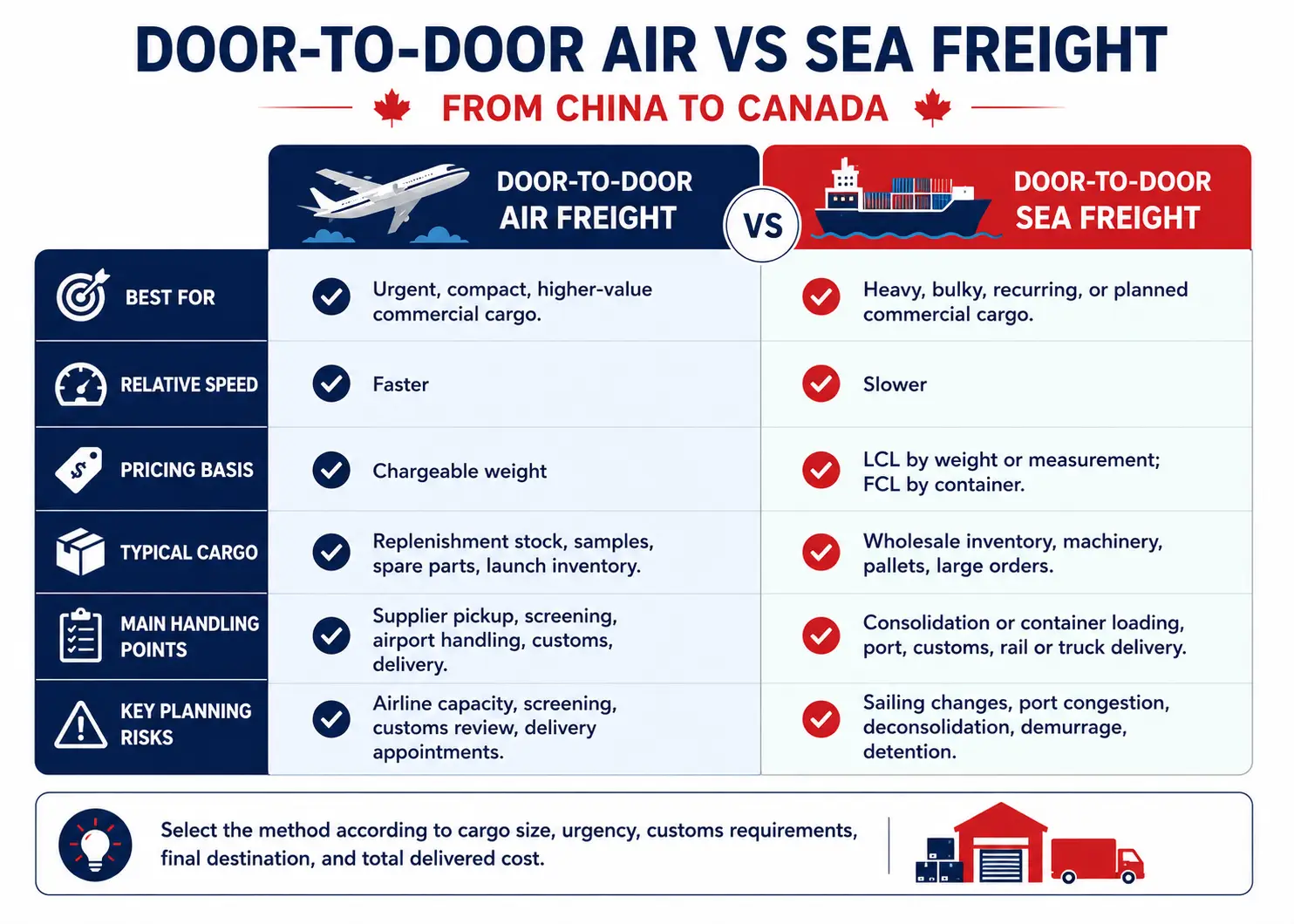
The best method should be selected according to the full delivered requirement—not only the international freight rate.
Importers should compare:
- Total landed cost
- Required delivery date
- Cargo dimensions and weight
- Inventory availability
- Product value
- Customs requirements
- Risk of delay
- Final delivery conditions
Some businesses use a split-shipment strategy. Urgent inventory moves by air while the remaining volume travels by sea. This can balance inventory risk and transportation cost.
How the Door-to-Door Shipping Process Works
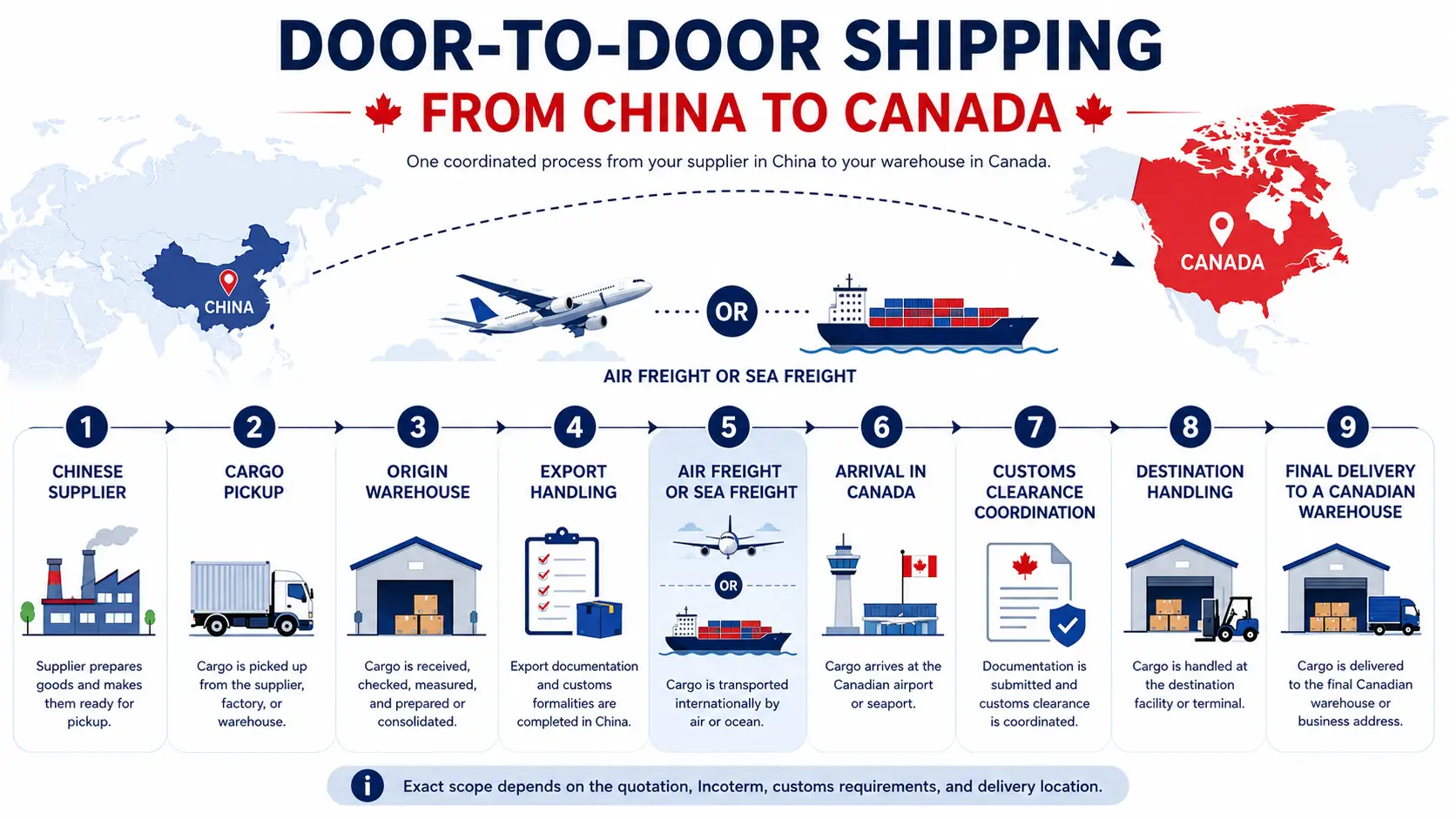
1. Shipment Information Is Collected
The importer provides:
- Product description
- Number of cartons or pallets
- Dimensions of each package type
- Gross weight
- Total cargo volume
- Commercial value
- Supplier location
- Canadian destination and postal code
- Cargo-ready date
- Incoterm
- Required delivery date
- Special cargo characteristics
Batteries, liquids, powders, chemicals, food products, cosmetics, medical goods, wood packaging, oversized cargo, and temperature-sensitive products should be disclosed before pickup.
2. The Service Scope Is Defined
The freight provider reviews the shipment and determines whether air, LCL, or FCL is most appropriate.
The quotation should identify:
- Pickup point
- Delivery destination
- Freight method
- Incoterm
- Origin services
- Main freight
- Customs responsibilities
- Destination handling
- Final-delivery conditions
- Duties and tax responsibility
- Included and excluded charges
- Quotation validity
A low headline rate may not be the lowest delivered cost if important origin or destination charges are added later.
3. The Supplier Prepares the Cargo
The supplier prepares the goods, export packaging, commercial invoice, packing list, marks, labels, and any product-specific records.
The cargo details should match the documents. Differences in package count, dimensions, weight, product description, or value may change the freight price or delay customs processing.
4. Pickup Is Coordinated in China
Depending on the Incoterm, cargo may be collected from the supplier, factory, warehouse, or another agreed location.
Pickup planning should confirm:
- Complete address
- Contact person
- Cargo-ready status
- Number of packages
- Total weight
- Loading conditions
- Vehicle access
- Operating hours
- Special-handling requirements
5. Cargo Is Received or Consolidated
The cargo may be delivered to an origin facility for receiving, measurement, weighing, labelling, palletizing, or consolidation.
Importers buying from several factories can use freight consolidation from China to Canada to combine compatible supplier orders into a coordinated shipment.
Consolidation may reduce duplicated origin movements and handling, depending on supplier locations, cargo compatibility, shipment timing, and total volume. It should not be assumed to produce a fixed percentage saving.
6. Export Handling Is Completed
Export handling may involve:
- Document review
- Export customs declaration
- Cargo screening
- Warehouse processing
- Airline or vessel booking
- Consolidation
- Container loading
- Transfer to the departure airport or seaport
Requirements vary according to the product, shipping method, supplier arrangement, and Chinese export process.
7. International Freight Moves to Canada
The shipment moves by the agreed air or ocean route.
Shipment tracking and status updates may be provided during pickup, export handling, departure, arrival, customs processing, and delivery.
Tracking events should not be interpreted as guaranteed delivery times. Customs examinations, terminal recovery, deconsolidation, rail movement, and delivery appointments can affect the final schedule.
8. Canadian Customs Clearance Is Coordinated
Commercial goods entering Canada must be correctly described, classified, valued, and reported.
The process may require:
- Importer-of-record information
- Business Number and import-export account
- CARM Client Portal setup
- Customs-broker delegation
- Commercial invoice
- Packing list
- Air waybill or bill of lading
- HS tariff classification
- Country-of-origin information
- Value-for-duty information
- Product specifications
- Permits or certificates
TopShipping coordinates shipment documentation and customs-clearance requirements with the appropriate parties. A freight forwarder should not automatically be treated as the customs broker or importer of record.
For detailed customs responsibilities, see the customs clearance from China to Canada guide.
Canadian importers should also consult the Canada Border Services Agency’s official guide to importing commercial goods into Canada and current CARM guidance for commercial importers.
9. Destination Handling Is Completed
After arrival, the cargo may pass through:
- An airline cargo terminal
- A marine terminal
- A rail ramp
- A container yard
- A bonded warehouse
- An LCL deconsolidation facility
Destination handling can take additional time, even after the aircraft or vessel has arrived.
Customs examinations, document holds, terminal congestion, deconsolidation schedules, storage, demurrage, detention, or rail availability can affect final delivery.
10. Final Delivery Is Arranged
After customs release and cargo availability, delivery is arranged to the agreed destination.
The importer should confirm:
- Commercial receiving hours
- Delivery appointment requirements
- Dock availability
- Forklift access
- Tailgate requirements
- Pallet size and weight
- Limited-access conditions
- Driver waiting time
- Unloading responsibility
- Remote-area classification
“Door delivery” normally means delivery to the agreed receiving point. It does not automatically include inside delivery, unpacking, assembly, placement, or disposal of packaging.
Documents Required for Door-to-Door Shipping
Most commercial shipments require at least three core transport and customs documents.
| Document | Main purpose | Important information |
|---|---|---|
| Commercial invoice | Supports customs valuation and transaction details | Seller, buyer, product, quantity, value, currency, origin, and Incoterm |
| Packing list | Describes how the shipment is packed | Cartons, pallets, dimensions, net weight, gross weight, and marks |
| Air waybill or bill of lading | Records the international transportation | Shipper, consignee, routing, cargo, and shipment references |
| HS classification details | Supports tariff classification | Product materials, function, composition, and intended use |
| Product-specific documents | Supports admissibility or carrier acceptance | Permits, certificates, SDS, test reports, or licences where applicable |
| Delivery information | Supports final-mile planning | Address, postal code, appointment, dock, access, and unloading details |
Descriptions such as “parts,” “accessories,” “samples,” or “goods” may be too vague for customs purposes. Product descriptions should explain what the item is, what it is made of, and how it is used when relevant.
What Affects Door-to-Door Shipping Costs?
There is no universal door-to-door freight rate.
The total cost depends on several connected variables.
Cargo Weight and Dimensions
Air freight uses chargeable weight. LCL normally uses weight or measurement. FCL is quoted according to the container and route, although cargo weight still affects loading and inland transportation.
Supplier Location in China
Pickup from Shenzhen, Guangzhou, Dongguan, Shanghai, Ningbo, Yiwu, Qingdao, or an inland city can produce different local transportation and origin-handling costs.
Canadian Delivery Destination
Delivery to Vancouver, Toronto, Montreal, Calgary, Edmonton, Ottawa, Winnipeg, Halifax, or a remote postal code can involve different terminal, rail, trucking, and appointment requirements.
Freight Method
Air, LCL, and FCL quotations have different pricing structures. A port-to-port rate cannot be directly compared with a complete door-to-door quotation.
Incoterm
EXW, FOB, DAP, and DDP allocate different transportation and customs responsibilities. The quotation should use a named place, such as “EXW Shenzhen” or “DAP Markham,” rather than an incomplete term such as “FOB China.”
Product Type
Batteries, chemicals, food, cosmetics, medical products, wood packaging, dangerous goods, and oversized cargo may require additional documentation, inspection, packaging, or carrier approval.
Customs and Government Requirements
Duties, GST, brokerage, permits, examinations, and product-specific requirements can affect the total landed cost.
Final-Delivery Conditions
Delivery appointments, liftgate service, limited access, driver waiting time, unloading, storage, and remote-area transportation may add cost.
Businesses preparing an initial budget can review the dedicated shipping cost from China to Canada guide.
How Long Does Door-to-Door Shipping Take?
Total door-to-door delivery time includes more than the flight or vessel movement.
It may include:
- Supplier preparation
- Pickup
- Origin handling
- Export customs
- Cargo consolidation
- Waiting for a flight or sailing
- International transportation
- Transshipment
- Terminal processing
- Customs clearance
- Customs examination
- Rail or truck movement
- Delivery appointment
- Final delivery
| Door-to-door method | General planning range |
|---|---|
| Air freight | Approximately 5–12 business days for many standard shipments |
| LCL sea freight | Approximately 28–55 days |
| FCL sea freight | Approximately 25–55 days |
| Sea freight to inland or remote destinations | Approximately 30–60+ days |
These are general planning ranges, not guaranteed schedules. The actual timeline must be confirmed for the route, cargo, carrier schedule, customs process, and final destination.
For a complete comparison, review the shipping time from China to Canada guide.
Common Door-to-Door Shipping Mistakes
Assuming Every Charge Is Included
Door-to-door does not necessarily include duties, GST, brokerage, examinations, storage, demurrage, detention, unloading, or special delivery services.
Comparing Incomplete Quotations
A low airport-to-airport or port-to-port rate cannot be compared directly with a quotation that includes pickup, customs coordination, and final delivery.
Providing Estimated Package Dimensions
Incorrect carton dimensions can change air chargeable weight or LCL volume after the cargo is received.
Using Vague Product Descriptions
Descriptions such as “accessories” or “samples” can create classification and customs questions.
Ignoring the Incoterm
The Incoterm determines where the supplier’s responsibility ends and where the importer’s logistics responsibility begins.
Confusing Transit Time with Total Delivery Time
A three-day flight does not mean the shipment will be delivered in three days. Pickup, export handling, customs, terminal processing, and final delivery must also be included.
Booking Before Reviewing Restricted Cargo
Batteries, liquids, chemicals, food, medical goods, and other sensitive products may require approval before pickup.
Failing to Prepare the Delivery Location
Heavy pallets or containers may require a dock, forklift, tailgate, appointment, or unloading equipment.
How TopShipping Coordinates Door-to-Door Freight
TopShipping helps Canadian businesses manage commercial shipments from Chinese suppliers to Canadian destinations.
Depending on the shipment and agreed scope, support may include:
- Reviewing cargo and delivery requirements
- Coordinating with the supplier
- Arranging pickup in China
- Receiving or consolidating cargo
- Coordinating export handling
- Arranging air, LCL, or FCL freight
- Providing shipment tracking and status updates
- Coordinating documentation with customs parties
- Arranging destination handling
- Coordinating final delivery in Canada
TopShipping has been operating since 2012, with operational support in Shenzhen and the Greater Toronto Area.
Each shipment is reviewed according to its commodity, dimensions, gross weight, supplier location, Canadian destination, Incoterm, timing, and customs requirements.
Information Needed for a Door-to-Door Quote
For a route-specific assessment, provide:
| Required information | Example |
|---|---|
| Commodity | Commercial lighting products |
| Package count | 18 cartons |
| Dimensions | 60 × 45 × 40 cm per carton |
| Gross weight | 420 kg |
| Supplier location | Shenzhen, Guangdong |
| Canadian destination | Markham, Ontario, including postal code |
| Commercial value | Value and currency shown on the invoice |
| Incoterm | EXW Shenzhen |
| Cargo-ready date | Confirmed factory completion date |
| Required timeline | Delivery required before a specific inventory date |
| Special characteristics | Batteries, liquids, wood packaging, or oversized pieces |
Accurate package-level dimensions and a complete product description help determine the appropriate freight method, chargeable quantity, customs requirements, and delivery plan.
Request a Door-to-Door Shipping Assessment
Send TopShipping your commodity, package count, dimensions, gross weight, supplier address, Canadian delivery postal code, Incoterm, cargo-ready date, and required timeline.
The shipment can then be reviewed for the appropriate air, LCL, or FCL option, along with origin handling, customs-clearance coordination, and final-delivery requirements.