
Every commercial shipment entering Canada from China must satisfy Canadian customs and any applicable product-specific import requirements before it can be released for delivery.
Customs clearance is more than submitting an invoice. The process connects the Canadian importer’s account, product classification, country of origin, value for duty, permits, transport documents, duties, taxes and cargo-release instructions. An error in any of these areas can delay delivery and create document amendment, examination, storage, demurrage or additional handling costs.
Businesses planning the wider freight movement can review our guide to the complete China-to-Canada shipping journey to see how supplier pickup, international freight, customs clearance and final delivery work together.
Key Takeaways for Canadian Importers
- A Canadian commercial importer generally needs a Business Number and an import-export RM program account.
- The importer’s business must be registered in the CARM Client Portal before enrolling in applicable CBSA programs.
- A customs broker can act as an authorized agent, but the importer remains responsible for accurate classification, origin, valuation and supporting records.
- The commercial invoice, packing list and transport document must describe the same goods, quantities, values and parties.
- Duties depend on the Canadian tariff classification, origin and any applicable trade measures—not simply on the fact that goods came from China.
- Product permits and compliance requirements should be confirmed before the supplier ships or loads the cargo.
- Customs preparation should begin before departure, not after the shipment arrives in Canada.
Audio Guide
A practical audio guide to CARM, import documents, HS codes, duties, taxes and common customs delays for Canadian businesses.
Customs Clearance at a Glance
| Clearance area | What must be confirmed | Why it matters |
|---|---|---|
| Importer setup | Legal business name, Business Number, RM account and CARM registration | Identifies the business responsible for the commercial import |
| Broker authorization | Authority delegated through the CARM Client Portal when a broker is used | Allows the broker to transact within the authorized scope |
| Product admissibility | Restrictions, permits, licences, labelling and agency requirements | Determines whether the goods may enter Canada |
| Tariff classification | Canadian 10-digit tariff classification | Affects duty treatment and regulatory requirements |
| Country of origin | Where the goods were manufactured or produced | Supports tariff treatment and origin requirements |
| Value for duty | Customs value declared in Canadian dollars | Provides the basis for applicable duty and tax calculations |
| Shipping documents | Invoice, packing list, bill of lading or air waybill | Supports reporting, release, accounting and cargo identification |
| Release and accounting | CBSA release decision, CAD and payment arrangements | Allows the cargo to proceed and completes customs accounting |
| Record keeping | Import, purchase, origin, classification and payment records | Supports future CBSA reviews, corrections or verifications |
Who Is Responsible for Customs Clearance?
A successful customs entry usually involves several parties. Their roles should not be treated as interchangeable.
| Party | Primary role |
|---|---|
| Canadian importer | Provides truthful product and transaction information, maintains the required accounts, pays applicable amounts and retains supporting records |
| Licensed customs broker | Acts as the importer’s authorized agent for customs transactions within the agreed scope |
| Freight forwarder | Coordinates transportation, shipping information, documents and communication among the supplier, carrier, importer and customs parties |
| Carrier | Transports the cargo and submits the required carrier or cargo information |
| Chinese supplier or exporter | Provides accurate product, invoice, origin, packing and export information |
| CBSA | Administers Canadian border, release, accounting and customs requirements |
| Other government departments | Regulate particular products such as food, plants, health products, energy-using goods or controlled commodities |
TopShipping is a freight forwarding and logistics company. We coordinate shipping documents and the clearance process with the importer, customs broker and other required parties. TopShipping should not be represented as a licensed Canadian customs broker unless that status is separately confirmed.
2026 CARM Requirements Importers Should Understand
The CBSA Assessment and Revenue Management system, commonly called CARM, is now the central system for commercial import accounting and payment administration.
Business Number and RM Account
A business importing commercial goods needs a Business Number and an import-export program account, identified by an RM suffix. Canadian businesses that have not completed this setup should address it before their cargo is due to arrive.
The importer—not its customs broker—must register its business and enrol in applicable programs through the CARM Client Portal.
Delegating Authority to a Customs Broker
Registering a broker in a shipping instruction or email is not the same as providing CARM authority.
When a customs broker will submit customs accounting information for the importer, the importer must provide the necessary delegation through the CARM Client Portal. A broker cannot submit a Commercial Accounting Declaration on behalf of an importer without the appropriate portal authority.
Commercial Accounting Declaration
The Commercial Accounting Declaration, or CAD, is the digital customs accounting document used under CARM. It replaced the former B3 customs coding and B2 adjustment forms.
The CAD is used for accounting, corrections and adjustments. It does not replace the separate cargo-release process.
Release Prior to Payment
The Release Prior to Payment program allows an eligible importer to obtain release before the final payment of duties and taxes. Importers seeking this privilege must enrol and post their own financial security through CARM.
Importers can no longer rely on a customs broker’s security to obtain Release Prior to Payment. Businesses that are not enrolled may need to pay applicable customs amounts before their goods are released.
Canadian importers should review the current CBSA CARM guidance before their first shipment or whenever their business, broker or financial-security arrangements change.
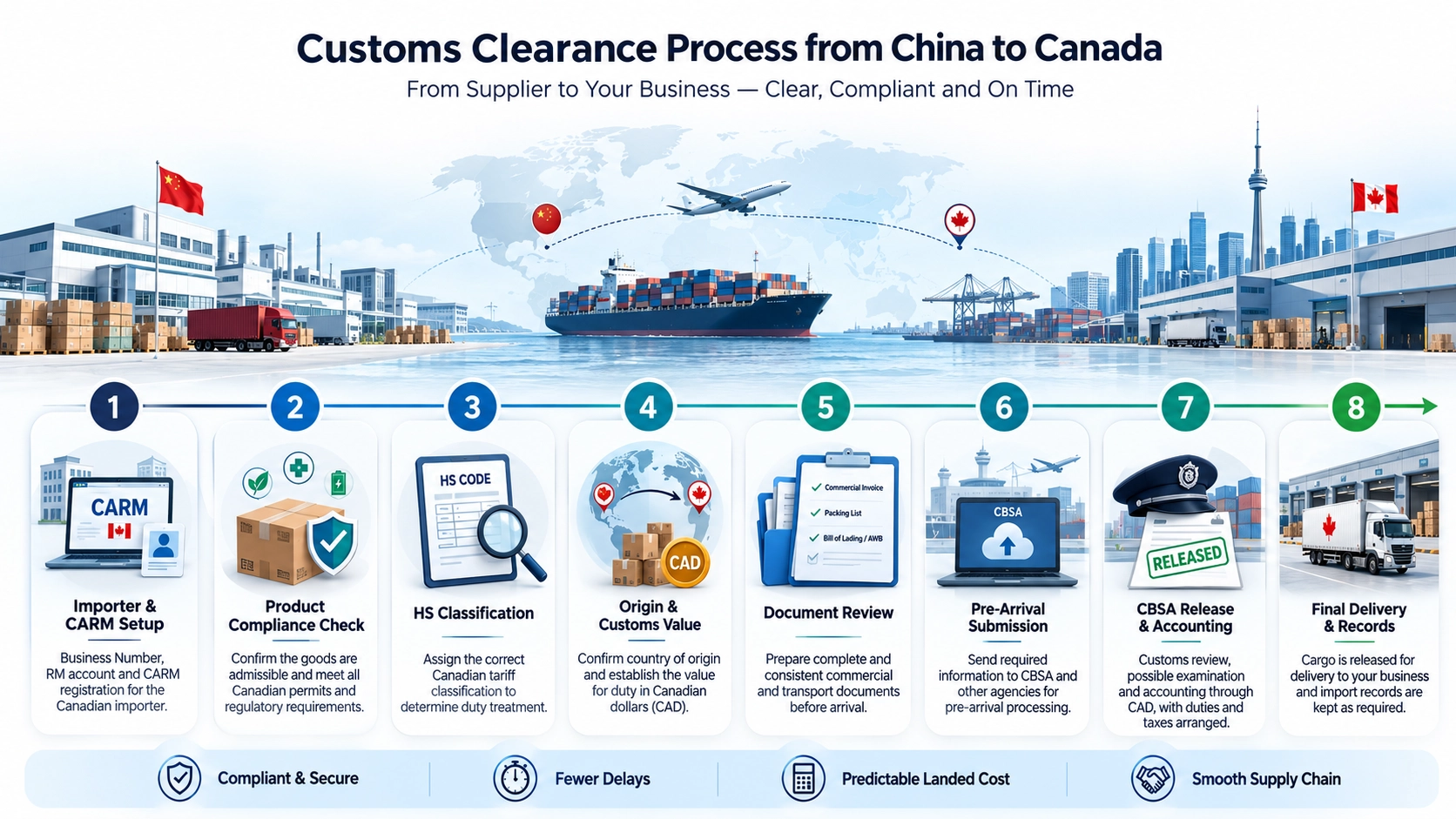
The Customs Clearance Process from China to Canada
1. Confirm the Canadian Importer
Before pickup or booking, confirm:
- The importer’s complete legal name
- Business address
- Business Number and RM account
- CARM Client Portal registration
- Customs broker and delegated authority, when applicable
- Contact person responsible for customs questions
- Payment or Release Prior to Payment arrangements
The importer name should remain consistent across customs instructions, commercial documents and business records.
2. Check Whether the Product Can Be Imported
Transportation acceptance does not automatically prove that a product complies with Canadian import requirements.
Before the goods leave the supplier, determine whether they are prohibited, controlled, regulated or subject to additional documentation. Product categories that may require further review include:
- Food, agricultural products, plants and animal products
- Cosmetics, natural health products and medical products
- Batteries and battery-powered goods
- Chemicals, liquids, powders and pressurized products
- Children’s products and consumer goods subject to safety requirements
- Vehicles, engines and energy-using products
- Textiles, footwear and goods subject to marking or labelling rules
- Wood products and solid-wood packaging
- Steel, aluminum or goods potentially affected by trade-remedy measures
- Branded products that may require authorization
- Radio, wireless or electrical products subject to technical requirements
The CBSA administers import requirements on behalf of several Canadian departments and agencies. Depending on the product, more than one authority may be involved.
3. Determine the Correct Tariff Classification
Commercial goods imported into Canada require a Canadian tariff classification. The classification normally extends to ten digits and should be based on the product’s objective characteristics rather than its marketing name.
Useful classification details include:
- Product function
- Material or composition
- Manufacturing method
- Technical specifications
- Model information
- Whether the item is a complete product, part or accessory
- Packaging or form at the time of import
- Intended commercial use when legally relevant
Descriptions such as “accessories,” “parts,” “samples,” “electronics” or “promotional items” are usually too vague to support reliable classification.
For a focused explanation of classification and landed-cost planning, read our Canadian HS code, duties and import taxes guide.
Importers should use the current Canadian Customs Tariff and obtain specialist advice or a ruling when the classification is uncertain.
4. Confirm Country of Origin
Country of origin is not always the same as the country from which the shipment departed.
For example, goods may be stored or consolidated in China even though their components or manufacturing process involve another country. The origin must be determined under the applicable Canadian rules.
Origin can affect:
- Tariff treatment
- Proof-of-origin requirements
- Marking obligations
- Trade-remedy measures
- Import controls
- Eligibility for preferential treatment
The importer bears responsibility for supporting the declared origin and should retain the relevant supplier, manufacturing and origin documentation.
5. Establish the Value for Duty
Every imported product requires a value for duty, including goods supplied free of charge, samples and replacement goods.
The transaction value method is generally used when the goods were sold for export to Canada and the applicable requirements are satisfied. Certain additions or deductions may be required depending on the sales and transportation arrangements.
The value for duty must be declared in Canadian dollars. When the supplier invoice is in another currency, the applicable CBSA-recognized exchange rate is based on the date the goods began their direct and uninterrupted journey to Canada.
Supporting records may include:
- Supplier invoice
- Purchase order
- Sales agreement
- Proof of payment
- Freight invoice
- Royalty or licence agreements
- Tooling, mould, design or assist costs
- Commission records
- Credit notes or post-sale adjustments
- Documents supporting related-party pricing
Importers should not instruct a supplier to reduce the invoice value to lower duties or taxes. An unsupported declared value can lead to reassessment, penalties and further compliance review.
The CBSA customs valuation handbook explains the available valuation methods and record requirements.
6. Prepare and Match the Documents
Documents should be reviewed before departure while the supplier can still correct them without disrupting the arrival process.
| Document or information | Important contents | Common problem |
|---|---|---|
| Commercial invoice | Seller, buyer, product description, quantity, unit value, total value, currency, origin and Incoterm | Generic product descriptions or values that do not match the transaction |
| Packing list | Carton or pallet count, contents, dimensions, net weight and gross weight | Counts or weights that conflict with the invoice or physical cargo |
| Bill of lading | Shipper, consignee, notify party, ports, container and ocean cargo information | Incorrect consignee or late amendment requests |
| Air waybill | Shipper, consignee, airports, packages, weight and air cargo information | Incomplete consignee or cargo descriptions |
| Classification details | Canadian tariff classification and supporting product data | Using a supplier’s code without confirming the Canadian classification |
| Origin information | Manufacturing country and supporting evidence | Confusing shipping country with country of origin |
| Permits and certificates | Product-specific regulatory documentation | Applying after the goods have already departed |
| Importer information | Legal name, BN/RM account and broker instructions | Business name or account does not match customs records |
| Purchase records | Purchase order, contract and proof of payment | Declared invoice value cannot be reconciled with the transaction |
| Technical documents | Specifications, catalogues, photos, SDS or test reports | Not available when CBSA or the broker requests clarification |
Our shipping documents checklist for China-to-Canada imports provides additional guidance on commercial invoices, packing lists and transport records.
7. Submit Pre-Arrival and Release Information
The carrier, freight forwarder and customs broker may submit different information through separate systems. One party’s submission does not automatically complete every other party’s obligation.
Before arrival, the importer and broker should have access to:
- Final commercial invoice
- Final packing list
- Bill of lading or air waybill
- Cargo control or shipment references
- Product classification
- Country of origin
- Customs value information
- Importer account details
- Permits, licences or certificates
- Supplier and transaction records when clarification may be required
Early preparation gives the parties time to resolve inconsistencies before airport storage, terminal free time or container-return deadlines become critical.
8. CBSA Review, Examination and Release
CBSA may release the shipment based on the submitted information, request additional documents or select the goods for examination.
A customs examination does not automatically mean the importer has done something wrong. Shipments can be selected based on risk assessment, product type, documentation, government-agency requirements or other operational criteria.
An examination may create additional time and third-party costs for moving, unloading, presenting, reloading or storing the cargo. These charges should be distinguished from government-assessed duties and taxes.
Cargo must not proceed to final delivery until the required customs and terminal releases are available.
9. Customs Accounting and Payment
After or in connection with release, the importer or authorized customs broker completes the required accounting through the CAD.
Depending on the importer’s setup, applicable duties and taxes may be paid before release or according to the importer’s CARM billing and Release Prior to Payment arrangements.
Most taxable commercial imports are subject to 5% GST at importation. The customs duty rate varies according to the tariff classification, origin, tariff treatment and any applicable surtax, anti-dumping or countervailing measure.
A freight quotation should clearly distinguish among:
- International freight
- Customs brokerage
- Government duties
- GST and other applicable taxes
- Product-specific fees
- Customs-examination costs
- Terminal or airline storage
- Demurrage and detention
- Delivery and appointment charges
10. Final Delivery and Record Keeping
Customs release does not always mean the cargo is immediately available for delivery. The shipment may still require:
- Terminal or airline release
- Payment of destination charges
- LCL deconsolidation
- Container availability
- Rail movement
- Truck appointment
- Warehouse receiving approval
- Empty-container return planning
After the shipment is completed, the importer should retain complete commercial and customs records. Canadian import records supporting origin and valuation generally must be kept for six years and made available if requested.
What Determines Customs Duties and Taxes?
There is no universal duty percentage for products imported from China.
The final customs assessment can depend on:
- The Canadian tariff classification
- Country of origin
- Applicable tariff treatment
- Value for duty
- GST or other applicable taxes
- Excise tax or excise duty, where relevant
- Surtaxes or safeguard measures
- Anti-dumping or countervailing duties under the Special Import Measures Act
- Product-specific exemptions, relief programs or end-use provisions
Two products with similar retail names can have different duty rates because their materials, technical characteristics or functions differ.
Importers should therefore confirm the classification and regulatory status before calculating landed cost or committing to a supplier order.
Customs Clearance Costs to Include in a Landed-Cost Plan
| Cost category | What can affect it |
|---|---|
| Customs duty | Classification, origin, tariff treatment and trade measures |
| GST and other taxes | Value for tax, applicable duty and product circumstances |
| Customs brokerage | Number of tariff lines, entry complexity and required reviews |
| Permit or agency fees | Product type and responsible government authority |
| Customs examination | Examination location, unloading, handling and reloading |
| Airline or terminal storage | Arrival timing, document readiness and release delays |
| Demurrage | Container remaining at a marine terminal beyond available free time |
| Detention | Carrier equipment remaining outside the terminal beyond permitted time |
| LCL warehouse storage | Delayed release or pickup after deconsolidation |
| Document amendments | Changes to invoices, bills of lading or declarations |
| Final delivery | Cargo size, location, appointment, equipment and receiving conditions |
TopShipping does not publish a universal clearance fee because the scope differs by shipment, product, importer and mode of transportation.
Air Freight Customs Clearance
Air freight reaches Canada quickly, which reduces the available time for correcting documents after departure.
For air cargo:
- Send final documents before the flight departs.
- Confirm the importer and broker file before arrival.
- Check the air waybill consignee information.
- Prepare permits for regulated goods in advance.
- Avoid vague product descriptions.
- Respond quickly to classification or valuation questions.
- Confirm airline storage terms and final-delivery instructions.
Businesses using urgent air cargo can review our air freight from China to Canada guide.
Sea Freight Customs Clearance
Ocean shipments provide more transit time, but document review should still be completed before loading or before the bill of lading is finalized.
For sea freight:
- Confirm whether the cargo is LCL or FCL.
- Match the invoice and packing list with the bill of lading.
- Review destination charges and free-time conditions.
- Prepare customs information before the vessel arrives.
- Plan for possible rail movement to inland Canadian destinations.
- Confirm container pickup, delivery and empty-return responsibilities.
- Separate customs release from carrier and terminal release.
For detailed ocean planning, see our LCL and FCL sea freight guide.
Customs Clearance for Multi-Supplier Shipments
When products are purchased from several factories, each underlying transaction must remain traceable.
The documentation should identify:
- Each supplier
- Products supplied by each seller
- Quantities and values
- Currency
- Country of origin
- Carton or pallet references
- Product classification information
- Purchase-order references
- Any supplier-specific certificates
A consolidated packing summary can help organize the freight, but it should not hide or replace the underlying invoices and commercial transactions.
Importers purchasing from several factories can review our multi-supplier freight consolidation guide.
Common Causes of Customs Delays
| Issue | Why it creates risk | Preventive action |
|---|---|---|
| Importer account is incomplete | Broker may be unable to complete the required transaction | Confirm BN, RM and CARM setup before departure |
| Broker has not been delegated | CAD submission or account access may be restricted | Complete CARM delegation early |
| Vague product description | Classification and admissibility cannot be evaluated reliably | State material, function, model and intended use |
| Incorrect tariff classification | May affect duties, taxes and permits | Validate the Canadian classification before shipping |
| Supplier undervalues the invoice | Declared value may not match the commercial transaction | Use accurate transaction records and payment evidence |
| Invoice and packing list do not match | Creates questions about quantity, weight or goods | Reconcile documents with final cargo data |
| Permit is missing | Regulated goods may not be released | Confirm agency requirements before production or pickup |
| Origin is unclear | Tariff treatment and marking may be affected | Obtain manufacturing and origin information from the supplier |
| Consignee information is wrong | Transport and customs records may not align | Confirm legal names and addresses before issuing the transport document |
| Importer responds slowly | Cargo may remain at the airline, terminal or warehouse | Assign a person to answer customs questions promptly |
| Arrival or delivery planning is incomplete | Released cargo may still incur storage or equipment charges | Arrange destination payment, pickup and receiving in advance |
A Pre-Shipment Customs Readiness Checklist
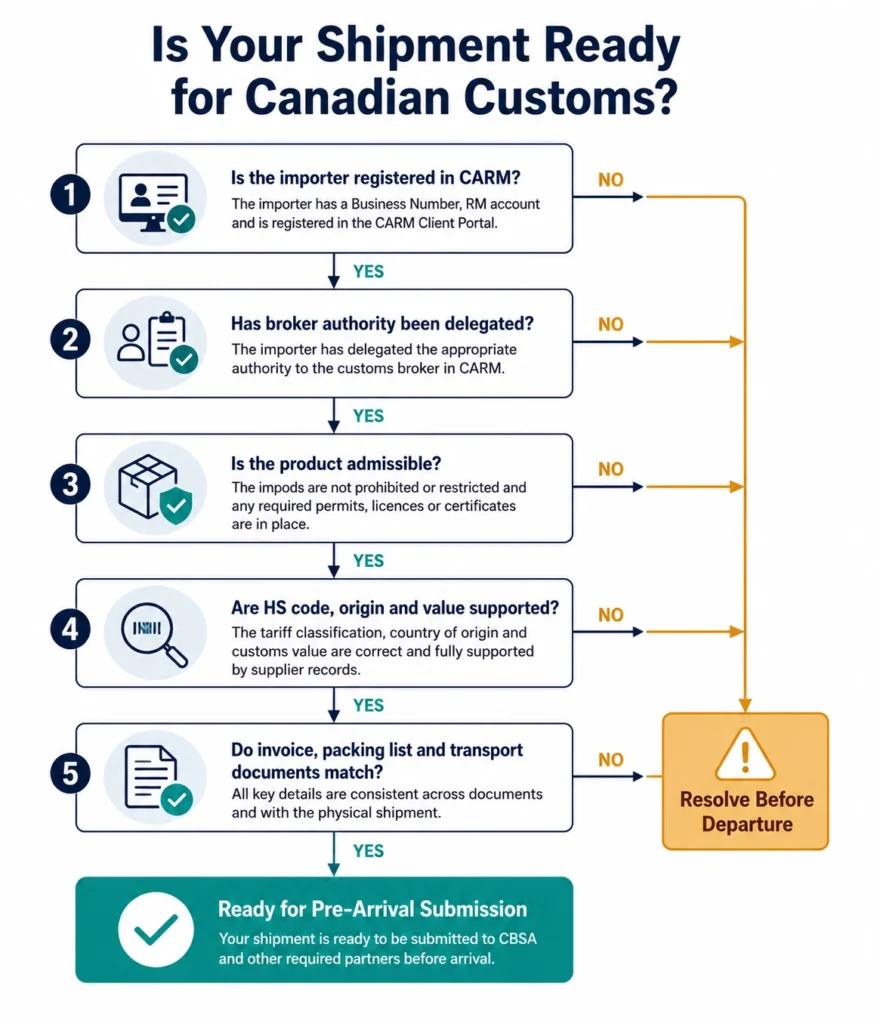
Before the supplier releases the cargo, confirm that:
- The Canadian importer has a valid BN and RM account.
- The importer is registered in CARM.
- Broker authority has been delegated where required.
- The product is admissible in Canada.
- Permits, licences and certificates have been obtained.
- The Canadian tariff classification has been reviewed.
- Country of origin is supported.
- The value for duty can be reconciled with the purchase transaction.
- Product descriptions identify material, function and model.
- Commercial invoice and packing list information match.
- The consignee and importer names are correct.
- The freight method and Incoterm are confirmed.
- The broker has received the clearance package.
- Payment or RPP arrangements are understood.
- The Canadian delivery location is ready to receive the cargo.
How TopShipping Supports Customs Clearance
TopShipping helps Canadian businesses coordinate commercial imports from China through connected freight, documentation and delivery planning.
Our customs-clearance support may include:
- Collecting shipment details from the Chinese supplier
- Reviewing invoice and packing-list consistency
- Coordinating product and classification information
- Organizing air or ocean transport documents
- Working with the importer and required customs parties
- Supporting multi-supplier document organization
- Monitoring shipment and release status
- Connecting customs release with destination handling
- Arranging final delivery to an agreed Canadian commercial location
TopShipping operates with teams in Shenzhen and the Toronto area and has been supporting commercial logistics since 2012.
The importer remains responsible for providing accurate product, value, origin and business information. Customs outcomes, examination decisions and release times are controlled by the responsible government and customs parties and cannot be guaranteed.
Request a Customs and Freight Review
Customs preparation is most effective when it begins before the cargo leaves China.
Send TopShipping:
- Supplier pickup location
- Canadian delivery address or postal code
- Product description
- Product materials and intended use
- Number of cartons or pallets
- Gross weight and dimensions
- Commercial invoice
- Packing list
- Cargo value and currency
- HS code, if available
- Incoterm
- Required delivery timeline
- Available permits, certificates or technical documents
Our team can review the shipment details, identify missing logistics information and coordinate the appropriate freight and customs-clearance process.