
Commercial goods imported into Canada are reported using a 10-digit Canadian tariff classification number. The first six digits follow the international Harmonized System, digits seven and eight identify the Canadian tariff item where the regular customs duty rate is assigned, and digits nine and ten provide the Canadian statistical suffix.
The HS code alone does not determine the total amount payable at the Canadian border. Importers must also establish the country of origin, applicable tariff treatment, value for duty, GST and whether the goods are subject to surtaxes, anti-dumping duties, countervailing duties, excise charges or other product-specific measures.
For most commercial imports, 5% federal GST is payable at importation. There is no single import-duty rate for goods from China: the regular duty depends on the product’s Canadian tariff classification and applicable tariff treatment, while additional trade measures may apply to specific products or exporters.
This guide is based on the 2026 Canadian Customs Tariff and is intended for commercial import planning. Tariff classifications, duty rates and trade measures should always be checked against current Canada Border Services Agency information before a shipment is finalized.
Canadian HS Codes, Duties and Import Taxes at a Glance
| Import element | What it determines | What the importer should verify |
|---|---|---|
| 10-digit Canadian tariff classification | Product classification, regular duty rate and statistical reporting | Product identity, material, function, construction and technical specifications |
| Country of origin | Tariff treatment and possible trade measures | Where the goods were manufactured or substantially transformed |
| Value for duty | Customs valuation base | Transaction value, currency conversion and required additions or deductions |
| Customs duty | Regular tariff amount | Applicable tariff item and tariff treatment |
| GST | Federal import tax | Duty-paid value and applicable exemptions |
| Surtaxes and trade remedies | Additional border charges | Current product, origin, exporter or manufacturer-specific measures |
| Importer account | Commercial import accounting | Business Number, RM account and CARM access |
What Is an HS Code in Canada?
HS stands for Harmonized System, the international system used to classify traded goods. Products are organized into Sections, Chapters, headings and subheadings according to their characteristics and function.
For Canadian commercial imports, however, the final number required for reporting is more specific than the international six-digit HS subheading. Canada extends the international code to a complete 10-digit tariff classification number.
How Canada’s 10-Digit Tariff Classification Is Structured
| Digits | Classification level | Purpose |
|---|---|---|
| 1–2 | Chapter | Broad family of goods |
| 1–4 | Heading | More specific product category |
| 1–6 | HS subheading | Internationally harmonized classification |
| 7–8 | Canadian tariff item | Canadian classification level where the regular duty rate is assigned |
| 9–10 | Canadian statistical suffix | Additional reporting detail for Canadian imports |
For example, a Canadian classification may follow a structure such as:
9507.90.10.00
- 95.07 — international heading
- 9507.90 — international HS subheading
- 9507.90.10 — Canadian tariff item
- 9507.90.10.00 — complete Canadian tariff classification number
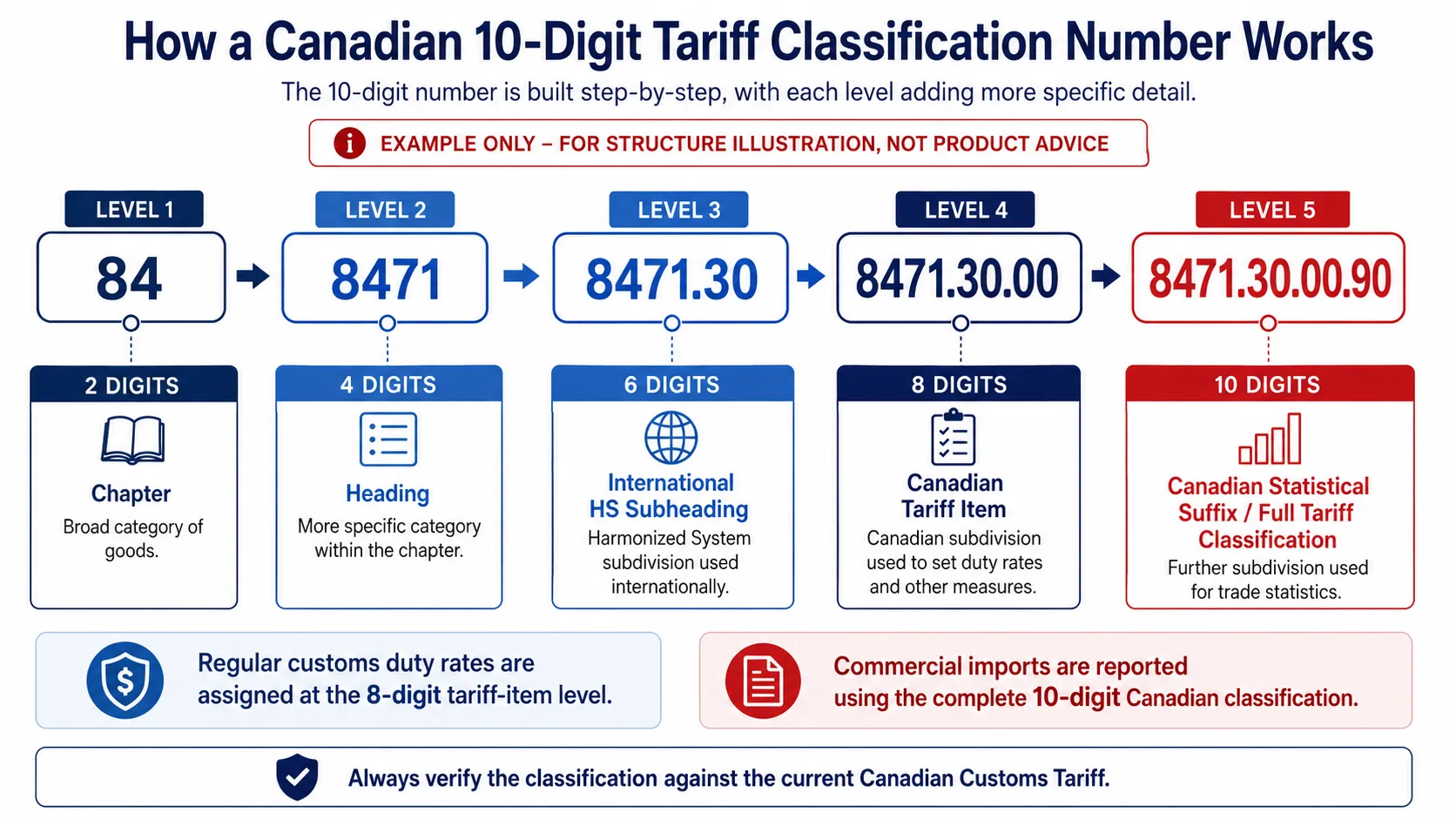
This example demonstrates the numbering structure only. It should not be used to classify a product without reviewing the actual goods and the current tariff provisions.
Use the 2026 Canadian Customs Tariff published by the CBSA as the primary tariff reference.
Is an HTS Code the Same as an HS Code in Canada?
Importers frequently search for terms such as Canadian HTS code, HTS code Canada or Canada HTS codes. The official Canadian tariff-classification material published by the CBSA uses the terms Harmonized System, Customs Tariff, tariff item and tariff classification number.
For goods entering Canada, the important requirement is therefore to identify the correct 10-digit Canadian tariff classification number in the current Canadian Customs Tariff.
A code copied from a foreign tariff database should not automatically be treated as the Canadian code. International HS classification is harmonized through the first six digits, while national tariff extensions can differ.
What Changed in the 2026 Canadian Customs Tariff?
The T2026 Canadian Customs Tariff became effective on January 1, 2026. Importers should use the current tariff rather than relying on an old spreadsheet, supplier database or classification used several years earlier.
The 2026 tariff includes scheduled duty-rate changes and amendments to certain classification numbers and tariff provisions. Importers holding existing tariff-classification rulings should also verify that the classification remains valid under T2026.
This is particularly important for businesses importing the same products repeatedly. A historically used code should still be checked against the current tariff before assuming that it remains unchanged.
How to Find the Correct HS Code for Canada
Finding a Canadian HS code is a legal tariff-classification process, not simply a keyword search. The product must first be identified accurately and then classified through the hierarchy and legal rules of the Canadian Customs Tariff.
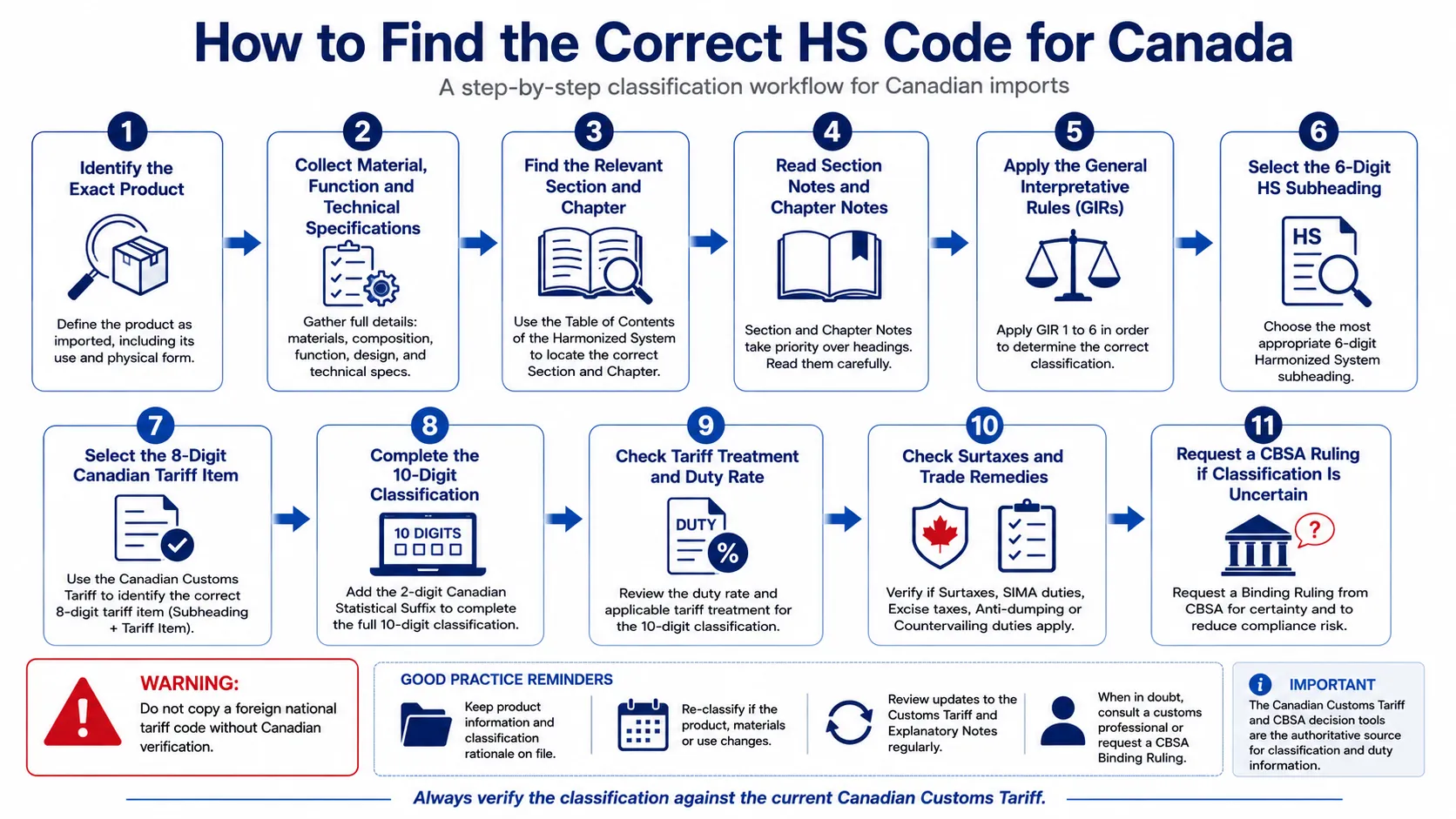
1. Collect Complete Product Information
Prepare enough information to distinguish the product from similar goods:
- Commercial product name
- Technical product name
- Primary function and intended use
- Material composition
- Percentage composition where relevant
- Dimensions and capacity
- Power, voltage or performance specifications
- Whether the product is complete or incomplete
- Whether it is assembled or unassembled
- Whether it is a part, accessory, machine, set or composite product
- Model and SKU
- Product photographs
- Technical drawings or catalogue pages
- Manufacturing process where relevant
2. Identify the Most Relevant Section and Chapter
Use the product’s material, function and level of manufacture to identify the likely part of the Customs Tariff.
Do not select a code only because the wording resembles a supplier’s commercial product name.
3. Read the Section and Chapter Notes
Section Notes and Chapter Notes are part of the legal tariff structure. They may specifically include, exclude or define products that otherwise appear to fit a heading.
This is particularly important for machinery, parts, accessories, composite goods, chemicals, textiles and technically complex products.
4. Apply the General Interpretative Rules
The General Rules for the Interpretation of the Harmonized System, commonly called GIRs, establish the methodology used to classify goods.
They address issues such as:
- Incomplete or unfinished goods
- Unassembled goods
- Mixtures
- Composite products
- Sets
- Goods that appear to fall under more than one heading
- Packaging and containers
The official CBSA tariff-classification methodology explains how headings, subheadings, tariff items, statistical suffixes and the GIRs are applied.
5. Select the Six-Digit HS Subheading
After identifying the correct heading, continue through the tariff hierarchy to the appropriate six-digit HS subheading.
The six-digit level is internationally harmonized, but it is still not the complete Canadian classification.
6. Select the Canadian Eight-Digit Tariff Item
Continue through the Canadian tariff subdivisions until the correct eight-digit tariff item is identified.
The regular customs duty rate is assigned at this tariff-item level.
7. Complete the 10-Digit Canadian Classification
Select the applicable statistical suffix to create the complete 10-digit number required for Canadian commercial reporting.
8. Check the Tariff Treatment and Duty Rate
After classification, review the duty-rate columns and determine which tariff treatment applies based on the country of origin and applicable customs rules.
9. Check Surtaxes and Trade Remedies
A regular tariff rate of “Free” does not necessarily mean that the goods enter Canada without additional customs charges.
The product may still be affected by:
- Surtaxes
- Anti-dumping duties
- Countervailing duties
- Tariff-rate quotas
- Excise duties or taxes
- Other product-specific measures
10. Request a Ruling When Classification Is Uncertain
For technically complex, high-value or recurring products, businesses may request an advance tariff-classification ruling from the CBSA rather than relying solely on an informal opinion.
A ruling can be particularly valuable when several tariff headings appear plausible or the classification has a material impact on landed cost.
Can You Use an HS Code from a Chinese Supplier?
A Chinese supplier’s proposed HS code can be useful as a starting point, but it should not automatically be copied into the Canadian customs declaration.
| Supplier information | How to use it for Canada |
|---|---|
| Six-digit HS subheading | Use as a possible starting point and verify against the Canadian tariff |
| Chinese national tariff code | Do not copy the national extension directly into the Canadian declaration |
| Code used on a previous order | Verify the product specifications and current Canadian tariff |
| Generic code for “parts” | Review the specific part, machine, material and function |
| Code selected because it has a lower duty rate | Use only if the classification is legally supported by the goods and tariff rules |
China and Canada use the same international Harmonized System foundation at the six-digit level, but their national tariff subdivisions and reporting requirements are not interchangeable.
How Are Import Duties Calculated in Canada?
The regular customs duty is generally calculated using the established value for duty in Canadian dollars and the applicable duty rate under the correct tariff item and tariff treatment.
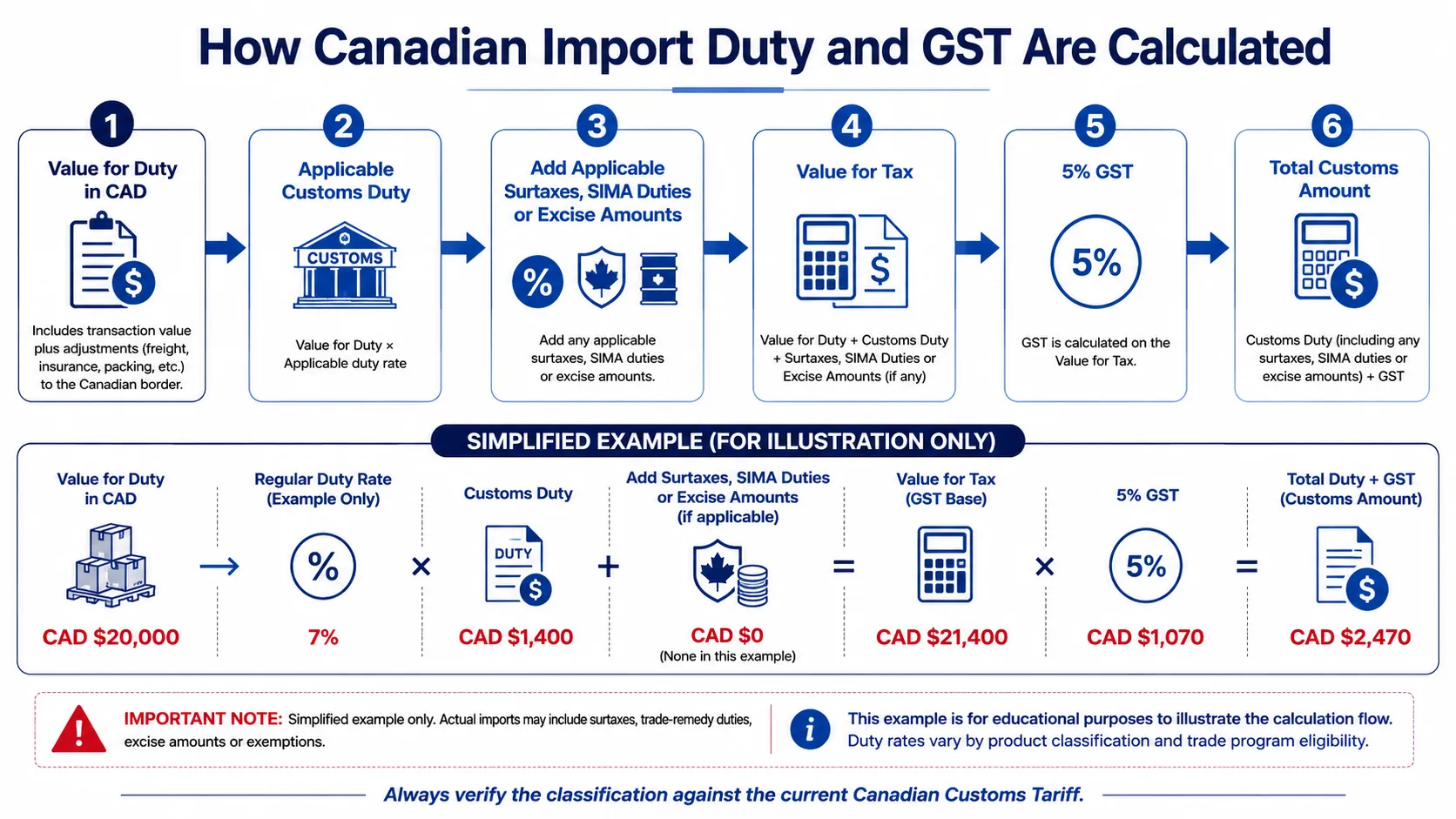
Regular customs duty = Value for duty × Applicable customs duty rate
This calculation does not automatically include surtaxes, SIMA duties, excise amounts or GST.
Canadian Import Duty Calculator Formula
For a simplified planning calculation:
- Establish the value for duty in Canadian dollars.
- Identify the correct Canadian tariff classification.
- Determine the applicable regular duty rate.
- Calculate regular customs duty.
- Add applicable surtaxes, anti-dumping duties, countervailing duties or excise amounts.
- Determine the applicable value for tax.
- Calculate the 5% GST where applicable.
A calculator cannot reliably determine the final import cost unless the tariff classification, origin and value for duty have already been established correctly.
Simplified Duty and GST Example
Assume that:
- Value for duty: CAD $20,000
- Regular duty rate: 7%
- No surtax, SIMA duty or excise charge applies
| Calculation | Amount |
|---|---|
| Value for duty | CAD $20,000 |
| Customs duty: CAD $20,000 × 7% | CAD $1,400 |
| GST calculation base | CAD $21,400 |
| GST: CAD $21,400 × 5% | CAD $1,070 |
| Total regular customs duty and GST | CAD $2,470 |
Calculation note: This is a simplified planning example only. Actual customs accounting may also include surtaxes, trade-remedy duties, excise amounts or other adjustments. Brokerage, freight, storage, terminal charges and final delivery are separate logistics costs.
GST on Commercial Imports into Canada
Most commercial goods imported into Canada are subject to 5% GST at the time of importation, unless a specific exemption applies.
GST should not simply be calculated by multiplying the foreign supplier’s invoice by 5%. The customs valuation and applicable duties must first be determined.
The GST calculation can be affected by:
- Value for duty
- Regular customs duty
- Applicable surtaxes
- Anti-dumping or countervailing duty
- Applicable excise amounts
Provincial tax, HST accounting, input tax credits and tax recoverability can depend on the importer’s registration and transaction structure. Businesses should obtain Canadian tax advice for those accounting issues rather than treating the retail sales-tax rate as the customs import-tax calculation.
Import Duty from China to Canada
There is no universal Canadian import-duty percentage for goods from China.
The applicable border cost depends on:
- The complete Canadian tariff classification
- Country of origin
- Applicable tariff treatment
- Value for duty
- Current surtaxes
- Anti-dumping or countervailing measures
- Excise taxes or duties where applicable
Two products bought from the same Chinese supplier for the same value can have different duty rates because their tariff classifications differ.
Similarly, a product with a regular customs duty rate of zero may still be subject to GST or a separate trade measure.
Country of Origin Is Not the Same as Shipping Country
Country of origin refers to where goods originate under the applicable Canadian origin rules. It is not necessarily the supplier’s office location, shipping port or country through which the cargo was transshipped.
For example, moving goods through Hong Kong, the United States or another logistics hub does not automatically change their origin.
Origin can affect:
- Tariff treatment
- Duty rate
- Proof-of-origin requirements
- Country-of-origin marking
- Surtaxes
- Anti-dumping and countervailing duties
- Import controls
Where production takes place in more than one country, importers should collect enough manufacturing information to support the origin declared to the CBSA.
Trade Remedies, Surtaxes and Additional Duties
A Canadian Customs Tariff lookup should not be the final step in an import-cost review.
Some goods may be subject to charges beyond the regular customs tariff, including:
- Anti-dumping duties
- Countervailing duties
- Provisional duties
- Product-specific surtaxes
- Tariff-rate quota surtaxes
These measures can change during the year and may depend on the product, HS classification, origin, manufacturer or exporter.
Importers dealing with steel, manufactured products or goods in industries affected by trade-remedy investigations should check current CBSA notices rather than assuming the regular tariff rate represents the complete customs liability.
Use the official CBSA anti-dumping and countervailing duty resources when reviewing potential SIMA exposure.
What Is Value for Duty?
Value for duty is the customs valuation amount used as the basis for calculating applicable customs duty.
It must be declared for imported goods even when:
- The regular customs duty rate is zero
- The goods were supplied free of charge
- The products are samples
- The importer believes no customs duty is payable
The value for duty must be established in Canadian currency.
Transaction Value Method
The transaction value method is the primary customs-valuation method and is used when its legal requirements are satisfied.
It generally begins with the price paid or payable for the goods in the relevant sale for export to Canada, subject to required additions or deductions.
Items that may require review include:
- Price paid or payable
- Packing costs
- Assists such as moulds, tooling or design work
- Certain commissions
- Royalties and licence fees
- Proceeds that revert to the seller
- Transportation and insurance amounts
- Currency conversion
If the transaction value method cannot legally be used, Canadian customs law provides alternative valuation methods that must generally be considered in sequence.
For detailed valuation rules, use the official CBSA Customs Valuation Handbook.
CARM, Business Numbers and Commercial Accounting in 2026
Canadian commercial importers should have the required business and import account structure in place before importing goods.
Businesses generally need:
- A Canadian Business Number
- An import-export program account, commonly identified by RM
- Access to the CARM Client Portal where applicable
- Delegated authority for a customs broker when the broker will act through the CARM system
The CBSA Assessment and Revenue Management system, known as CARM, is Canada’s current commercial import accounting environment.
Commercial Accounting Declaration Replaced B3 and B2
A particularly important current requirement is the Commercial Accounting Declaration, or CAD.
The CAD is the digital customs accounting document used for imported commercial goods. It replaced the previous B3 customs coding form and B2 adjustment form.
Businesses using older customs checklists, templates or supplier documentation should therefore make sure their internal processes reflect the current CARM and CAD environment.
Customs Classification vs Customs Clearance
Tariff classification and customs clearance are related but different processes.
| Area | Main question |
|---|---|
| Tariff classification | What is the correct Canadian tariff classification number? |
| Tariff treatment | Which duty-rate column applies? |
| Customs valuation | What is the correct value for duty? |
| Duty and tax calculation | What amounts are payable? |
| Customs clearance | What information and documents are required to obtain release? |
For the shipment-release process, importer preparation and customs documentation workflow, use our customs clearance from China to Canada guide.
Documents Needed to Support HS Classification and Import Cost
A tariff code is easier to defend when the importer maintains commercial and technical documentation that clearly identifies the goods.
- Commercial invoice
- Packing list
- Detailed product description
- Material composition
- Technical specifications
- Model number and SKU
- Product photographs
- Product catalogue or technical data sheet
- Drawings where relevant
- Country-of-origin information
- Supplier’s proposed HS subheading
- Bill of lading or air waybill
- Certificates, permits or test reports where required
- Importer Business Number and RM account information
Descriptions such as “parts,” “accessories,” “samples,” “equipment” or “general merchandise” are normally too broad for reliable tariff classification.
For a wider import-document checklist, review our shipping documents from China to Canada guide.
Common Canadian HS Code and Duty Mistakes
| Mistake | Why it creates risk | Better approach |
|---|---|---|
| Copying the supplier’s national tariff code | National tariff extensions differ | Verify the complete Canadian 10-digit classification |
| Classifying by product name only | Material, function and legal notes may change the heading | Review technical specifications and tariff rules |
| Using one code for every product in a mixed shipment | Different goods may have different classifications | Classify each distinct commercial product line |
| Using an old code without checking T2026 | Tariff classifications and duty provisions can change | Verify the current Canadian Customs Tariff |
| Assuming duty-free means tax-free | GST or additional measures may still apply | Review all customs charges separately |
| Ignoring surtaxes or SIMA measures | Regular customs duty may represent only part of the liability | Check current trade measures |
| Confusing country of export with origin | The wrong tariff treatment or trade measure may be applied | Confirm manufacturing origin |
| Using an artificially low declared value | The value may be reassessed and penalties or interest may apply | Use a defensible customs valuation |
| Waiting until cargo arrives to classify the goods | Unexpected permits or additional duties may be identified too late | Complete the tariff review before pickup |
How HS Codes Affect Landed Cost
The tariff classification affects the customs component of landed cost, but it is only one part of the full cost of importing commercial goods into Canada.
A complete landed-cost estimate can include:
- Supplier price
- Pickup in China
- Origin handling
- International air or sea freight
- Cargo insurance
- Regular customs duty
- GST
- Surtaxes or trade-remedy duties
- Customs brokerage
- Disbursement fees
- Port, airport or terminal charges
- Customs examinations
- Storage
- Rail or trucking
- Final delivery
For complete freight-rate and landed-cost planning, review our shipping cost from China to Canada guide.
Do Incoterms Change the HS Code or Customs Duty?
No. Incoterms do not change the legal tariff classification of a product or create a different customs duty rate.
They can, however, affect:
- Who arranges transportation
- Who provides commercial documents
- Who pays particular freight charges
- Who is expected to handle import clearance under the commercial agreement
- How transportation and other costs appear in the transaction documentation
For a detailed responsibility comparison, review FOB vs EXW vs DDP for China-to-Canada shipments.
HS Codes and DDP Shipping
DDP shipping does not remove the requirement for accurate tariff classification, origin and customs valuation.
Before accepting a DDP quotation, confirm:
- Who will act as importer of record
- The Canadian tariff classification being used
- The declared customs value
- The country of origin
- Whether regular customs duty is included
- Whether GST is included
- Whether surtaxes or SIMA duties have been considered
- Whether customs brokerage is included
- What customs accounting records will be provided
For detailed DDP responsibilities, see our DDP shipping from China to Canada guide.
When Should You Request an Advance Tariff Ruling?
An advance tariff-classification ruling can be considered when:
- The product is technically complex
- Several headings appear reasonable
- The duty difference between classifications is significant
- The product will be imported repeatedly
- The classification affects a major commercial investment
- The importer wants formal certainty before establishing a long-term import program
An informal supplier code, search-engine result, AI answer or freight quotation does not provide the same certainty as an official ruling.
Pre-Shipment HS Code and Import Tax Checklist
- Confirm the exact product name and model.
- Confirm material composition and principal function.
- Identify the complete 10-digit Canadian tariff classification.
- Use the current 2026 Canadian Customs Tariff.
- Check the applicable regular duty rate.
- Confirm the country of origin.
- Review current surtaxes and trade-remedy measures.
- Establish a defensible value for duty.
- Convert customs value into Canadian currency using the applicable customs rules.
- Estimate 5% GST where applicable.
- Check excise taxes or duties where relevant.
- Confirm the Business Number and RM account.
- Confirm CARM access and customs-broker delegation where required.
- Ensure the invoice and packing list match the physical goods.
- Check permits, certificates and product-specific import requirements.
- Calculate landed cost rather than customs duty alone.
How TopShipping Supports Canadian Importers
TopShipping coordinates commercial freight and customs-related shipment information for Canadian businesses importing goods from China.
Depending on the shipment, operational support may include:
- Collecting product and supplier information
- Reviewing invoice and packing-list consistency
- Coordinating tariff-classification information with the importer and customs broker
- Identifying missing commercial documents before departure
- Planning air or sea freight
- Multi-supplier consolidation
- Coordinating customs-clearance documentation
- Estimating freight and landed-cost components
- Tracking cargo through release and final delivery
TopShipping does not replace the importer’s customs responsibility or a binding CBSA tariff ruling. The Canadian importer remains responsible for accurate customs declarations, while binding classification decisions and rulings are issued through the appropriate Canadian customs process.
Request a China-to-Canada Import Assessment
If you are preparing a commercial shipment from China, provide the product description, technical specifications, supplier location, cargo details, commercial value, origin information and Canadian destination.
TopShipping can coordinate the freight and customs-related information required to prepare the shipment and compare the applicable logistics options.