

Shipping commercial goods from China to Canada normally requires a commercial invoice, packing list, transport document, accurate importer information and sufficient product data for Canadian customs clearance. Depending on the shipping method and type of cargo, additional records such as a certificate of origin, import permit, test report, Safety Data Sheet or dangerous goods declaration may also be required.
The exact document package is not identical for every shipment. It depends on the product, cargo value, country of origin, Incoterm, freight method, Canadian importer setup and any regulations that apply to the goods.
This guide explains which documents are required, who prepares each one and what Canadian importers should verify before cargo leaves China. It is intended for businesses importing commercial inventory, machinery, components, wholesale products, retail goods and e-commerce stock—not personal gifts or casual shipments.
TopShipping supports Canadian businesses as a China to Canada freight forwarding partner, coordinating supplier information, freight documentation, customs preparation and final delivery.
Shipping Documents Checklist at a Glance
| Document or Record | Usually Prepared or Issued By | When It Is Needed | Main Purpose |
|---|---|---|---|
| Commercial invoice | Chinese supplier or seller | Nearly all commercial shipments | Describes the transaction, products, value, buyer and seller |
| Packing list | Chinese supplier or packing facility | Most B2B shipments | Shows cartons, pallets, quantities, weights and dimensions |
| Bill of lading | Ocean carrier or freight forwarder | Sea freight shipments | Records the ocean carriage, routing and cargo details |
| Air waybill | Airline or freight forwarder | Air freight shipments | Records the air carriage, routing and cargo details |
| Importer Business Number and RM account | Canadian importer | Commercial importing into Canada | Identifies the importer for Canadian customs purposes |
| HS classification and product data | Importer or customs broker, supported by supplier data | Customs declaration | Determines classification, duties and import requirements |
| Country-of-origin evidence | Supplier, manufacturer or exporter | As required | Supports the declared origin and tariff treatment |
| Import licence, permit or certificate | Importer, supplier or competent authority | Regulated goods | Demonstrates compliance with product-specific requirements |
| Dangerous goods documents | Manufacturer, shipper or qualified dangerous goods party | Batteries, chemicals and other regulated cargo | Supports transport classification, acceptance and safe handling |
| Insurance certificate | Insurer, broker or freight provider | Insured cargo or contractually required shipments | Confirms the cargo insurance arrangement |
| Customs release and accounting data | Importer or customs broker | Canadian customs processing | Supports release, accounting and payment of duties and taxes |
The commercial invoice, packing list and transport document are the core operational records for most shipments. However, the Canadian importer must also be properly established, and the product must be classified and reviewed for admissibility before shipping.
Who Is Responsible for the Documents?
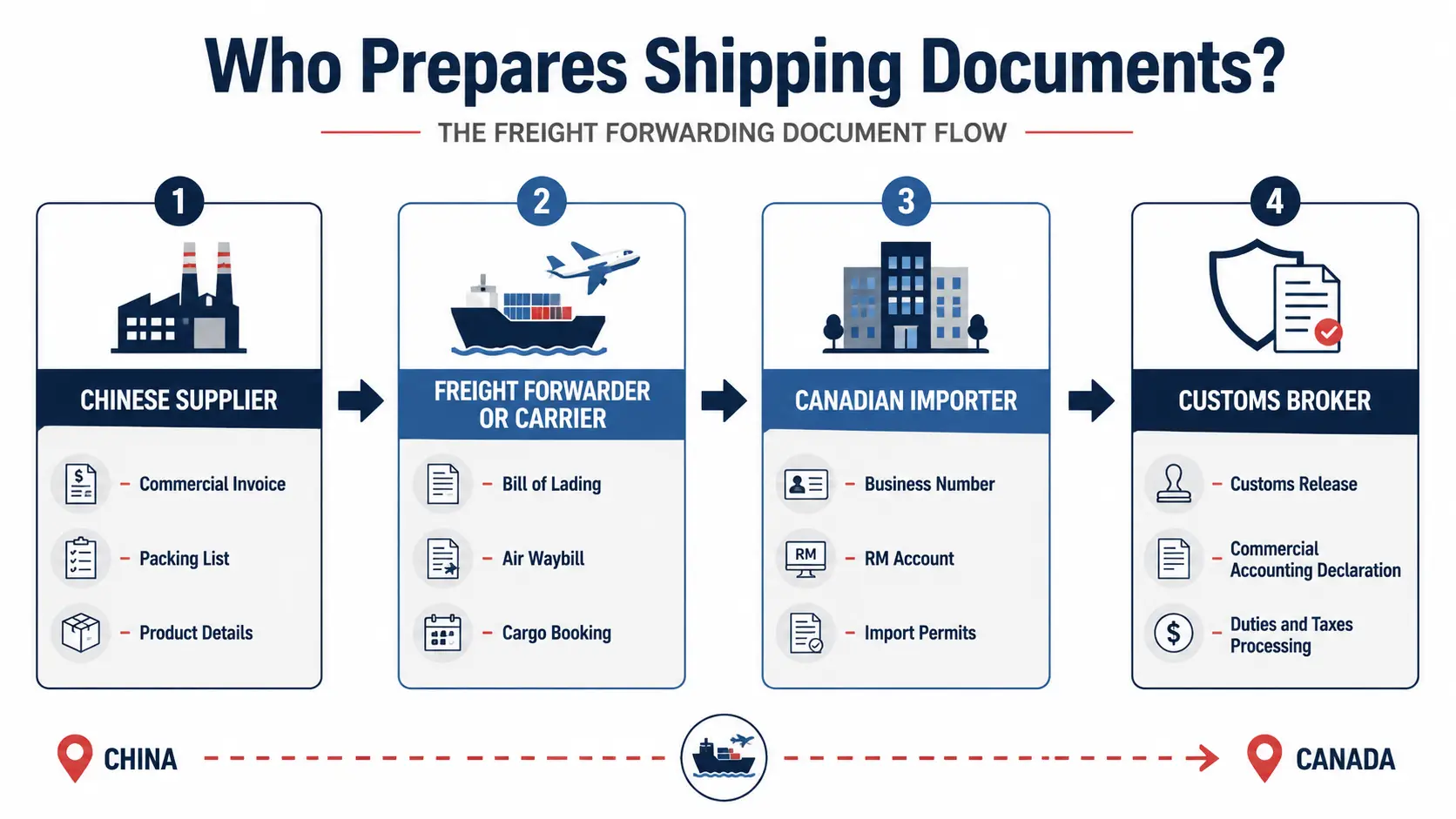
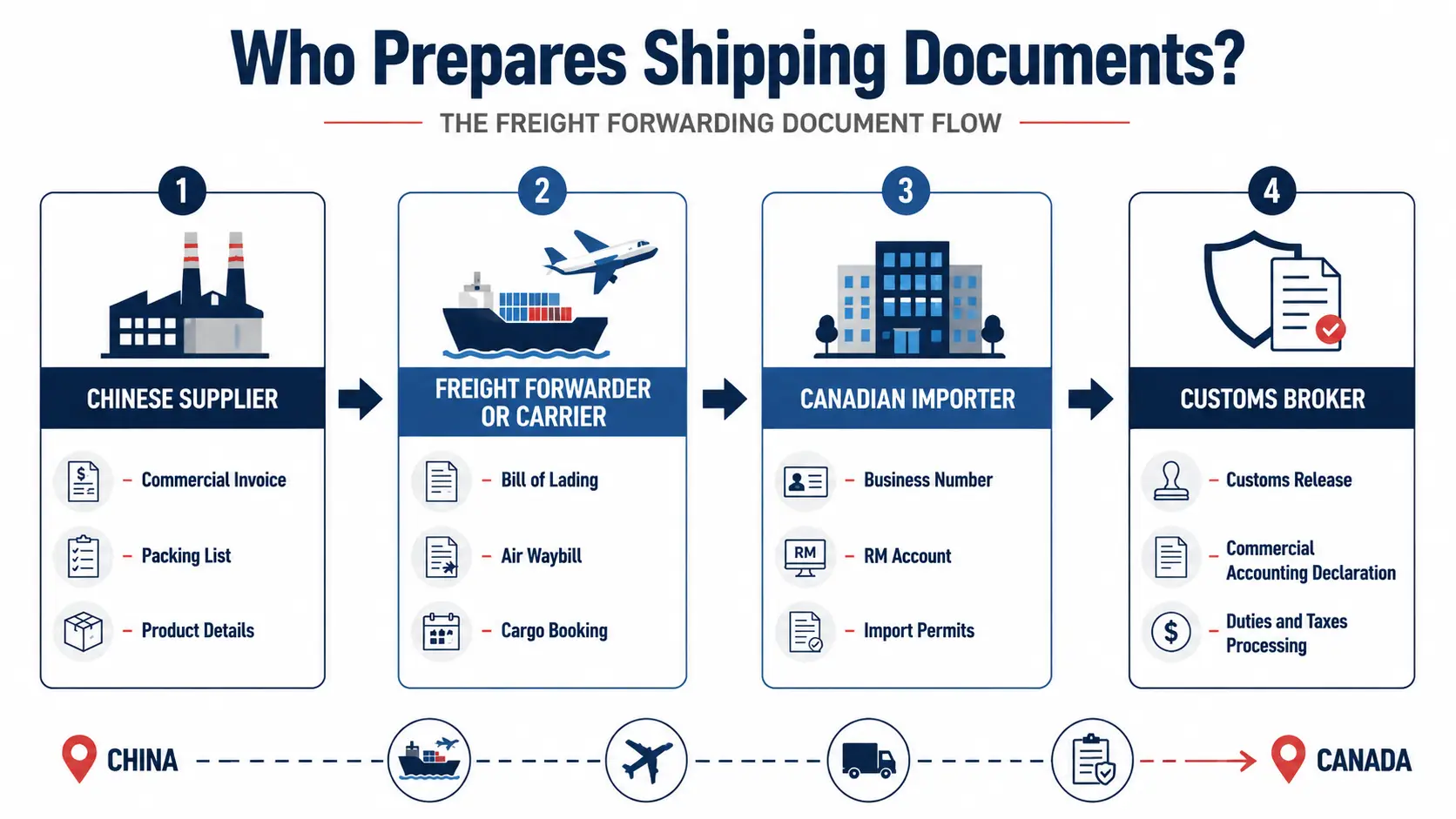
Document preparation is shared among several parties. One of the most common causes of delay is assuming that the freight forwarder, supplier or customs broker will create every document automatically.
The Chinese Supplier or Exporter
The supplier normally provides the commercial invoice, packing list, product specifications and country-of-origin information. The supplier may also provide test reports, certificates, battery documentation, material details and export information when applicable.
Supplier documents must reflect the goods that were actually produced and packed. A quotation or early pro forma invoice should not be used as the final shipment record when quantities, prices or product specifications have changed.
The Canadian Importer
The Canadian importer is responsible for providing its correct legal name, address, importer account information and customs broker instructions. The importer should also confirm the HS classification, value for duty, country of origin and any permits or regulatory requirements.
Using a customs broker does not eliminate the importer’s responsibility for accurate import information.
The Freight Forwarder or Carrier
The carrier or freight forwarder issues the transport document, such as a bill of lading or air waybill. The forwarder also uses the supplier’s packing information to arrange pickup, booking, consolidation, export handling and final delivery.
The importer and supplier should review draft transport details before the final document is issued.
The Customs Broker
A customs broker may prepare and submit Canadian release and accounting information based on documents supplied by the importer, supplier, carrier and freight forwarder. The broker may identify missing information, but the underlying product, transaction and origin details must come from the responsible commercial parties.
1. Commercial Invoice
The commercial invoice is the primary transaction document for commercial goods shipped from China to Canada. It helps customs authorities identify the seller, buyer, products, price, currency, origin and terms of sale.
A commercial invoice should include:
- Supplier or vendor’s legal name and address
- Buyer or Canadian importer’s legal name and address
- Consignee details when different from the buyer
- Invoice number and invoice date
- Purchase order or contract reference when applicable
- Detailed product descriptions
- Model, SKU or part number when relevant
- Material composition and intended use when needed for classification
- Quantity and unit of measure
- Unit price and total price
- Currency of settlement
- Country of origin
- Incoterm and named place
- Freight, insurance, discounts or other relevant transaction charges
- Authorized signature or company confirmation when required
Product descriptions should be specific. Descriptions such as “parts,” “accessories,” “samples,” “electronics” or “general goods” do not provide enough information for reliable customs classification.
A stronger description would be:
Stainless-steel mounting brackets for commercial shelving, model SB-220, non-electrical, 500 pieces.
The Canada Border Services Agency permits a commercial invoice to be used when it contains the prescribed information. If it does not include all required data, a Canada Customs Invoice may be used to provide the remaining information. Importers should review the official CBSA invoice requirements before establishing a standard supplier invoice template.
Commercial Invoice vs Pro Forma Invoice
A pro forma invoice is normally a preliminary quotation or pre-shipment document. It may be useful for booking, payment or product review, but a final commercial invoice should reflect the actual shipment.
For samples, warranty replacements or goods supplied free of charge, the invoice should explain the reason for the shipment. A supportable customs value is still required; writing “no commercial value” does not automatically remove customs valuation requirements.
2. Packing List
The packing list describes how the shipment is physically packed. Freight forwarders, carriers, customs brokers, warehouses and delivery providers use it to verify cargo quantity, handling requirements and shipment measurements.
A complete packing list should show:
- Packing list number and date
- Commercial invoice or purchase order reference
- Supplier and consignee details
- Number of cartons, crates, drums or pallets
- Package numbering
- Products and quantities in each package
- Net weight
- Gross weight
- Carton, crate or pallet dimensions
- Total volume in cubic metres when applicable
- Shipping marks and labels
- Pallet type and packaging method
- Container loading information when available
The packing list must match the physical cargo. If a booking is based on 40 cartons but 47 cartons are delivered to the warehouse, the freight booking, transport document, customs information and final delivery plan may all require correction.
For consolidated cargo, the packing list should identify which cartons belong to each supplier and which products are contained in each package.
3. Bill of Lading for Sea Freight
A bill of lading is the main transport document for ocean cargo. It is issued by the ocean carrier or freight forwarder after the cargo is received or loaded, depending on the document type and service arrangement.
A bill of lading commonly includes:
- Shipper
- Consignee
- Notify party
- Ocean carrier
- Vessel and voyage
- Port of loading
- Port of discharge
- Place of receipt and final destination when applicable
- Cargo description
- Number and type of packages
- Gross weight and measurement
- Container number
- Seal number
- Freight payment terms
- Bill of lading number
For consolidated or forwarder-managed shipments, both a master bill of lading and a house bill of lading may be involved.
The shipper, consignee, cargo description, package count and weight should be checked before the final bill is issued. Amendments after departure can cause additional fees or delay cargo release.
Businesses using LCL or FCL can review TopShipping’s sea freight service from China to Canada for ocean transportation, container coordination and destination delivery support.
4. Air Waybill for Air Freight
An air waybill is the primary transport document for air cargo. It is issued by the airline or freight forwarder and records the shipper, consignee, route, pieces, weight and handling information.
An air waybill commonly includes:
- Shipper and consignee information
- Air waybill number
- Departure and destination airports
- Airline and flight routing
- Number of pieces
- Gross weight
- Chargeable weight
- Nature and quantity of goods
- Handling information
- Freight and charge details
- Special cargo instructions when applicable
Air cargo can arrive in Canada shortly after departure, so customs documents should be reviewed before the flight is booked. A missing invoice, unclear product description or incomplete importer setup can remove much of the time advantage gained by air freight.
For urgent inventory, samples and time-sensitive commercial goods, TopShipping provides air freight from China to Canada with supplier pickup, air cargo coordination, customs support and final delivery planning.
5. Canadian Importer Number and CARM Setup
A Business Number and an import-export program account, commonly identified by an RM account, are not shipping documents in the traditional sense. However, they are essential importer records for businesses bringing commercial goods into Canada.
The Canadian importer should confirm:
- Exact legal business name
- Business Number
- Active import-export program account
- Importer address and contact details
- Customs broker relationship and authorization
- Method for paying duties and taxes
- Access to the CARM Client Portal when applicable
The CBSA states that businesses need a Business Number and an RM account before importing or exporting commercial goods. Current account registration and commercial import accounting information is available through the official CARM portal guidance.
Importer information should be confirmed before cargo departs China. Using the wrong company name, inactive account or unrelated consignee can delay the customs process.
6. HS Code and Detailed Product Classification Data
Each imported product needs an appropriate tariff classification. Canada uses a 10-digit tariff classification number for customs declarations.
Classification requires more than a short product name. The importer or customs broker may need:
- Product function
- Material composition
- Manufacturing details
- Technical specifications
- Model or part number
- Photos and catalogues
- User manual
- Component breakdown
- Intended commercial use
- Country of manufacture
The supplier may suggest an HS code, but the Canadian importer should not rely on the supplier’s code without review. Different countries may apply national tariff digits differently, and a code used for Chinese export purposes may not be complete for Canadian import reporting.
Classification, value and origin can affect duties, taxes and additional government requirements. Our guide to HS codes, duties and taxes for Canadian imports explains these subjects separately to avoid turning the document checklist into a duty-calculation guide.
7. Canada Customs Invoice
A separate Canada Customs Invoice, Form CI1, is not automatically required when the supplier’s commercial invoice already contains all required data.
The usual documentation approach is one of the following:
- A commercial invoice containing the required Canadian invoice information
- A commercial invoice containing the core transaction details, supported by Form CI1 for missing information
- A fully completed Form CI1
The invoice information should be provided in English or French and must accurately describe the transaction and goods.
A Canada Customs Invoice is different from the customs accounting declaration. It provides invoice-level information, while the customs accounting process records the import entry, tariff treatment, value, duties and taxes.
8. Cargo Control, Customs Release and Accounting Records
Some Canadian customs records are created or submitted by the carrier, importer or customs broker rather than the Chinese supplier.
These may include:
- Cargo control information
- Cargo Control Number
- Customs release request
- Supporting invoice data
- Other-government-department information
- Commercial Accounting Declaration
- Duty and tax payment records
The Commercial Accounting Declaration, commonly called the CAD, is the digital accounting document used in the CARM environment. It replaced the previous B3 customs coding form for commercial accounting.
Canadian importers do not normally ask their Chinese supplier to prepare the CAD. The importer or customs broker prepares the declaration using the commercial invoice, classification, origin, valuation and transport information.
For assistance connecting freight documentation with Canadian release requirements, review TopShipping’s customs clearance service.
9. Country of Origin and Proof of Origin
Country of origin refers to where the product was manufactured, produced or grown—not simply the country from which it was shipped.
Origin information should appear consistently on the commercial invoice and supporting product records. Depending on the tariff treatment and product, proof of origin may take the form of:
- Commercial invoice showing the country of origin
- Canada Customs Invoice
- Manufacturer’s declaration
- Certificate of origin
- Origin declaration
- Other records identifying where the goods were produced
A separate certificate of origin is not mandatory for every shipment. Importers should confirm what evidence is required for the applicable tariff treatment and retain the supporting records.
10. Chinese Export Declaration and Export Documents
The Chinese exporter or its authorized customs agent normally handles the export declaration at origin. The Canadian importer may not receive every document submitted to Chinese Customs, but the exporter must still be able to complete the export process.
Origin-side records may include:
- Chinese export customs declaration
- Export licence for controlled products
- Booking confirmation
- Warehouse receipt
- Container loading record
- Verified Gross Mass information for applicable ocean containers
- Export inspection or commodity documentation
- Manufacturer or exporter registration information
Under EXW arrangements, the Canadian buyer’s logistics provider may need to coordinate export handling because the supplier’s responsibility is limited. Under FOB arrangements, the supplier usually handles more of the China-side export process.
The division of responsibility should be confirmed in writing. For a broader comparison, review the guide to FOB, EXW and DDP shipping from China to Canada.
11. Import Permits, Licences and Product-Specific Certificates
Some goods require approval or supporting documentation from a Canadian government department before importation.
Depending on the product, additional records may include:
- Import permit
- Licence
- Health certificate
- Phytosanitary certificate
- Veterinary certificate
- Food import licence
- Product registration
- Laboratory test report
- Safety or conformity report
- Ingredient or formulation statement
- Material declaration
- Bilingual label information
- Technical specification
- Inspection certificate
- Licence, Permit, Certificate or Other document, known as an LPCO
Food, plants, animals and related commodities may fall under Canadian Food Inspection Agency requirements. Importers can use the official Automated Import Reference System to identify current CFIA requirements for regulated commodities.
A certificate commonly used in another country is not automatically sufficient for Canada. Product compliance should be checked against the responsible Canadian authority before production or shipment.
12. Dangerous Goods and Battery Documents
Batteries, chemicals, aerosols, flammable liquids, powders and other regulated cargo may require transport-specific documentation in addition to regular customs paperwork.
Depending on the product and mode of transport, documents may include:
- Safety Data Sheet, also called SDS or MSDS
- Dangerous goods declaration
- UN number and proper shipping name
- Packing group information
- Classification report
- UN38.3 test summary for applicable lithium batteries
- Battery specification sheet
- State-of-charge information
- Emergency contact details
- Packaging, marking and labelling evidence
- Airline or ocean carrier approval
The exact requirements vary by battery type, configuration, quantity, packaging and mode of transport. Transport Canada provides current guidance for shipping and importing lithium batteries and battery-powered devices.
Dangerous goods should be declared before booking. Undeclared batteries, liquids or chemicals can cause rejection, rebooking, penalties or safety risks.
13. Cargo Insurance Certificate
A cargo insurance certificate may be issued when the shipment is insured under a specific policy or shipment certificate.
It normally identifies:
- Insured party
- Cargo description
- Insured value
- Voyage or route
- Policy or certificate number
- Covered risks
- Claims contact information
- Coverage period
- Deductible when applicable
Insurance is separate from the carrier’s limited contractual liability. The certificate may also be required under a letter of credit, sales contract or financing arrangement.
14. Purchase Order, Sales Contract and Payment Records
Purchase orders and payment records are not always submitted for routine customs release, but they are important supporting records.
The importer should retain:
- Purchase order
- Sales contract
- Supplier quotation
- Payment confirmation
- Bank transfer record
- Letter of credit
- Credit note
- Royalty or licence agreement
- Rebate agreement
- Warranty agreement
- Freight and insurance invoices
These documents may be required to support the declared transaction value, explain discounts or confirm the commercial relationship between the buyer and seller.
The commercial invoice should not contradict the purchase order or proof of payment.
Documents Required by Shipping Method
Express Courier Shipments
Commercial courier shipments normally require a commercial invoice, detailed product description, value, quantity, origin, importer details and courier waybill. Regulated goods may require additional permits or certificates.
Courier clearance does not remove the importer’s responsibility for accurate classification, value and admissibility.
Air Freight Shipments
Air freight normally requires:
- Commercial invoice
- Packing list
- Air waybill
- HS classification data
- Importer information
- Origin information
- Product-specific permits or certificates
- Dangerous goods records when applicable
Because air cargo moves quickly, all customs and product documentation should be ready before departure.
LCL Sea Freight
LCL shipments normally require a commercial invoice, packing list and house bill of lading. The forwarder may consolidate several importers’ goods into one container, making accurate package identification especially important.
Carton marks, package counts, dimensions and supplier references should match the warehouse receiving records.
FCL Sea Freight
FCL shipments require the standard commercial and customs documents plus accurate container and seal information. Depending on the shipment, the file may also include a container loading plan, Verified Gross Mass information and fumigation or treatment records.
The importer should approve the bill of lading draft before the carrier’s documentation deadline.
DDP and Door-to-Door Shipments
DDP or door-to-door service does not eliminate document requirements. The service provider still needs accurate product descriptions, values, origin information, package measurements and regulatory documents.
Before accepting a DDP quotation, confirm:
- Who will act as importer
- Whose importer account will be used
- Whether duties and taxes are included
- Which products are eligible
- Whether customs brokerage is included
- Which destination charges are included
- What documentation the supplier must provide
The difference between duty-paid delivery and importer-managed delivery is explained in the DDP vs DAP shipping guide.
For managed delivery from the supplier’s location to the final Canadian address, review TopShipping’s door-to-door shipping service.
Multi-Supplier Consolidated Shipments
When goods are purchased from several suppliers, each supplier should provide its own commercial invoice, packing list and product details.
The consolidation file should clearly connect:
- Each supplier to its cartons
- Each invoice to its products
- Each product to its declared value
- Each carton to the combined packing record
- Each regulated product to its certificate or permit
- The consolidated cargo to the final transport document
TopShipping’s China freight consolidation service can coordinate supplier deliveries, warehouse receiving, combined cargo records and international freight.
Information That Must Match Across Documents
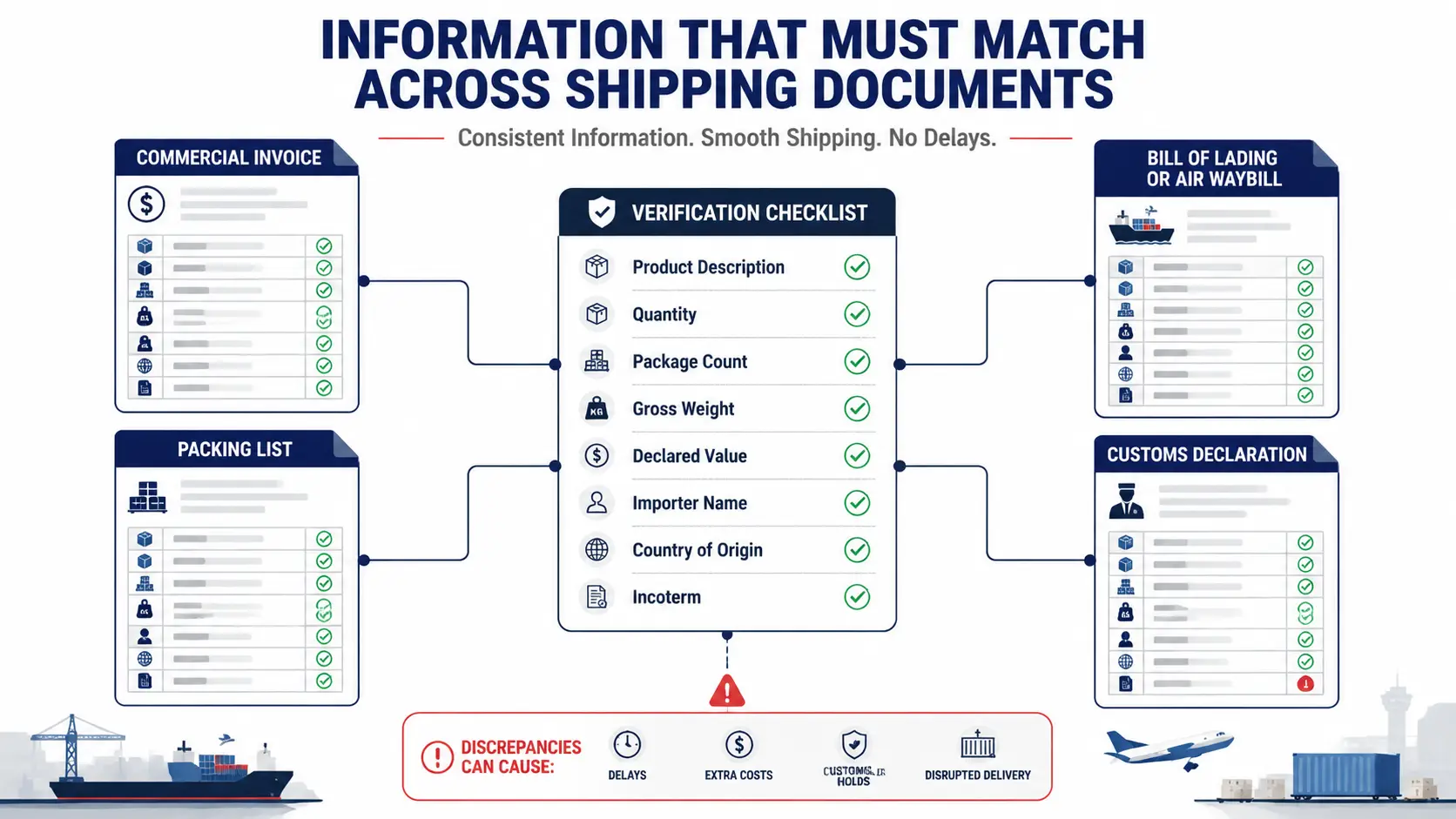
Document consistency is as important as document availability.
| Information | Documents That Should Be Consistent |
|---|---|
| Product description | Invoice, packing list, transport document and customs declaration |
| Quantity | Invoice, packing list and purchase order |
| Package count | Packing list, warehouse receipt and transport document |
| Gross weight | Packing list, booking and transport document |
| Declared value | Invoice, payment records and customs declaration |
| Currency | Invoice, purchase agreement and customs data |
| Buyer and importer | Invoice, importer account and customs declaration |
| Shipper and supplier | Invoice, packing list and transport document |
| Country of origin | Invoice, origin evidence and customs declaration |
| Incoterm | Purchase order, invoice and freight quotation |
| Container and seal | Loading record and bill of lading |
Small wording differences are not always a problem, but contradictory quantities, values, parties or product descriptions should be corrected before departure.
Common Shipping Document Mistakes
Using Vague Product Descriptions
“Accessories,” “samples” or “machine parts” do not provide enough information. Describe the product, material, function and model.
Declaring an Unsupported Value
Do not use an artificially low or zero value. The declared value should be supported by the transaction and commercial records.
Using a Pro Forma Invoice as the Final Invoice
Replace preliminary documents with a final commercial invoice reflecting the goods actually shipped.
Invoice and Packing List Mismatch
Quantities, package counts and product references should match. If several products are packed together, show how the items are distributed.
Incorrect Importer Information
Verify the importer’s legal name, address and account information before preparing the bill of lading or air waybill.
Missing Regulated-Product Documents
Do not wait until the cargo arrives at the airport, port or consolidation warehouse to check permits, battery reports, food licences or other compliance records.
Assuming DDP Means No Paperwork
DDP changes the division of cost and responsibility; it does not make commercial invoices, product data or compliance documents unnecessary.
Approving the Transport Document Too Late
Review the bill of lading or air waybill draft before final issuance. Corrections after departure can be slower and more expensive.
Pre-Shipment Document Workflow
Before Placing the Purchase Order
Confirm the product can be imported into Canada. Review classification, origin, labelling, permits and technical requirements.
Before Booking Freight
Collect the commercial invoice draft, packing details, cargo dimensions, product specifications, Incoterm and supplier pickup information.
For the complete operational sequence, read the guide on how to ship commercial goods from China to Canada.
Before Cargo Pickup
Confirm final carton count, gross weight, dimensions, packaging, dangerous goods status and warehouse delivery instructions.
Before Departure
Approve the final commercial invoice, packing list and transport-document draft. Send the customs file to the Canadian broker when applicable.
Before Arrival in Canada
Confirm that the importer account, customs broker, permits, release information and payment arrangements are ready. Do not wait for the arrival notice to begin document preparation.
How TopShipping Supports Shipping Documentation
TopShipping helps Canadian importers organize the information required to move commercial cargo from Chinese suppliers to Canada.
Depending on the service, our support may include:
- Coordinating commercial invoice and packing list corrections with suppliers
- Reviewing cargo descriptions, quantities, weights and dimensions for freight readiness
- Collecting documents from multiple Chinese suppliers
- Coordinating air waybill or bill of lading details
- Identifying missing product or dangerous goods information before booking
- Organizing shipment records for air freight, sea freight, consolidation and door-to-door delivery
- Coordinating shipment information with customs brokers and destination providers
- Supporting final delivery planning after customs release
Final customs classification, admissibility and regulatory requirements depend on the imported product and the responsible Canadian authorities. Importers should confirm product-specific requirements before shipping.
Request a Shipping Document Review
Incorrect documents can delay freight booking, export handling, customs release and final delivery. Reviewing the commercial invoice, packing list, product information and importer details before departure can reduce avoidable corrections and storage costs.
Send TopShipping your product description, supplier location, invoice, packing list, carton dimensions, gross weight, Incoterm and Canadian destination. We will review the freight information and help identify the documentation needed for the planned shipping service.
Comments 1
Questions, experience and practical feedback are welcome.