
Choosing between LCL vs FCL shipping from China to Canada is not simply a choice between sharing a container and booking a complete container. The correct option depends on chargeable volume, cargo density, destination handling charges, supplier locations, handling sensitivity, inventory deadlines and the final delivery point in Canada.
As a practical starting point, LCL is usually evaluated first for smaller shipments, while FCL becomes increasingly competitive as cargo volume rises. Shipments around 10–18 CBM should normally be quoted both ways because the true break-even point changes with the route, cargo weight, Chinese origin charges, Canadian destination fees and current ocean freight rates.
TopShipping compares the complete shipping scope—not only the port-to-port rate—to determine whether less than container load or full container load shipping offers the better landed-cost and operational result for your cargo.
LCL vs FCL Shipping at a Glance
| Comparison Factor | LCL Shipping | FCL Shipping |
|---|---|---|
| Container Use | Your cargo shares container space with shipments from other importers. | The complete container is booked for one shipment, even if it is not physically full. |
| Best For | Smaller commercial shipments, mixed SKUs, trial orders and multi-supplier consolidation. | Larger, heavier, recurring, fragile or handling-sensitive commercial cargo. |
| Pricing Basis | Usually charged by weight or measurement, known as W/M. | Quoted per 20ft, 40ft or 40ft High Cube container, plus route-specific charges. |
| Cargo Handling | More handling during consolidation and deconsolidation. | Fewer cargo handovers after the container is loaded and sealed. |
| Transit Flow | Requires origin CFS receiving, consolidation and destination deconsolidation. | Usually follows a more direct container movement through container yards and terminals. |
| Cost Efficiency | Usually more economical when cargo volume is too small to justify a dedicated container. | Usually provides a lower cost per CBM when container utilization is high. |
| Operational Control | Lower control over container loading sequence and co-loaded cargo. | Greater control over loading, cargo separation, bracing and container use. |
| Main Cost Risk | CFS, deconsolidation, minimum charges and destination handling can materially affect the total. | Container trucking, terminal charges, demurrage, detention and unloading delays can increase cost. |
For a broader overview of port options, container services and delivery routes, review our sea freight from China to Canada service.
What Is LCL Shipping?
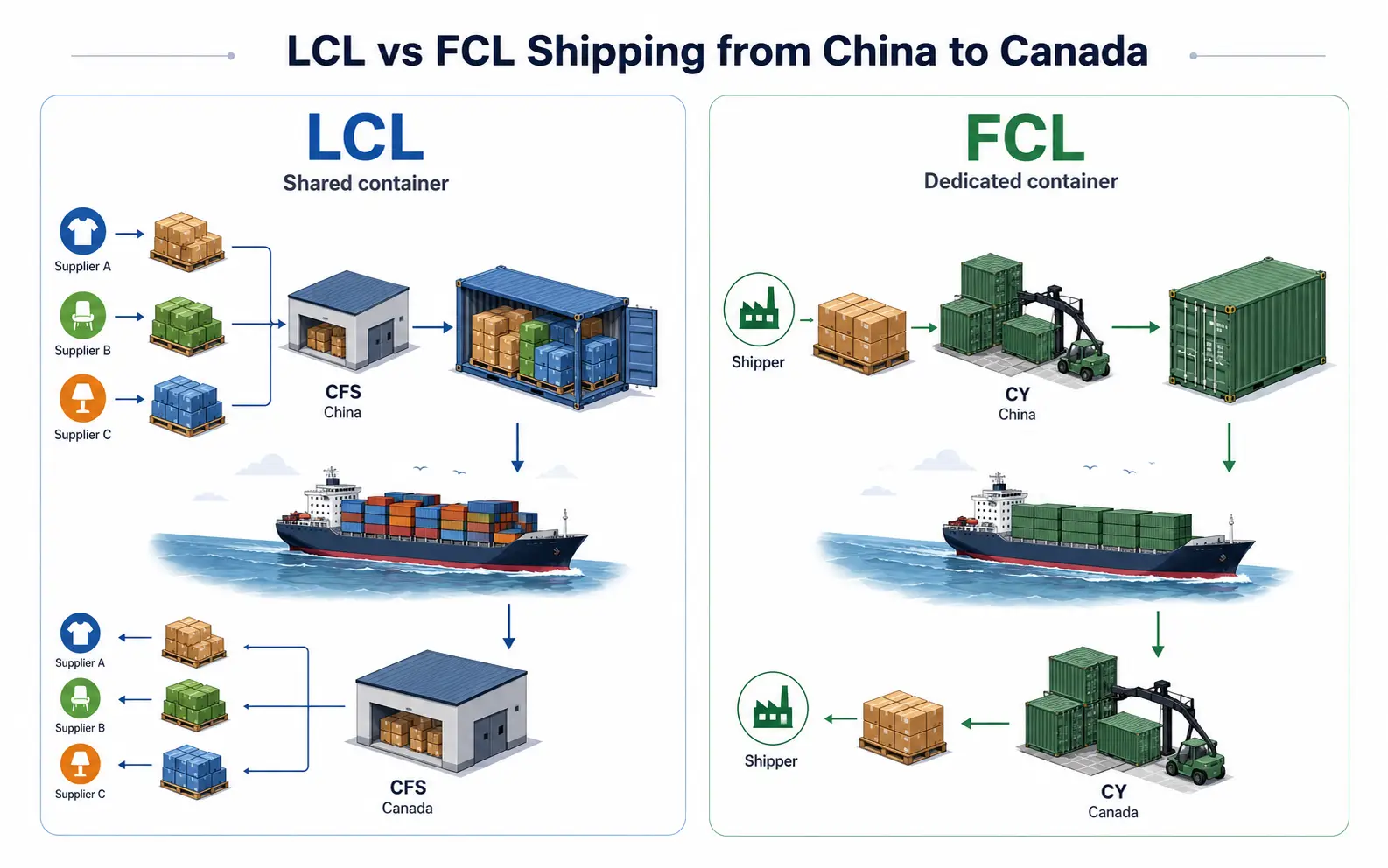
LCL stands for Less than Container Load. It is used when one shipment does not require an entire ocean container. Cartons, crates or pallets are delivered to a consolidation warehouse in China, where they are combined with compatible cargo moving toward the same destination region.
LCL shipments normally move through a container freight station, or CFS. At origin, the freight forwarder or consolidator receives the cargo, verifies package details, prepares the consolidation and loads several shipments into one container. After arrival in Canada, the container is moved to a destination CFS, opened and separated so each individual shipment can be released.
This structure allows Canadian importers to use ocean freight without paying for unused container space. However, the additional warehouse, consolidation and deconsolidation stages create more handling and more local charge items than a typical FCL shipment.
Typical LCL Shipment Flow
- Pickup from the supplier or delivery to the China consolidation warehouse.
- Cargo receiving, measurement, weighing and document verification.
- Consolidation with other compatible shipments.
- Container loading and export handling.
- Ocean transport from China to Canada.
- Destination CFS transfer and deconsolidation.
- Customs release and final truck delivery in Canada.
What Is FCL Shipping?
FCL stands for Full Container Load. In commercial shipping, FCL means the complete container is reserved for one shipment or one shipper. The container does not need to be filled to its maximum physical capacity. Importers may book FCL before the container is completely full when lower handling exposure, loading control, cargo security or schedule reliability is more important than maximum space utilization.
FCL cargo is commonly loaded at a factory, supplier warehouse or designated container loading facility. After loading, the container is sealed and transported to the departure port. It remains a single containerized unit through the ocean movement, although customs examinations, transloading or specific inland delivery arrangements may require the container to be opened.
Typical FCL Shipment Flow
- Empty container release and delivery to the loading location.
- Container loading, cargo securing and seal application.
- Submission of shipping instructions and Verified Gross Mass when required.
- Truck movement to the Chinese port and terminal gate-in.
- Ocean transport to a Canadian port.
- Customs release and terminal availability.
- Rail or truck delivery to the final warehouse or unloading location.
- Empty container return within the permitted free-time period.
For packed FCL containers, the shipper must arrange and communicate the container’s Verified Gross Mass before vessel loading. The International Maritime Organization explains the official SOLAS VGM requirement.
When Should You Choose LCL or FCL?
Cargo volume is the first filter, but it should not be the only decision factor. A low-density 15 CBM shipment, a high-value 8 CBM shipment and a dense 12 CBM machinery shipment can produce different recommendations even when they move on the same trade lane.
| Shipment Profile | Recommended Starting Point | Planning Note |
|---|---|---|
| Under 5 CBM | LCL is usually the first option to quote. | Check minimum CFS, documentation and delivery charges because fixed fees can be significant on very small shipments. |
| 5–10 CBM | LCL is commonly more economical. | FCL may still be considered for fragile, high-value, contamination-sensitive or urgent commercial cargo. |
| 10–15 CBM | Quote both LCL and 20ft FCL. | Destination charges, weight and route-specific container rates can change the result. |
| 15–20 CBM | FCL often becomes operationally and financially competitive. | Compare total door-to-door cost rather than only the ocean freight line. |
| Above 20 CBM | FCL is normally the primary option. | Confirm whether a 20ft, 40ft or 40ft High Cube provides the best weight and volume utilization. |
| Heavy Cargo at Lower CBM | Compare W/M LCL against 20ft FCL. | Dense cargo can become expensive under weight-based LCL charging before it fills a container. |
These volume ranges are planning guides, not fixed shipping rules. The correct decision requires an all-in comparison for the actual origin, destination, cargo and shipment date.
LCL vs FCL Cost from China to Canada
The cheapest port-to-port rate is not always the cheapest shipment. A reliable LCL vs FCL cost comparison must include origin handling, ocean freight, Canadian destination charges, customs services and final delivery.
Current freight rates change frequently. For updated market ranges and the main cost drivers, use our dedicated shipping cost from China to Canada guide.
How LCL Shipping Cost Is Calculated
LCL ocean freight is commonly calculated by weight or measurement, shown as W/M. The chargeable unit is normally the greater of:
- Total cargo volume in cubic metres; or
- Total gross weight in metric tons.
CBM formula: Length × Width × Height in metres × number of packages.
When package dimensions are supplied in centimetres, use: Length × Width × Height × quantity ÷ 1,000,000.
Chargeable W/M formula: Compare total CBM with gross weight in metric tons and use the higher result.
| Cargo Example | Volume | Gross Weight | Chargeable W/M | Reason |
|---|---|---|---|---|
| Cartons of consumer goods | 2.4 CBM | 680 kg | 2.4 W/M | Volume is greater than 0.68 metric tons. |
| Dense machine parts | 1.2 CBM | 1,600 kg | 1.6 W/M | Weight in metric tons is greater than volume. |
| Palletized retail inventory | 8.5 CBM | 3,200 kg | 8.5 W/M | Volume is greater than 3.2 metric tons. |
The W/M rate is only one part of an LCL quotation. Origin CFS handling, export documentation, destination deconsolidation, customs clearance and final delivery may be charged separately.
If your supplier has provided carton dimensions but not a confirmed shipment volume, calculate your sea-freight CBM before comparing LCL and FCL quotations.
How FCL Shipping Cost Is Calculated
FCL is normally quoted as a rate for a specific container type and route. The base freight may be quoted per 20ft, 40ft or 40ft High Cube container, but the complete shipment can also include:
- Empty container positioning and factory pickup;
- Container loading or warehouse loading charges;
- Export customs and documentation;
- Origin and destination terminal handling;
- Ocean freight and carrier surcharges;
- Canadian customs brokerage, duties and taxes;
- Rail transportation, drayage and final delivery;
- Chassis, waiting time, storage, demurrage or detention when applicable.
All-In Cost Components
| Cost Component | LCL Treatment | FCL Treatment | What to Check |
|---|---|---|---|
| Supplier Pickup | Truck pickup to the consolidation warehouse. | Truck delivery, empty container positioning or factory loading. | Distance from supplier to warehouse or port. |
| Origin Handling | CFS receiving, weighing, measuring and consolidation. | Container handling, loading coordination and terminal gate-in. | Whether charges are included under EXW or FOB terms. |
| Ocean Freight | Usually charged per W/M. | Usually charged per container. | Route, carrier, sailing schedule and surcharges. |
| Destination Handling | CFS transfer, deconsolidation and shipment release charges. | Terminal handling and container availability charges. | Do not compare quotes without destination charges. |
| Customs Clearance | Required for the individual commercial shipment. | Required for the containerized commercial shipment. | Brokerage scope, importer setup and document accuracy. |
| Final Delivery | Usually delivered as cartons, pallets or crates from the CFS. | Container delivery, live unload, drop-and-pick or transload delivery. | Postal code, dock availability, appointment and unloading time. |
| Delay Charges | CFS storage or delayed cargo pickup. | Demurrage, detention, chassis and truck waiting time. | Free time, customs readiness and warehouse unloading capacity. |
LCL vs FCL Transit Time and Schedule Reliability
Both methods use ocean freight, but LCL normally requires more operational stages. The cargo must meet the consolidator’s warehouse cut-off, wait for the planned consolidation, and be separated at the destination CFS before customs release and delivery.
FCL avoids cargo-level consolidation and deconsolidation. This can reduce handling time and make the shipment flow more predictable, although the container can still be delayed by vessel schedules, port congestion, customs examinations, rail capacity or delivery appointments.
| Shipping Stage | LCL | FCL |
|---|---|---|
| Cargo Cut-Off | Must arrive at the CFS before the consolidator’s receiving deadline. | Container must be loaded and gated into the terminal before vessel cut-off. |
| Origin Processing | Receiving, measurement, warehouse handling and consolidation. | Container loading, sealing, VGM and terminal delivery. |
| Ocean Movement | Moves inside a shared consolidated container. | Moves as a dedicated container unit. |
| Destination Processing | Container transfer to CFS, unloading and shipment separation. | Container release after terminal and customs processing. |
| Final Delivery | Delivery after individual cargo availability. | Container delivery, transload or inland rail and drayage. |
For route-specific planning ranges and a breakdown of port-to-port versus door-to-door lead time, read our shipping time from China to Canada guide.
Cargo Handling, Damage Risk and Shipment Control
FCL normally involves fewer cargo handovers after loading, but it is not automatically damage-proof. Cargo must still be packed, blocked, braced and distributed correctly inside the container. Poor weight distribution, weak cartons, insufficient moisture protection or inadequate securing can damage an FCL shipment even when the container remains sealed.
LCL cargo is handled at both origin and destination warehouses and may be loaded near cargo from other shippers. Strong export packaging is therefore particularly important. Fragile products, high-value goods, irregular crates, moisture-sensitive goods and cargo that should not be stacked require clear handling instructions before booking.
| Cargo Characteristic | LCL Consideration | FCL Consideration |
|---|---|---|
| Fragile Goods | Require strong crates, pallet protection and clear non-stack instructions. | Provides greater control over loading and cargo separation. |
| High-Value Cargo | Can be shipped, but handling points and insurance conditions must be reviewed. | Fewer cargo handovers may make FCL preferable when the cost difference is reasonable. |
| Heavy Machinery | Weight-based W/M and CFS handling limits must be checked. | A 20ft container is often more practical for dense cargo, subject to axle and road limits. |
| Bulky Lightweight Goods | Charged mainly by volume. | A 40ft High Cube can provide better volume efficiency. |
| Mixed Supplier Orders | Well suited to consolidation when total volume remains moderate. | Can combine suppliers into one dedicated container when total volume is sufficient. |
Cargo insurance should be considered for both LCL and FCL. Carrier liability is limited and is not a substitute for appropriate marine cargo insurance based on the value and risk profile of the shipment.
FCL Container Sizes and Practical Loading Capacity
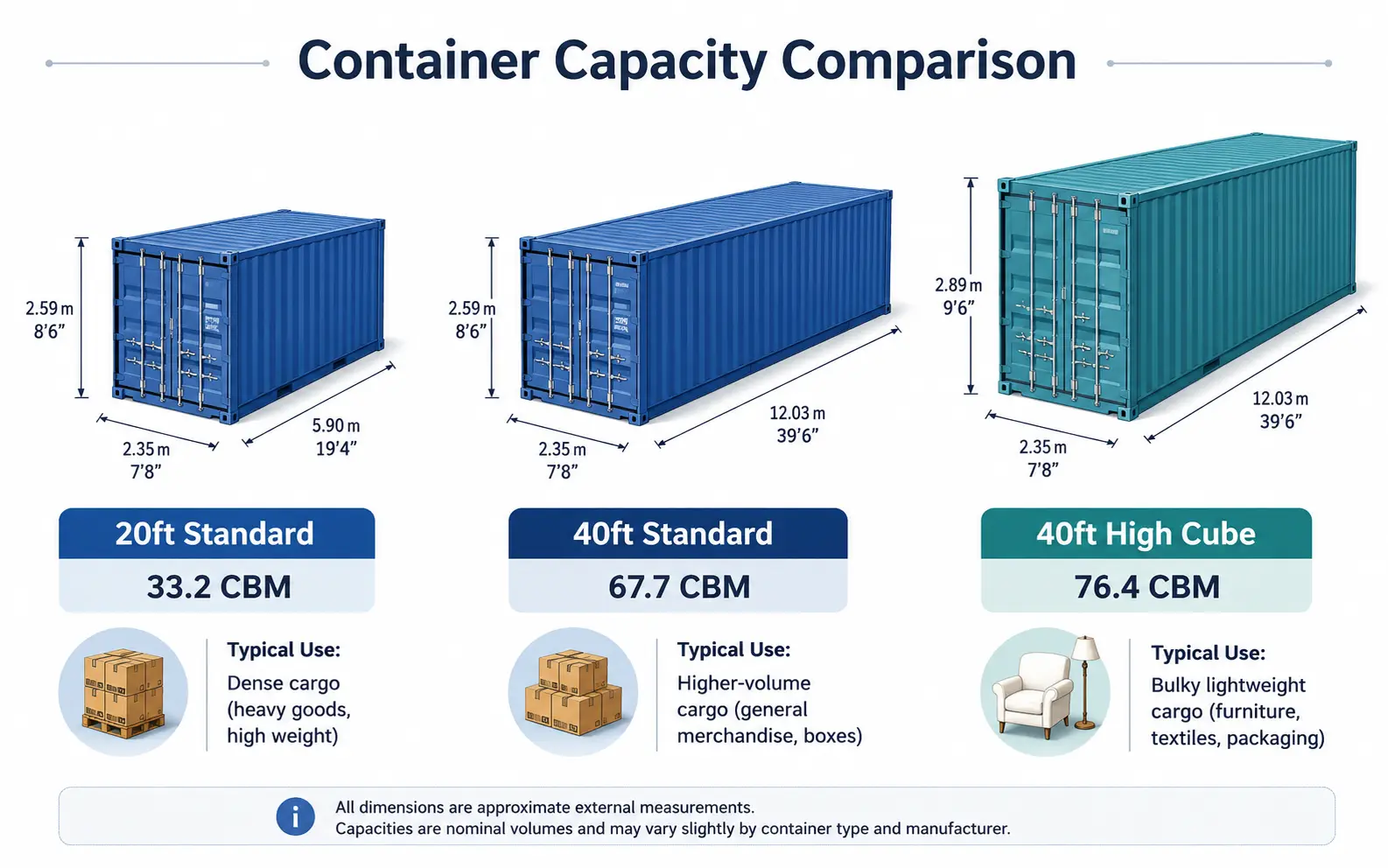
Nominal container volume is not the same as practical cargo capacity. Carton dimensions, pallet footprints, wooden crates, dunnage, load distribution and unusable gaps can reduce the amount that can actually be loaded.
| Container Type | Approx. Nominal Volume | Typical Planning Volume | Approx. Maximum Payload | Common Use |
|---|---|---|---|---|
| 20ft Standard | 33.2 CBM | About 25–28 CBM | About 28,300 kg | Dense cargo, machinery, metal products and smaller FCL shipments. |
| 40ft Standard | 67.7 CBM | About 55–60 CBM | About 28,870 kg | Higher-volume cartons, pallets and recurring inventory. |
| 40ft High Cube | 76.4 CBM | About 65–70 CBM | About 28,690 kg | Furniture, textiles and other bulky, lower-density goods. |
Container specifications vary by equipment and carrier. The container safety plate, permitted road weight, axle limits and inland transportation rules must be confirmed before loading. A container’s technical payload should not be treated as the automatically permitted cargo weight for every China-to-Canada routing.
LCL vs FCL for Multiple Suppliers in China
Importers buying from several factories should compare the cost of separate shipments against a coordinated consolidation plan. Supplier orders can be collected at a China warehouse, checked against packing lists and combined into one export movement.
For smaller combined volumes, LCL consolidation may reduce repeated origin charges and simplify shipment coordination. When combined cargo is large enough, suppliers can deliver to one loading warehouse and the goods can be loaded into a dedicated FCL container.
A proper consolidation plan should confirm:
- Supplier city and pickup address;
- Cargo-ready date for each order;
- Carton count, dimensions and gross weight by supplier;
- Commercial invoice and packing list consistency;
- SKU labels, pallet requirements and shipment marks;
- Whether inspection, repacking or photo verification is required;
- The final combined CBM and container utilization.
Learn more about our China freight consolidation service.
Customs Clearance for LCL and FCL Shipments to Canada
LCL and FCL shipments are both subject to Canadian import requirements. Choosing LCL does not remove customs duties, taxes, product compliance or importer obligations. The customs process depends on the imported product, HS classification, declared value, country of origin and applicable government requirements—not simply the container method.
Canadian commercial importers generally need a Business Number and import/export program account. Importers should also complete their CARM setup and authorize their customs broker before cargo arrival. The official CBSA guide to importing commercial goods and the CARM information portal provide current government guidance.
| Document or Information | Main Requirement | Why It Matters |
|---|---|---|
| Commercial Invoice | Clear product description, quantity, value, currency, seller, buyer, origin and Incoterm. | Supports customs valuation, classification and duty assessment. |
| Packing List | Package count, dimensions, net weight, gross weight and packaging type. | Allows the forwarder, warehouse and customs broker to reconcile the physical cargo. |
| Bill of Lading | Shipper, consignee, notify party, ports, routing and cargo details. | Serves as the primary ocean transport document. |
| HS Code | Product-specific tariff classification. | Determines duty treatment, taxes and possible regulatory controls. |
| Importer Details | Legal business information, BN/RM account and broker authorization. | Required for commercial accounting and customs release. |
| Certificates or Permits | Product-specific approvals, test reports or regulated-goods documents. | Required for controlled goods such as food, cosmetics, medical products, chemicals or certain wood products. |
TopShipping can coordinate shipment documents and work with the importer and broker through our customs clearance from China to Canada service.
How Incoterms Affect the LCL vs FCL Comparison
The supplier’s quotation may be based on EXW, FOB, DAP, DDP or another Incoterm. The same cargo can produce a different LCL-versus-FCL result depending on which party pays for pickup, export handling, port charges, customs clearance and delivery.
| Incoterm | Typical Supplier Scope | Main Importer or Forwarder Scope | LCL/FCL Planning Effect |
|---|---|---|---|
| EXW | Makes cargo available at the supplier location. | Pickup, export handling, international freight, import clearance and delivery. | Origin pickup and consolidation costs must be included in the comparison. |
| FOB | Handles export clearance and delivery to the named Chinese port under the agreed scope. | Ocean freight, Canadian import clearance and destination delivery. | Useful for comparing the international and destination portions of LCL and FCL. |
| DAP | Arranges transport to the named destination. | Usually handles import clearance, duties, taxes and unloading. | Confirm which destination and customs charges are excluded. |
| DDP | Assumes the agreed duty-paid delivery obligations. | Receives the cargo under the confirmed arrangement. | Compare the full landed scope and confirm importer-of-record and compliance responsibilities. |
For a detailed responsibility and cost comparison, read our FOB vs EXW vs DDP China to Canada guide.
Practical LCL vs FCL Shipping Scenarios
| Shipment Scenario | Likely Starting Option | Reason |
|---|---|---|
| 3 CBM of mixed retail products from two suppliers | LCL with consolidation | The combined volume is small and supplier orders can be received at one China warehouse. |
| 8 CBM of fragile, high-value equipment | Quote both LCL and FCL | LCL may cost less, but FCL can reduce cargo handling if the price difference is acceptable. |
| 12 CBM of dense metal components | Quote both, with careful weight review | Weight-based LCL charging may make a 20ft container competitive before the cargo reaches high volume. |
| 17 CBM of regular wholesale inventory | 20ft FCL is often worth evaluating first | The shipment is near a common decision range where flat container pricing may outperform all-in LCL cost. |
| 26 CBM of machinery and industrial parts | 20ft FCL | Dense cargo can use the weight capability of a 20ft container more efficiently. |
| 60 CBM of furniture or lightweight household goods | 40ft High Cube FCL | High-cube equipment provides greater usable volume for bulky, lower-density cargo. |
Choose LCL Shipping When
- Your cargo occupies only a small part of a container.
- You are testing a new supplier, SKU or Canadian market.
- You want to import smaller inventory batches more frequently.
- You are combining moderate volumes from multiple suppliers.
- Your delivery schedule can accommodate consolidation and deconsolidation.
- Your cargo is correctly packed for additional warehouse handling.
- The complete all-in LCL quotation remains lower than the FCL alternative.
Choose FCL Shipping When
- Your shipment is large enough to make a dedicated container economical.
- Your cargo is dense, heavy, bulky or palletized.
- You need greater control over container loading and cargo separation.
- Your goods are fragile, high-value or sensitive to repeated handling.
- You import recurring wholesale or production inventory.
- Your warehouse can unload the container within the available delivery window.
- The all-in FCL cost is close to or lower than the all-in LCL cost.
How TopShipping Compares LCL and FCL Options
TopShipping reviews the full China-to-Canada movement rather than selecting a shipping method from CBM alone. The comparison can include supplier pickup, consolidation, origin charges, ocean freight, Canadian destination charges, customs support and final delivery.
Our team evaluates:
- Total CBM and gross weight;
- Cargo density and package dimensions;
- Number and location of Chinese suppliers;
- Product value, fragility and handling restrictions;
- Cargo-ready date and inventory deadline;
- Chinese port and Canadian routing options;
- Incoterm and quotation scope;
- Customs, compliance and document requirements;
- Delivery address, dock access and unloading capability;
- Total all-in cost and operational risk.
Both LCL and FCL can be arranged within a coordinated door-to-door shipping from China to Canada solution.
Information Needed for an LCL or FCL Quote
| Required Detail | Information to Provide |
|---|---|
| Origin | Supplier city, pickup address or agreed Chinese port. |
| Destination | Canadian city, postal code and complete delivery address. |
| Cargo | Accurate product name, material, intended use and HS code if available. |
| Packages | Carton, pallet or crate count for each supplier. |
| Dimensions | Length, width and height of every package type. |
| Weight | Gross weight by package type and total gross weight. |
| Commercial Terms | EXW, FOB, DAP, DDP or another agreed Incoterm. |
| Timing | Cargo-ready date and required delivery window. |
| Special Requirements | Batteries, liquids, powders, chemicals, wood packaging, fragile goods, oversized cargo or temperature requirements. |
Incomplete dimensions or estimated weights can change the W/M calculation, container selection and final freight cost.
Request an LCL or FCL Shipping Quote
Send TopShipping your supplier location, Canadian delivery address, cargo description, carton or pallet count, dimensions, gross weight, Incoterm and cargo-ready date. We will compare LCL and FCL options based on total cost, transit flow, handling exposure and delivery requirements.
Comments 1
Questions, experience and practical feedback are welcome.