
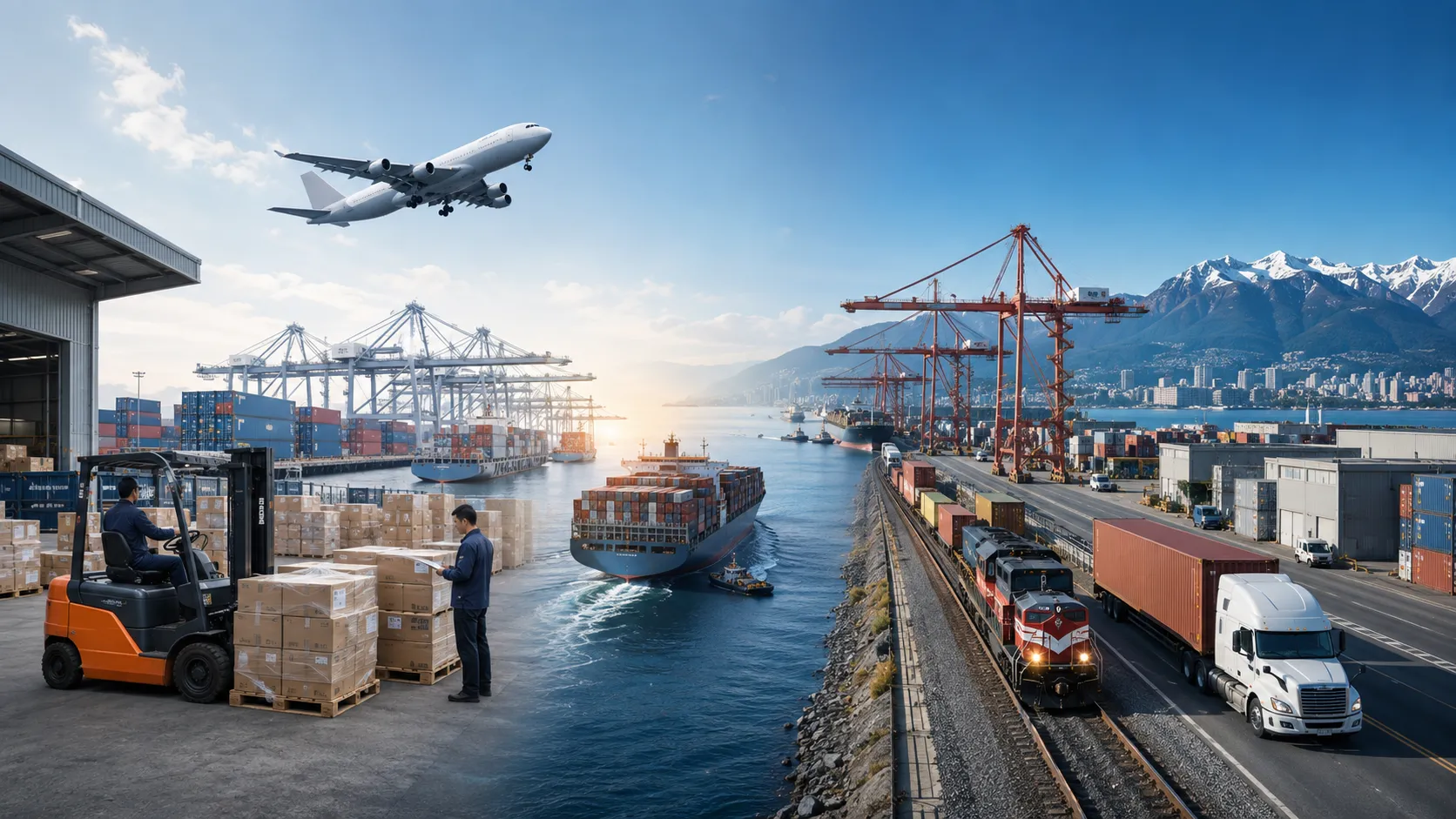
Shipping from Shenzhen to Canada can be arranged by commercial air freight, LCL sea freight, FCL container shipping or a coordinated door-to-door freight service. Shenzhen is one of the most practical South China origins for Canadian importers because cargo can be collected from Shenzhen itself or nearby manufacturing centres such as Dongguan and Huizhou, then routed through major air or ocean gateways according to cargo size, urgency and destination in Canada.
For August 2026 planning, standard commercial air freight from China to Canada is approximately USD $6.00–$8.50 per chargeable kilogram, coordinated door-to-door air freight approximately USD $7.50–$12.00 per chargeable kilogram, LCL sea freight approximately USD $150–$220 per chargeable CBM or W/M, a 20ft FCL container approximately USD $6,500–$8,000, and a 40ft or 40HQ container approximately USD $7,200–$9,000.
Typical complete planning time is approximately 5–12 business days by air, 25–50 days by FCL sea freight and 30–55 days by LCL. These are business-planning ranges rather than guaranteed carrier schedules or fixed Shenzhen-specific quotations.
This page focuses on the Shenzhen-to-Canada route: supplier geography, Shenzhen port and airport selection, South China consolidation, air and ocean freight routing, Canadian gateways and final inland delivery. For the wider country-to-country process, use our China-to-Canada freight guide.
Shipping from Shenzhen to Canada: Quick Planning Snapshot
| Shipping method | August 2026 planning cost | Main international movement | Typical complete planning time | Best suited for |
|---|---|---|---|---|
| Express courier | USD $12–$18+ per chargeable kg | 2–5 days | 3–7 business days | Samples, documents and small urgent parcels |
| Standard air freight | USD $6.00–$8.50 per chargeable kg | 3–5 days airport to airport | 5–12 business days | Urgent commercial inventory |
| Door-to-door air freight | USD $7.50–$12.00 per chargeable kg | Uses the selected air route | 5–12 business days | Time-sensitive supplier-to-warehouse cargo |
| LCL sea freight | USD $150–$220 per chargeable CBM or W/M | 20–40 days | 30–55 days | Smaller planned ocean shipments |
| 20ft FCL | USD $6,500–$8,000 | 16–30 days | 25–50 days | Dense or medium-volume commercial cargo |
| 40ft / 40HQ FCL | USD $7,200–$9,000 | 16–30 days | 25–50 days | Bulky, wholesale or recurring inventory |
Planning note: Rates are indicative market-planning ranges in US dollars. Supplier pickup, origin handling, customs brokerage, duty, GST, examinations, storage, destination handling, rail or truck transportation and final delivery may be additional depending on the quotation.
For detailed rate calculations, use our current freight-rate and landed-cost guide. For detailed timelines, use our China-to-Canada transit and delivery-time guide.
Why Shenzhen Is Different from Other China Shipping Origins
Shenzhen is not simply another city from which cargo can be exported. It sits inside one of South China’s densest manufacturing and logistics regions and gives importers access to several different export gateways.
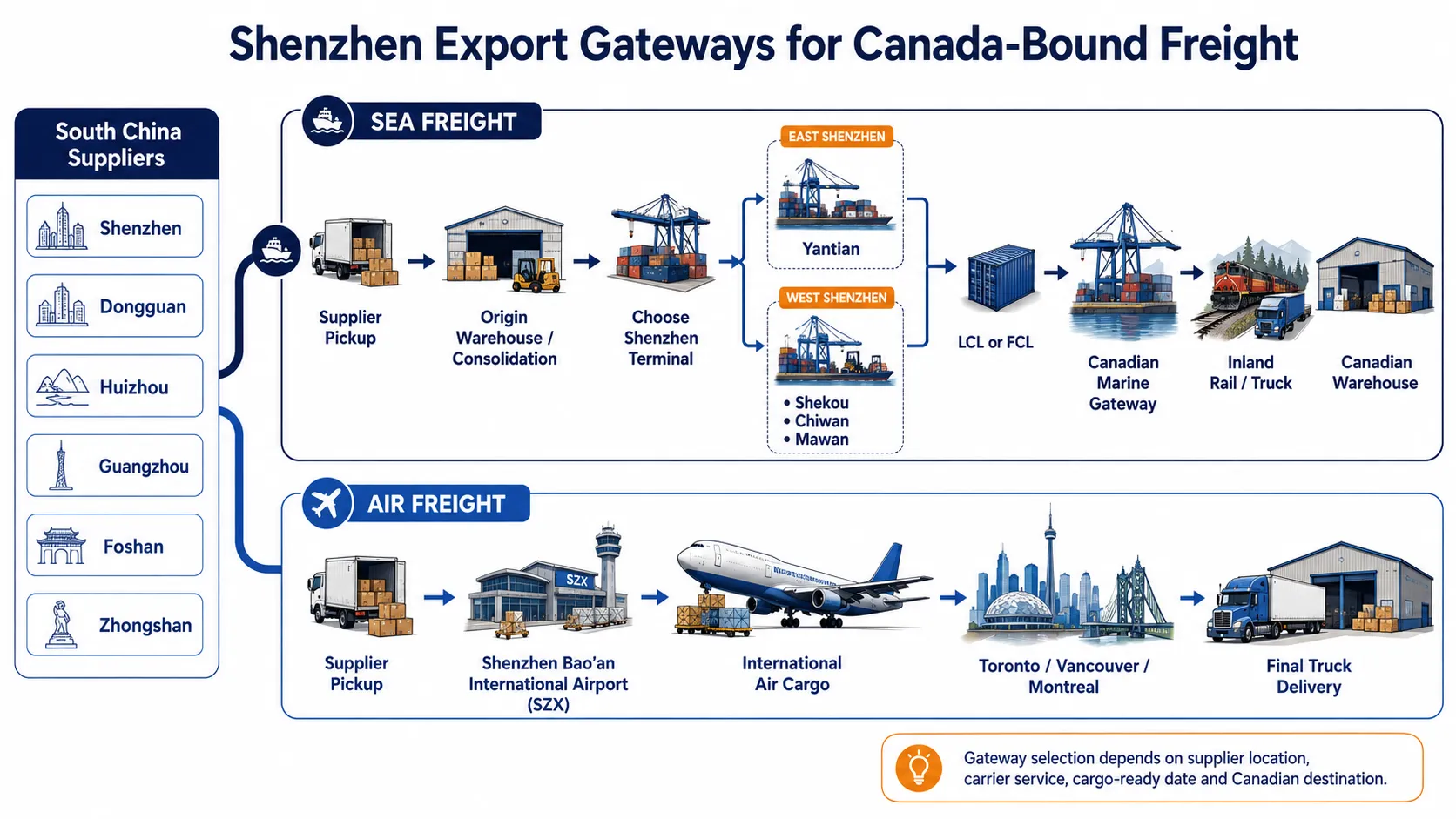
The practical advantage is flexibility. A shipment collected in Shenzhen may use a Shenzhen airport, an eastern Shenzhen container terminal or a western Shenzhen container terminal depending on the supplier location, freight method, carrier service and booking conditions.
Nearby manufacturing areas can also feed into a Shenzhen shipment. Common supplier locations include:
- Shenzhen
- Dongguan
- Huizhou
- Guangzhou
- Foshan
- Zhongshan
- Other Pearl River Delta manufacturing locations
However, cargo should not automatically be trucked to Shenzhen only because the importer describes the order as “South China cargo.” If the supplier is closer to another practical gateway and the available carrier service is better there, the origin plan should be compared before pickup.
Which Shenzhen Gateway Should Your Cargo Use?
Not every Shenzhen sea shipment leaves from the same terminal. Shenzhen has important container facilities on both its eastern and western sides, and terminal selection can affect factory-pickup distance, cut-off times, carrier availability and origin handling.
Yantian International Container Terminal
Yantian is an important deep-water container gateway in eastern Shenzhen and is strongly connected to South China export manufacturing.
It can be particularly practical when the supplier, warehouse or consolidation activity is located in eastern Shenzhen, Longgang, Yantian, eastern Dongguan, Huizhou or nearby areas, subject to the actual vessel service.
Importers do not normally choose a terminal based only on geographic distance. The freight forwarder should also review the carrier service, sailing, container availability and cargo-ready date.
For terminal information, the official Yantian International Container Terminals website is the primary operational reference.
Shekou, Chiwan and Mawan
Western Shenzhen also has major container operations through the Shekou, Chiwan and Mawan terminal network.
These terminals can be practical for cargo from western Shenzhen, Nanshan, Bao’an and surrounding Pearl River Delta areas when the selected carrier and service use western Shenzhen.
The important planning principle is:
Supplier location + carrier service + terminal cut-off + destination routing should determine the gateway, not the city name alone.
The China Merchants Port South China terminal information provides official information for the western Shenzhen terminal network.
Shenzhen Bao’an International Airport (SZX)
Shenzhen Bao’an International Airport, identified by the IATA code SZX, is the main Shenzhen airport used for international commercial air-cargo planning.
Air cargo through Shenzhen may be appropriate for electronics, components, time-sensitive inventory, replacement parts, launch stock and other commercial shipments where inventory availability is more important than the lower cost of ocean freight.
The final airline routing should be confirmed at booking because cargo may use direct or connecting services according to destination, capacity and cargo acceptance.
The official Shenzhen Bao’an International Airport website should be used for current airport information.
How to Choose Between Shenzhen Air and Sea Freight
| Shipment condition | Recommended starting option | Reason |
|---|---|---|
| Small and very urgent | Express courier | Integrated parcel-style service |
| Commercial cargo needed quickly | Air freight | Shorter inventory lead time |
| Higher-value compact cargo | Air freight | Speed may justify higher transport cost |
| Smaller planned ocean cargo | LCL | Uses shared container capacity |
| Approximately 10–18 CBM | Compare LCL and FCL | Destination charges can change the economics |
| Heavy or larger commercial inventory | FCL | Dedicated container capacity |
| Several South China suppliers | Consolidation first | Creates one coordinated freight movement |
| Only selected SKUs are urgent | Split air + sea | Protects inventory without airfreighting the whole order |
For a wider modal comparison, use our air-versus-ocean freight decision guide.
Air Freight from Shenzhen to Canada
Air freight from Shenzhen to Canada is normally selected when the importer has a fixed inventory requirement or when the cost of waiting for sea freight exceeds the additional transportation cost.
Common Shenzhen air-cargo profiles include:
- Electronics and electronic components
- Consumer technology products
- Production parts
- Replacement components
- E-commerce launch inventory
- High-value compact products
- Samples and prototypes
- Shortage quantities required before an ocean shipment arrives
Air Freight Timeline
| Air-freight stage | Indicative planning time |
|---|---|
| Supplier pickup around Shenzhen or nearby South China | 1–2 business days |
| Receiving, measurement, screening and export handling | 1–3 business days |
| Main air movement | 3–5 days |
| Canadian airport handling and routine customs release | 1–3 business days |
| Final delivery | 1–4 business days depending on destination |
| Typical combined planning range | 5–12 business days |
Planning note: Some stages can overlap, so the complete timeline should not be calculated by adding the maximum value of every stage.
For chargeable weight, air-cargo terminology and detailed operational guidance, use our commercial air-cargo guide.
Sea Freight from Shenzhen to Canada
Sea freight is normally the stronger option for heavy, bulky, recurring or planned commercial cargo from Shenzhen.
Ocean freight can move as LCL or FCL through a suitable Shenzhen container terminal before reaching a Canadian marine gateway.
LCL Shipping from Shenzhen
LCL, or Less than Container Load, is used when the importer does not need a complete container.
The cargo normally passes through an origin consolidation process and later a destination deconsolidation process. This creates more handling stages than FCL and means the ocean freight rate itself is only one component of the complete delivered cost.
LCL can be practical for:
- Smaller commercial orders
- One or several pallets
- Trial shipments
- Mixed SKUs
- Orders from several South China suppliers
- Recurring smaller replenishment shipments
LCL can be rated using CBM or Weight/Measurement. If your supplier has provided carton dimensions but not the final cargo volume, use our sea-freight CBM calculation guide before comparing quotations.
FCL Container Shipping from Shenzhen
FCL reserves a dedicated container for the shipment and can become more practical as volume, cargo density or handling sensitivity increases.
| Container type | Nominal internal volume | Typical practical loading range |
|---|---|---|
| 20ft Standard | About 33 CBM | 25–28 CBM |
| 40ft Standard | About 67–68 CBM | 55–60 CBM |
| 40ft High Cube | About 76 CBM | 65–70 CBM |
Capacity note: Practical container utilization depends on carton dimensions, pallets, crates, cargo weight, loading orientation and unusable space.
Once commercial cargo approaches approximately 10–18 CBM, requesting both LCL and FCL quotations is normally a sensible planning step rather than assuming that LCL remains cheaper.
For the complete comparison, use our LCL vs FCL shipping guide.
For wider container operations and ocean-freight terminology, review our commercial ocean freight guide.
Shenzhen to Vancouver Sea Freight
Vancouver is one of the most important Canadian marine gateways for trans-Pacific container freight originating in South China.
A Shenzhen-to-Vancouver shipment can involve:
- Supplier pickup in Shenzhen or nearby South China
- Container terminal or LCL consolidation facility
- Yantian or an appropriate western Shenzhen terminal
- International ocean movement
- Vancouver-area marine terminal
- Canadian customs release and cargo availability
- Local drayage or inland rail/truck transportation
- Final delivery
The shipment should not be planned only around the vessel arrival date. Container availability, customs release, terminal availability and final inland transportation still need to occur before the cargo is commercially available.
Shipping from Shenzhen to Toronto and the Greater Toronto Area
Toronto is an inland Canadian destination, not a trans-Pacific container port.
Ocean cargo destined for Toronto, Markham or other Greater Toronto Area locations normally first reaches an appropriate Canadian marine gateway and then continues inland by rail and/or truck.
Air cargo can arrive through Toronto-area air-cargo facilities according to the selected airline routing.
For businesses delivering into Markham or the GTA, see our GTA and Markham freight-delivery guide.
Shipping from Shenzhen to Western and Central Canada
For destinations such as Calgary, Edmonton and Winnipeg, the international gateway and the final delivery city should be treated as separate logistics decisions.
For ocean freight, the cargo may arrive at a Canadian marine gateway and continue inland by rail and truck. For air freight, routing depends on available airline services, connections and cargo acceptance.
Always provide the exact Canadian postal code when requesting a quotation because inland transportation can materially affect the complete freight cost and delivery timeline.
Multi-Supplier Consolidation in Shenzhen
Shenzhen can work as an origin coordination point when a Canadian importer purchases goods from several South China factories.
For example, an importer may purchase:
- Electronics from Shenzhen
- Components from Dongguan
- Packaging from Huizhou
- Accessories from Guangzhou
Compatible cargo can be collected and received into an origin warehouse before the combined shipment is finalized.
Recommended Consolidation Workflow
- Record each supplier and purchase order.
- Confirm supplier pickup addresses.
- Track each cargo-ready date independently.
- Collect ready cargo into the agreed consolidation facility.
- Confirm carton or pallet quantities.
- Measure final dimensions and gross weight.
- Review commercial documents supplier by supplier.
- Calculate the combined shipment CBM.
- Compare air, LCL and FCL according to the final cargo profile.
- Release the combined shipment for export.
A consolidation plan should not automatically wait indefinitely for one late supplier. If critical cargo is ready and a non-critical supplier is delayed, splitting the shipment can be commercially better.
For the dedicated process, use our multi-supplier cargo consolidation guide.
Electronics and Battery Cargo from Shenzhen
Shenzhen-origin shipments frequently include electronic products or components, which makes advance cargo classification especially important.
Before booking, confirm whether the goods contain:
- Lithium-ion batteries
- Lithium-metal batteries
- Batteries packed with equipment
- Batteries contained in equipment
- Power banks
- Liquids
- Magnets
- Chemicals
- Aerosols
- Other regulated or sensitive materials
Battery-powered or dangerous-goods cargo should not be booked as ordinary general cargo without first confirming the product configuration, documentation, packaging and carrier acceptance requirements.
The freight method can also affect how the cargo must be prepared. Air and ocean transportation do not necessarily apply identical acceptance rules.
Door-to-Door Shipping from Shenzhen to Canada
Door-to-door freight can connect supplier pickup in Shenzhen with an agreed Canadian business, warehouse or 3PL destination.
Depending on the quotation, the coordinated process may include:
- Supplier pickup
- Origin warehouse receiving
- Multi-supplier consolidation
- Export handling
- Air or ocean freight
- Canadian destination handling
- Customs-clearance coordination
- Rail, drayage or truck transportation
- Final commercial delivery
Door-to-door does not automatically mean that duty, GST, customs examinations, storage, demurrage, detention, appointments or every destination charge is included.
For detailed service scope, use our supplier-to-warehouse delivery guide.
DDP Shipping from Shenzhen to Canada
DDP, or Delivered Duty Paid, is an Incoterm rather than a transportation mode.
The shipment may still move by air, LCL or FCL while DDP defines a broader seller delivery responsibility under the agreed commercial structure.
A Canadian importer considering DDP should confirm:
- The named Canadian delivery location
- The importer structure
- Canadian tariff classification
- Declared customs value
- Country of origin
- Responsibility for duty and GST
- Customs representation
- Product admissibility
- Final delivery scope
- Treatment of storage or examination charges
For detailed responsibilities, use our delivered-duty-paid shipping guide.
Customs Preparation for Shenzhen-to-Canada Cargo
The fact that cargo originates in Shenzhen does not change the need to prepare the Canadian commercial import correctly.
Before the goods leave China, confirm:
- Canadian importer details
- Business Number and applicable RM account
- CARM setup where applicable
- Product description
- Canadian HS tariff classification
- Country of origin
- Commercial value and currency
- Applicable duty and GST
- Permits or certificates where required
- Commercial invoice
- Packing list
- Air waybill or bill of lading information
The official CBSA commercial importing resources should be used for current Canadian commercial-import requirements.
For deeper clearance preparation, use our Canadian customs-release workflow. For classification and border-cost planning, use our Canadian tariff, duty and GST guide.
Shipping Documents from Shenzhen to Canada
Commercial shipment documents should describe the actual goods and physical cargo accurately.
| Document or information | Main purpose |
|---|---|
| Commercial invoice | Identifies products, value, transaction and commercial terms |
| Packing list | Shows cartons, pallets, weight, dimensions and packing structure |
| Air waybill | Transportation document for air freight |
| Bill of lading | Transportation document for ocean freight |
| Product description | Supports carrier and customs review |
| HS classification | Supports Canadian tariff reporting |
| Country-of-origin information | Supports tariff and trade-measure review |
| Permits or certificates | Required for regulated products where applicable |
Internal supplier model names such as “Part A,” “Accessory,” or “Sample” may not be detailed enough for commercial transportation and customs purposes.
For a full pre-shipment checklist, review our commercial shipping-document guide.
How Incoterms Affect Shenzhen Freight
The Incoterm determines important responsibilities between the Chinese supplier and Canadian buyer.
| Incoterm | Shenzhen logistics implication |
|---|---|
| EXW | The buyer generally coordinates collection beginning at the supplier location |
| FCA | The seller delivers to the agreed carrier or named location |
| FOB | For applicable sea freight, the seller places cargo on board at the named port |
| CIF | The seller arranges applicable ocean carriage and specified insurance to the named port under the rule |
| DAP | The seller arranges delivery toward the named destination while import clearance normally remains with the buyer |
| DDP | The seller takes extensive delivery and import responsibilities subject to legal and operational feasibility |
A quote should not simply say “FOB Shenzhen.” The actual named port or place should be stated because Shenzhen has several potential ocean terminals.
For a broader responsibility comparison, review our buyer-and-seller shipping responsibility guide.
Shipping Cost from Shenzhen to Canada
The Shenzhen origin can influence the complete freight cost through supplier pickup distance, terminal selection and consolidation requirements, but the route page should not be treated as a fixed tariff sheet.
Main cost drivers include:
- Air, LCL or FCL method
- Supplier pickup location
- Selected Shenzhen gateway
- Actual gross weight
- Air volumetric weight
- Sea-freight CBM or W/M
- Container size
- Cargo-ready date
- Canadian gateway
- Final Canadian postal code
- Incoterm
- Customs requirements
- Warehouse receiving conditions
For detailed rates and landed-cost calculations, use our freight pricing and landed-cost guide.
Shipping Time from Shenzhen to Canada
Shipping time should be measured from the stage that matters to the importer.
A carrier may quote airport-to-airport or port-to-port movement, while a Canadian business may actually need the date the inventory becomes available at its warehouse.
| Method | Main international movement | Typical complete planning time |
|---|---|---|
| Express courier | 2–5 days | 3–7 business days |
| Air freight | 3–5 days | 5–12 business days |
| FCL sea freight | 16–30 days | 25–50 days |
| LCL sea freight | 20–40 days | 30–55 days |
The dedicated shipment lead-time planning guide covers cargo readiness, origin handling, international transit, customs and final delivery in more detail.
Shenzhen-to-Canada Shipping Process
- Confirm the supplier and cargo-ready date.
- Collect final carton, pallet, weight and dimension data.
- Review the Canadian product and customs requirements.
- Confirm the Incoterm and named location.
- Compare air, LCL and FCL.
- Select the appropriate Shenzhen export gateway.
- Arrange supplier pickup or multi-supplier consolidation.
- Complete origin receiving and export handling.
- Move the cargo internationally.
- Complete Canadian customs release and cargo availability.
- Arrange inland rail or truck transportation where required.
- Deliver to the Canadian warehouse or commercial destination.
When Shenzhen May Not Be the Best Export Gateway
A supplier being located in South China does not automatically mean that every shipment should export through Shenzhen.
Alternative routing should be reviewed when:
- The supplier is significantly closer to another port or airport.
- A carrier offers a materially better service from another South China gateway.
- Several suppliers are concentrated around another consolidation location.
- The selected cargo has special acceptance requirements.
- Terminal cut-offs do not match the cargo-ready date.
- The final Canadian destination favours another available routing.
For example, suppliers located around Shanghai, Suzhou or Kunshan will usually require a different origin strategy. In that case, use our shipping from Shanghai to Canada guide.
What Information Is Needed for a Shenzhen-to-Canada Quote?
| Information | Why it matters |
|---|---|
| Supplier pickup address | Determines Shenzhen-side pickup and gateway options |
| Number of suppliers | Determines whether consolidation should be reviewed |
| Product description | Supports cargo acceptance and customs planning |
| Carton or pallet count | Supports handling and capacity planning |
| Final dimensions | Determines air chargeable weight or sea volume |
| Total gross weight | Supports freight rating |
| Total CBM | Supports LCL/FCL comparison |
| Cargo value and currency | Supports customs and landed-cost planning |
| Incoterm and named place | Defines where freight responsibility begins |
| Cargo-ready date | Determines available booking options |
| Required inventory date | Helps select air or sea freight |
| Canadian postal code | Determines inland and final-delivery scope |
| Special cargo information | Identifies batteries, liquids, chemicals or unusual cargo |
How TopShipping Supports Shenzhen-to-Canada Freight
TopShipping coordinates commercial freight from Shenzhen and surrounding South China suppliers to Canadian businesses.
Depending on the shipment scope, support may include:
- Shenzhen supplier communication
- Factory pickup
- South China consolidation
- Air freight
- LCL sea freight
- FCL container shipping
- Origin handling
- Commercial-document coordination
- Customs-clearance coordination
- Canadian inland transportation
- Warehouse and final delivery
The objective is to select the correct Shenzhen origin gateway and freight method for the actual supplier location, cargo profile and Canadian destination rather than treating every South China shipment as the same route.
Request a Shenzhen-to-Canada Freight Quote
If your supplier is located in Shenzhen, Dongguan, Huizhou or another nearby South China manufacturing area, provide the supplier address, product details, final dimensions, gross weight, CBM, cargo-ready date and Canadian postal code.