
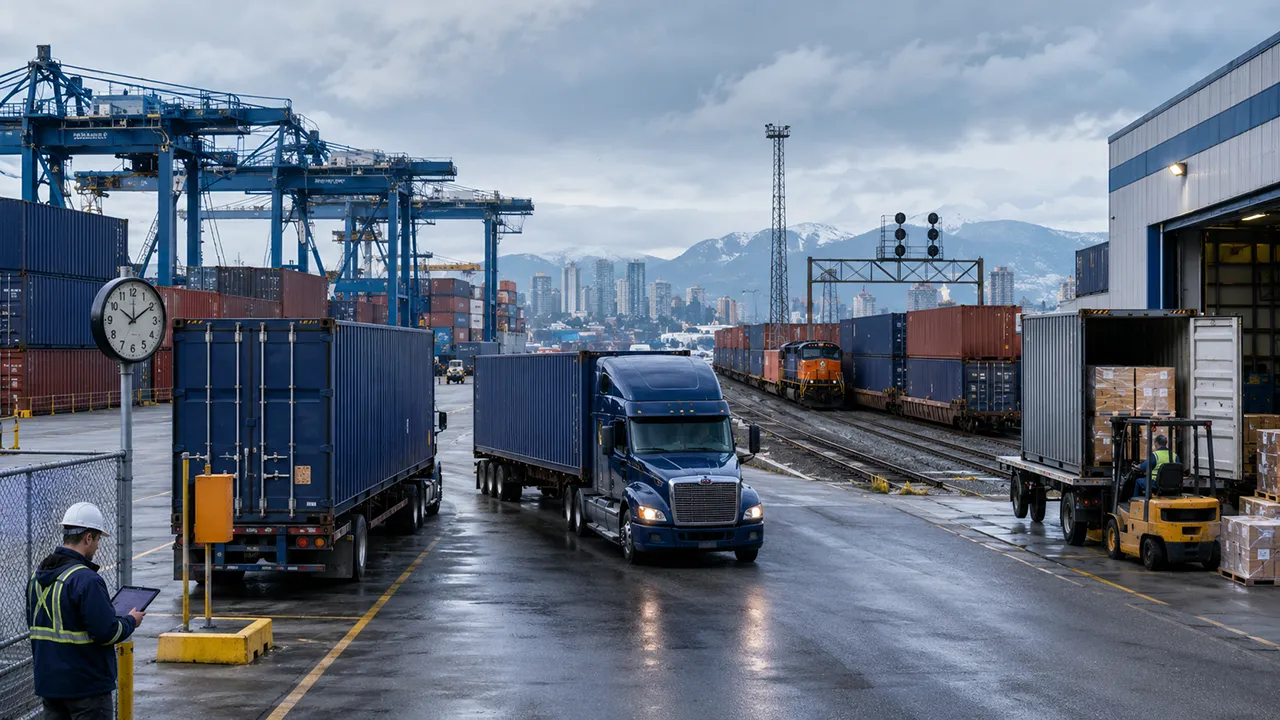
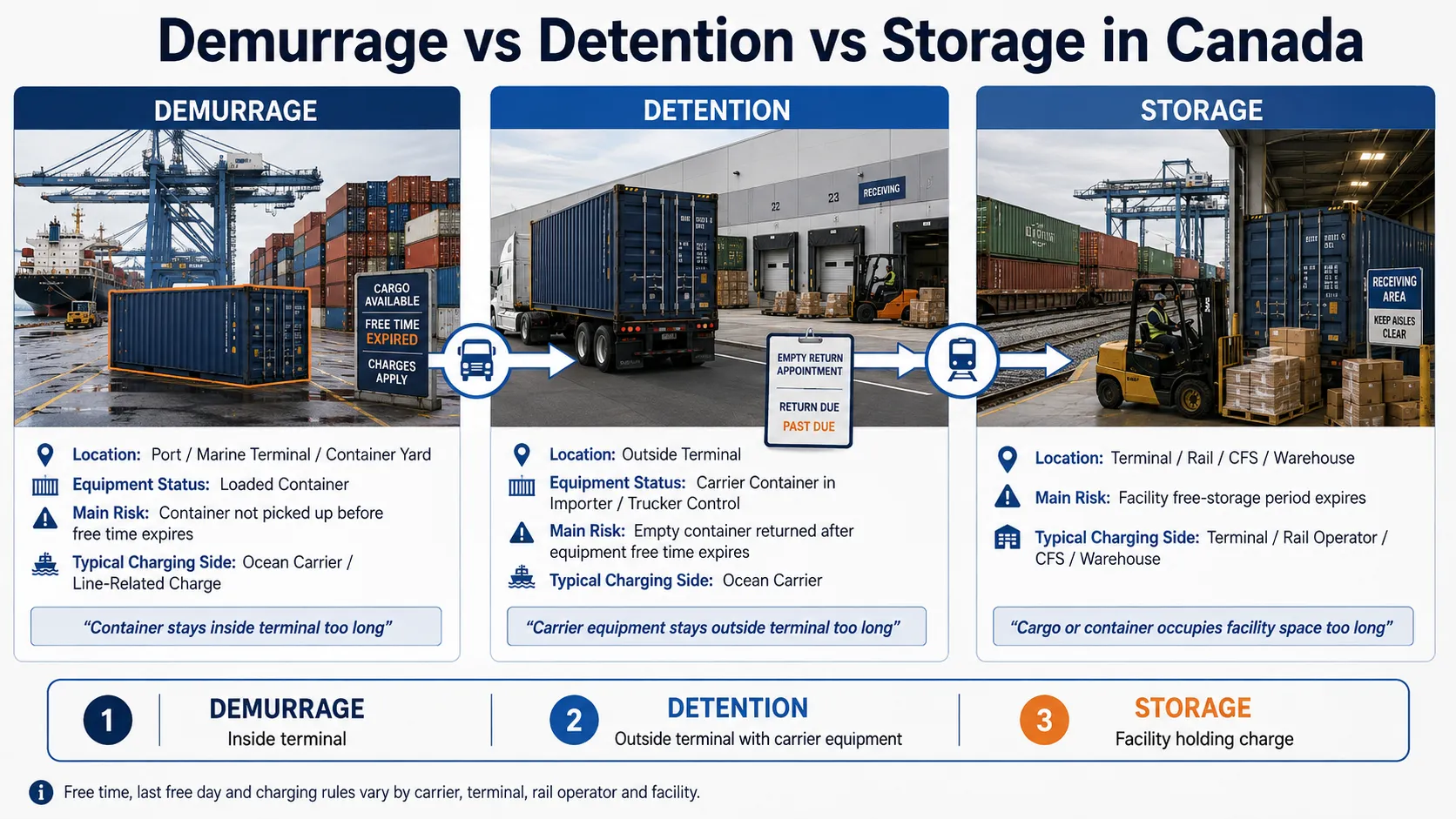
Demurrage, detention and storage are different post-arrival costs that can affect commercial imports into Canada. Demurrage usually relates to a loaded container remaining inside a terminal beyond its allowed free time, detention usually applies when carrier equipment is kept outside the terminal too long, and storage can be a separate terminal, rail, CFS or warehouse charge.
For Canadian importers shipping from China, understanding these differences is important because delays involving customs release, terminal pickup, inland rail, warehouse receiving or empty-container return can create avoidable additional costs.
Planning note
Demurrage, detention and storage rules are not identical across carriers, terminals, rail operators and warehouses. Always confirm the shipment-specific free time, last free day, tariff and equipment-return instructions.
Demurrage vs Detention vs Storage: Quick Comparison
| Charge | What it usually means | Where it usually applies | Who may charge it |
|---|---|---|---|
| Demurrage | A loaded container remains too long after applicable free time expires | Port, marine terminal, container yard or applicable depot | Ocean carrier or line-related charging structure |
| Detention | Carrier equipment is kept too long after leaving the terminal | Outside the terminal during delivery, unloading or empty return | Ocean carrier |
| Storage | Cargo or a container remains at a facility beyond allowed free time | Marine terminal, rail terminal, CFS, warehouse or other facility | Terminal, railway, CFS or warehouse operator |
The easiest way to remember the difference is to ask two questions: Where is the container or cargo now, and whose equipment or facility is being occupied?
What Is Demurrage in Canada?
Demurrage generally becomes relevant when an import container remains inside the applicable terminal, port or container facility longer than the free period allowed under the shipment’s conditions.
For example, a full container arrives at a Canadian marine gateway and becomes available for pickup. If the importer cannot remove it before the applicable free time expires, demurrage may begin according to the carrier’s tariff or applicable charging arrangement.
Common causes include:
- Customs-release delays
- Missing or incorrect import documents
- Truck or appointment shortages
- Warehouse receiving problems
- Container examinations
- Port or terminal congestion
- Late communication of cargo availability
Importers should not assume that the vessel arrival date is automatically the first chargeable day. Cargo availability, terminal rules and carrier free-time calculations can differ by shipment.
What Is Detention in Canada?
Detention generally applies after carrier equipment has left the terminal but is not returned within the permitted period.
In a typical FCL import, the full container is collected from the terminal, delivered to the Canadian warehouse, unloaded and then returned empty to an authorized location.
If unloading or empty return takes too long, detention may apply.
Typical detention risks include:
- Warehouse cannot unload the container quickly enough
- Weekend or holiday scheduling delays
- Incorrect empty-return location
- No return appointment available
- Equipment is held for inventory handling
- Trucker cannot obtain return instructions
Demurrage therefore normally concerns delay before terminal pickup, while detention normally concerns the carrier’s equipment after pickup.
What Is Storage?
Storage is usually a facility-related charge for cargo or equipment remaining at a terminal, rail facility, CFS, warehouse or similar location beyond the facility’s allowed period.
Storage can exist separately from ocean-carrier demurrage or detention.
For example, an LCL shipment may arrive in Canada, be deconsolidated at a CFS and become available for pickup. If the importer does not collect the cargo within the permitted period, warehouse or CFS storage may begin even though the importer never controlled the ocean container itself.
Important
Storage is not automatically another name for demurrage. A shipment can potentially face separate carrier, terminal, rail or warehouse charges depending on how the movement is structured.
What Is Free Time?
Free time is the period during which cargo or carrier equipment can remain within a particular stage of the transport process before the relevant charge begins.
Free time can depend on:
- Ocean carrier
- Terminal
- Container type
- Import or export movement
- Rail operator
- Port or inland location
- Contract or service agreement
- Shipment type
- Special equipment
There is no single universal number of free days that should be assumed for every Canada-bound container.
Always use the shipment-specific notice, tariff and carrier or terminal instructions as the operational reference.
What Is the Last Free Day?
The last free day is the final day on which the applicable cargo or equipment movement can normally be completed before a particular charge starts.
For a full-container import, there may be more than one important deadline:
- Last free day for terminal pickup
- Last free day at an inland rail terminal
- Final day for returning the empty container
- Warehouse or CFS free-storage deadline
These dates should be tracked independently.
Operational tip
Ask for the last free day in writing and share it with the importer, customs broker, drayage provider and receiving warehouse. A clearly communicated deadline can prevent expensive last-minute coordination problems.
How Demurrage Works for FCL Imports
FCL shipments are particularly exposed to demurrage because the importer is responsible for moving a complete container through the destination process.
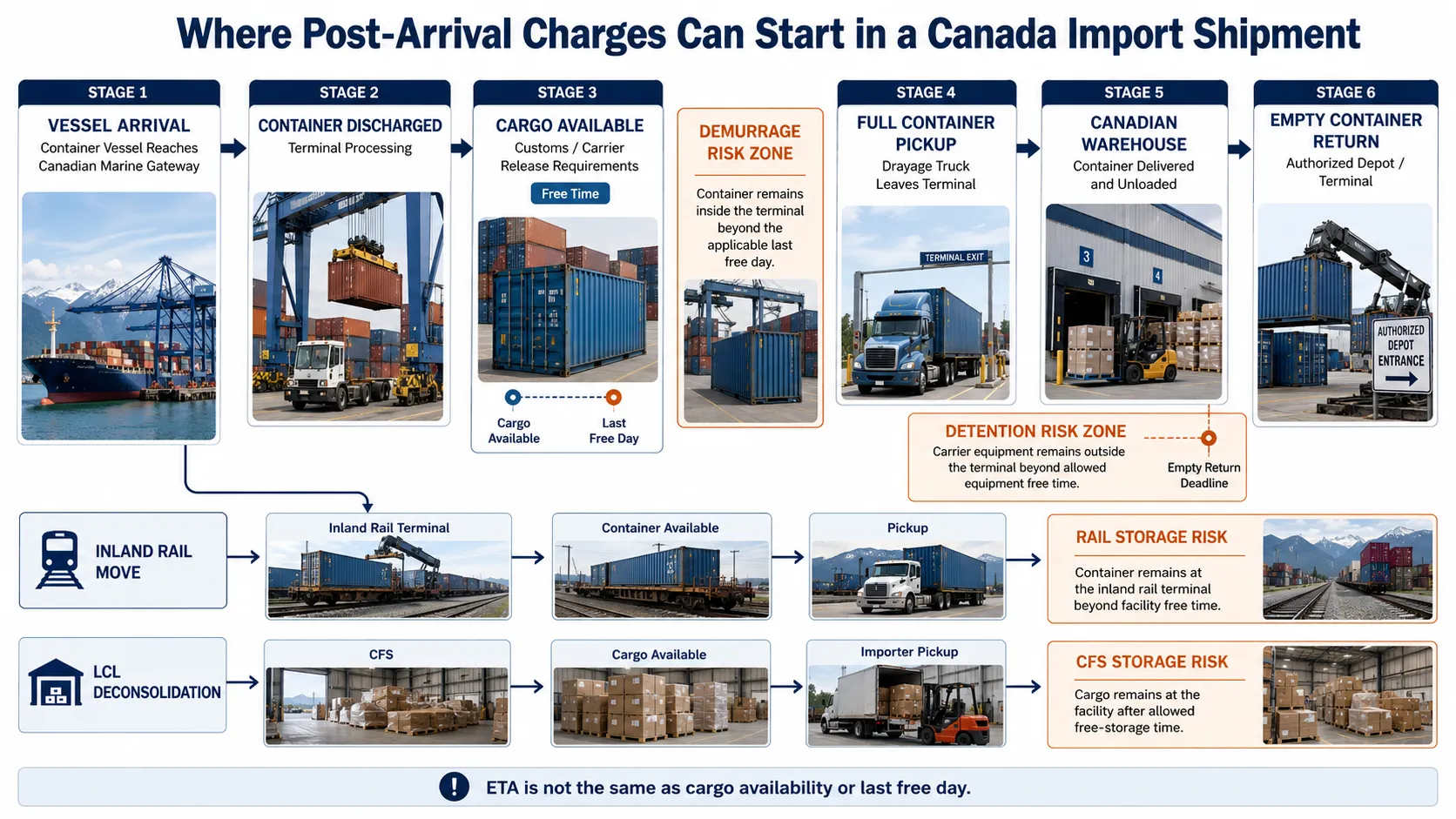
A simplified FCL sequence looks like this:
- Container arrives at the Canadian marine gateway.
- Terminal processing is completed.
- Container becomes available.
- Customs-release requirements are completed.
- Importer or trucker arranges pickup.
- Container leaves the terminal.
- Container is delivered and unloaded.
- Empty container is returned.
The main demurrage risk normally occurs between cargo availability and terminal pickup. Once the container leaves the terminal, the more relevant carrier-equipment risk generally becomes detention.
How Detention Works for FCL Imports
After the full container is picked up, the importer and drayage provider need enough time to deliver it, unload it and return the carrier’s equipment.
Problems can arise when:
- The warehouse appointment is several days after pickup.
- The warehouse cannot unload the container immediately.
- The trucker receives late empty-return instructions.
- The permitted return depot changes.
- Weekend scheduling reduces available operating time.
A successful FCL plan therefore needs to cover both terminal pickup and empty-container return.
Demurrage, Detention and Storage for LCL Imports
LCL cargo follows a different destination process because several shippers share the same container.
After arrival, the consolidated container is generally moved through a deconsolidation process and the individual shipments become available for pickup.
For the individual importer, the more visible cost risk may therefore be:
- CFS storage
- Warehouse storage
- Destination handling delays
- Late customs release
- Delayed cargo pickup
The importer may not personally control the ocean container, so traditional empty-container detention is often less directly relevant to the individual LCL consignee than it is in an FCL shipment.
For the wider operational differences between shared and dedicated container space, review our ocean freight and container-shipping guide.
How Rail Dwell Can Create Extra Costs in Canada
Many China-to-Canada ocean shipments do not end at the marine terminal. Containers destined for inland markets can continue by rail to cities or distribution areas such as Toronto, Calgary, Edmonton or Winnipeg.
This creates another time-sensitive stage:
Marine Gateway → Rail Transfer → Inland Rail Terminal → Cargo Available → Pickup
If the container reaches an inland rail terminal and is not collected within the applicable free period, rail storage or other facility charges can begin.
Canadian rail operators such as CN and CPKC maintain their own terminal and storage rules, so importers should confirm the specific inland-terminal conditions for each shipment.
For current rail-terminal information, importers can review official resources from CN and CPKC.
Port Arrival Is Not the Same as Cargo Availability
One of the most common planning mistakes is treating the vessel’s arrival date as the date the container is immediately ready for pickup.
Several events may still need to occur:
- Vessel discharge
- Terminal processing
- Customs processing
- Carrier release
- Rail transfer
- Container availability
For this reason, importers should track cargo availability and the applicable last free day rather than relying only on vessel ETA.
How Customs Delays Can Cause Demurrage or Storage
Customs preparation is one of the most important factors an importer can control before cargo arrives.
If the shipment cannot be released because important classification, valuation, importer or document information is missing, the cargo may remain at the destination facility while available free time continues to run.
Potential issues include:
- Incorrect or incomplete commercial invoice
- Missing packing information
- Importer-account problems
- HS classification questions
- Country-of-origin questions
- Missing permits or certificates
- Customs examination
For advance release preparation, review our Canadian customs-release workflow.
Canada also uses sufferance warehouses for short-term storage of imported goods awaiting release. These facilities can have their own handling or storage charges and should not automatically be treated as the same thing as ocean-carrier demurrage or detention.
Current commercial-import information is available from the Canada Border Services Agency.
Example: FCL Shipment from China to Toronto
Consider a container shipped from China to a Toronto-area importer.
The container first reaches a Canadian marine gateway. It then moves inland, potentially by rail, before becoming available for pickup at an inland terminal.
Several separate timing risks can exist:
- The container remains too long at the marine terminal.
- Rail transfer is delayed.
- The container reaches the inland terminal but is not collected before free time expires.
- The trucker collects the container but the warehouse cannot unload it quickly.
- The empty container is returned late.
This demonstrates why importers should not think about demurrage, detention or storage as one single destination charge.
Example: LCL Shipment from China to Canada
Now consider a smaller LCL shipment.
The consolidated container arrives in Canada and the cargo is deconsolidated. The importer receives notification that its cartons are available for collection.
If customs is not ready or the importer does not arrange pickup within the available free-storage period, CFS or warehouse storage can begin.
The importer may never physically control the ocean container, but destination storage can still materially increase the complete shipping cost.
Who Charges Demurrage, Detention and Storage?
| Charge | Typical charging party |
|---|---|
| Demurrage | Ocean carrier or applicable carrier-controlled charging arrangement |
| Detention | Ocean carrier |
| Marine-terminal storage | Terminal operator or through the applicable billing arrangement |
| Rail storage | Rail operator or inland terminal |
| CFS storage | CFS or destination warehouse |
| Sufferance warehouse storage | Warehouse operator |
The freight forwarder may coordinate information or receive some charges on behalf of other parties, but this does not mean every charge originates with the freight forwarder.
Are Demurrage and Detention Included in a Freight Quote?
Usually, potential demurrage, detention and unexpected storage should not be assumed to be included in the base freight price.
These costs often arise because the shipment exceeds free time or encounters an operational delay that cannot be predicted accurately when the initial quote is prepared.
An importer comparing quotations should confirm:
- What destination charges are included
- Who communicates free time
- Who monitors last free day
- Who arranges final pickup
- Whether inland rail is included
- Who coordinates empty-container return
- How unexpected storage is billed
How Demurrage and Storage Affect Landed Cost
Demurrage, detention and storage are not standard costs that appear on every shipment, but they can materially increase the landed logistics cost when a delay occurs.
The complete cost of importing commercial goods can include:
- Supplier pickup
- Origin handling
- International freight
- Destination handling
- Customs brokerage
- Duty and GST
- Inland rail or trucking
- Warehouse delivery
- Demurrage where applicable
- Detention where applicable
- Storage where applicable
For the broader cost structure, use our freight pricing and landed-cost guide.
How to Avoid Demurrage, Detention and Storage Charges
The most effective strategy is to prepare before arrival rather than trying to solve the problem after free time is nearly exhausted.
Before Cargo Leaves China
- Confirm the Canadian importer setup.
- Review customs documents.
- Check product admissibility.
- Confirm final destination and warehouse requirements.
- Understand whether the shipment will move by port pickup, inland rail or door-to-door delivery.
Before the Vessel Arrives
- Confirm customs broker readiness.
- Provide all commercial documents.
- Confirm expected Canadian gateway.
- Prepare trucking or inland transportation.
- Notify the receiving warehouse.
After Arrival
- Track cargo availability rather than only ETA.
- Confirm the last free day.
- Confirm customs release.
- Book terminal or rail pickup promptly.
- Confirm the warehouse appointment.
- For FCL, arrange empty-container return before pickup whenever possible.
Planning note
The importer, customs broker, freight coordinator, drayage provider and receiving warehouse should all know the same critical dates. Most avoidable post-arrival costs begin when responsibility for the next step is unclear.
What to Ask Before Booking an FCL Shipment
| Question | Why it matters |
|---|---|
| What destination terminal is expected? | Helps plan drayage or inland rail |
| How will free time be communicated? | Prevents missed pickup deadlines |
| Who monitors the last free day? | Clarifies responsibility |
| Does the container move inland by rail? | Adds another potential storage stage |
| Who arranges terminal pickup? | Avoids late drayage planning |
| Can the warehouse receive immediately? | Reduces detention risk |
| Where should the empty container be returned? | Reduces equipment-return delays |
How This Fits into China-to-Canada Freight Planning
Demurrage, detention and storage are only one part of the complete commercial freight process.
Importers also need to coordinate the shipping method, supplier pickup, origin handling, customs preparation, Canadian gateway and final delivery.
For the broader movement, use our complete China-to-Canada freight guide.
Businesses using coordinated final delivery can also review our supplier-to-warehouse delivery guide to understand where destination responsibilities can enter the shipment scope.
Final Importer Checklist
- Know whether the shipment is LCL or FCL.
- Know the expected Canadian gateway.
- Confirm whether inland rail is involved.
- Prepare customs documents before arrival.
- Track cargo availability.
- Record the last free day.
- Arrange terminal or rail pickup early.
- Confirm warehouse receiving availability.
- For FCL, plan empty-container return.
- Confirm which party invoices destination charges.
- Do not assume demurrage, detention and storage are the same charge.
Conclusion
Demurrage, detention and storage describe different timing and facility risks in the Canadian import process. For an importer, the practical goal is not simply memorizing the definitions. It is knowing where the cargo is, which deadline applies and which party must take the next action.
Canadian businesses importing from China can reduce these costs by preparing customs information early, tracking cargo availability, sharing last-free-day information, coordinating terminal or rail pickup and planning the empty-container return before the shipment becomes urgent.