
Chinese New Year Shipping from China to Canada: 2027 Planning Checklist
Chinese New Year 2027 falls on Saturday, February 6, 2027. Canadian importers shipping commercial goods from China should begin planning well before that date because factory closures, reduced supplier staffing, origin trucking availability and ocean or air freight schedules can affect when cargo actually leaves China.
The safest approach is to confirm each supplier’s last production day, final cargo-ready date, warehouse receiving deadline and carrier cut-off before committing to a shipment. Book planned ocean freight early, reserve air freight for genuinely time-sensitive cargo, and account for staggered factory restarts after the holiday.
For Chinese New Year 2027 shipping, focus on six actions:
- Confirm your suppliers’ individual holiday closure and reopening dates.
- Calculate backward from the required delivery date in Canada.
- Check the last practical FCL, LCL or air freight departure before the supplier closure.
- Verify pickup, warehouse receiving and carrier cut-offs rather than relying on vessel departure dates alone.
- Prepare commercial documents and Canadian import requirements before cargo is dispatched.
- Create a backup plan for late production, missed departures or post-holiday delays.
Use the complete China-to-Canada shipping guide for the broader freight process. This checklist concentrates on the seasonal decisions that become especially important around Chinese New Year.
When Is Chinese New Year in 2027?
Chinese New Year, also known as Lunar New Year or the Spring Festival, begins on February 6, 2027. The date is confirmed in the Hong Kong government’s published 2027 holiday calendar.
However, the date of Lunar New Year’s Day is not the same as the complete factory closure period or the mainland Chinese public holiday schedule.
Manufacturers may close production lines before the official holiday, while administrative teams, warehouses, trucking providers and export facilities can operate on different schedules. Some facilities resume quickly; others need more time to restore normal production and dispatch capacity.
As of October 2026, importers should obtain the confirmed 2027 mainland public holiday arrangements and supplier-specific closure notices when available instead of treating an unverified February date range as an official nationwide shutdown.
| Milestone | 2027 Planning Reference | What Importers Should Confirm |
|---|---|---|
| Lunar New Year’s Day | February 6, 2027 | Confirmed calendar date |
| Mainland Public Holiday | Exact 2027 arrangement to be verified | Official government holiday notice |
| Factory Production Closure | Supplier-specific | Last working and production days |
| Supplier Dispatch Cut-off | Supplier and pickup-specific | Last date goods can leave the facility |
| Ocean and Air Cargo Cut-offs | Carrier and service-specific | Latest receiving, documentation and booking deadlines |
| Factory Reopening | Supplier-specific | First working day and expected production capacity |
| Normal Shipping Recovery | Route and carrier-specific | Available space, equipment and confirmed departures |
This distinction prevents a common planning mistake: assuming that a container can depart on schedule simply because the official holiday has not yet started.
Why Chinese New Year Affects Shipping from China to Canada
The holiday affects multiple connected stages of the export supply chain. The disruption does not begin or end everywhere on the same date.
Factories may stop accepting new production orders
Many manufacturers establish their own last-order, last-production and final-dispatch dates. An order can be complete on paper but still require inspection, packaging, labelling, palletizing or movement to an export warehouse.
Even when a factory promises delivery before the holiday, importers should distinguish between the production completion date and the date cargo will physically be available for pickup.
Origin trucking and warehouse receiving may become harder to coordinate
Before the holiday, exporters often try to move completed cargo through the same limited working window. Drivers, pickup appointments, warehouse receiving slots and equipment positioning can become constraints.
For example, a supplier may finish packaging on Thursday, but if the last available collection was Wednesday, that order may not reach the booked export facility in time.
Ocean carriers may adjust capacity and sailing schedules
Ocean carriers respond to changing holiday-period demand by adjusting services, consolidating cargo or cancelling selected departures. A cancelled departure is commonly called a blank sailing.
In 2026, Maersk reported a pre-holiday cargo rush and temporary Transpacific blank sailings. This is historical operational evidence, not a confirmed 2027 sailing schedule or a forecast for a specific Canadian route.
A previously published sailing should therefore be checked again before the shipper commits cargo, particularly when transshipment or inland Canadian delivery is involved.
Air cargo availability can change
Air freight may provide a faster option for urgent inventory, but available capacity, cargo acceptance, security screening and flight connections still need confirmation. Air transport does not eliminate factory, pickup or export-handling constraints.
Post-holiday recovery is not instantaneous
After the holiday, production lines, trucking networks, consolidation warehouses and carrier schedules may resume at different speeds.
A factory announcing its first working day does not necessarily mean that previously delayed orders are fully produced, inspected, packed and ready to ship.
Importers should obtain a revised cargo-ready date and confirm the next available departure instead of assuming that every shipment will move on the first day after reopening.
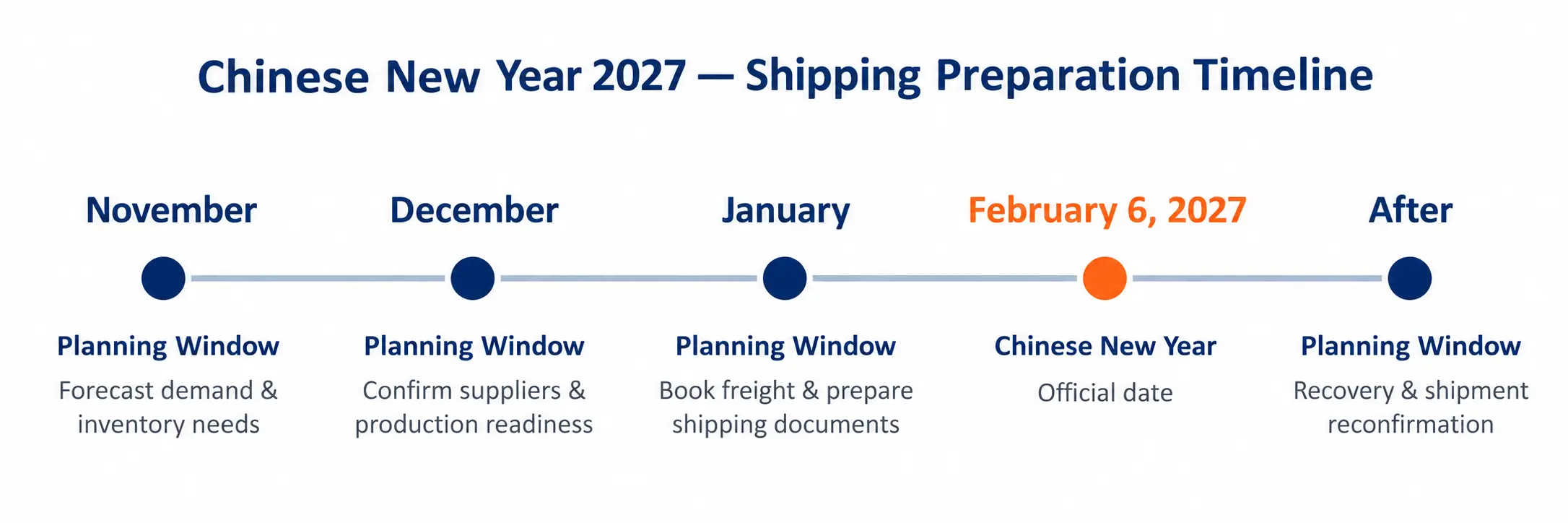
Chinese New Year 2027 Freight Planning Timeline
For Canadian importers, the planning calendar should begin with required inventory availability in Canada and then work backward through transit, export handling and factory production.
The following intervals are recommended planning checkpoints relative to February 6, 2027. They are not guaranteed carrier booking windows, official factory closures or port cut-off dates.
| Planning Window | Recommended Action | Priority |
|---|---|---|
| 10–12 weeks before (mid-to-late November 2026) | Review inventory demand, identify critical suppliers and request holiday schedules | Forecast and supplier alignment |
| 6–8 weeks before (mid-to-late December 2026) | Confirm production progress, freight options and preliminary space requirements | Production and booking readiness |
| 4–6 weeks before (late December–early January) | Reconfirm actual cargo-ready dates, equipment needs, pickup capacity and carrier schedules | Origin execution |
| 2–4 weeks before (January 9–23, 2027) | Move ready cargo into the agreed export process and verify cut-offs | Shipment execution |
| Final 1–2 weeks (January 23–February 5, 2027) | Track confirmed bookings, identify cargo at risk and execute backup plans where necessary | Exception management |
| Holiday and reopening period | Monitor supplier staffing, warehouse availability, carrier changes and revised ready dates | Recovery management |
These Are Planning Windows, Not Booking Guarantees
Example: A Canadian retailer needs inventory in early March
Suppose a retailer in Ontario needs finished inventory available at its warehouse in early March 2027. Booking an ocean shipment just before February 6 would not establish that the inventory can arrive by the required date.
The importer should first calculate the complete delivery lead time, including origin preparation, main transportation, Canadian customs release, inland movement and warehouse receiving.
Working backward may show that the cargo needs to leave China well before the holiday. If the supplier cannot meet that schedule, the buyer can decide whether to prioritize selected products for air freight, use existing inventory, accept a later delivery or revise the purchase plan.
For the normal differences between port transit and total delivery time, review the China-to-Canada shipping time guide. Seasonal buffer decisions should be made on top of a current route-specific schedule.
Shipping by Sea Before Chinese New Year: FCL and LCL Checklist
Sea freight is commonly used for planned wholesale inventory, heavier products, furniture, equipment and larger commercial shipments. Both FCL and LCL can be affected by origin readiness and changing carrier schedules, but their handling requirements differ.
FCL: Full Container Load
For FCL, the importer or shipper should confirm the container booking, equipment type, empty-container collection, factory loading plan, export documents and the carrier’s applicable deadlines.
Important FCL checks include:
- Confirmed vessel service, sailing and booking reference
- Container type and equipment availability
- Empty-container pickup and return arrangements
- Factory loading date and sufficient loading labour
- Verified Gross Mass (VGM) and documentation requirements
- Container gate-in and terminal receiving cut-offs
- Export documentation and customs handling responsibilities
- Alternative sailing arrangements if the booking changes
A vessel’s estimated departure date is not the same as the deadline for delivering a loaded container to the terminal. Missing an earlier documentation or gate-in cut-off can make the departure unusable even if the vessel has not sailed.
LCL: Less than Container Load
LCL cargo generally moves through a Container Freight Station (CFS), where shipments are received and consolidated before the container is prepared for export.
For LCL, confirm:
- Latest acceptable CFS receiving date
- Warehouse address and operating schedule
- Carton or pallet identification requirements
- Final gross weight, dimensions and CBM
- Shipping instructions and documentation deadlines
- Consolidation and container-loading schedule
- Expected deconsolidation arrangements in Canada
The LCL receiving deadline may be earlier than the equivalent FCL container gate-in deadline. Do not assume that both shipments can use the same final cargo-delivery date.

For larger commercial shipments, our sea freight service guide explains how FCL and LCL fit into the wider China-to-Canada shipping process.
Should You Use Air Freight Around Chinese New Year?
Air freight can be useful when a product is time-sensitive, a small quantity can prevent a stockout or a missed production deadline would create a larger financial loss than the additional freight cost.
It is not automatically the best choice for every shipment delayed by Chinese New Year. Importers should compare the product value, chargeable weight, available cargo space, airline acceptance requirements and total delivery cost.
| Situation | Potential Shipping Approach | Main Condition |
|---|---|---|
| Large planned inventory ready early | FCL or LCL sea freight | Confirmed departure and adequate delivery buffer |
| Small, high-priority replenishment | Air freight | Confirmed cargo acceptance and flight space |
| Only a few SKUs are urgent | Split air and sea shipment | Clear SKU priorities and separately confirmed bookings |
| Supplier cannot finish production before closing | Rebook after reopening or revise inventory plan | Verified new production and pickup dates |
| Several suppliers finish at different times | Selective consolidation or separate shipments | Do not let a late order delay critical cargo |
Use split shipping only where it solves a real inventory problem
A split-shipment strategy separates critical stock from goods that can arrive later. For example, a distributor may send a limited quantity of replacement parts by air while arranging the remaining order by ocean freight.
The comparison should use complete delivered quotes, including origin handling, cargo acceptance, customs services and Canadian delivery.
If the order contains time-sensitive commercial inventory, our commercial air freight guide</a covers chargeable weight, cargo acceptance and shipment planning.
Multi-Supplier Consolidation Before the Holiday
Canadian importers buying from several Chinese manufacturers face an additional challenge: one supplier may close earlier or reopen later than the others.
Combining cargo from several suppliers can improve coordination, but waiting for every purchase order may cause the entire shipment to miss the pre-holiday departure.
Set a final receiving date for every supplier
Ask each factory for a confirmed cargo-ready date and establish the last date its goods can reach the agreed warehouse or loading facility.
The consolidation team should know which purchase orders must move together and which can be excluded without affecting the customer’s operational requirements.
Use an exception plan for late supplier orders
A useful rule is to establish three statuses: ready and accepted, at risk, and postponed. Cargo that cannot meet the approved receiving cut-off should not automatically delay inventory that is already ready for export.
Our multi-supplier freight consolidation guide explains how supplier pickup, warehouse receiving, cargo identification and final shipment planning can be coordinated.
What Must Be Ready Before the Chinese New Year Shipping Cut-off?
A confirmed freight booking is valuable only when the shipment can also satisfy the operational requirements of the supplier, warehouse, carrier and Canadian importer.
| Item | Required Confirmation | Usual Coordinator |
|---|---|---|
| Purchase Order | Final approved SKUs and quantities | Canadian buyer and supplier |
| Production | Realistic final production completion date | Supplier |
| Inspection | Any agreed QC or product checks completed | Buyer or appointed inspection provider |
| Packing | Final cartons, pallets, gross weights and dimensions | Supplier |
| Shipping Marks | Correct order and consignee references | Supplier and warehouse |
| Pickup | Confirmed collection date, address and loading availability | Logistics provider and supplier |
| Carrier Booking | Confirmed departure, space, equipment and cut-offs | Freight coordinator |
| Commercial Documents | Invoices, packing lists and applicable certificates | Importer and supplier |
| Canadian Import Setup | Importer account, broker coordination and product requirements | Canadian importer |
| Final Delivery | Receiving address, postal code, appointment and unloading needs | Canadian consignee |
Prepare customs information before the cargo departs
Chinese New Year does not change the basic Canadian import requirements. Importers still need accurate product descriptions, origin information, valuation, classification and any required permits or supporting documents.
The Canada Border Services Agency’s official guide to importing commercial goods explains the current responsibilities of business importers.
To prepare the shipment paperwork, consult TopShipping’s commercial shipping documents checklist.
Document preparation should not be postponed merely because the shipment is expected to leave China after the holiday. Early review can reveal errors while the supplier still has staff available to correct them.
How to Reduce Chinese New Year Shipping Costs Without Missing Deadlines
Holiday-period shipping decisions should be evaluated against the total cost of delivering usable inventory to the Canadian destination. A cheaper transportation option may become expensive if the business experiences a stockout, missed launch or unnecessary storage charge.
Compare quotations with the same service scope
Make sure each quotation identifies the origin, destination, Incoterm, cargo characteristics, main freight service and charges included or excluded. A port-to-port ocean quote cannot be compared directly with a door-to-door air freight quote.
Use final package measurements
Changes in carton dimensions or pallet configuration can affect air-freight chargeable weight, LCL billing volume and FCL loading efficiency.
Avoid unnecessary last-minute shipping changes
Changing from sea to air can be justified when inventory urgency is genuine. However, a late mode change may also require repacking, revised documents, additional origin handling or new cargo acceptance checks.
Plan inventory in tiers
Separate essential inventory, normal replenishment and non-urgent stock. This allows a buyer to prioritize critical products without automatically paying for premium transportation across the entire purchase order.
For current freight pricing components and quotation comparisons, use the China-to-Canada shipping cost guide. Do not use a historical Chinese New Year surcharge or last year’s container rate as a guaranteed price for 2027.
What Happens to Chinese Shipping After the Holiday?
Post-holiday shipping recovery depends on factory staffing, completed orders, trucking availability, cargo handling and the carrier’s scheduled capacity. Reopening dates and normal operating capacity may not coincide.
Importers should monitor three separate milestones:
- Supplier reopening: The factory or warehouse is accepting communications and resuming operations.
- Cargo readiness: The specific goods are finished, checked, packed and available for dispatch.
- Confirmed transportation: The shipment has an accepted booking and feasible origin cut-offs.
Ports and some cargo facilities may continue operating during parts of the holiday. For example, YANTIAN’s February 2026 port operations update described measures taken to handle the pre-holiday cargo peak. Operational conditions vary by facility and year, however, so do not assume that port activity means every supplier, warehouse or trucking service is available.
Reconfirm every delayed booking
If cargo missed its intended sailing or flight, request the revised booking status, new departure estimate, new warehouse receiving deadline and updated delivery expectations.
For ocean shipments, ask whether the cargo was rolled to another departure or whether the original booking must be replaced. For LCL, confirm whether the cargo has been received and which consolidation departure is available.
Update your Canadian inventory plan
Communicate revised estimated arrival and warehouse-availability dates to purchasing, sales and fulfillment teams. A new vessel ETA does not necessarily include customs clearance, terminal availability, rail transportation or final trucking.
What If Your Shipment Cannot Leave China Before Chinese New Year?
Missing the pre-holiday shipping window does not mean that every shipment must stop until all factories reopen. The right next step depends on whether the goods are finished, their current location and the carrier services that are still operating.
If the goods are already packed
Confirm whether pickup, export warehouse receiving or a suitable air or ocean booking is still available. Ask for realistic cut-offs rather than an unconfirmed promise of immediate departure.
If production is incomplete
Request a revised production schedule after the supplier returns. Ask whether essential SKUs can be completed separately without compromising inspection, labelling or compliance requirements.
If a vessel departure is cancelled
Review alternative confirmed sailings, possible origin storage requirements and any additional charges. Rebooking should preserve correct shipment documents and destination handling arrangements.
If the Canadian warehouse has a fixed deadline
Compare a limited urgent air shipment with a later complete ocean delivery. The decision should consider inventory value, the cost of a stockout and the feasibility of producing or collecting the goods before the deadline.
Do Not Treat an ETD as a Delivery Promise
Final Chinese New Year 2027 Shipping Checklist for Canadian Importers
Before confirming the shipment plan, verify each item below with the responsible supplier or logistics provider.
- Chinese New Year 2027 calendar date recorded correctly.
- Factory-specific closure and reopening dates confirmed.
- Final production and inspection deadlines agreed.
- Actual cargo-ready date documented.
- Supplier pickup and loading availability confirmed.
- FCL gate-in or LCL warehouse receiving cut-off confirmed.
- Carrier booking, equipment and available space checked.
- Any air cargo requirements reviewed if expedited shipping is needed.
- Final carton counts, weights, dimensions and CBM received.
- Commercial invoice and packing list checked for consistency.
- Canadian importer and customs arrangements prepared.
- Final Canadian destination and warehouse receiving needs confirmed.
- Contingency plan established for missed departures or delayed reopening.
- Supplier and carrier updates assigned to a named contact.
Plan Your Chinese New Year Shipment with TopShipping
If your business is importing commercial cargo from China to Canada before or after Chinese New Year 2027, start with the real supplier-ready date and required Canadian delivery outcome.
TopShipping can review shipment information and coordinate relevant freight planning requirements, including supplier pickup, cargo consolidation, air or sea freight options and destination delivery arrangements.
When requesting a freight assessment, provide the supplier city, exact pickup address, cargo description, carton or pallet quantity, final dimensions, gross weight, cargo value, expected ready date and Canadian delivery postal code. Also include the supplier’s holiday closing and reopening schedule, if available.
The aim is to establish a realistic shipping plan before seasonal capacity, factory closures or missed cut-offs reduce the available options.
FAQ — Chinese New Year Shipping from China to Canada: 2027 Planning Checklist
Chinese New Year 2027 begins on Saturday, February 6. Shipping disruptions can begin before that date as factories complete orders, employees prepare for the holiday and exporters compete for available transportation. Factory closing dates, carrier schedules and warehouse cut-offs are not necessarily the same as the official public holiday dates. Canadian importers should confirm supplier-specific schedules and book according to actual cargo readiness and carrier availability.
Start discussing planned ocean shipments several weeks before the holiday, ideally as soon as production dates and cargo details are sufficiently reliable. For many importers, a six-to-eight-week planning checkpoint is useful, but it is not a guaranteed booking deadline. Actual space availability, FCL equipment, LCL receiving deadlines and vessel cut-offs depend on the service and origin. Confirm the schedule before committing to a customer delivery date.
Not necessarily. Some major container terminals and related cargo operations continue functioning during parts of the holiday, although staffing, trucking, warehouse services and connected transport schedules may differ from normal operations. The availability of a working port does not guarantee that a factory can release cargo or that a suitable vessel departure exists. Importers should verify the full origin-to-carrier process rather than relying only on port operating status.
Air freight may be suitable for urgent inventory, replacement parts or selected high-priority SKUs when airline space and cargo acceptance can be confirmed. However, air freight still depends on production completion, supplier pickup, airport handling and available capacity. It also has a different pricing basis from ocean freight. A split shipment may be more practical than switching an entire commercial order to air transportation.
There is no universal recovery period. Factories, trucking providers, consolidation warehouses and carriers may resume normal operations at different times. The first working day after the holiday does not guarantee that unfinished orders are ready or that every shipping service has available capacity. Importers should request revised cargo-ready dates, confirmed carrier bookings and updated delivery estimates before adjusting their Canadian inventory commitments.