
Choosing between air freight and sea freight from China to Canada affects much more than the transportation cost. The shipping method influences your inventory lead time, cash flow, packaging requirements, customs preparation, cargo risk, delivery schedule and final landed cost.
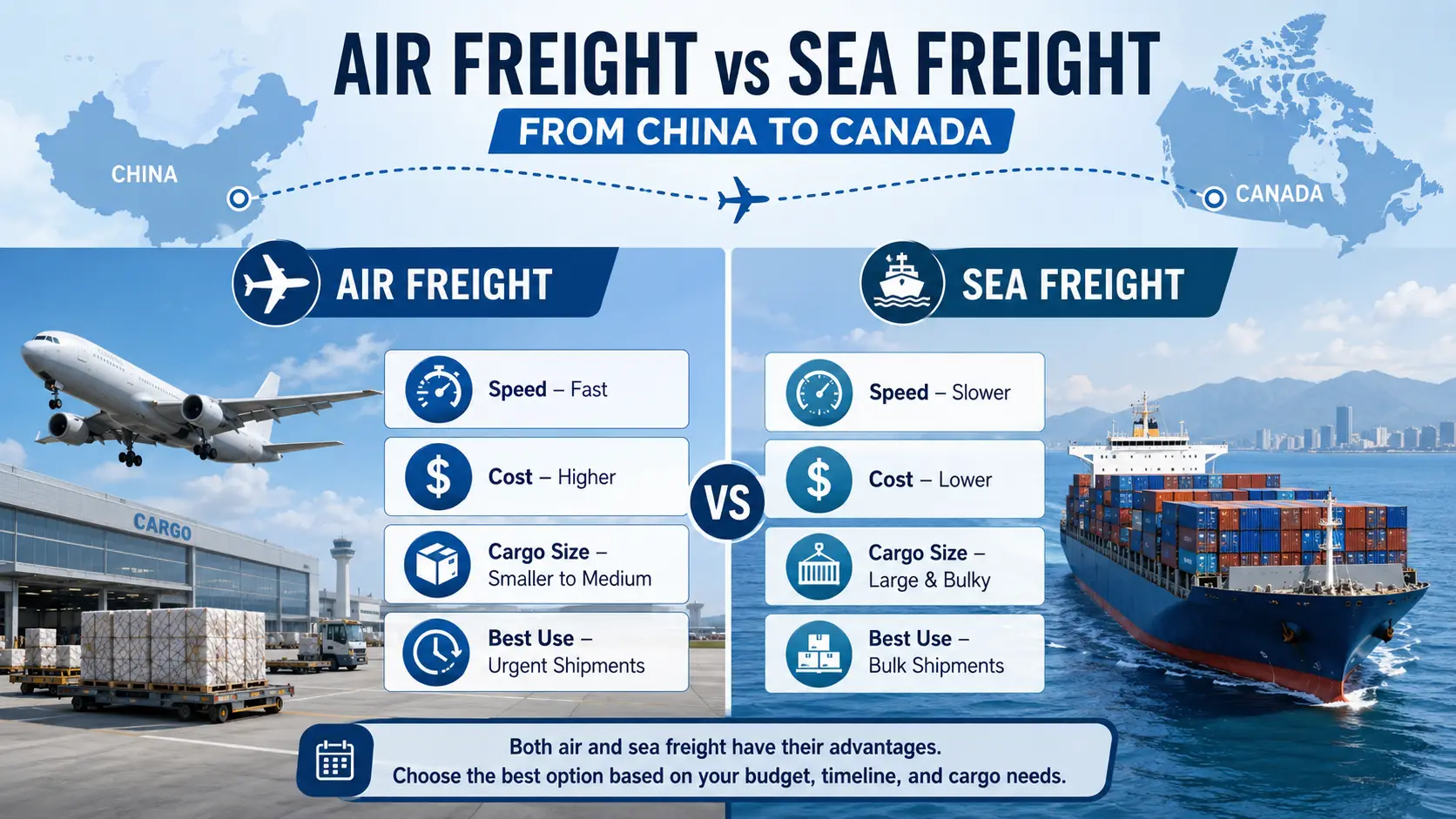
Air freight is generally better for urgent, compact and higher-value commercial cargo. Sea freight is usually more economical for heavier, bulkier and planned shipments. However, the correct choice cannot be made by comparing only an air freight rate per kilogram with an ocean freight rate per cubic metre.
Canadian importers should compare the complete logistics scope, including supplier pickup in China, export handling, chargeable weight or cargo volume, carrier schedules, customs clearance, duties and taxes, destination handling and final delivery in Canada. An experienced China-to-Canada freight forwarder can compare these variables before the shipment is booked.
Air vs Sea Freight from China to Canada at a Glance
| Comparison Factor | Air Freight | Sea Freight |
|---|---|---|
| Best suited for | Urgent, compact, high-value or time-sensitive commercial cargo | Heavy, bulky, recurring and larger commercial shipments |
| Typical transportation speed | Usually the fastest freight option | Requires longer inventory and delivery planning |
| Common door-to-door planning range | Approximately 5–12 business days for many standard shipments | Approximately 25–55 days depending on route and delivery scope |
| Pricing basis | Chargeable weight based on actual or volumetric weight | LCL based on W/M or CBM; FCL quoted per container |
| Cost efficiency | More economical for smaller urgent cargo than for large bulky shipments | Usually provides a lower transport cost per unit at higher volumes |
| Cargo capacity | Limited by aircraft dimensions, airline acceptance and weight restrictions | Suitable for LCL, full containers, machinery and oversized cargo |
| Schedule flexibility | More frequent departures are often available on major routes | Dependent on vessel schedules, port operations and container availability |
| Handling profile | Faster terminal flow, although screening and airport handling still apply | LCL involves consolidation and deconsolidation; FCL normally involves less cargo handling |
| Inventory strategy | Urgent replenishment, launches, samples and stockout prevention | Planned replenishment, wholesale inventory and recurring import programs |
| Typical commercial documents | Commercial invoice, packing list, air waybill and customs information | Commercial invoice, packing list, bill of lading and customs information |
Which Is Better: Air Freight or Sea Freight?
Neither method is automatically better for every shipment. The better option is the one that produces the most practical balance between total landed cost, required delivery date, cargo characteristics and inventory risk.
Air freight from China to Canada is normally the better choice when:
- The cargo must arrive quickly.
- A production line or customer order is waiting for the goods.
- The shipment contains samples, replacement parts or launch inventory.
- The products are compact and relatively high in value.
- A stockout would cost more than the additional freight expense.
- The importer is shipping a smaller quantity before committing to a larger order.
Sea freight from China to Canada is normally the better choice when:
- The shipment is large, heavy or bulky.
- The importer can plan inventory several weeks in advance.
- Reducing transportation cost per product is a priority.
- The cargo is suitable for LCL or FCL container shipping.
- The goods include wholesale inventory, machinery, furniture or palletized cargo.
- The business imports regularly and can maintain a structured replenishment schedule.
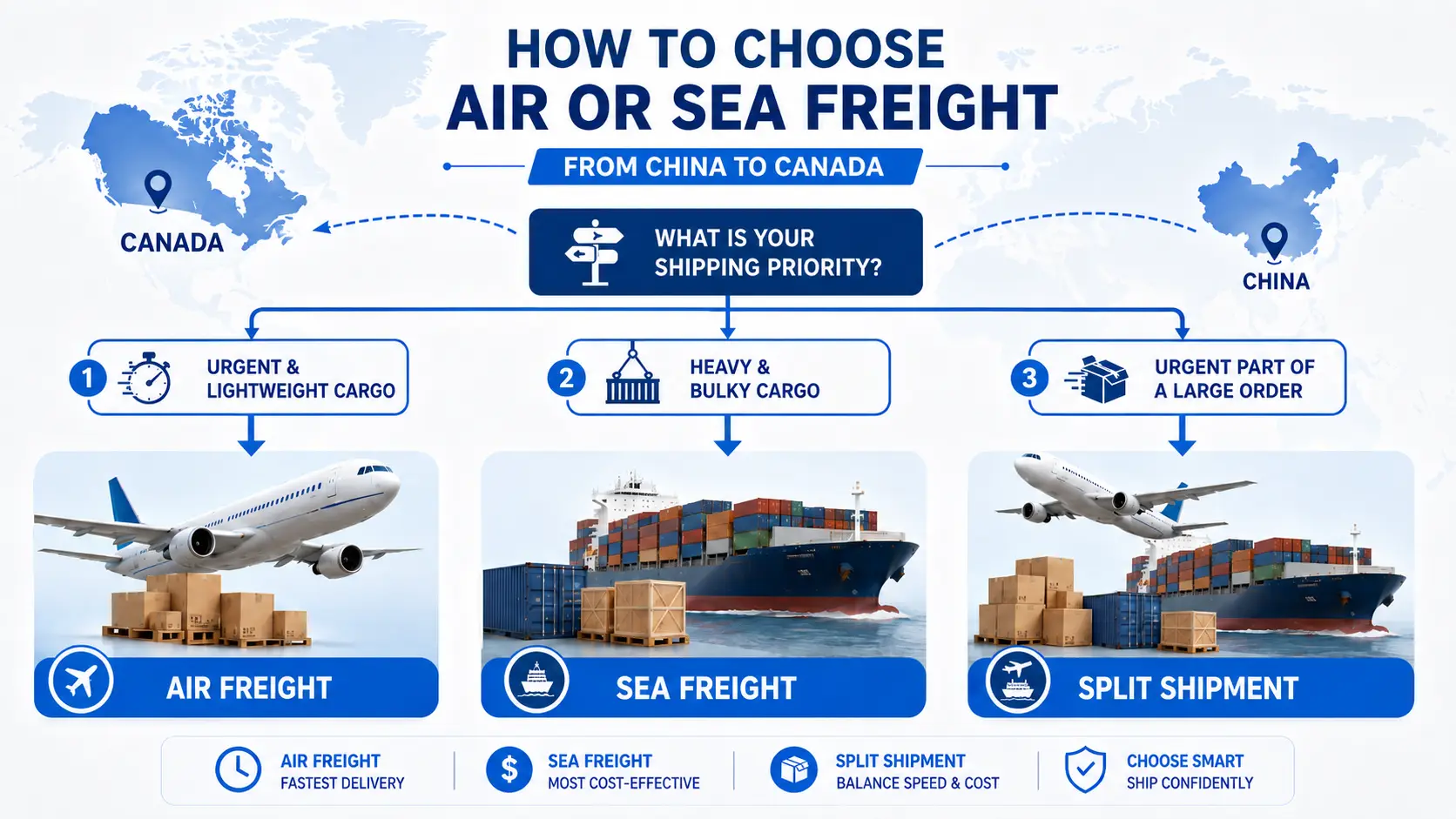
Many importers use both methods. Core inventory is transported by sea, while urgent SKUs, samples or shortage quantities are sent by air. This split-shipment strategy can reduce overall logistics costs without exposing the business to a long stockout.
Air Freight vs Sea Freight Cost from China to Canada
Sea freight is generally less expensive for larger and heavier shipments, while air freight carries a higher transportation cost in exchange for faster delivery. However, comparing only the base freight rate can produce an inaccurate conclusion.
The correct comparison is the total landed cost from the supplier in China to the final warehouse, business, 3PL or fulfillment location in Canada. Importers should include origin charges, freight, customs-related costs, destination handling and inland delivery when comparing quotations.
For a more detailed breakdown of freight rates and additional charges, review the guide to shipping cost from China to Canada.
How Air Freight Pricing Works
Air freight is commonly priced according to chargeable weight. The freight provider compares the shipment’s actual gross weight with its volumetric weight and normally applies the higher figure.
Actual weight includes the cargo, cartons, pallets and export packaging. Volumetric weight represents the amount of aircraft space occupied by the shipment. As a result, lightweight but bulky products may have a much higher chargeable weight than their physical weight.
A shipment of dense metal components may be charged mainly according to actual weight. A shipment of lightweight cushions, empty plastic products or large retail displays may be charged according to volumetric weight because it occupies more aircraft space.
Air freight quotations may also include or exclude:
- Pickup from the supplier in China
- Export documentation and handling
- Security screening
- Fuel and airline surcharges
- Airport terminal charges
- Customs brokerage
- Duties and taxes
- Final delivery in Canada
How Sea Freight Pricing Works
Sea freight can move as LCL or FCL. The pricing method depends on whether the cargo shares container space or uses a complete container.
LCL freight is usually calculated by weight or measurement, commonly expressed as W/M. The shipment’s cubic volume is compared with its gross weight according to the carrier or consolidator’s pricing rule. The higher chargeable unit is used.
FCL freight is quoted per container. Common equipment includes 20-foot standard, 40-foot standard and 40-foot High Cube containers. The container price is not based on how full the container is, so unused space still forms part of the booking cost.
| Pricing Element | Air Freight | LCL Sea Freight | FCL Sea Freight |
|---|---|---|---|
| Main charging unit | Chargeable kilogram | Weight or measurement | Complete container |
| Volume sensitivity | High because volumetric weight can increase the chargeable weight | High because CBM affects the chargeable W/M | Relevant when selecting the container size and loading plan |
| Weight sensitivity | Actual weight may determine the charge | Dense cargo can be charged by weight | Container payload and road weight limits must be checked |
| Destination charges | Airport handling and delivery may be separate | Deconsolidation and destination handling can be significant | Terminal, container, rail and drayage charges may apply |
| Best cost use case | Compact and urgent commercial cargo | Smaller sea freight shipments | Larger, heavier or recurring shipments |
Why the Cheapest Freight Rate May Not Be the Cheapest Option
A low ocean freight rate does not necessarily mean the shipment has the lowest total cost. A longer sea freight lead time can increase inventory carrying costs, require earlier supplier payments and create a higher stockout risk.
Similarly, a high air freight rate may still be commercially justified when fast delivery prevents lost sales, production delays, contractual penalties or emergency local purchasing.
The comparison should therefore include:
- Transportation and handling cost
- Customs clearance and import charges
- Inventory financing cost
- Storage requirements
- Potential sales lost during a stockout
- Production downtime risk
- Product margin and value per cubic metre
- Seasonal or launch deadlines
Air Freight vs Sea Freight Transit Time
Air freight is substantially faster than sea freight, but the flight time or ocean transit time represents only one part of the complete shipment.
Total door-to-door time begins when the goods are ready or collected from the supplier and ends when they are delivered to the Canadian destination. Pickup, export handling, consolidation, customs clearance and inland transportation must be included.
Importers can review a more detailed breakdown in the China to Canada shipping time guide.
| Shipping Stage | Air Freight | Sea Freight |
|---|---|---|
| Supplier pickup and origin handling | Usually 1–3 business days | Usually 2–5 days |
| Export processing | Usually 1–3 business days | Usually 2–5 days |
| Main international transport | Often 1–3 days for the airport movement | Often 16–40 days depending on port and routing |
| Arrival and customs clearance | Often 1–4 business days | Often 2–7 days, subject to port and customs conditions |
| Final delivery in Canada | Often 1–5 business days | Often 2–10 days by truck or intermodal rail |
| General door-to-door planning range | Approximately 5–12 business days | Approximately 25–55 days depending on the route |
These figures are planning ranges rather than guaranteed transit times. Cargo readiness, carrier capacity, customs inspections, route changes, weather, port congestion and final delivery appointments can affect the schedule.
Airport-to-Airport vs Port-to-Port Time
Airport-to-airport and port-to-port transit figures exclude several important stages. They normally do not include supplier pickup, export handling, customs clearance or final delivery.
A three-day airport transit does not necessarily mean the goods will reach the importer in three days. Likewise, a 20-day ocean transit does not mean the container will be available at the final warehouse on day 20.
For a meaningful comparison, both quotations should use the same scope. Comparing an airport-to-airport air rate with a door-to-door sea rate will not provide a reliable cost or timing decision.
Shipment Size, Weight and Volume
Cargo dimensions and density often determine whether air or sea freight is economically practical.
Air freight can be efficient for smaller shipments with high product value relative to their weight and volume. Sea freight becomes increasingly attractive as cargo volume and gross weight rise.
| Shipment Profile | Method to Evaluate First | Reason |
|---|---|---|
| Documents, samples or very small urgent parcels | Express courier or air freight | Speed and simpler small-shipment handling are usually more important |
| Small commercial shipment under approximately 100 kg | Compare courier and air freight | Minimum air freight charges may affect the result |
| Commercial cargo between approximately 100 and 500 kg | Air freight is often practical, but sea freight should be quoted for bulky goods | Density, dimensions and deadline strongly influence the decision |
| Cargo of several hundred kilograms occupying multiple cubic metres | Compare air freight with LCL sea freight | The air volumetric weight may make sea freight substantially more economical |
| Smaller non-urgent palletized shipment | LCL sea freight | The shipment can share container space without paying for a full container |
| Cargo approaching approximately 13–18 CBM | Quote both LCL and FCL | FCL can become more competitive depending on route and destination charges |
| Large, heavy or recurring commercial shipment | FCL sea freight | A dedicated container can reduce unit cost and handling |
| Urgent portion of a large purchase order | Split air and sea shipment | The urgent quantity arrives quickly while the balance moves economically by sea |
These ranges should not be treated as fixed booking rules. Product density, minimum charges, origin city, Canadian destination and current carrier rates can shift the break-even point.
LCL vs Air Freight
LCL and air freight often compete for smaller and medium-sized commercial shipments. The decision depends on the cargo deadline, chargeable volume, destination charges and product value.
LCL may appear inexpensive at the ocean freight stage, but the shipment passes through a consolidation warehouse in China and a deconsolidation facility in Canada. Origin and destination handling charges can therefore represent a significant part of the final cost.
Air freight usually has a higher main transportation charge but offers a much shorter lead time. It may be preferable when the inventory is urgent, the goods are compact or the shipment value justifies faster movement.
LCL is generally better when:
- The cargo is not urgent.
- The shipment is too bulky for economical air freight.
- The importer can tolerate additional consolidation time.
- The goods have a lower value relative to their volume.
- Reducing freight cost per unit is more important than speed.
Air freight is generally better when:
- The shipment must arrive within days rather than weeks.
- The goods have a high value relative to their weight.
- The importer needs launch inventory or emergency restocking.
- A sea freight delay could interrupt sales or production.
- The total chargeable weight remains commercially reasonable.
FCL vs Air Freight
For most full-container shipments, sea freight is considerably more practical than air freight. The volume of a 20-foot, 40-foot or 40-foot High Cube container would normally generate a very high air freight charge.
FCL also provides a dedicated container for one shipment. This reduces the consolidation and deconsolidation stages associated with LCL and can improve cargo control for large orders.
However, an importer does not always need to wait for the entire container. A purchase order can be divided so that a small urgent quantity moves by air while the remaining volume moves by FCL.
For a detailed comparison of container options and the approximate FCL crossover range, review LCL vs FCL shipping from China to Canada.
Cargo Type and Product Value
The product itself is one of the strongest factors in the air versus sea decision.
Products Commonly Shipped by Air
- Commercial samples and prototypes
- Electronics and compact technology products
- High-value components
- Urgent automotive or industrial spare parts
- Replacement inventory
- Seasonal launch quantities
- Medical or laboratory goods when properly approved
- Small e-commerce restocking shipments
Products Commonly Shipped by Sea
- Furniture and bulky household products
- Machinery and industrial equipment
- Wholesale cartons and palletized inventory
- Construction materials
- Textiles and high-volume consumer products
- Retail fixtures and displays
- Packaging materials
- Large recurring e-commerce inventory orders
These are general examples. Product classification, dimensions, packaging and regulatory status must still be reviewed before booking.
Air vs Sea Freight for Batteries and Regulated Cargo
Lithium batteries, battery-powered products, liquids, powders, chemicals, aerosols, magnetic goods and other regulated products require additional review.
Air freight generally applies stricter acceptance, packaging, testing, labelling and documentation requirements to dangerous goods. Some products may be accepted only by specific airlines or on cargo aircraft. Others may be rejected if the required test reports and declarations are unavailable.
Sea freight can provide more routing options for certain regulated products, but it does not remove dangerous goods requirements. The cargo may still require a safety data sheet, UN classification, dangerous goods declaration, compliant packaging, container segregation or carrier approval.
Before selecting either method, provide:
- Exact product name and intended use
- Material or chemical composition
- Battery type, capacity and configuration
- UN number if applicable
- Safety Data Sheet where required
- UN 38.3 test information for applicable lithium batteries
- Packaging specification
- Product certificates or permits
Regulated cargo should be reviewed before supplier pickup. Discovering a dangerous goods restriction after the cargo reaches an airport or port warehouse can create repacking, storage and return costs.
Risk, Handling and Cargo Protection
Air freight is faster, so goods spend less time in international transit. However, air cargo still passes through supplier handling, export warehouses, security screening, airline terminals and destination facilities.
LCL sea freight normally involves more physical handling because the cargo is consolidated with other shipments and later separated in Canada. Strong export packaging is therefore particularly important for fragile, crushable or moisture-sensitive products.
FCL generally offers the lowest handling frequency because the cargo is loaded into a dedicated container. The container may remain sealed until the destination examination or unloading point, subject to customs or carrier requirements.
| Cargo Risk Factor | Air Freight | LCL Sea Freight | FCL Sea Freight |
|---|---|---|---|
| Transit exposure | Shorter overall duration | Longer duration with consolidation stages | Longer duration but fewer cargo transfers |
| Handling frequency | Moderate | Usually the highest of the three options | Usually lower after container loading |
| Moisture exposure | Generally lower transit exposure, although temperature changes can occur | Container humidity and warehouse exposure should be considered | Container condensation protection may be required |
| Packaging requirements | Compact, secure and suitable for terminal handling | Strong export packaging suitable for repeated handling | Suitable for container loading, stacking and weight distribution |
| Insurance consideration | Important for high-value cargo | Important for fragile or handling-sensitive cargo | Important for high-value containerized shipments |
The shipping method does not replace proper packaging or cargo insurance. Importers should consider the product’s value, fragility, moisture sensitivity, theft exposure and replacement lead time when arranging insurance.
Reliability and Schedule Risk
Air freight generally offers shorter and more frequent transportation schedules on major trade routes. When a planned flight is unavailable, another departure may be available within a relatively short period.
Sea freight depends on vessel schedules, port cut-off dates, container equipment and sailing capacity. A rolled booking, missed connection or port delay can add several days or more to the shipment.
However, air freight is not guaranteed to operate without delays. Capacity shortages, security inspections, weather, aircraft changes, documentation problems and customs examination can affect the delivery date.
Reliability should be evaluated according to the complete supply chain rather than the carrier schedule alone. Supplier production delays, missing documents and late delivery to the export terminal can affect both air and sea shipments.
Canadian Destination and Inland Delivery
The final destination in Canada can change the cost and transit-time comparison.
Air cargo may arrive through airports serving Toronto, Vancouver, Montreal or other major Canadian markets. After customs release, the shipment normally moves by truck to the final destination.
Sea freight commonly enters through Vancouver, Prince Rupert, Montreal, Halifax or another suitable gateway. Cargo destined for Toronto, Markham, Calgary, Edmonton or inland Canadian cities may require additional rail or truck transportation.
An ocean route with a low port-to-port rate may become less competitive after destination terminal charges, intermodal rail and final-mile trucking are added. The nearest port is also not automatically the least expensive route because sailing frequency, rail connections and equipment availability can affect the total result.
Door-to-Door Air Freight vs Door-to-Door Sea Freight
A door-to-door quotation can provide a more useful comparison because both methods are measured over the same logistics scope.
Door-to-door shipping from China to Canada may include:
- Supplier pickup in China
- Export handling and documentation
- Air or ocean transportation
- Customs clearance coordination
- Destination handling
- Rail or truck transportation where required
- Final delivery to the agreed Canadian address
Importers should confirm whether the quotation is based on EXW, FCA, FOB, DAP, DDP or another agreed shipping term. They should also confirm which charges are included and which costs remain payable by the importer.
Incoterms for Air and Sea Freight
The Incoterm agreed with the Chinese supplier determines where the seller’s responsibility ends and where the buyer’s logistics responsibility begins.
| Incoterm | Air Freight Use | Sea Freight Use | Important Consideration |
|---|---|---|---|
| EXW | Can be used | Can be used | The buyer generally arranges pickup and the main logistics process from the supplier location |
| FCA | Technically appropriate for air and multimodal transport | Can also be used for containerized or multimodal transport | The named delivery point must be stated clearly |
| FOB | Not technically intended for air freight | Used for sea or inland waterway transport | The seller delivers the goods on board the vessel at the named port |
| DAP | Can be used | Can be used | The seller arranges delivery to the named place, while the buyer normally handles import duties and taxes |
| DDP | Can be used subject to import feasibility | Can be used subject to import feasibility | Importer structure, customs compliance and the treatment of duties and taxes must be confirmed |
Suppliers sometimes use informal expressions such as “FOB airport,” but FOB is formally designed for sea and inland waterway transport. FCA is generally the more appropriate Incoterm when the supplier delivers air cargo to a carrier, freight terminal or nominated warehouse.
Importers can review the allocation of costs and responsibilities in the guide to FOB vs EXW vs DDP shipping from China to Canada.
Customs Clearance for Air and Sea Freight
Choosing air freight instead of sea freight does not remove Canadian import requirements. Both methods require accurate product information, customs classification, declared value and importer details.
Air freight arrives quickly, so documentation should be prepared before departure. A missing invoice, unclear product description or incorrect HS code can remove much of the time advantage gained by using air transport.
Sea freight provides more preparation time while the cargo is in transit, but documents should still be reviewed before loading. Corrections after the bill of lading is issued or after the container arrives can create amendment, storage, demurrage or examination costs.
Common requirements are explained in the shipping documents from China to Canada checklist.
Common Import Documents
- Commercial invoice
- Packing list
- Air waybill for air cargo
- Bill of lading for sea freight
- Detailed product descriptions
- HS codes
- Country of origin information
- Importer and consignee details
- Product certificates or permits where required
- Dangerous goods documents where applicable
Duties and taxes are generally determined by factors such as the product classification, origin and customs value rather than simply by whether the goods arrive by air or sea. The guide to HS codes, duties and taxes for Canadian imports explains these landed-cost elements in more detail.
Canadian commercial importers should also confirm their Business Number, import account, CARM arrangements and customs broker authorization before the shipment arrives. TopShipping can assist with coordinating customs clearance from China to Canada as part of the agreed freight scope.
Air Freight vs Sea Freight for Inventory Planning
The transportation decision should be connected to the importer’s inventory system rather than made independently for each shipment.
Use Air Freight for Inventory Protection
Air freight can protect the business when actual demand is higher than forecast, production is delayed or a sea shipment will not arrive before inventory runs out.
The additional freight cost can be justified when it prevents:
- Lost sales
- Marketplace stockouts
- Production downtime
- Customer contract delays
- Emergency local purchasing
- Loss of seasonal selling opportunities
Use Sea Freight for Planned Replenishment
Sea freight works best when purchase orders, supplier production and inventory forecasts are coordinated several weeks in advance.
Importers can reduce reliance on expensive emergency air shipments by establishing:
- Reorder points based on total lead time
- Safety stock for high-demand products
- Supplier production buffers
- Separate forecasts for high- and low-velocity SKUs
- Scheduled LCL or FCL departures
- Earlier purchasing before peak seasons
Use a Hybrid Air and Sea Strategy
A hybrid strategy separates products according to urgency, value and demand.
For example, an importer placing a large order with a Chinese factory may ship 10% of the inventory by air for the launch date and send the remaining 90% by sea. The first quantity supports immediate sales while the main order moves at a lower cost.
The shipment may also be split by SKU. Fast-selling or higher-margin products can move by air, while slower-moving or bulky items remain in the sea freight shipment.
Practical Shipping Scenarios
| Shipping Scenario | Recommended Approach | Reason |
|---|---|---|
| Product samples are needed for approval | Air freight or courier | Fast delivery is more important than freight cost per unit |
| Replacement machine part is stopping production | Air freight | The cost of downtime may exceed the air freight cost |
| Several pallets of regular wholesale inventory | LCL sea freight | The shipment is planned and does not require a complete container |
| Furniture or bulky consumer products | FCL sea freight when volume permits | Volumetric air freight cost would normally be high |
| New product launch with uncertain demand | Small air shipment followed by sea freight | Reduces initial inventory risk while supporting the launch |
| Large recurring purchase orders | Scheduled FCL sea freight | Better unit cost and more predictable inventory planning |
| Unexpected e-commerce stockout | Air freight for urgent quantity | Restores inventory before the main sea shipment arrives |
| Goods purchased from several Chinese suppliers | Consolidate and compare air with LCL | The best option depends on combined weight, volume and deadline |
| Heavy machinery | Sea freight | Weight, dimensions and loading requirements usually make air impractical |
| High-value compact electronics | Air freight or a split shipment | Product value and inventory urgency can justify faster transport |
How to Choose Between Air and Sea Freight
Use the following decision process before requesting a quotation.
- Confirm the cargo-ready date. The shipping timeline cannot begin until the supplier has completed production, packaging and export preparation.
- Define the required delivery date. Separate a true operational deadline from a preferred delivery date.
- Calculate actual weight and dimensions. Air and sea freight use different chargeable-weight methods.
- Review product value and margin. High-value or high-margin goods may support a faster transport method.
- Evaluate stockout risk. Estimate the commercial cost of waiting for sea freight.
- Check cargo restrictions. Batteries, liquids, powders, chemicals and regulated products require prior approval.
- Compare quotations using the same scope. Both quotes should be port-to-port, airport-to-airport or door-to-door.
- Include all destination charges. Customs brokerage, duties, taxes, terminal handling, rail, trucking and delivery appointments may apply.
- Review Incoterms. Confirm which origin and destination responsibilities belong to the supplier and importer.
- Consider splitting the shipment. A combined air and sea plan may provide the best operational result.
Information Needed to Compare Air and Sea Freight
A freight comparison is only reliable when the cargo information is accurate. Provide the following details:
| Required Information | Details to Provide |
|---|---|
| Product description | Exact product name, material, intended use and HS code if available |
| Supplier location | Factory address, city or nearest airport and seaport |
| Canadian destination | City, postal code and type of delivery location |
| Number of packages | Cartons, pallets, crates or other shipping units |
| Dimensions | Length, width and height of each package |
| Gross weight | Weight of each package and total shipment weight |
| Cargo-ready date | Date when goods will be packed and available for pickup |
| Required delivery date | Operational deadline, launch date or preferred arrival date |
| Incoterm | EXW, FCA, FOB, DAP, DDP or another agreed term |
| Special cargo details | Batteries, liquids, powders, chemicals, magnets, wood packaging or oversized cargo |
| Customs information | Importer details, declared value, HS code and permits where applicable |
Estimated dimensions or unclear product descriptions can materially change the final quotation. The cargo should be measured after export packaging whenever possible.
Final Verdict: Air Freight or Sea Freight?
Choose air freight when speed, inventory continuity and delivery certainty are worth more than the lowest transportation cost. It is generally suitable for urgent stock, compact high-value goods, samples, product launches and critical replacement parts.
Choose sea freight when the cargo is large, heavy, bulky or regularly imported and the business can plan around a longer lead time. LCL is suitable for smaller ocean shipments, while FCL normally provides better control and cost efficiency at higher volumes.
For many Canadian importers, the best answer is not exclusively air or sea. A planned sea freight program supported by selective air shipments can reduce total logistics cost while protecting the business against stockouts and unexpected demand.
To receive a method comparison, send TopShipping your product details, package dimensions, gross weight, supplier location, Canadian destination, cargo-ready date and required delivery timeline through the China to Canada freight quote form.