

CBM is especially important for LCL sea freight because the shipment may be rated using its volume or weight, depending on which produces the higher chargeable quantity. For FCL shipments, CBM remains important for deciding whether the cargo is suitable for a 20ft, 40ft or 40HQ container and for estimating container utilization.
This guide focuses specifically on calculating shipping volume. For the complete ocean-freight process, container options and Canadian gateway planning, use our ocean container and LCL shipping guide.
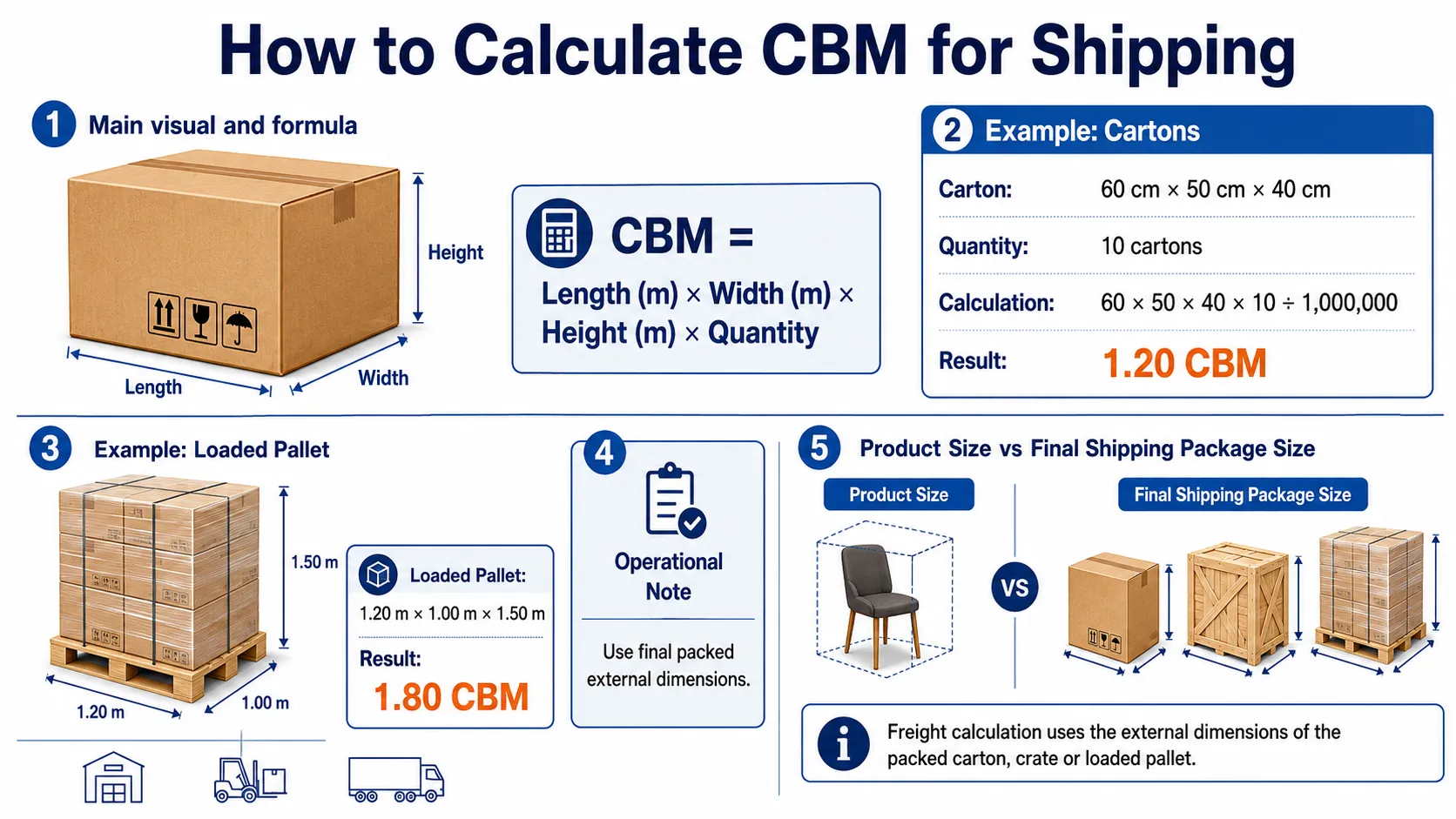
CBM Calculator Formula for Sea Freight
| Dimensions provided in | CBM formula |
|---|---|
| Metres | Length × Width × Height × Quantity |
| Centimetres | Length × Width × Height × Quantity ÷ 1,000,000 |
| Millimetres | Length × Width × Height × Quantity ÷ 1,000,000,000 |
The measurements should represent the final packed external dimensions, not the dimensions of the product before packaging.
What Does CBM Mean in Shipping?
CBM means cubic metre. One cubic metre represents a three-dimensional space measuring:
1 metre × 1 metre × 1 metre
Freight operators use CBM to understand how much cargo space cartons, crates, pallets or other shipping units occupy.
CBM is particularly important when planning:
- LCL sea freight
- Container utilization
- Warehouse receiving
- Supplier consolidation
- Truck capacity
- Origin and destination handling
- Freight quotations
CBM measures space, not physical weight. A shipment can therefore have a high CBM but low gross weight, or a low CBM but very high gross weight.
How to Calculate CBM Using Carton Dimensions
Most commercial shipments from China are quoted using final carton dimensions supplied by the manufacturer or measured at the origin warehouse.
Assume one carton measures:
- Length: 60 cm
- Width: 50 cm
- Height: 40 cm
The calculation for one carton is:
60 × 50 × 40 ÷ 1,000,000 = 0.12 CBM
| Number of cartons | CBM per carton | Total CBM |
|---|---|---|
| 1 | 0.12 | 0.12 CBM |
| 5 | 0.12 | 0.60 CBM |
| 10 | 0.12 | 1.20 CBM |
| 25 | 0.12 | 3.00 CBM |
| 50 | 0.12 | 6.00 CBM |
If every carton has the same dimensions, calculate the CBM of one carton and multiply it by the total carton quantity.
How to Calculate CBM for Different Carton Sizes
When a shipment contains several carton sizes, do not average the dimensions.
Calculate each carton group separately and then add the results.
Mixed-Carton CBM Example
| Carton group | Dimensions | Quantity | CBM |
|---|---|---|---|
| Group A | 60 × 50 × 40 cm | 8 | 0.96 CBM |
| Group B | 80 × 60 × 50 cm | 6 | 1.44 CBM |
| Total | — | 14 cartons | 2.40 CBM |
The formulas are:
Group A: 60 × 50 × 40 × 8 ÷ 1,000,000 = 0.96 CBM
Group B: 80 × 60 × 50 × 6 ÷ 1,000,000 = 1.44 CBM
Total shipment volume = 0.96 + 1.44 = 2.40 CBM
This method is more accurate than averaging carton sizes because each package group contributes its actual packed volume to the shipment.
How to Calculate CBM for a Pallet
If cargo will be shipped as palletized freight, the final external dimensions of the loaded pallet should be confirmed.
Measure:
- Full pallet length
- Full pallet width
- Total height from the bottom of the pallet to the highest point of the cargo
Assume one loaded pallet measures:
- 1.20 m long
- 1.00 m wide
- 1.50 m high
The pallet volume is:
1.20 × 1.00 × 1.50 = 1.80 CBM
If the shipment contains two identical pallets:
1.80 × 2 = 3.60 CBM
Do not calculate only the cartons inside the pallet if the final palletized dimensions create a larger shipping footprint. Stretch wrap, pallet overhang, corner protection and the pallet itself can affect the final measurements.
Carton CBM vs Pallet CBM
| Cargo condition | Measurement to provide |
|---|---|
| Loose cartons | Final dimensions of each carton group |
| Palletized cargo | Final external dimensions of the loaded pallets |
| Wooden crates | External crate dimensions |
| Machinery in a shipping frame | External dimensions of the final transport frame |
| Irregular cargo | Maximum packed shipping dimensions |
The freight quotation should be based on the cargo in the condition in which it will actually be handed over for transportation.
How to Calculate CBM for Irregular Cargo
Irregular products such as machinery, furniture, equipment or shaped components should generally be measured using the maximum external dimensions of the final shipping package or transport frame.
For freight planning, the important question is not the mathematical volume of the product material itself. The relevant measurement is the space occupied by the shipping unit.
For example, a machine may have curved or recessed sections, but if it is secured inside a rectangular wooden crate, use the external dimensions of the crate.
The same principle applies to:
- Wooden cases
- Export crates
- Machinery skids
- Wrapped furniture
- Oversized parts
- Non-stackable cargo
For unusual or non-stackable cargo, provide photographs and final dimensions before booking because special handling or space requirements may affect the quotation.
What Is W/M in LCL Sea Freight?
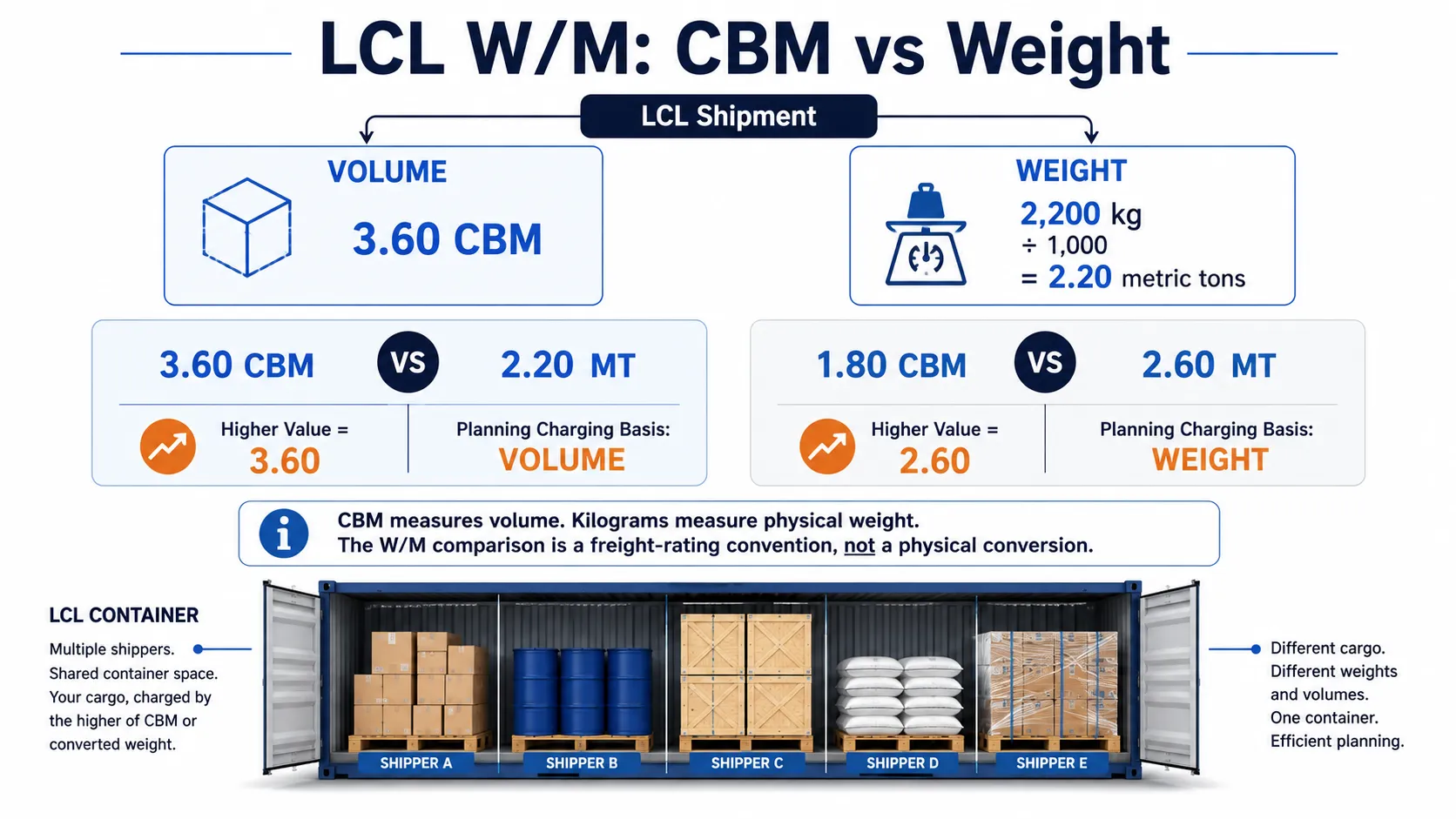
LCL quotations commonly use the term W/M, meaning Weight or Measurement.
The shipment’s:
- Volume in cubic metres, and
- Gross weight expressed in metric tons
are compared for freight-rating purposes.
A common planning rule is:
1 CBM is compared with 1 metric ton, or 1,000 kg.
The higher chargeable quantity can then be used under the applicable LCL tariff.
Example 1: Cargo Charged by Volume
Assume:
- Volume: 3.60 CBM
- Gross weight: 2,200 kg
Convert weight to metric tons:
2,200 kg ÷ 1,000 = 2.20 metric tons
| Measurement | Result |
|---|---|
| Volume | 3.60 CBM |
| Weight | 2.20 metric tons |
| Higher W/M value | 3.60 |
In this example, the shipment is volume-dominant for the W/M comparison.
Example 2: Cargo Charged by Weight
Assume:
- Volume: 1.80 CBM
- Gross weight: 2,600 kg
Convert the weight:
2,600 kg ÷ 1,000 = 2.60 metric tons
| Measurement | Result |
|---|---|
| Volume | 1.80 CBM |
| Weight | 2.60 metric tons |
| Higher W/M value | 2.60 |
The shipment is weight-dominant in this example.
Important: W/M tariffs can include minimum charges, density rules and other consolidator-specific conditions. Use the actual freight quotation as the final rating reference.
For an industry reference, Maersk defines ocean-freight W/M as a comparison between the shipment’s metric tons and cubic metres, with the greater measurement used as the freight-rating basis. You can review the Maersk shipping-terms glossary for the carrier’s definition.
For current LCL rates, W/M pricing examples and complete landed-cost planning, see our LCL and container freight pricing guide.
CBM Is Not the Same as Weight
One of the most common misunderstandings in ocean freight is treating the expression “1 CBM = 1,000 kg” as a physical conversion.
CBM and kilograms measure different things:
| Unit | Measures |
|---|---|
| CBM | Physical cargo volume |
| kg | Physical cargo weight |
| Metric ton | 1,000 kg of physical weight |
| W/M | Freight-rating comparison between weight and measurement |
The 1 CBM versus 1 metric ton comparison is a freight-rating convention used in many LCL quotations. It does not mean that every cubic metre of cargo physically weighs 1,000 kg.
CBM for LCL vs FCL Shipping
CBM affects LCL and FCL shipments differently.
| Factor | LCL | FCL |
|---|---|---|
| Primary freight basis | CBM or W/M | Container booking |
| Why CBM matters | Can directly affect the chargeable quantity | Helps determine container utilization and equipment selection |
| Shared container | Yes | No |
| Need to compare cargo weight | Yes, for W/M | Yes, for payload and operational limits |
For FCL, the base ocean rate is generally quoted for the selected container rather than simply multiplying cargo CBM by an LCL rate.
CBM is still extremely important because it helps determine whether the shipment is suitable for LCL, a 20ft container, a 40ft container or a 40ft High Cube.
For a deeper operational comparison, use our shared-container vs full-container decision guide.
How Much CBM Fits in a Shipping Container?
The published internal volume of a container is different from the volume that can normally be used efficiently for commercial cargo.
| Container type | Approximate nominal volume | Typical practical planning range |
|---|---|---|
| 20ft Standard | About 33 CBM | Approximately 25–28 CBM |
| 40ft Standard | About 67–68 CBM | Approximately 55–60 CBM |
| 40ft High Cube | About 76 CBM | Approximately 65–70 CBM |
Container-planning note: These are general planning ranges rather than guaranteed loading capacities. Actual usable volume depends on carton dimensions, palletization, cargo shape, loading pattern, payload restrictions and unusable gaps between packages.
Why 30 CBM of Cartons May Not Fit into 30 CBM of Container Space
CBM is a mathematical volume calculation. Container loading is a physical packing problem.
Two shipments with the same total CBM can use container space differently because of:
- Different carton dimensions
- Pallets
- Irregular package shapes
- Non-stackable cargo
- Weight distribution
- Loading orientation
- Space required for cargo protection
- Unused gaps between packages
This is why CBM should be used for planning, while actual container loading should also consider the package dimensions and loading configuration.
How to Calculate CBM for Multiple Suppliers
If you are purchasing from several Chinese suppliers, calculate each supplier’s cargo separately before calculating the combined shipment volume.
Example
| Supplier | Cargo volume | Gross weight |
|---|---|---|
| Supplier A | 2.30 CBM | 620 kg |
| Supplier B | 1.80 CBM | 410 kg |
| Supplier C | 3.10 CBM | 890 kg |
| Total | 7.20 CBM | 1,920 kg |
Do not rely only on the supplier’s first production estimate. After all cargo reaches the consolidation facility, final dimensions and weight can be checked before the freight method is confirmed.
If you purchase inventory from several factories, our multi-supplier cargo consolidation guide explains how compatible orders can be combined before air, LCL or FCL transportation.
Should You Use Supplier CBM or Warehouse-Measured CBM?
Supplier CBM is useful for initial planning, but the final shipping quotation should use the final packed cargo dimensions whenever possible.
Supplier estimates can change because of:
- Final carton size
- Carton quantity
- Additional protective packaging
- Palletization
- Export crates
- Production changes
- Mixed SKUs
- Repacking at the origin warehouse
For time-sensitive quotations, ask the supplier to confirm whether the dimensions are estimated production dimensions or final packed shipping dimensions.
How to Check CBM on a Packing List
A useful commercial packing list should provide enough package information to verify the shipment volume.
Check for:
- Carton or pallet count
- Package type
- Length
- Width
- Height
- Gross weight
- Net weight where relevant
- Total shipment volume
If the packing list provides only a total CBM, ask for the package-level dimensions when the shipment is large or when the number appears inconsistent.
For the wider commercial document workflow, see our commercial shipping-document guide.
How CBM Affects Sea Freight Cost
CBM can affect the cost of a sea shipment, particularly when cargo moves by LCL.
However, the following calculation should not be used:
CBM × advertised LCL rate = complete China-to-Canada shipping cost
An LCL shipment can also involve:
- Supplier pickup
- Origin warehouse receiving
- CFS handling
- Documentation
- Export handling
- Main ocean freight
- Canadian CFS or deconsolidation charges
- Customs-clearance services
- Duties and GST
- Storage where applicable
- Canadian inland transportation
- Final warehouse delivery
Therefore, this page should be used to calculate shipment volume. Use the dedicated freight pricing and landed-cost guide when calculating the financial cost of the shipment.
When Should You Compare LCL with FCL?
CBM is an important input when deciding whether to continue using LCL or request a full-container quotation.
| Shipment volume | Recommended starting action |
|---|---|
| Under 5 CBM | Review LCL first and confirm minimum charges |
| 5–10 CBM | Review complete LCL origin and destination charges |
| 10–18 CBM | Request both LCL and FCL quotations |
| Higher-volume cargo | Evaluate FCL as the primary ocean option |
| Very heavy cargo at low CBM | Compare weight-rated LCL against 20ft FCL |
There is no universal CBM number at which FCL automatically becomes cheaper. Cargo density, container rates, port pair, destination charges, handling requirements and Canadian delivery conditions affect the break-even point.
Common CBM Calculation Mistakes
Using Centimetres Without Converting to Cubic Metres
If the measurements are in centimetres, divide the multiplied dimensions by 1,000,000.
Forgetting the Number of Cartons
The CBM of one carton must be multiplied by the number of identical cartons.
Using Product Dimensions Instead of Packed Dimensions
Freight occupies the space created by the final shipping package, not the bare product.
Ignoring the Pallet
If cartons are palletized, the final loaded pallet dimensions can be different from the combined mathematical carton volume.
Using Estimated Dimensions as Final Dimensions
Production estimates are useful for early budgeting but should be replaced with final packed measurements before booking.
Rounding Every Carton Too Early
Calculate each carton group with sufficient decimal precision and round the final shipment CBM rather than heavily rounding every intermediate calculation.
Confusing CBM with Kilograms
CBM measures volume. Kilograms measure weight. The 1 CBM versus 1,000 kg relationship used in LCL W/M is a rating comparison, not a physical unit conversion.
Assuming CBM Alone Determines the Total Freight Cost
CBM is only one pricing input. Origin handling, destination fees, customs, inland delivery and other shipment-specific charges can still apply.
CBM Pre-Quote Checklist
- Confirm production is complete or identify that dimensions are still estimated.
- Use final packed external dimensions.
- Group cartons with identical measurements.
- Calculate each carton group separately.
- Multiply by package quantity.
- Add all carton groups together.
- Measure final pallet dimensions after palletization.
- Include crates, frames and protective packaging.
- Confirm total gross weight.
- Compare gross metric tons against CBM for LCL W/M planning.
- Provide supplier pickup location.
- Provide the Canadian delivery postal code.
- Provide cargo-ready date.
- Identify non-stackable or irregular cargo.
- Provide photographs for unusual cargo.
What Information Should You Send for an LCL Quote?
| Information | Why it matters |
|---|---|
| Supplier pickup address | Determines China-side collection and origin routing |
| Number of cartons or pallets | Supports handling planning |
| Final dimensions | Determines shipment CBM |
| Total gross weight | Required for W/M comparison |
| Total CBM | Supports LCL pricing and method selection |
| Product description | Supports cargo acceptance and customs preparation |
| Cargo-ready date | Determines available shipment planning |
| Canadian postal code | Determines destination and final-delivery requirements |
| Stackability | Identifies possible space and handling restrictions |
CBM Calculation Workflow Before Shipping from China
- Wait for final packaging information. Do not rely only on product dimensions.
- Group identical packages. Separate cartons with different dimensions.
- Calculate CBM for each group.
- Add the groups together.
- Confirm palletized dimensions if applicable.
- Confirm final gross weight.
- Compare CBM with metric tons for LCL W/M planning.
- Provide the data to the freight forwarder.
- Compare LCL and FCL if the volume is approaching container territory.
- Confirm the final measured volume before booking.
For businesses that have not yet selected a freight method, our complete China-to-Canada freight guide explains how cargo size, urgency, supplier location and Canadian destination affect the wider shipping decision.
How TopShipping Uses CBM for Sea Freight Planning
TopShipping uses final cargo information to help Canadian businesses evaluate commercial freight options from Chinese suppliers.
For an LCL or container-shipping assessment, provide:
- Final package dimensions
- Number of cartons, pallets or crates
- Total gross weight
- Total CBM
- Supplier location
- Cargo-ready date
- Product description
- Canadian delivery destination
The shipment can then be reviewed against LCL, FCL, consolidation and final-delivery requirements rather than relying on an estimated CBM alone.
Request a Sea Freight Assessment
If your supplier has provided the package count, dimensions and gross weight, send the cargo details together with the Chinese pickup address and Canadian postal code.
TopShipping can review the shipment volume, LCL or FCL suitability and the wider China-to-Canada freight requirements.