
DDP Shipping from China to Canada at a Glance
| DDP Element | Typical Arrangement | What the Canadian Buyer Should Confirm |
|---|---|---|
| China pickup | Collection from the factory, supplier or consolidation warehouse | Exact pickup address, loading conditions and cargo-ready date |
| Export handling | Origin warehouse processing, export documents and customs declaration | Exporter details, origin charges and required product documents |
| International freight | Air freight, LCL sea freight or FCL container transport | Mode, route, carrier, service level and estimated schedule |
| Canadian import clearance | Customs entry and release coordinated under the agreed DDP structure | Importer of record, customs broker, CARM account and record access |
| Duties and taxes | Applicable customs duty and import taxes handled according to the quotation | HS code, value for duty, origin, GST treatment and special-duty exclusions |
| Destination handling | Airport, terminal, deconsolidation, rail or container processing | Storage, examination, demurrage, detention and terminal exclusions |
| Final delivery | Delivery to the named warehouse, business, 3PL or fulfillment destination | Appointment, dock access, tailgate, waiting time, unloading and remote-area fees |
Practical definition: DDP means the seller assumes the broadest delivery obligation under the Incoterms rules, including export clearance, main transportation, import formalities, applicable duties and taxes, and delivery to the named destination. The buyer normally receives and unloads the shipment unless unloading is separately included in the contract.
What Does DDP Mean in International Shipping?
DDP stands for Delivered Duty Paid. Under DDP, the seller is responsible for delivering the goods to the named destination after completing export and import formalities and paying the costs allocated to the seller under the agreed term. Among the eleven Incoterms 2020 rules, DDP places the highest overall delivery obligation on the seller.
The full term should identify a precise destination and the rule version. For example, DDP Markham, Ontario, Canada, Incoterms 2020 is more useful than simply writing “DDP Canada.” The named place affects final-mile pricing, delivery appointments, risk transfer and whether special handling is required.
The International Chamber of Commerce Incoterms rules allocate delivery tasks, costs and risk between seller and buyer. They do not replace the sales contract, determine product quality, guarantee customs admissibility or automatically define every charge in a freight forwarder’s quotation. The commercial contract and logistics quotation must still describe the operational scope in detail.
What Is Included in DDP Shipping?
A professionally structured DDP freight service can combine the full movement from a Chinese supplier to a Canadian destination. The exact inclusion depends on the cargo, mode, Incoterm wording and written quotation.
| Cost or Service | Common DDP Treatment | Important Qualification |
|---|---|---|
| Supplier pickup in China | Usually included when the pickup address is confirmed | Waiting time, difficult access or loading equipment may cost extra |
| China warehouse handling | May include receiving, weighing, measuring and short-term storage | Repacking, palletizing, labelling and extended storage should be itemized |
| Export documentation and customs | Normally included in the origin scope | The exporter and document responsibility must be legally workable |
| Air or sea freight | Included for the confirmed route and service level | Rates can change before booking if capacity, fuel or carrier conditions change |
| Cargo insurance | Not automatically included merely because the term is DDP | Confirm insured value, coverage type, deductible and exclusions separately |
| Canadian customs brokerage | Can be included under the agreed customs arrangement | The importer of record and broker authorization must be identified |
| Regular customs duty | Usually included when calculated from confirmed classification and value | Reassessment can occur if the HS code, origin or customs value changes |
| GST and other import taxes | Handled according to the quoted DDP tax structure | Confirm who pays, who receives the customs record and whether tax recovery is possible |
| Anti-dumping, countervailing or surtax amounts | Only included if specifically reviewed and stated | These charges can be substantial and should never be assumed |
| Destination handling | Standard handling may be included | Customs examination, storage, demurrage and detention are often conditional |
| Final delivery in Canada | Included to the named delivery point | Tailgate, residential, inside, remote-area and appointment services require confirmation |
| Unloading | Normally remains the buyer’s responsibility under DDP | Request liftgate, forklift or labour when the receiving site cannot unload |
Before accepting an “all-inclusive DDP shipping” price, ask for the included and excluded cost items in writing. A low rate is not useful if customs examination, special duties, terminal storage or final delivery requirements appear later as unplanned charges.
How DDP Shipping from China to Canada Works
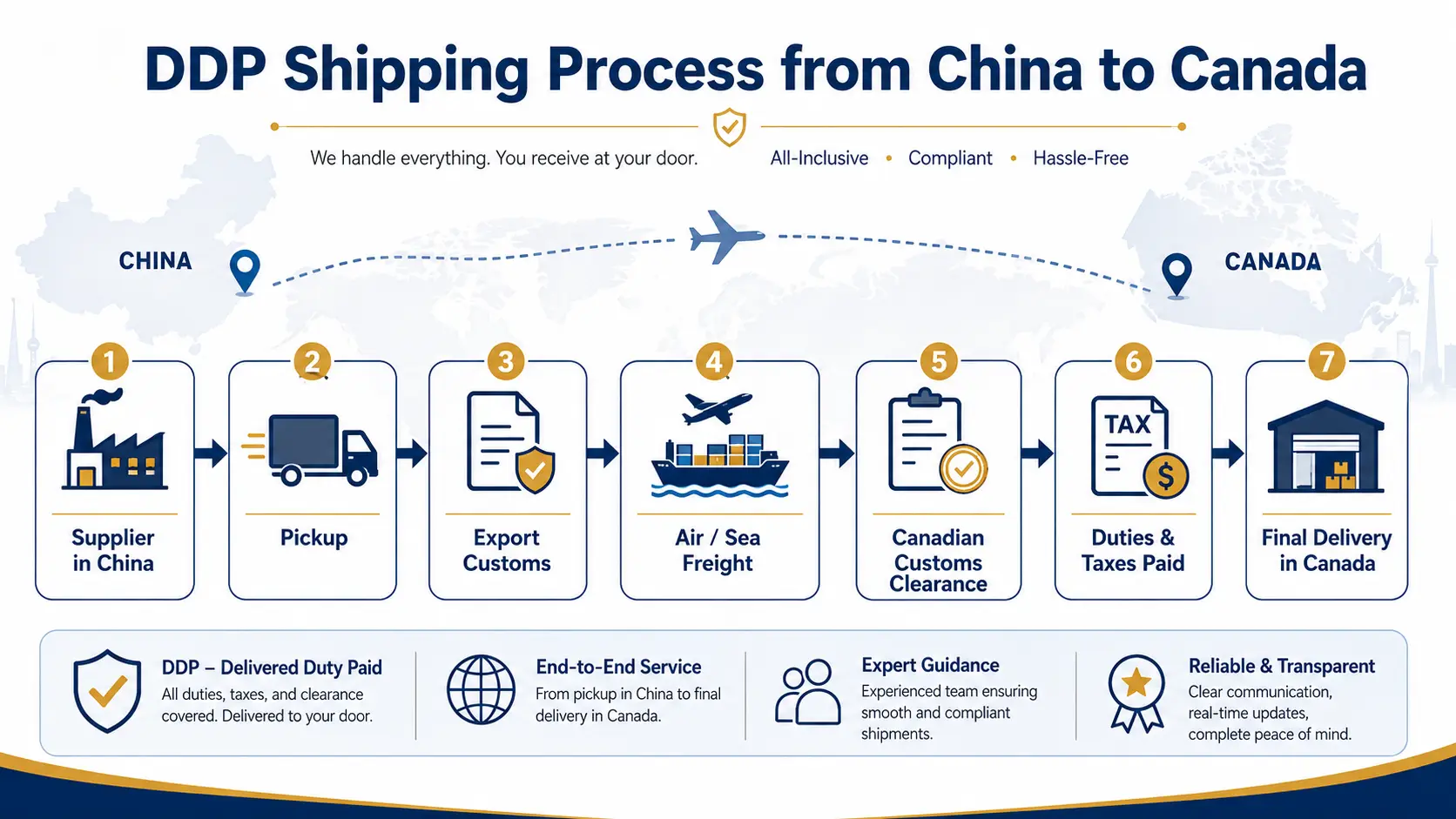
- The shipment is reviewed. Product description, material, intended use, HS code, value, origin, carton count, dimensions, gross weight, supplier address, ready date and Canadian destination are checked.
- The importer and customs structure are confirmed. The parties identify the importer of record, customs broker, CARM requirements, duty and tax treatment, and records that will be available after clearance.
- The shipping method is selected. DDP air freight, LCL sea freight or FCL container shipping is chosen according to urgency, cargo density, volume, handling risk and landed cost.
- The Chinese supplier is coordinated. Pickup timing, commercial invoice, packing list, export packaging, labels, certificates and loading conditions are confirmed.
- Cargo is collected or received at a warehouse. The shipment may be measured, weighed, counted and checked before export booking.
- Export handling is completed. Export documentation, customs declaration, security screening, consolidation or container loading are arranged.
- The cargo moves to Canada. The shipment travels by the confirmed air or ocean route with tracking and operational updates.
- Canadian customs clearance is completed. The customs entry uses the agreed importer information, classification, value, origin and supporting documents.
- Destination handling and release are coordinated. The cargo is recovered from the airline, terminal, rail ramp, container yard or deconsolidation warehouse.
- Final delivery is arranged. The shipment is delivered to the exact named warehouse, business address, 3PL, prep centre or fulfillment location.
DDP Air Freight from China to Canada
DDP air freight from China to Canada is suitable for urgent, compact, higher-value or time-sensitive commercial cargo. It can combine supplier pickup, export handling, air transportation, customs clearance, duties and taxes, and final delivery under one coordinated scope.
Air DDP shipping is commonly used for:
- Urgent inventory replenishment
- Product launches and seasonal stock
- Samples and pre-production orders
- Machinery parts and critical components
- Compact electronics and consumer goods
- E-commerce or marketplace inventory
- Higher-value cargo where shorter transit is commercially important
Air freight is priced by chargeable weight. The airline compares actual gross weight with volumetric weight and charges the higher figure. This means a lightweight but bulky shipment can have a higher DDP air freight cost per kilogram than a dense shipment with the same actual weight.
For a full explanation of chargeable weight, routing and airport-to-door options, review air freight from China to Canada.
DDP Sea Freight from China to Canada
DDP sea freight from China to Canada is generally more suitable for heavy, bulky, recurring or planned commercial imports. Ocean DDP shipping can move as LCL when the cargo shares container space or as FCL when one importer uses a complete container.
DDP LCL Shipping
LCL DDP shipping can be practical when the shipment is too large for economical air freight but does not fill a container. The cargo moves through consolidation and deconsolidation warehouses, so packaging quality, warehouse handling and destination charges must be reviewed carefully.
DDP FCL Shipping
FCL DDP shipping is used for larger wholesale orders, machinery, palletized cargo and recurring inventory. A 20-foot, 40-foot or 40-foot High Cube container may be selected according to cargo volume, weight distribution and loading requirements. FCL usually provides fewer cargo-handling points than LCL, although container delivery, unloading time, demurrage and detention still require planning.
For routing, container selection and ocean freight planning, see sea freight from China to Canada.
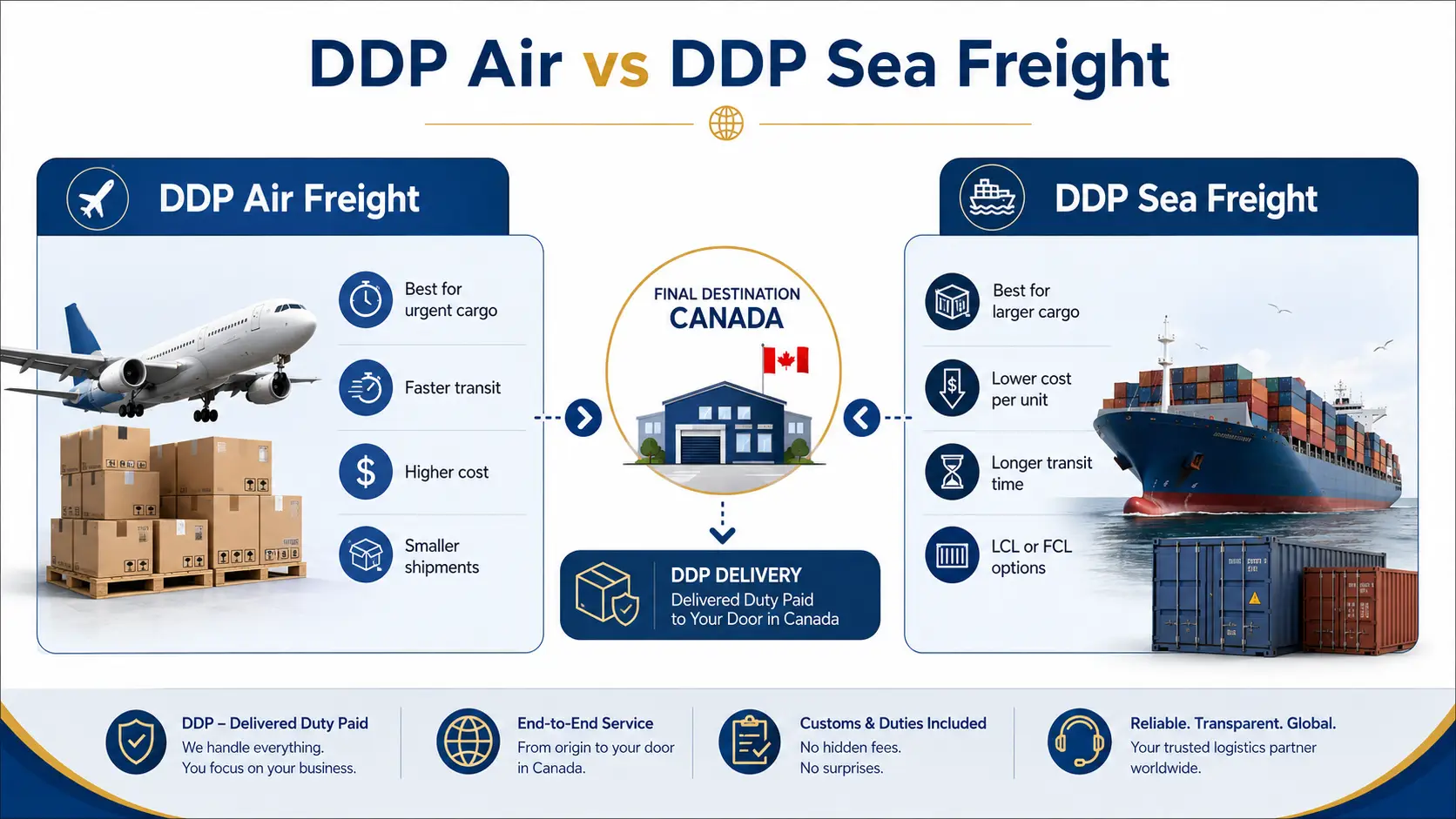
DDP Air vs DDP Sea Shipping
| Comparison Point | DDP Air Freight | DDP Sea Freight |
|---|---|---|
| Best for | Urgent, compact, valuable or time-sensitive cargo | Heavy, bulky, recurring and cost-sensitive cargo |
| Main pricing basis | Chargeable kilogram | LCL by W/M or CBM; FCL by container |
| Typical planning range | Approximately 5–12 business days door to door for many standard shipments | Approximately 25–55 days depending on LCL or FCL, route and inland delivery |
| Handling profile | Airport and security handling with shorter total transit exposure | LCL has more handling; FCL usually has fewer handling points |
| Cost behaviour | Higher cost per kilogram, especially for bulky cargo | Lower freight cost per unit for larger planned volumes |
| Common use | Restocking, launches, samples, spare parts and premium inventory | Wholesale stock, pallets, machinery and regular replenishment |
These are operational planning ranges rather than guaranteed transit commitments. Supplier readiness, carrier capacity, customs review, weather, port or airport congestion, rail connections and final delivery appointments can affect the schedule. Review the detailed shipping time from China to Canada guide when planning inventory.
DDP Shipping Cost from China to Canada
There is no fixed DDP shipping price that applies to every China-to-Canada shipment. A DDP rate includes more cost components than basic airport-to-airport or port-to-port freight. The total depends on the transportation method, customs value, tariff classification, destination and written service scope.
How DDP Pricing Is Calculated
- DDP air freight: normally based on chargeable weight, cargo type, route, airline capacity and final delivery zone.
- DDP LCL sea freight: normally based on chargeable volume or weight, consolidation fees, destination handling and delivery.
- DDP FCL sea freight: normally based on container size, origin and destination ports, carrier schedule, inland transport and delivery conditions.
- Customs component: based on HS classification, country of origin, value for duty, regular duty rate, GST and any additional import measure.
- Final-mile component: based on delivery city, distance, vehicle type, dock access, appointment and unloading requirements.
Main Factors Affecting the DDP Rate
- Product description, material and intended use
- Canadian HS code and applicable duty rate
- Country of origin and tariff treatment
- Commercial invoice value and currency
- Actual weight, carton dimensions and cargo volume
- Number of cartons, pallets or containers
- Supplier location and pickup conditions in China
- Air, LCL or FCL shipping method
- Canadian destination and final delivery requirements
- Customs brokerage, GST and other import charges
- Peak-season capacity, fuel and carrier surcharges
- Special handling, permits, inspection or regulated-cargo requirements
Many importers search for a DDP shipping cost per kilogram. A per-kilogram figure can be useful for an initial air or consolidated-sea comparison, but it is not a reliable landed-cost quote until the product classification, cargo dimensions, commercial value, Canadian destination and customs structure are confirmed.
For a broader breakdown of freight, customs and delivery cost components, use the guide to shipping costs from China to Canada.
Importer of Record, CARM and Tax Records
DDP does not eliminate the need for a legally and operationally valid Canadian import structure. Before booking, the parties must identify who will be shown as the importer of record and who is responsible for customs accounting, payment, records, corrections and any later reassessment.
Commercial importers generally require a Business Number and an import-export program account. The CBSA Assessment and Revenue Management system, known as CARM, is the official system used to account for commercial imports and manage duties and taxes. A Canadian resident importer or a properly established non-resident importer may be used depending on the sales and customs arrangement.
A customs broker can transmit the customs entry and assist with clearance, but using a broker does not make the underlying importer information optional. The DDP quotation should state:
- The legal importer of record
- The Business Number and RM account used for the entry
- Whether CARM registration and broker delegation are complete
- Who pays duties and import taxes
- Who receives the Commercial Accounting Declaration and supporting records
- How post-entry corrections, refunds or reassessments will be handled
- Whether the Canadian buyer can support any intended GST input tax credit
Current registration and account requirements should be checked through the official CBSA CARM guidance. DDP tax treatment can affect accounting and recoverability, so shipment-specific advice may also be needed from a customs broker or tax professional.
Customs Duties, GST and HS Codes under DDP
DDP shipping includes duty-paid delivery obligations, but it does not make goods exempt from Canadian customs law. Every commercial shipment still requires a defensible product classification, country of origin, customs value and supporting records.
The duty and tax estimate may depend on:
- The complete Canadian tariff classification
- The product’s true country of origin
- The value for duty and customs valuation method
- The applicable regular customs duty rate
- GST and product-specific tax treatment
- Excise duty or excise tax where applicable
- Surtaxes, anti-dumping or countervailing duties
- Permits, licences, quotas or agency requirements
Do not accept a DDP offer based on an unsupported low declared value or a generic HS code. Incorrect customs data can lead to reassessment, penalties, delayed release and loss of usable import records. The guide to HS codes, duties and taxes for Canadian imports explains the classification and landed-cost process in more detail.
Documents Needed for DDP Freight
Document preparation should begin before pickup, not after the cargo reaches the airport or port. The required file depends on the product, but a standard commercial DDP shipment commonly needs:
- Commercial invoice with seller, buyer, currency, quantity and transaction value
- Packing list with carton or pallet count, weights and dimensions
- Detailed product description, materials and intended use
- Country-of-origin information
- Proposed HS code and supporting technical specifications
- Air waybill or bill of lading
- Importer of record and customs broker information
- Business Number and RM account details when applicable
- Certificates, permits, test reports or licences for regulated goods
- Battery, dangerous-goods or transport-compliance documents where required
- Purchase order, payment record or contract when needed to support customs value
Review the complete shipping documents from China to Canada checklist before the supplier releases the cargo.
DDP vs DAP, Door-to-Door and FOB Shipping
DDP, DAP, door-to-door and FOB are often used as though they describe the same service. They do not. Door-to-door describes physical transportation coverage, while DDP, DAP and FOB allocate responsibilities under an Incoterm.
| Term | Main Meaning | Canadian Import Clearance and Charges | Typical Use |
|---|---|---|---|
| DDP | Seller delivers to the named destination with broad import and duty-paid obligations | Handled under the seller’s agreed DDP structure | Buyer wants fewer logistics tasks and a defined landed-delivery scope |
| DAP | Seller delivers to the named place ready for unloading | Normally handled and paid by the buyer/importer | Buyer wants transport managed but retains import control |
| Door-to-door | Pickup at origin and delivery to destination | Depends entirely on the Incoterm and quotation | Physical end-to-end delivery under DAP, DDP or another arrangement |
| FOB | Seller exports and delivers cargo on board the vessel at the named port | Buyer handles main ocean freight, Canadian customs and inland delivery | Established sea-freight importer wants control of the main carriage |
A shipment can be door to door without being DDP. It may be delivered under DAP, with the Canadian importer paying customs charges. For a transport-focused service without automatically assuming duty-paid terms, review door-to-door shipping from China to Canada.
For a detailed responsibility comparison, read FOB vs EXW vs DDP for China-to-Canada shipments.
DDP Shipping for E-commerce and Amazon-Related Inventory
DDP shipping can be useful for e-commerce businesses that need inventory delivered to a Canadian warehouse, 3PL, prep centre or marketplace-related destination without coordinating separate freight, customs and final-mile providers.
Common use cases include:
- Urgent air replenishment to prevent stockouts
- Planned LCL or FCL inventory restocking
- New product launches and seasonal sales campaigns
- Delivery to a Canadian 3PL or fulfillment centre
- Mixed-SKU shipments from several Chinese suppliers
- Wholesale inventory supporting online and retail channels
DDP does not replace marketplace preparation. Carton labels, SKU or FNSKU labels, pallet configuration, delivery appointments, routing rules and receiving limits must be confirmed before final delivery. For inventory-specific planning, visit e-commerce shipping from China to Canada.
Multi-Supplier DDP Shipping and Cargo Consolidation
Canadian importers often purchase different products from several factories in Shenzhen, Guangzhou, Dongguan, Foshan, Yiwu, Ningbo, Shanghai or other Chinese manufacturing centres. Shipping every supplier order separately can create repeated pickup, export, documentation and delivery costs.
A consolidation warehouse can receive each order, record package details, check external condition, compare quantities with the supplier’s packing list and combine compatible cargo into one coordinated DDP air or sea shipment.
Consolidation can help:
- Combine several supplier pickups under one shipment plan
- Reduce duplicate international movements
- Improve control of carton count and package data
- Identify missing or damaged packages before export
- Prepare one organized freight and customs document set
- Coordinate one final delivery in Canada
Learn how China freight consolidation to Canada can be combined with air, LCL, FCL or duty-paid delivery.
What Goods Can Be Shipped by DDP?
DDP is generally suitable for legitimate commercial goods that can be exported from China, imported into Canada and supported by accurate documents. Availability depends on product admissibility, transport acceptance, customs requirements and the importer structure.
Commonly Suitable Cargo
- General consumer products
- Wholesale and retail inventory
- Textiles, apparel and accessories
- Home, office and commercial products
- Non-hazardous components and spare parts
- Machinery and equipment subject to route review
- E-commerce inventory and commercial samples
- Products with clear specifications, values and origin records
Cargo Requiring Additional Review
- Lithium batteries and battery-powered products
- Chemicals, liquids, powders and aerosols
- Food, supplements and agricultural products
- Cosmetics and personal-care products
- Medical devices and health-related goods
- Wireless, radio-frequency or electrical products
- Wood packaging or products subject to inspection controls
- Oversized, overweight, temperature-sensitive or dangerous goods
- Products subject to permits, quotas, surtaxes or trade remedies
Counterfeit goods, undeclared cargo, prohibited products and shipments using false values or descriptions are not accepted. TopShipping focuses on B2B commercial freight rather than personal parcel shipping. Service minimums and eligibility depend on the route, cargo type and transport method.
How to Evaluate a DDP Quote from a Chinese Supplier or Alibaba Seller
Some suppliers offer an attractive “DDP price” together with the product order. The convenience can be real, but the buyer should verify that the customs and delivery structure is transparent and compliant.
Ask the supplier or DDP shipping agent:
- What exact Canadian address is named in the quotation?
- Which Incoterms version applies?
- Who is the importer of record?
- Which Business Number and RM account will be used?
- Which HS code and country of origin were used for the estimate?
- What commercial value will be declared?
- Are regular customs duty and GST included?
- Are surtaxes, anti-dumping or countervailing duties included or excluded?
- Are brokerage, terminal handling and final delivery included?
- Who pays if the shipment is examined or stored by customs?
- Will the buyer receive the customs accounting record?
- Are tailgate, appointment, remote-area and unloading charges included?
Common DDP Red Flags
- The provider cannot identify the importer of record
- The quote says “tax included” without showing the HS code or value basis
- The proposed declared value is lower than the real transaction value
- The provider refuses to supply customs or transport documents
- The rate is guaranteed before cargo dimensions and product details are known
- Regulated goods are accepted without document or compliance review
- Customs examination, storage and special duties are not addressed
- The quotation promises guaranteed customs clearance
Information Needed for a DDP Shipping Quote
Accurate cargo information allows the forwarder to compare DDP air freight, LCL and FCL options and estimate the customs and final-delivery components more reliably.
- Supplier name, city and pickup address in China
- Exact delivery city, postal code and address in Canada
- Detailed product name, materials and intended use
- HS code if already verified
- Country of manufacture
- Commercial invoice value and currency
- Number of cartons, pallets or containers
- Gross weight and package dimensions
- Total CBM for sea freight
- Battery, liquid, chemical or regulated-product information
- Required certificates, permits or test reports
- Cargo-ready date and required delivery timeline
- Preferred air, LCL or FCL method
- Receiving hours, dock access and unloading requirements
Why Use TopShipping for DDP Freight from China to Canada?
TopShipping supports Canadian businesses with China-side supplier coordination and Canada-side delivery planning through one freight process. The purpose is not simply to attach the label “DDP” to a shipment, but to define the operational and customs scope before booking.
- Supplier pickup and coordination across major Chinese production regions
- DDP air freight, LCL and FCL planning according to cargo requirements
- Multi-supplier consolidation and warehouse handling in China
- Commercial invoice, packing list and cargo-data review before departure
- Customs clearance coordination and importer-information checks
- Delivery to warehouses, businesses, 3PLs and fulfillment locations in Canada
- Clear written inclusions, exclusions and shipment-specific requirements
- One coordination point from supplier collection to final delivery
Request a DDP Shipping Quote
DDP shipping can simplify a China-to-Canada import when the product, customs structure, duties, taxes, freight mode and final delivery requirements are reviewed before booking. Send TopShipping your product description, supplier location, commercial value, package count, dimensions, gross weight, ready date and Canadian delivery address. We will review whether DDP air freight, LCL or FCL is practical and provide a quotation based on the confirmed scope.