
LCL Destination Charges in Canada: How to Read an Ocean Freight Quote
LCL destination charges in Canada are the local fees involved in receiving a shared ocean container, separating individual shipments and making each consignment available for release or pickup. Depending on the quotation, these can include container freight station (CFS) handling, deconsolidation, destination processing and delivery-order or release documentation. Customs brokerage, import duty and GST, inspections, storage and truck delivery are separate cost categories that may also appear on the final invoice.
The practical rule is simple: a port-to-port LCL ocean rate is not automatically a complete Canadian delivery price. Before booking freight from China, ask for an itemized destination-charge schedule, the charging basis and minimums, the named Canadian CFS, and a written list of inclusions and exclusions.
What Are LCL Destination Charges in Canada?
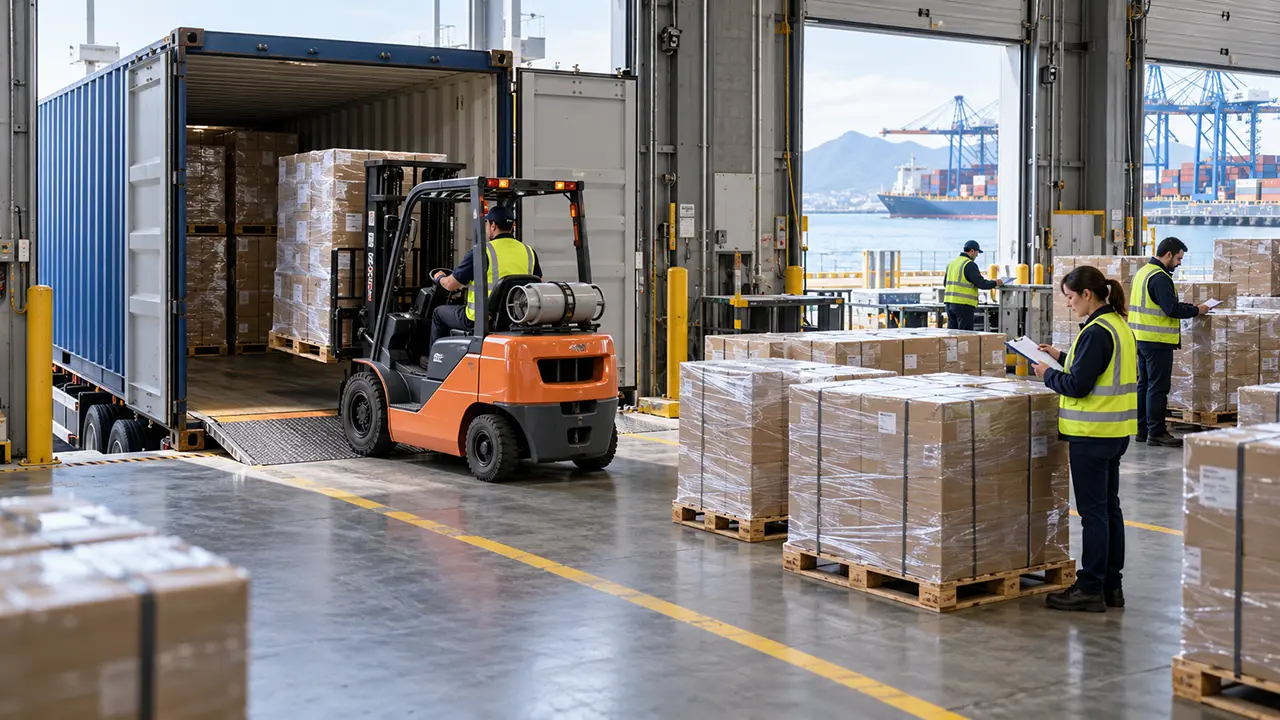
LCL stands for Less than Container Load. Several shippers’ goods travel together in one ocean container. At the Canadian destination, the container is processed and the individual consignments are separated. This additional warehouse and release work helps explain why LCL can involve local charges that are different from the ocean freight itself.
The exact name on an invoice varies by carrier, consolidator, destination agent and facility. One provider may bundle several services under a single destination-handling charge; another may show separate CFS, deconsolidation and document lines. Different labels do not necessarily mean different services. Ask what work each line covers before treating charges as duplicated.
If you are choosing between shared-container and full-container shipping, our sea freight service overview explains where LCL fits in the wider China-to-Canada transportation process.
LCL Destination Fees: What Each Invoice Line Usually Means
The following table is a reading guide, not a universal Canadian tariff. A charge may be included, separately billed, combined with another line, or not applicable at all. The quotation and the responsible provider’s tariff control the actual scope.
| Charge or term | What it may cover | Common billing basis | What the importer should verify |
|---|---|---|---|
| CFS / deconsolidation | Unloading the shared container, separating and handling individual shipments | W/M, CBM, weight, or minimum | Facility name, rate, chargeable units, minimum and whether unpacking is already bundled |
| Destination handling / terminal-related allocation | Local processing or an allocated share of destination terminal services | Per shipment, per W/M, or bundled | Exact activities and any overlap with CFS charges |
| Delivery Order (D/O) / cargo release | Documentation or instructions required for cargo release | Often per shipment or bill of lading | Issuing party, release conditions and number of bills covered |
| Documentation / administrative fee | Destination agent processing, notices or other shipment documentation | Often per shipment | Whether it is included in another processing charge |
| Manifest / security-related processing | Applicable carrier or agent data processing | Tariff or service dependent | Who collects it and whether it is already included |
| Additional handling | Palletizing, sorting, restacking, special cargo or an extra warehouse service | Per pallet, handling unit, weight or actual work | What triggered it and whether it was authorized |
| CFS / warehouse storage | Cargo remaining beyond the permitted storage period | Facility tariff, often time- and quantity-based | Free time, last free day and the start of chargeable storage |
| Customs examination handling | Movement, unloading, positioning or reloading for an official examination | Actual event or third-party tariff | Whether the shipment was selected and which parties invoiced the service |
These destination-related charges should be distinguished from the general freight rates and total shipping budgets maintained in our China-to-Canada shipping cost guide. That page owns current rate estimates; this guide explains how to audit the Canadian destination lines of an LCL quote.
Which Charges Are Not the Same as LCL Destination Handling?
A shipment invoice can include costs arising in Canada without every line being a CFS fee. Separating the categories helps prevent misleading comparisons between forwarders.
| Cost category | Examples | How to treat it when comparing quotes |
|---|---|---|
| Ocean transportation | Base LCL freight, ocean-carrier surcharges | Compare separately from Canadian local charges |
| Canadian destination services | CFS handling, deconsolidation, release or destination agency fees | Confirm exactly which local services are included |
| Customs brokerage | Licensed broker’s entry, declaration and release services | Check the broker’s own fee schedule and service scope |
| Government import amounts | Applicable customs duty, GST and other assessed import amounts | Do not present these as a freight-forwarder destination fee |
| Inland transport and delivery | Pickup from CFS, trucking to a warehouse, appointments or liftgate service | Quote against the exact delivery postal code and unloading conditions |
| Contingent or exception costs | Inspection-related handling, storage, waiting, redelivery | Ask when these can arise and who approves or pays them |
Canadian commercial importers must meet the Canada Border Services Agency’s (CBSA) import-accounting and payment requirements. The CBSA guide to release, accounting and payment explains that import duties and taxes are government obligations, not simply another ocean-handling line. A customs broker may charge separately for its professional services.
How CFS, Deconsolidation and Cargo Release Work After Arrival
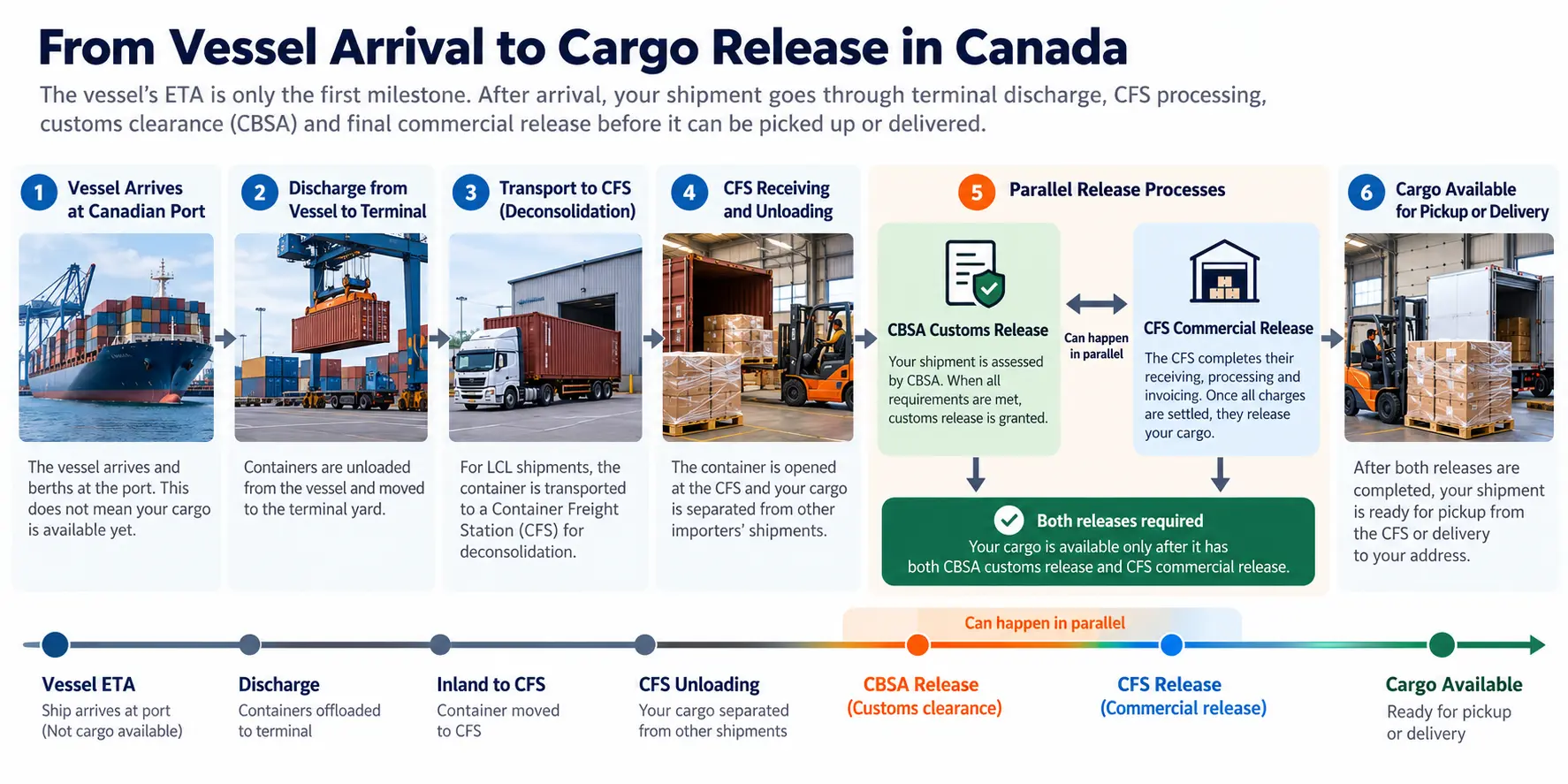
The Canadian arrival process normally involves more than the ship berthing. For a typical LCL consignment, the operational chain can look like this:
- Ocean arrival: The consolidated container reaches a Canadian marine gateway or follows the booked inland route.
- Container movement: The shared container is moved for destination processing under the applicable carrier and facility arrangements.
- Deconsolidation: A CFS or approved handling facility separates the individual house-bill consignments, checks cargo identification and prepares the freight for pickup or onward movement.
- Customs and commercial release: The importer or appointed licensed broker completes the applicable import-release requirements; the destination agent and facility apply their own cargo-release and payment conditions.
- Availability notice: The importer or pickup provider receives the relevant location, reference, availability and storage-deadline information.
- Pickup or final delivery: Cargo leaves the facility for its business, distribution centre or 3PL destination.
Customs release and warehouse or carrier release are related, but they are not always the same operational milestone. A shipment can be cleared for import yet still require a destination invoice to be settled or a pickup appointment to be arranged.
Arrival is not cargo availability
How Are Canadian LCL Destination Charges Calculated?
Understand CBM, W/M and the minimum charge
Many LCL tariffs use W/M (weight or measurement). A common method compares the shipment’s cubic metres with its weight in metric tons and uses the greater result. However, not every destination provider uses the same density conversion, minimum or billing unit. Some tariffs use other weight-to-volume ratios or facility-specific handling rules. Ask for the exact formula that applies to the destination invoice rather than assuming that the ocean-freight W/M calculation will be copied to every local charge.
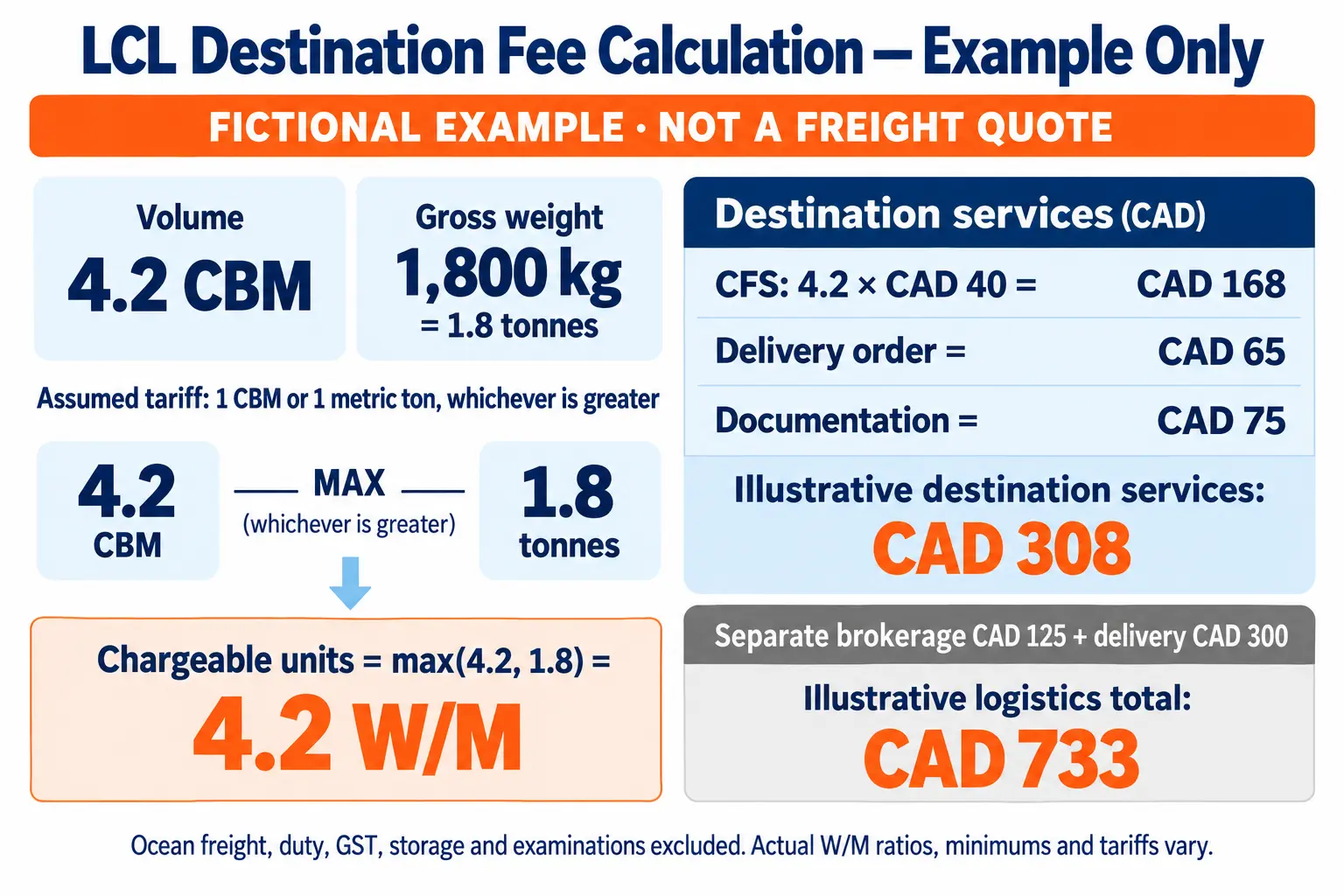
For example, under an assumed tariff of one chargeable unit per CBM or metric ton, a shipment measuring 4.2 CBM and weighing 1,800 kg produces 4.2 W/M units because 4.2 is greater than 1.8. Another operator’s tariff may produce a different billed quantity.
Illustrative Canadian destination invoice — not a market quotation
The figures below are fictional CAD amounts chosen only to demonstrate invoice arithmetic. They are not advertised TopShipping charges, Canadian market averages, carrier tariffs or price recommendations. No ocean freight, duty, GST, examination or storage is included in this illustration.
| Illustrative line | Assumed basis | Calculation (CAD) | Illustrative amount |
|---|---|---|---|
| Destination CFS handling | 4.2 W/M at CAD 40 per W/M | 4.2 × 40 | CAD 168 |
| Delivery Order processing | Per shipment | Flat 65 | CAD 65 |
| Destination documentation | Per shipment | Flat 75 | CAD 75 |
| Illustrative destination-services subtotal | Three local lines only | 168 + 65 + 75 | CAD 308 |
| Separate customs brokerage | Assumed professional service | Flat 125 | CAD 125 |
| Separate truck delivery | Assumed business delivery | Flat 300 | CAD 300 |
| Combined illustrative logistics amount | Excludes ocean and government charges | 308 + 125 + 300 | CAD 733 |
The lesson is not that an importer should expect CAD 733. It is that the boundary of a quotation matters. A CAD 308 destination-services subtotal cannot fairly be compared with a CAD 733 subtotal that also includes brokerage and trucking. Actual quotations must show the currency, tax treatment, tariff basis, minimum amounts and separately payable items.
How to Compare Two LCL Quotes Without Missing Canadian Fees
Imagine one agent quotes an inexpensive port-to-port ocean rate while another provides a larger figure that includes several Canadian destination items. Neither quote is necessarily better until they cover equivalent services.
Ask each provider to complete the same scope comparison:
| Question | Quote A | Quote B |
|---|---|---|
| Chinese origin and named Canadian gateway | Confirm | Confirm |
| Ocean freight basis and rate validity | Confirm | Confirm |
| Destination CFS and deconsolidation included? | Included / excluded | Included / excluded |
| D/O, release and administrative charges included? | Included / excluded | Included / excluded |
| Destination W/M, minimums and currency | Confirm | Confirm |
| Canadian customs brokerage and government amounts | Separate / included where lawful | Separate / included where lawful |
| CFS address, availability notice and free-storage rule | Confirm | Confirm |
| Pickup or final delivery to exact postal code | Included / excluded | Included / excluded |
| Examination, storage, waiting and redelivery exposure | Written exclusions | Written exclusions |
Request both quotes on the same cargo measurements, supplier-ready date, trade terms and destination. If the supplier has offered a “freight prepaid” or “CIF” arrangement, ask exactly which destination services remain payable in Canada; these phrases do not prove that local handling and delivery are covered. For a more general explanation of import cost responsibilities, see our CIF versus FOB shipping guide.
Which Documents Help You Audit a Destination Invoice?
When a Canadian destination invoice differs from the original quotation, compare the documents in order instead of relying on the total alone.
- Accepted quotation: Note the service scope, currency, validity period, minimums and stated exclusions.
- House Bill of Lading: Confirm the shipper, consignee, shipment references, package count and freight terms. Where relevant, distinguish the house bill from the master bill for the shared container.
- Packing list and measured cargo details: Check final CBM, gross weight, pallet count and any remeasurement that affects W/M billing.
- Arrival notice: Check the notified agent, actual release point, cargo availability information and payment instructions.
- Destination invoice: Match each charge to a quoted service, applicable tariff or documented additional event.
- Customs release and pickup records: Confirm which stage was completed and whether storage or further handling was triggered.
If the consignee, packaging, weight or cargo details do not agree across documents, resolve the discrepancy before the collection deadline. Our shipping documents checklist covers the broader records needed for imports from China.
Questions to send when you do not recognize a charge
- What service does this fee cover, and which entity is collecting it?
- Was it included in the original quote or billed separately under a disclosed tariff?
- Is the charge per house bill, shipment, CBM, W/M, pallet or calendar day?
- What minimum applies and what measurement was used?
- Does this duplicate another destination-handling line, or is the scope different?
- Is it mandatory for cargo release, or is it an optional delivery or handling service?
- When does free storage end, and what action is required to prevent additional costs?
Ask for written clarification and supporting references promptly. A billing dispute should not cause the importer to lose track of the last free day.
Are Customs Examinations, Storage and Demurrage Destination Charges?
These charges can arise after arrival, but they should not be presented as standard fees that every LCL shipment must pay.
Customs examination costs
The CBSA may select goods for an examination. The agency explains that the shipping industry commonly bills the physical processing associated with examinations and passes those costs to the responsible party. An importer should distinguish government selection of the shipment from third-party handling, positioning, unloading, reloading and storage charges that may result. See the CBSA guidance on shipping and examinations for official context.
CFS storage and the last free day
Storage may begin when individual cargo is not collected within the facility’s applicable free period. The free-storage clock, notification rules, operating hours and tariff vary. Ask when the cargo will actually be available and obtain the last free-storage day in writing. Do not assume a fixed number of free days.
Demurrage and detention are different concepts
Demurrage and detention generally concern container or equipment time under carrier arrangements, while an LCL importer more commonly encounters CFS or warehouse storage at the individual-shipment level. Contract terms can still pass through other charges. The detailed definitions belong to our Canadian demurrage, detention and storage guide.
Contingent charges cannot be guaranteed away
Why the Canadian Destination Changes the LCL Cost
A shipment intended for a warehouse in Metro Vancouver does not have the same local movement as one heading to Toronto, Markham, Montreal, Calgary or Edmonton. The ocean arrival gateway, consolidation arrangement and inland transport plan affect where the shipment becomes available and which parties handle it.
Toronto and Markham are not trans-Pacific marine seaports. A China-origin ocean shipment for an inland Ontario destination may arrive through a marine gateway and continue by rail or another inland service before final CFS processing or delivery, depending on the booked route. Ask whether an advertised “Toronto destination” quote means arrival at an inland CFS, availability for customer pickup or final delivery to the business.
For importers receiving goods at a warehouse or third-party logistics provider, door-to-door freight coordination can be compared with CFS pickup when the included customs and last-mile services are stated clearly.
Recurring LCL Imports: How to Keep Destination Costs Predictable
For a Canadian wholesaler importing inventory every month or quarter, the goal is not simply to obtain one low ocean rate. It is to make destination billing, cargo availability and warehouse receiving predictable across successive shipments.
An importer with repeat orders can establish a simple shipment-by-shipment control process:
- Use consistent cargo data: Track packed CBM, gross weight, pallet count and changes between purchase orders.
- Compare costs on the same scope: Separate ocean, Canadian destination handling, brokerage, government amounts and final delivery in the internal budget.
- Keep a destination-fee log: Record the actual CFS, D/O, administrative and storage lines paid on each arrival.
- Coordinate importer readiness: Prepare commercial records and customs-broker instructions before vessel arrival.
- Protect warehouse availability: Share CFS pickup rules, the last free day and receiving appointments with the responsible trucker or 3PL.
- Revisit shipment mode: If recurrent batches grow or become dense, compare complete LCL and FCL proposals instead of assuming the prior mode is still best.
Repeated shipments can improve planning and make deviations easier to spot, but they do not automatically guarantee a fixed annual freight rate or exemption from changing destination tariffs. For the broader container decision, consult our LCL versus FCL comparison.
TopShipping can review the practical inputs for a recurring China-to-Canada shipping plan, including supplier locations, anticipated shipment cadence, cargo dimensions, the Canadian receiving address and the proposed service scope. Confirm any pricing, capacity or contractual terms in a shipment-specific written proposal.
Pre-Booking Checklist: Avoid Unexpected Canadian LCL Fees
- Obtain an itemized estimate of Canadian destination charges, with currency and validity.
- Identify which local charges are included in the initial ocean quote.
- Request the applicable CFS / deconsolidation charging basis and minimums.
- Confirm the destination agent, Canadian CFS city and planned release location.
- Check whether the D/O and documentation lines are bundled or separate.
- Distinguish brokerage fees from CBSA-assessed duty and taxes.
- Confirm who monitors cargo availability and the last free-storage day.
- Ask how examinations, storage and other contingent charges will be communicated.
- Provide final carton or pallet dimensions and gross weight before booking.
- Confirm whether a truck is included and the exact Canadian delivery postal code.
- For repeat imports, record the cost categories and facility used each time.
Ask for an Itemized LCL Quote from China to Canada
Before booking, send your Chinese supplier city, commodity description, cargo-ready date, carton or pallet count, final dimensions, gross weight, total CBM, Incoterm and Canadian destination postal code. If this is repeat wholesale inventory, also share how often you expect to ship.
Ask for a quotation that identifies the ocean leg, Canadian CFS and release charges, customs-service scope and final-delivery arrangements separately. This makes it easier to evaluate both the first shipment and future replenishment orders.
To review a commercial LCL shipment with the TopShipping team, request a freight quotation with the available cargo details. If your project is still at an early planning stage, start with the China-to-Canada shipping guide for the complete transportation process.
FAQ — LCL Destination Charges in Canada: How to Read an Ocean Freight Quote
LCL destination charges are local costs for processing a shared-container shipment after ocean arrival. They may include CFS handling, deconsolidation, destination administration, delivery-order processing and other release services. Charges differ by operator, facility, cargo measurements and the services already included in the quotation. Brokerage, import duty and GST, storage and truck delivery should be identified separately when comparing the complete delivered cost.
They can overlap. Deconsolidation describes separating individual shipments from a shared container, while a CFS handles cargo receiving, movement, sorting and release. Some providers include deconsolidation within a CFS charge; others invoice more than one handling line because separate services are involved. Ask for the exact scope and tariff behind each line before assuming the invoice has a duplicate charge.
Not automatically. "Freight prepaid" generally addresses the agreed freight payment arrangement, not necessarily every destination service. Canadian CFS, release, brokerage, government amounts and trucking may be excluded even where the international ocean leg has been paid. The safest approach is to obtain an itemized quotation identifying included services, excluded charges, billing currency, applicable minimums and the Canadian delivery or release point.
Prepare customs information before arrival, monitor the destination agent's notice and confirm when the individual shipment becomes available. Ask the CFS or provider for the last free-storage day, pickup conditions and operating hours in writing. Arrange payment, release instructions and truck or warehouse receiving before the deadline. Free time is not uniform across Canadian CFS locations and should not be calculated from vessel ETA alone.
Use the same cost categories for each shipment: ocean freight, CFS and release services, customs brokerage, duty and GST, inland delivery and contingent charges. Track CBM, weight, facility and tariff basis alongside the final invoices. For monthly or seasonal inventory, this makes unusual charges visible and helps determine when an LCL-to-FCL comparison becomes worthwhile. Repeated shipments do not by themselves guarantee a fixed annual destination-fee rate.
Discussion
1 comment
Your perspective
Share a useful question, experience or correction. Your email address will not be published.
[…] explanation of one of the most misunderstood parts of groupage shipping, see our dedicated LCL destination charges in Canada […]