
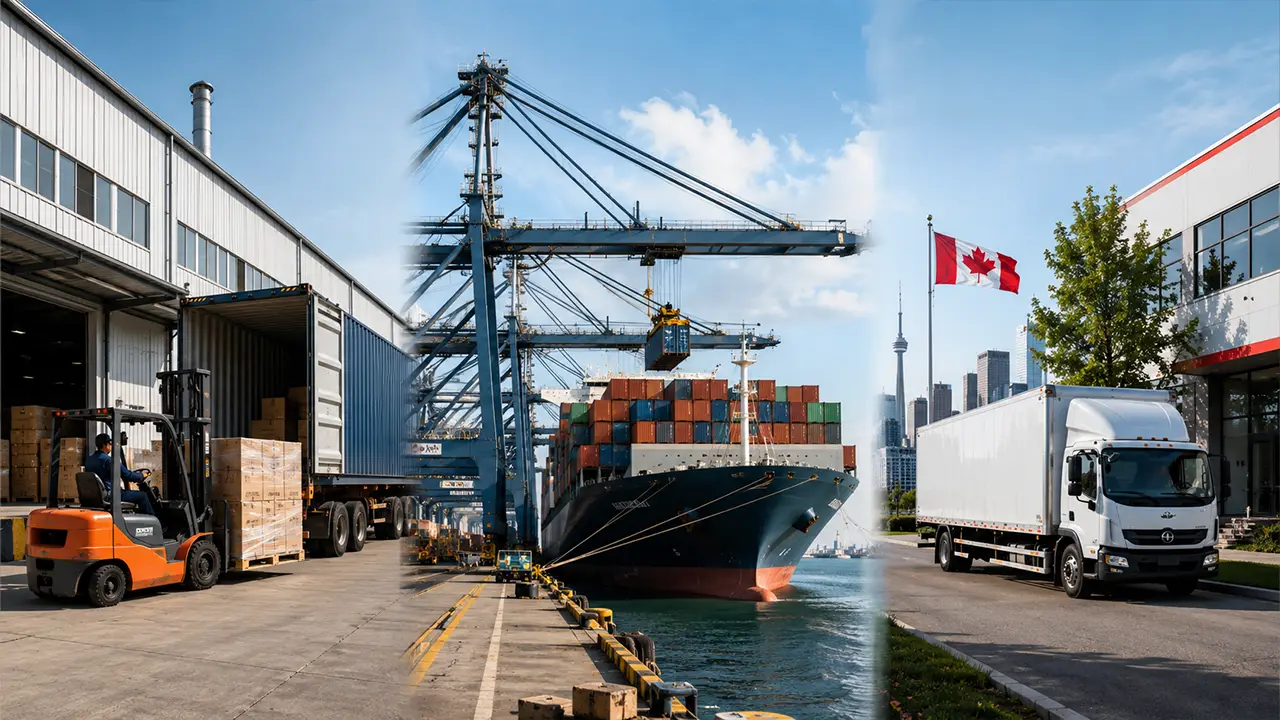
FOB, EXW, and DDP are among the most common shipping terms used when Canadian businesses buy products from Chinese suppliers. The term written on the supplier quotation affects much more than the product price. It determines who arranges factory pickup, export customs clearance, international freight, Canadian import clearance, duties, taxes, and final delivery.
For companies shipping from China to Canada, the best Incoterm is not automatically the one with the lowest supplier price. The correct comparison is the total landed cost, the point where risk transfers, the party controlling the freight, and whether the seller can legally and operationally complete the responsibilities stated in the contract.
This guide compares FOB vs EXW vs DDP for China-to-Canada shipments under Incoterms 2020 and explains when each option is practical for Canadian importers.
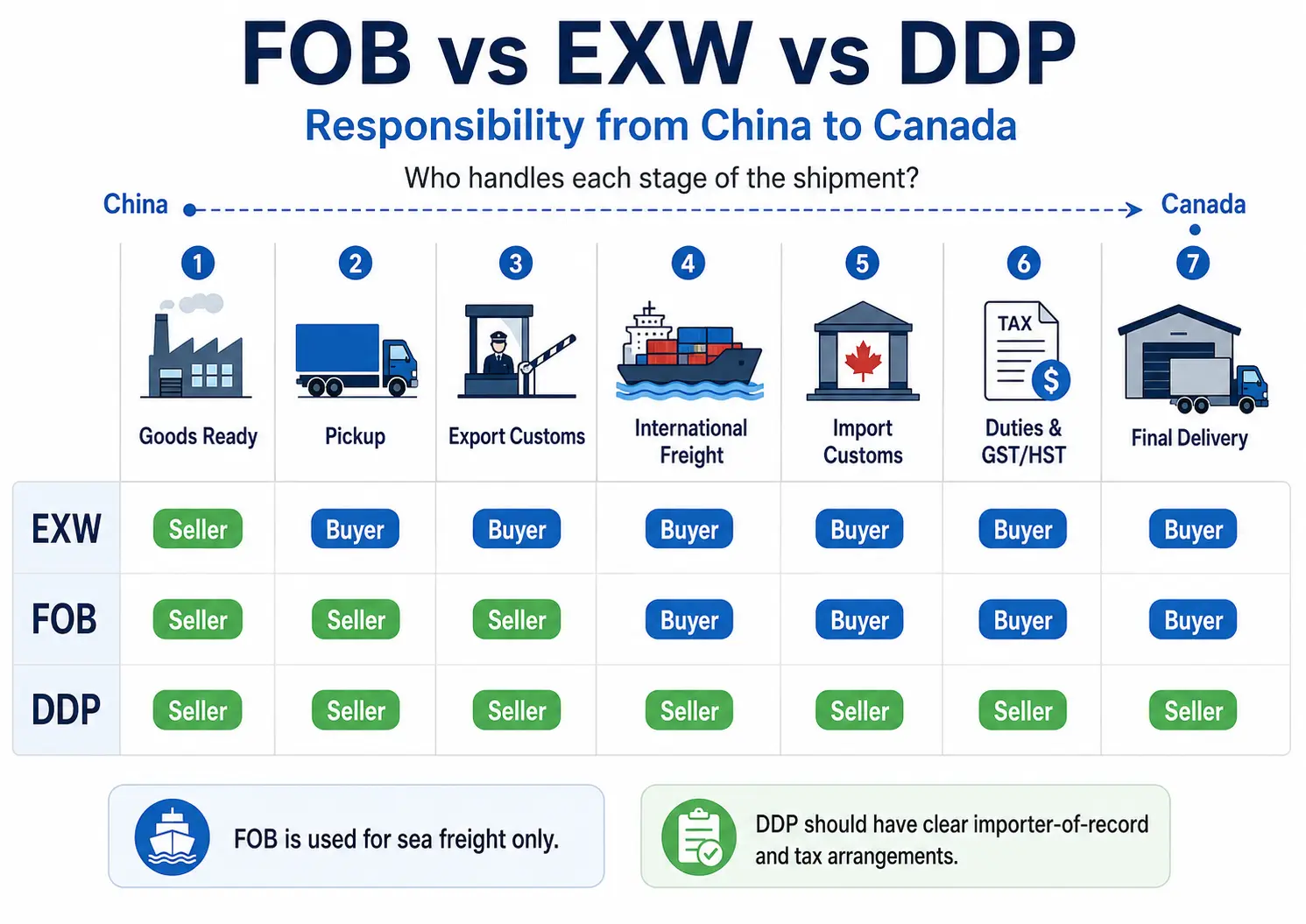
FOB vs EXW vs DDP at a Glance
| Comparison Point | EXW | FOB | DDP |
|---|---|---|---|
| Full name | Ex Works | Free On Board | Delivered Duty Paid |
| Seller’s main obligation | Makes the goods available at the named factory, warehouse, or location | Clears the goods for export and loads them on board the vessel at the named port | Delivers the goods to the named destination after export, freight, import clearance, and payment of applicable duties and taxes |
| Buyer’s logistics responsibility | Very high | Medium | Low, provided the DDP scope is valid and complete |
| China pickup | Buyer | Seller | Seller |
| China export clearance | Buyer | Seller | Seller |
| International freight | Buyer | Buyer | Seller |
| Canadian import clearance | Buyer | Buyer | Seller |
| Duties and import taxes | Buyer | Buyer | Seller |
| Final delivery in Canada | Buyer | Buyer | Seller |
| Applicable transport modes | Any mode | Sea and inland waterway transport only | Any mode |
| Typical use | Importer has a reliable China-side freight partner | Commercial ocean freight where the buyer wants control of the main carriage | Buyer wants an agreed duty-paid delivery solution with fewer logistics tasks |
| Main concern | Export coordination, pickup charges, and early risk transfer | Destination costs and using FOB incorrectly for air or container-terminal handovers | Importer of record, tax treatment, compliance, and unclear exclusions |
Practical answer: FOB is often a balanced option for established Canadian importers using ocean freight. EXW gives the buyer more control but requires strong logistics support in China. DDP can simplify delivery, but only when the importer-of-record arrangement, customs compliance, duties, GST/HST, and exclusions are clearly documented.
What Incoterms Control and What They Do Not
Incoterms rules published by the International Chamber of Commerce allocate delivery tasks, costs, and risks between the seller and buyer. They help define who performs specific logistics obligations and where delivery and risk transfer occur.
Incoterms do not automatically determine:
- When ownership or legal title transfers
- How and when the supplier is paid
- Product specifications, quality standards, or warranty obligations
- Remedies for breach of contract
- Governing law or dispute resolution
- Whether a product is admissible or compliant with Canadian regulations
- The exact services included in a freight forwarder’s quotation
The sales contract should therefore state the complete term, named place or port, and rule version. For example, write FOB Shanghai Port, China, Incoterms 2020 rather than simply writing “FOB China.” A vague location creates uncertainty about trucking, terminal handling, and the exact point of delivery.
What Is EXW Shipping from China?
EXW means Ex Works. Under EXW, the Chinese supplier’s core responsibility is to place the goods at the buyer’s disposal at the named location, usually a factory or warehouse. The buyer assumes responsibility for nearly all transport activity from that point onward.
Under a strict EXW arrangement, the seller is generally not responsible for loading the collecting vehicle or clearing the goods for export. In practice, many Chinese factories assist with loading and documents, but that assistance should not be assumed. It must be confirmed in writing.
What the Buyer Normally Handles Under EXW
- Collection from the factory or supplier warehouse
- Loading responsibility when not included by the seller
- China domestic trucking
- Export declaration and export customs coordination
- Origin warehouse, terminal, port, or airport charges
- International air freight or sea freight
- Cargo insurance when required
- Canadian customs clearance
- Customs duties, GST/HST, and other import charges
- Destination handling and final delivery in Canada
Advantages of EXW for Canadian Importers
- The supplier’s product quotation is easier to separate from logistics costs.
- The importer can select its own freight forwarder and control the routing.
- EXW can work well when cargo is collected from several suppliers and moved to one consolidation warehouse.
- The importer can obtain a transparent view of pickup, export, and freight charges.
Risks and Hidden Costs Under EXW
An EXW price often looks lower than a FOB or DDP price because much of the logistics cost has been removed from the supplier quotation. The buyer may later receive separate charges for pickup, loading, export documentation, customs declaration, warehouse handling, terminal delivery, and local trucking.
Export formalities can also create operational problems. The Canadian buyer is outside China and may not be able to perform export procedures directly. A capable freight forwarder or export agent must coordinate the process with the supplier and ensure the exporter details and commercial documents are acceptable.
EXW is particularly useful when purchasing from multiple factories. TopShipping can collect separate orders and manage freight consolidation in China before the combined cargo moves to Canada.
When EXW Is Usually a Good Choice
- You have a trusted freight forwarder with operational coverage in China.
- You want to control collection, consolidation, export, and international freight.
- The supplier cannot provide a reliable FOB quotation.
- You buy from several suppliers and want one consolidated shipment.
- You need independent verification of origin charges instead of accepting a bundled supplier freight price.
What Is FOB Shipping from China?
FOB means Free On Board. Under FOB, the Chinese seller arranges transport to the named port, completes export customs formalities, and delivers the cargo on board the vessel nominated for the shipment. Risk transfers from the seller to the buyer when the goods are on board the vessel.
The buyer then controls and pays for the main ocean freight, cargo insurance when selected, Canadian destination charges, import clearance, duties, taxes, and inland delivery.
What the Seller Normally Handles Under FOB
- Commercial preparation of the goods
- Transport from the factory to the named Chinese port
- Export documentation and customs clearance
- Origin handling required to deliver the cargo on board the vessel
What the Buyer Normally Handles Under FOB
- Booking and payment of the international ocean freight
- Marine cargo insurance when required
- Destination terminal and port charges
- Customs brokerage and import clearance in Canada
- Applicable duties, GST/HST, and other taxes
- Demurrage, detention, examination, or storage charges when incurred
- Rail or truck delivery to the final Canadian destination
Why FOB Is Common for China-to-Canada Ocean Freight
FOB gives the importer control of the main freight while leaving China-side export clearance with the supplier. This often creates a more practical division of responsibilities than EXW for a Canadian buyer who does not want to manage factory-to-port export procedures.
FOB is commonly used for commercial sea freight from China to Canada, including supplier quotations from ports such as Shanghai, Shenzhen, Ningbo, Qingdao, Xiamen, and Guangzhou-area terminals.
Important FOB Limitation: It Is Not an Air Freight Term
FOB under Incoterms 2020 is designed for sea and inland waterway transport. It should not be used for air freight, courier shipments, rail freight, or multimodal delivery to an airport terminal. For air shipments, EXW, FCA, CPT, CIP, DAP, or DDP may be more appropriate depending on the commercial arrangement.
For urgent cargo moving by aircraft, review the operational options for air freight from China to Canada.
FOB and Containerized Cargo
FOB is widely used for container shipments, but the contractual risk-transfer point may not match how container cargo is physically handed over. A sealed container is often delivered to a terminal before it is loaded on the vessel. In such cases, FCA at a named terminal or another agreed location can be operationally more precise because risk transfers when the cargo is delivered to the carrier at the named place.
This does not mean every existing FOB container contract is unusable. It means the importer should understand the gap between commercial habit and the physical custody chain, especially for high-value cargo, payment documents, or insurance claims.
When FOB Is Usually a Good Choice
- You are shipping by ocean freight.
- The supplier can properly complete export clearance in China.
- You want to choose the carrier, sailing, freight forwarder, and insurance arrangement.
- You want better control of destination charges and delivery planning.
- You import regularly and can manage Canadian customs and inland transport.
What Is DDP Shipping from China to Canada?
DDP means Delivered Duty Paid. It places the greatest delivery obligation on the seller. The seller is responsible for arranging export clearance, international transport, Canadian import clearance, payment of applicable duties and taxes, and delivery to the named destination. The buyer is normally responsible for unloading the arriving vehicle unless the contract states otherwise.
A properly structured DDP shipping service from China to Canada can reduce coordination for the Canadian buyer, but “DDP” should not be treated as a substitute for a detailed scope of work.
What Must Be Confirmed in a DDP Quote
- The exact named delivery address in Canada
- The legal importer of record
- The customs broker and customs accounting process
- Whether customs duties are included
- Whether GST/HST is included and how it is accounted for
- Whether anti-dumping, countervailing, excise, or other special charges are excluded
- Whether customs examination, storage, demurrage, detention, and inspection fees are excluded
- Whether residential, tailgate, appointment, remote-area, or inside-delivery charges apply
- Whether permits, licences, product testing, or agency approvals are required
- The cargo value, HS code, country of origin, and valuation method used for the quotation
Importer of Record and CARM Considerations
DDP requires the seller to complete import formalities, but the contractual wording alone does not create a compliant Canadian importer structure. The parties must determine who will act as importer of record and whether that party has the necessary Canadian business, customs, tax, and broker arrangements.
The Canada Border Services Agency uses the CBSA Assessment and Revenue Management system to assess and collect duties and taxes on commercial imports. A DDP provider should be able to explain how the shipment will be accounted for and who remains responsible for records, corrections, and post-entry customs issues.
The Canada Revenue Agency also states that the owner or importer of record is responsible for GST/HST on imported goods. The ability to recover import tax may depend on the identity and registration status of the importer. The Canadian buyer should therefore avoid a DDP structure that obscures the importer, declared value, HS code, or tax documentation.
Advantages of DDP
- One party coordinates most of the shipment from origin to destination.
- The buyer receives a more complete cost estimate before dispatch.
- DDP can reduce operational work for new or infrequent importers.
- It can be practical for e-commerce stock, samples, replacement parts, and shipments with a clearly defined compliance path.
Risks of DDP
- The supplier may use an unclear or non-compliant importer arrangement.
- The quotation may exclude inspections, storage, remote delivery, or special duties.
- The buyer may receive limited customs documentation.
- An incorrect HS code or declared value can create reassessment and compliance exposure.
- The buyer has less control over carrier selection, routing, transit time, and freight cost.
- A low DDP quote may depend on assumptions that are not valid for the actual product.
Canadian businesses should request a written customs and tax breakdown and confirm the import process before accepting DDP. TopShipping can support document review and customs clearance for China-to-Canada shipments.
Responsibility by Shipment Stage
| Shipment Stage | EXW Responsibility | FOB Responsibility | DDP Responsibility |
|---|---|---|---|
| Goods packed and ready | Seller | Seller | Seller |
| Loading at supplier location | Buyer unless separately agreed | Seller | Seller |
| Factory pickup and China trucking | Buyer | Seller | Seller |
| China export customs | Buyer | Seller | Seller |
| Origin terminal charges | Buyer | Seller up to FOB delivery point | Seller |
| Main international freight | Buyer | Buyer | Seller |
| Cargo insurance | Buyer decides | Buyer decides | Not automatically required by DDP; confirm coverage |
| Canadian destination charges | Buyer | Buyer | Seller, subject to written exclusions |
| Canadian customs clearance | Buyer | Buyer | Seller |
| Duties and import taxes | Buyer | Buyer | Seller |
| Final delivery | Buyer | Buyer | Seller to the named place |
| Unloading at destination | Buyer | Buyer | Buyer unless separately agreed |
FOB vs EXW: Which Gives the Importer More Control?
EXW gives the buyer control from the supplier location, while FOB gives the buyer control from the point the goods are loaded on the vessel. The difference is the China-side scope between the factory and the vessel.
EXW can be better when the buyer has a strong China logistics network, needs multi-supplier consolidation, or wants to audit every origin cost. FOB is usually easier when one supplier can reliably arrange domestic transport and export clearance to the named port.
For many Canadian importers, FOB reduces operational risk because the Chinese supplier remains responsible for export clearance. However, FOB does not include ocean freight, Canadian customs, duties, destination charges, or final delivery.
FOB vs DDP: Control Versus Convenience
Under FOB, the Canadian importer controls the main freight and destination process. Under DDP, the seller controls almost the entire route and delivers to the named Canadian destination.
FOB is generally more transparent for experienced importers because the buyer can compare carrier rates, select a freight forwarder, review customs entries, and manage delivery. DDP is more convenient when the seller or logistics provider has a compliant and clearly documented import solution.
The correct choice depends on whether the buyer values direct freight control or a more complete delivered service. A DDP price should always be compared against the full FOB landed cost rather than only the FOB product price.
EXW vs DDP: Opposite Ends of the Responsibility Scale
EXW gives the seller the minimum delivery obligation, while DDP gives the seller the maximum delivery obligation. This makes the price difference appear large, but the two quotations are not comparable until every logistics component is added.
An EXW quote may exclude collection, export, international freight, customs, duties, taxes, and delivery. A DDP quote is expected to include these stages, subject to the named destination and agreed exclusions. The buyer should normalize both quotes into the same landed-cost format.
How to Calculate the Real Landed Cost
To compare FOB, EXW, and DDP correctly, calculate the shipment on a common basis:
Total landed cost = product cost + China pickup + export handling + origin charges + international freight + insurance + destination charges + customs brokerage + duties + GST/HST + inland delivery + foreseeable accessorial charges.
Important inputs include:
- Incoterm and exact named location
- Product description and HS code
- Country of origin
- Commercial value and currency
- Carton or pallet count
- Gross weight and chargeable weight
- Total cubic metres
- Pickup address in China
- Port or airport of departure
- Final postal code in Canada
- Required delivery equipment and appointment conditions
- Permits, licences, testing, labelling, or inspection requirements
Use the detailed shipping cost from China to Canada guide to understand how air, LCL, FCL, customs, and final-mile charges affect the final budget.
Examples for Canadian Importers
Example 1: One Full Container from Shanghai
A Canadian wholesaler buys a full container from one established manufacturer. The supplier can complete export customs and deliver the container to Shanghai port. FOB Shanghai may be practical because the buyer can control the ocean carrier, Canadian customs broker, and final truck delivery.
Example 2: Products from Four Suppliers in Shenzhen
An e-commerce importer buys goods from four factories. Each supplier provides an EXW price. A China-based freight partner collects the cargo, checks quantities, consolidates the orders, prepares export documents, and sends one LCL or air shipment to Canada. EXW can work because the buyer has operational support at origin.
Example 3: Urgent Air Shipment to Toronto
A manufacturer needs replacement components urgently. FOB is not the correct Incoterm for air transport. EXW, FCA, CPT, CIP, DAP, or DDP should be considered based on who will handle pickup, export, import clearance, and final delivery.
Example 4: First Commercial Import with a DDP Offer
A new Canadian importer receives a low DDP quotation from a supplier. Before accepting it, the buyer requests the importer-of-record identity, HS code, declared value, duty rate, GST/HST treatment, customs broker details, and a list of excluded charges. If the supplier cannot provide clear answers, a separately managed door-to-door shipping solution may provide better transparency without relying on an unclear DDP structure.
How Duties, Taxes, and HS Codes Affect the Choice
The Incoterm does not change the legal tariff classification or admissibility of the product. It changes which party is contractually responsible for completing and paying for specific steps.
Canadian duty depends on factors such as HS classification, origin, tariff treatment, value for duty, and any applicable trade-remedy measures. GST/HST and other taxes may also apply. Certain products require licences, permits, certificates, labelling, testing, or approval from other government departments.
Before approving FOB, EXW, or DDP, review the product-level requirements in the HS code, duties, and taxes guide for Canadian imports.
Questions to Ask a Chinese Supplier Before Choosing an Incoterm
- What is the exact named factory, warehouse, port, terminal, or delivery address?
- Is the quotation based on Incoterms 2020?
- Who will load the collecting vehicle?
- Who will act as exporter and complete China export customs?
- Which origin charges are included?
- Is the shipment moving by air, LCL, FCL, rail, courier, or multimodal transport?
- Who selects and pays the international carrier?
- Who arranges cargo insurance?
- Who is the importer of record in Canada?
- Are customs brokerage, duties, GST/HST, and final delivery included?
- Which charges remain payable if customs examines or delays the shipment?
- Will the buyer receive the commercial invoice, packing list, transport document, and customs accounting records?
Common Red Flags in FOB, EXW, and DDP Quotes
- The quotation says only “FOB China” without naming a port.
- A supplier uses FOB for an air freight shipment.
- The EXW quote does not provide an exact pickup address or loading conditions.
- The DDP provider cannot identify the importer of record.
- The DDP quote includes “all tax” but does not show the HS code, duty rate, or GST/HST treatment.
- The declared customs value is lower than the actual commercial transaction value without a lawful valuation basis.
- The supplier refuses to provide customs or transport documents.
- Destination fees, examinations, storage, remote delivery, or appointment charges are not addressed.
- The quotation promises a guaranteed customs result without reviewing the product and import requirements.
Which Incoterm Is Best for Shipping from China to Canada?
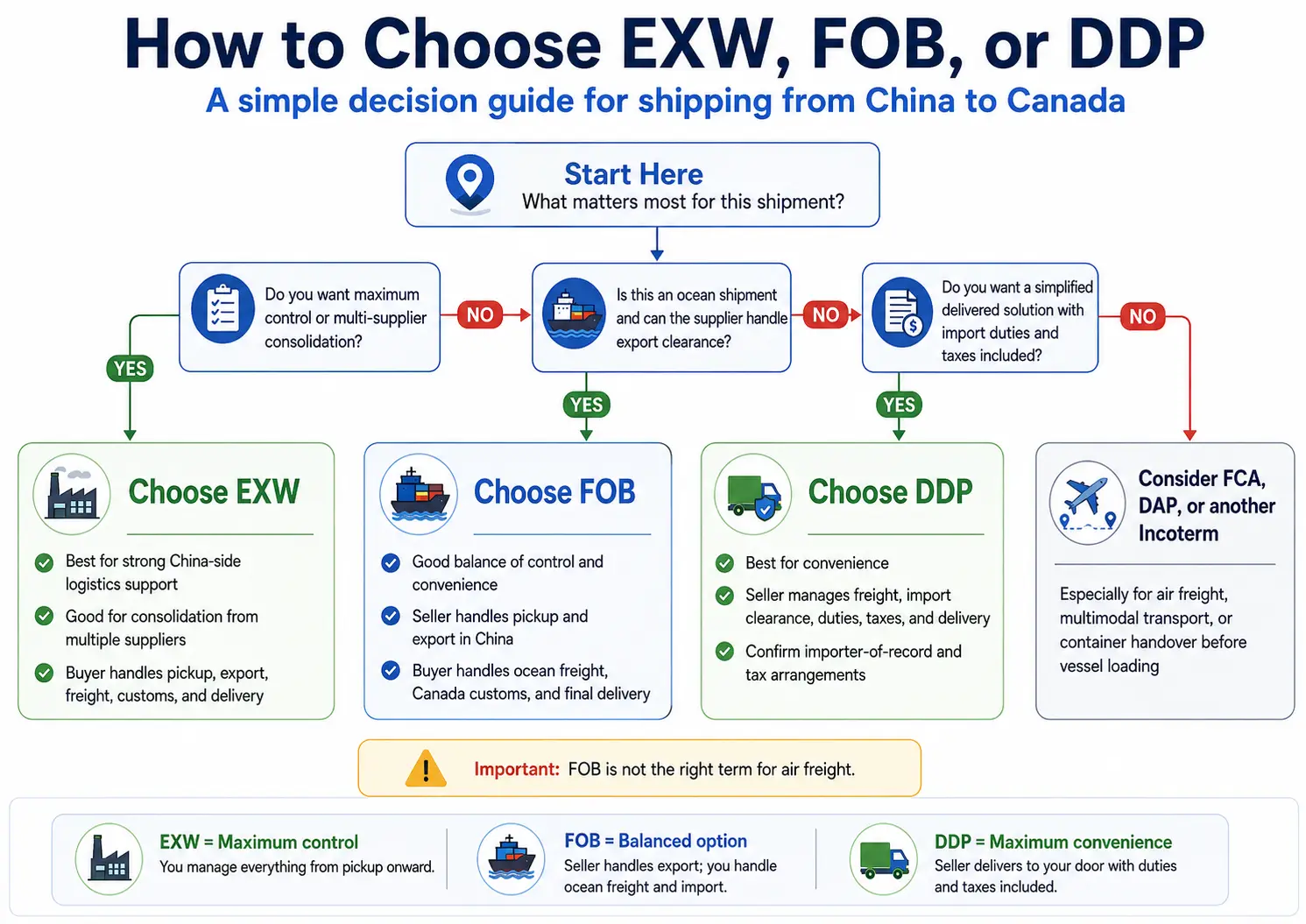
There is no universal best Incoterm for every shipment. The most practical choice depends on cargo mode, supplier capability, buyer experience, customs requirements, and the desired level of cost control.
- Choose EXW when you have reliable China-side logistics support, need supplier pickup or consolidation, and want maximum origin control.
- Choose FOB for appropriate ocean shipments when the supplier can manage China export procedures and you want to control the main freight and Canadian destination process.
- Choose DDP when you need a delivered duty-paid solution and the seller can document a compliant importer, customs, tax, and final-delivery structure.
- Consider FCA instead of FOB for air freight, multimodal transport, or container cargo handed to a carrier before vessel loading.
For most established Canadian ocean importers, FOB is often a practical middle ground. For multi-supplier sourcing, EXW combined with professional consolidation can be efficient. For buyers prioritizing convenience, DDP may work, but only after compliance and cost inclusions are verified.
How TopShipping Helps Compare Supplier Terms
TopShipping reviews the supplier’s Incoterm, pickup point, cargo details, transport mode, destination, and customs requirements before recommending a freight structure. Our team can coordinate supplier communication, China pickup, export handling, air or sea freight, documentation review, customs support, and final delivery in Canada.
To compare an EXW, FOB, or DDP quotation, provide the supplier quotation, product description, HS code if available, cargo value, carton count, weight, dimensions, pickup city, and Canadian delivery postal code.
Request a China-to-Canada freight quote to compare the real logistics scope and landed-cost exposure before confirming the supplier’s shipping term.