
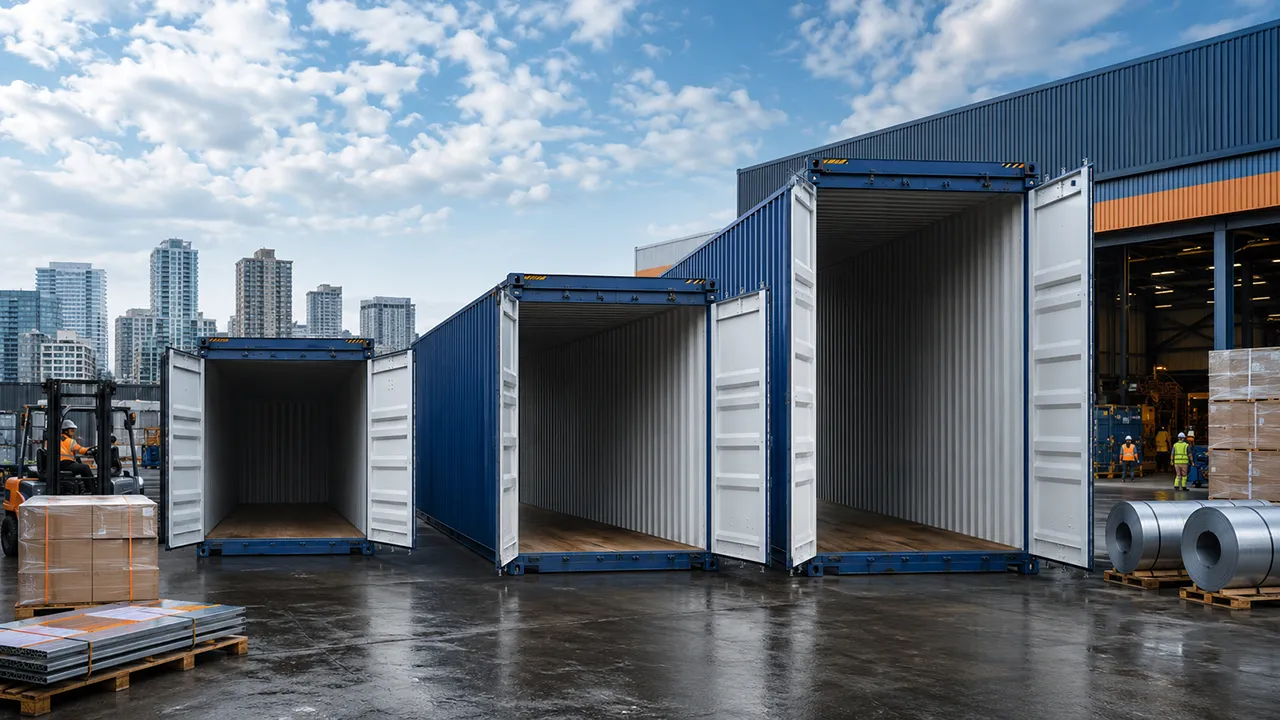
A 20ft dry container provides about 33.2 CBM of nominal internal volume, a 40ft about 67.7 CBM, and a 40ft High Cube about 76.3 CBM. The 40HQ has roughly the same floor area as a standard 40ft container but adds about 30 cm of internal height, making it especially useful for bulky or taller cargo.
For China-to-Canada freight, the right container should be selected using cargo CBM, gross weight, carton or pallet dimensions, door clearance and load distribution rather than container volume alone. A larger container does not automatically provide proportionally more payload.
Important
Container dimensions, tare weight and maximum payload vary by equipment series and manufacturer. Use the figures below for planning, then confirm the CSC plate and specifications of the actual container assigned before final loading.
20ft vs 40ft vs 40HQ: Quick Comparison
| Specification | 20ft Standard | 40ft Standard | 40ft High Cube |
|---|---|---|---|
| External length | About 6.06 m | About 12.19 m | About 12.19 m |
| External width | About 2.44 m | About 2.44 m | About 2.44 m |
| External height | About 2.59 m | About 2.59 m | About 2.90 m |
| Representative internal length | About 5.90 m | About 12.03 m | About 12.03 m |
| Representative internal width | About 2.35 m | About 2.35 m | About 2.35 m |
| Representative internal height | About 2.39 m | About 2.39 m | About 2.70 m |
| Representative door opening | About 2.34 × 2.29 m | About 2.34 × 2.29 m | About 2.34 × 2.60 m |
| Nominal internal capacity | About 33.2 CBM | About 67.7 CBM | About 76.3 CBM |
| Typical practical planning range* | About 25–28 CBM | About 55–60 CBM | About 65–70 CBM |
| Typical strength | Dense and heavy cargo | Higher-volume general cargo | Bulky or taller cargo |
*Practical-volume note: These ranges are planning references rather than rated container capacities. Uniform loose cartons can sometimes utilize more space, while pallets, crates, irregular shapes, non-stackable cargo and protective packing can reduce usable volume substantially.
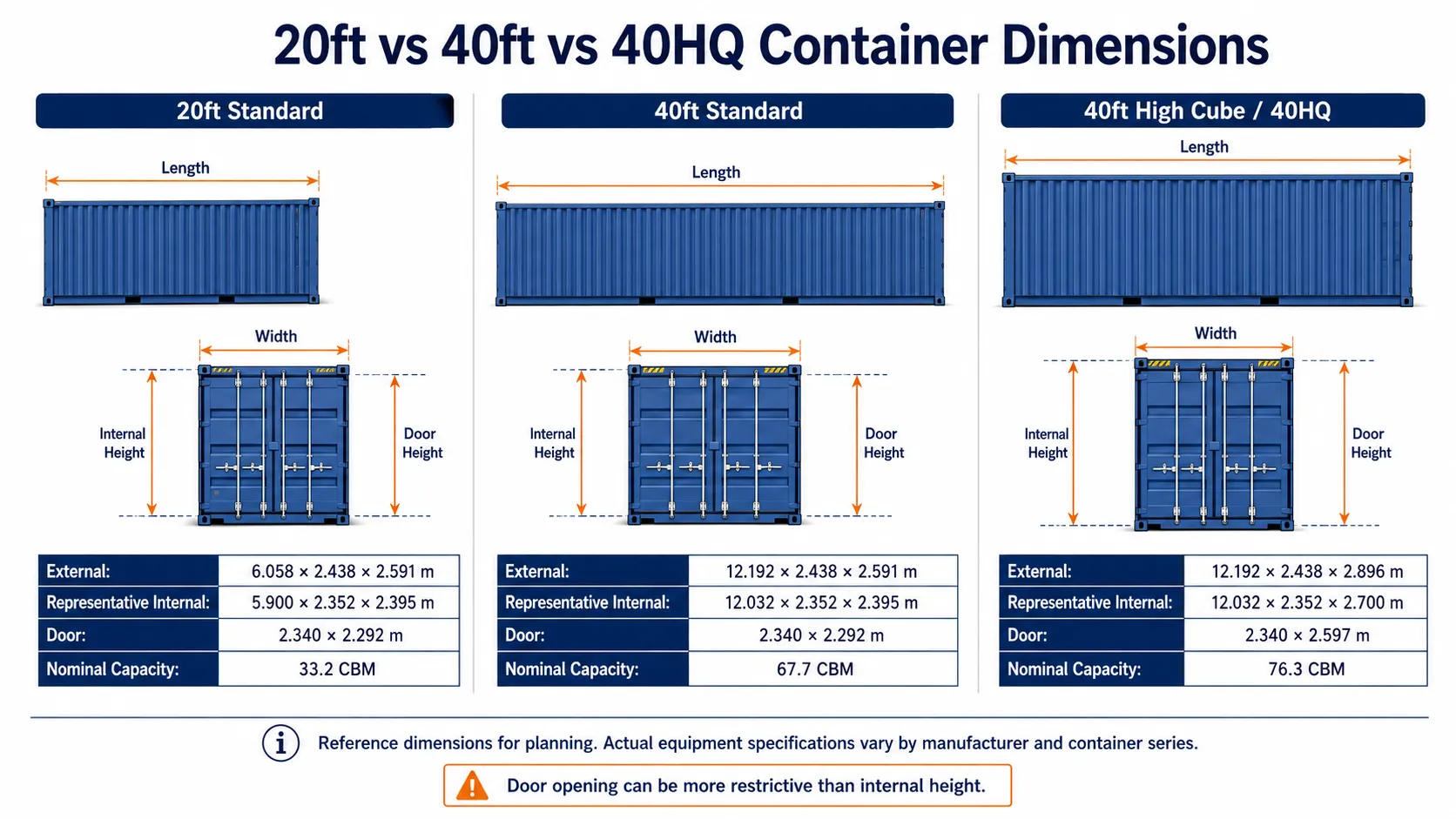
What Is the Main Difference Between a 20ft, 40ft and 40HQ Container?
The biggest differences are floor length, internal volume and height.
A standard 40ft container is roughly twice the length of a 20ft container and provides slightly more than twice the nominal cubic capacity. A 40HQ has the same basic external length and width as a standard 40ft but is approximately 30.5 cm taller externally and provides roughly 30 cm of additional internal height.
That additional height raises nominal volume from approximately 67.7 CBM in a standard 40ft to approximately 76.3 CBM in a 40HQ.
What does not double is payload. A 40ft container does not normally carry twice as much cargo weight as a 20ft container.
20ft Container Dimensions and Capacity
A standard 20ft dry container is frequently used for dense or relatively heavy commercial cargo because it provides a smaller volume while still offering substantial rated payload.
| 20ft specification | Representative value |
|---|---|
| External dimensions | 6.058 × 2.438 × 2.591 m |
| Internal dimensions | About 5.900 × 2.352 × 2.395 m |
| Door opening | About 2.340 × 2.292 m |
| Nominal internal capacity | About 33.2 CBM |
| Representative max gross weight | About 30,480 kg |
| Representative tare weight | About 2,350 kg |
| Representative max payload | About 28,130 kg |
The 20ft container can be a strong choice for products such as:
- Metal components
- Hardware
- Dense machinery parts
- Industrial components
- Stone or other dense materials where accepted
- Heavy palletized cargo
- Commercial goods that reach weight constraints before volume constraints
However, the container’s technical payload is not automatically the amount that can legally or operationally move through every China-to-Canada route. Inland road limits, axle weights, chassis restrictions, rail requirements and local regulations can impose a lower practical limit.
40ft Standard Container Dimensions and Capacity
A standard 40ft dry container provides substantially more floor space and volume than a 20ft container while keeping approximately the same internal height.
| 40ft specification | Representative value |
|---|---|
| External dimensions | 12.192 × 2.438 × 2.591 m |
| Internal dimensions | About 12.032 × 2.352 × 2.395 m |
| Door opening | About 2.340 × 2.292 m |
| Nominal internal capacity | About 67.7 CBM |
| Representative max gross weight | About 32,500 kg |
| Representative tare weight | About 3,750 kg |
| Representative max payload | About 28,750 kg |
A 40ft Standard can be appropriate for:
- General wholesale inventory
- Cartonized consumer goods
- Multiple pallets
- Commercial equipment
- Manufacturing inputs
- Inventory that needs more floor area but not additional height
The important comparison with a 20ft container is that internal volume roughly doubles while maximum payload does not. A dense shipment can therefore become weight-limited long before a 40ft container is physically full.
40ft High Cube Container Dimensions and Capacity
A 40ft High Cube—commonly called 40HQ, 40HC or 40′ High Cube—uses almost the same floor footprint as a standard 40ft container but provides additional vertical space.
| 40HQ specification | Representative value |
|---|---|
| External dimensions | 12.192 × 2.438 × 2.896 m |
| Internal dimensions | About 12.032 × 2.352 × 2.700 m |
| Door opening | About 2.340 × 2.597 m |
| Nominal internal capacity | About 76.3 CBM |
| Representative max gross weight | About 32,500 kg |
| Representative tare weight | Varies by equipment series; often roughly 3.8–4.3 tonnes |
| Representative payload | Often roughly 28.2–28.7 tonnes, depending on equipment |
The main advantage of the 40HQ is therefore volume and height—not dramatically higher weight capacity.
It is commonly useful for:
- Furniture
- Mattresses
- Light consumer products
- Plastic products
- Textiles
- Large cartons
- Tall palletized loads
- Bulky e-commerce inventory
- Products that cube out before weighing out
Quick decision
If a standard 40ft is suitable by weight but your cargo is constrained by carton height, pallet height or total cubic volume, a 40HQ is often the first alternative worth checking.
40ft vs 40HQ: Is the High Cube Really Bigger?
Yes—but almost all of the additional space is vertical.
| Feature | 40ft Standard | 40HQ |
|---|---|---|
| External length | About 12.19 m | About 12.19 m |
| External width | About 2.44 m | About 2.44 m |
| Internal height | About 2.39 m | About 2.70 m |
| Door height | About 2.29 m | About 2.60 m |
| Nominal volume | About 67.7 CBM | About 76.3 CBM |
| Single-layer floor pallet count | Similar | Similar |
Because the floor length and width are essentially the same, moving from 40ft Standard to 40HQ does not normally create additional single-layer pallet positions. Its value comes from extra height and approximately 8–9 additional cubic metres of nominal volume.
Why Door Dimensions Matter as Much as Internal Dimensions
A common container-planning mistake is checking only internal height.
Cargo still has to pass through the door.
For a standard 20ft or 40ft dry container, the representative internal height may be about 2.395 m while the door opening is only about 2.292 m high.
This difference can determine whether a tall pallet or crate can physically enter the container.
A 40HQ provides a representative door height around 2.597 m, making it much more useful for taller cargo.
For example, a loaded pallet measuring 2.40 m high may fit inside the nominal internal height of a standard container but cannot simply be assumed to pass through a standard 2.29 m door opening.
The loading method, forklift mast, tilt, packaging and clearance requirements must also be considered.
Nominal CBM vs Usable CBM
Container capacity figures such as 33.2, 67.7 and 76.3 CBM describe nominal internal volume. They do not mean an importer can automatically load exactly that amount of commercial cargo.
Real cargo creates unused space because of:
- Carton dimensions
- Pallet footprints
- Gaps between packages
- Crates
- Dunnage and securing materials
- Non-stackable products
- Irregular shapes
- Weight distribution
- Door clearance
- Unloading requirements
For early commercial planning, roughly 25–28 CBM for a 20ft, 55–60 CBM for a 40ft Standard and 65–70 CBM for a 40HQ can be useful conservative reference ranges for many normally packed shipments.
They are not guaranteed loading capacities.
Planning note
Do not select a container by comparing your supplier’s total CBM with nominal container capacity alone. A 60 CBM shipment does not automatically fit efficiently into every 40ft container. Package-level dimensions and the actual loading pattern matter.
Calculate Your Cargo CBM Before Choosing a Container
The first step in container selection is to calculate the volume of the actual packed shipment.
For rectangular cartons:
CBM = Length × Width × Height × Quantity
When measurements are in centimetres:
CBM = Length × Width × Height × Quantity ÷ 1,000,000
If the shipment contains several carton sizes, calculate each package group separately and add the results rather than averaging dimensions.
You can use our CBM calculation guide for sea freight to calculate cartons, pallets, mixed cargo and LCL W/M before selecting equipment.
20ft vs 40ft vs 40HQ Payload: Bigger Does Not Mean Twice the Weight
This is one of the most important points in container selection.
A representative 20ft dry container may have a technical payload around 28 tonnes. A representative 40ft or 40HQ can also be in roughly the same general payload range.
The 40ft therefore provides approximately twice the floor length and significantly more CBM, but it does not provide twice the legal cargo weight.
Dense Cargo
Dense cargo can reach a weight or inland-transport limitation while substantial cubic space is still unused.
Examples can include:
- Metal components
- Industrial machinery
- Fasteners and hardware
- Dense building products
- Heavy manufacturing inputs
For these shipments, a 20ft container may sometimes be more operationally logical than paying for unused cubic capacity in a 40ft.
Bulky Cargo
Bulky cargo normally reaches the physical volume limit long before the technical payload limit.
Examples include:
- Furniture
- Foam products
- Plastic household goods
- Textiles
- Large retail packaging
- Lightweight consumer inventory
These products are stronger candidates for a 40ft or 40HQ.
Maximum Payload Is Not the Same as Legal Road Weight
The payload marked on the container is an equipment rating. It does not guarantee that the same amount of cargo can legally or operationally move from the supplier through every truck, terminal, vessel, rail connection and Canadian final-delivery route.
The actual plan may also need to consider:
- Container tare weight
- Truck tractor and chassis weight
- Axle limits
- Provincial road regulations
- Origin-country trucking restrictions
- Rail restrictions
- Terminal acceptance
- Weight distribution inside the container
- Verified Gross Mass requirements
For heavy cargo, ask the freight coordinator to review inland transportation before loading the container—not after the container has already been sealed.
How Many Pallets Fit in a 20ft, 40ft or 40HQ Container?
Pallet fit depends on the pallet footprint, orientation, overhang and clearance required for loading.
As a general single-layer floor-planning reference:
| Pallet footprint | 20ft Standard | 40ft Standard | 40HQ |
|---|---|---|---|
| EPAL / Euro pallet — 1,200 × 800 mm | About 11 | About 25 | About 25 |
| Industrial pallet — 1,200 × 1,000 mm | About 9–10 | About 20–21 | About 20–21 |
| North American 48 × 40 in pallet | Layout-dependent; commonly around 9–10 | Layout-dependent; commonly around 20 | Layout-dependent; commonly around 20 |
Pallet note: These are floor-layout references, not guaranteed loading counts. Pallet overhang, wrapping, container wall variation, blocking, forklift clearance and cargo weight can reduce the actual number.
A 40HQ generally does not provide more single-layer pallet positions than a standard 40ft because their floor dimensions are essentially the same. The High Cube advantage is vertical space.
When Is a 20ft Container Better Than a 40ft?
A 20ft can be the stronger starting choice when:
- Cargo is dense or heavy.
- Total CBM is moderate.
- A 40ft would leave substantial unused volume.
- Floor loading is more important than vertical volume.
- The shipment consists of machinery or heavy industrial products.
- The payload or inland weight limit will be reached before the cubic limit.
However, a 20ft should not automatically be selected simply because the shipment is below 33 CBM. Actual loading dimensions and FCL economics still matter.
When Is a 40ft Standard Better?
A 40ft Standard can make sense when:
- The shipment needs significantly more floor length than a 20ft.
- Cargo height comfortably fits through the standard door.
- The additional vertical space of a 40HQ provides little value.
- The cargo consists of standard pallets or cartons.
- The 40ft equipment and rate are operationally favourable for the route.
A standard 40ft is therefore not an outdated or inferior version of the 40HQ. It can still be the right equipment when additional height is unnecessary.
When Is a 40HQ Better?
A 40HQ is usually worth evaluating when:
- Cargo is bulky but relatively light.
- Cartons can be stacked higher.
- Pallet height exceeds standard-container door clearance.
- Furniture or large consumer products are being shipped.
- Additional vertical volume reduces the number of containers required.
- The price difference compared with a standard 40ft is commercially reasonable.
For many cube-heavy shipments, the additional vertical space can improve cost per saleable unit even if the 40HQ freight rate itself is slightly different.
20ft vs 40ft vs 40HQ Decision Table
| Cargo profile | Container to evaluate first | Why |
|---|---|---|
| 20–25 CBM of dense machinery parts | 20ft | Volume is moderate and weight may become the main constraint |
| 45–55 CBM of standard cartons | 40ft | Good floor area and volume without needing extra height |
| 60+ CBM of light bulky cartons | 40HQ | Additional vertical volume is useful |
| Tall palletized cargo | 40HQ | Higher door and internal clearance |
| Very dense cargo approaching road-weight limits | 20ft or split load | Extra 40ft volume may provide little practical benefit |
| 18 CBM commercial shipment | Compare LCL and 20ft FCL | CBM alone does not establish the lowest complete cost |
These are starting points rather than automatic equipment decisions.
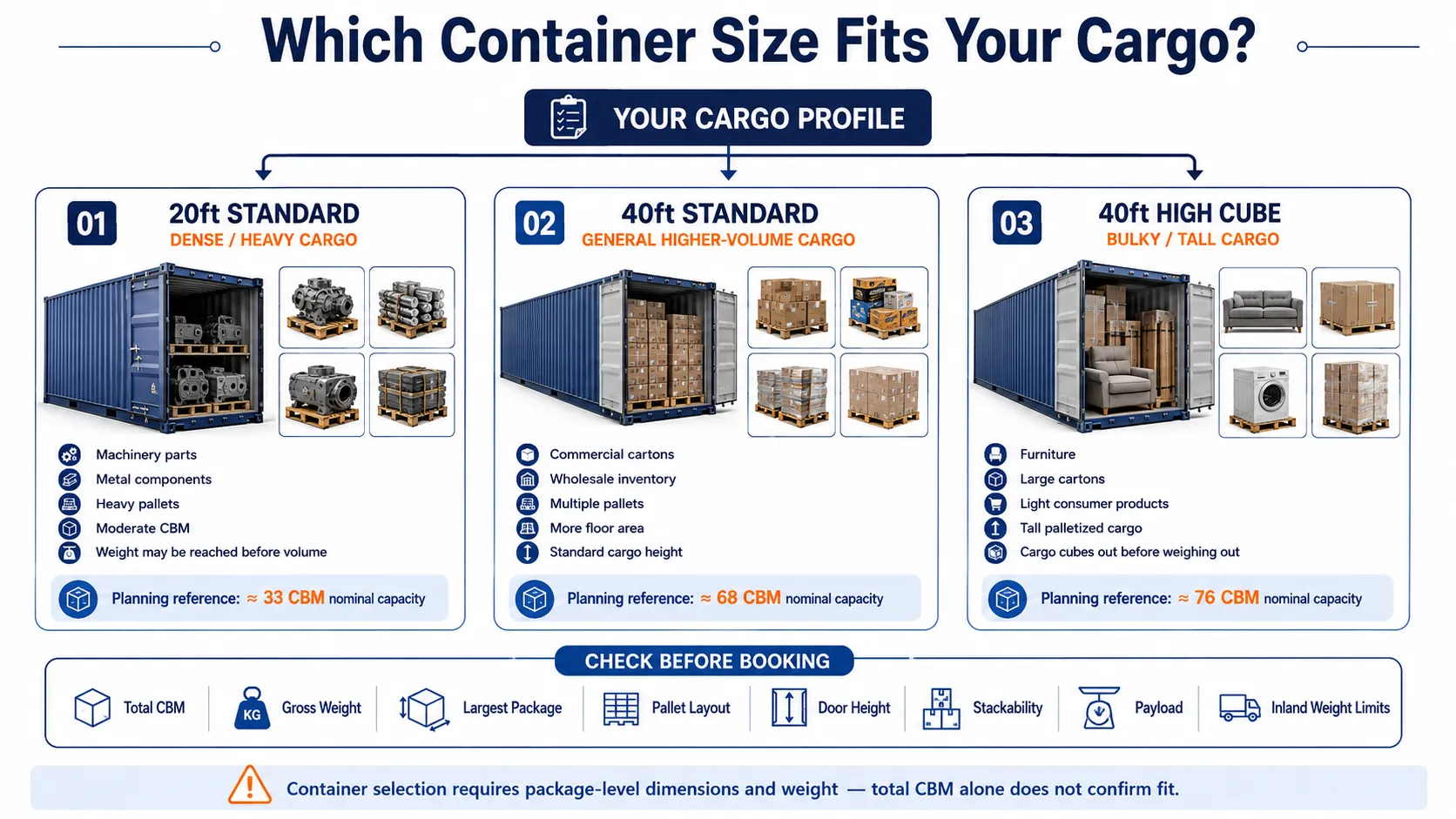
Example 1: Dense Industrial Cargo
A Canadian manufacturer orders approximately 23 CBM of metal components from China with a high gross cargo weight.
Although the cargo would physically occupy only part of a 40ft container, the shipment may reach an inland or equipment weight constraint before additional cubic space can be used.
In this situation, a 20ft container may be the more logical equipment to evaluate first, subject to the actual weight and route limits.
Example 2: 54 CBM of General Commercial Cartons
A distributor imports approximately 54 CBM of regularly shaped cartons with moderate cargo density.
A standard 40ft container may be a reasonable starting point if the package dimensions produce an efficient loading pattern and the cargo fits comfortably through the standard door.
The final decision should still use package-level dimensions rather than total CBM alone.
Example 3: 64 CBM of Bulky Furniture
A Canadian retailer imports approximately 64 CBM of relatively lightweight furniture and large cartons.
A 40HQ becomes a stronger candidate because the extra internal height can provide more usable cubic capacity than a standard 40ft.
However, irregular furniture shapes, non-stackable units and protective packaging can reduce practical utilization substantially below the container’s nominal 76.3 CBM.
Example 4: Tall Pallets
A supplier prepares palletized cargo with a final loaded height of approximately 2.40 m.
The standard 20ft and 40ft internal height may appear sufficient on paper, but the representative standard door height is only about 2.29 m.
A 40HQ, with a door opening around 2.60 m high in representative equipment, may solve the clearance problem.
This example shows why door opening must be checked before booking.
20ft vs 40ft Container Cost: Is a Bigger Container Better Value?
Container size should not be selected only by comparing the headline freight price.
The commercial comparison should consider:
- Container ocean rate
- Origin trucking
- Container loading
- Destination handling
- Canadian inland transportation
- Weight-related trucking requirements
- Number of containers required
- Cost per saleable unit
- Inventory requirement
A 40HQ can produce a lower cost per unit for bulky goods if its additional volume eliminates the need for another container. Conversely, a 20ft can be more efficient for dense cargo where a larger container would not allow materially more legal cargo weight.
For current FCL prices and the wider landed-cost structure, use our current LCL and container freight pricing guide.
Should You Use LCL Instead of a 20ft Container?
A shipment does not need to fill a 20ft container before FCL can be considered, and there is no universal CBM at which FCL automatically becomes cheaper than LCL.
For smaller shipments, LCL may avoid paying for unused dedicated container space. As cargo volume grows, destination handling and other LCL charges can make a 20ft FCL increasingly competitive.
Once cargo reaches approximately 10–18 CBM, requesting both LCL and FCL quotations is often a useful planning step.
The complete decision should consider:
- CBM
- Gross weight
- Cargo density
- Handling sensitivity
- Destination charges
- Current container rates
- Required delivery timing
For a deeper method comparison, review our shared-container vs dedicated-container shipping guide.
Container Selection for Shipping from China to Canada
For China-to-Canada commercial freight, container selection should start before the supplier begins final loading.
A good equipment request should include:
- Supplier pickup location
- Final package count
- Dimensions of every carton, pallet or crate type
- Total CBM
- Total gross cargo weight
- Largest individual package
- Tallest package or pallet
- Stackability
- Fragile or non-stackable cargo
- Loading equipment available at origin
- Unloading equipment available in Canada
- Final Canadian destination
For the complete ocean-shipping process, loading requirements, Canadian gateways and FCL operations, use our ocean container and FCL shipping guide.
Do Not Use Dry-Container Dimensions for Special Equipment
The dimensions in this guide apply to standard dry 20ft, 40ft and 40ft High Cube containers.
Do not apply them to:
- Reefer containers
- Open-top containers
- Flat racks
- Platform containers
- Tank containers
- Other special equipment
Reefer containers, for example, have refrigeration machinery and insulated walls that reduce internal cargo dimensions compared with general-purpose dry equipment.
Why the Exact Container Specification Must Be Confirmed
International container dimensions are standardized enough for global intermodal transportation, but individual equipment series can still vary in tare weight, internal dimensions and rated payload.
The final loading decision should therefore use:
- The actual equipment type booked
- The carrier’s current equipment specification
- The assigned container’s CSC plate
- The final cargo load plan
- Applicable road, rail and terminal restrictions
The container number and equipment details should be checked before heavy or dimension-critical cargo is loaded.
Equipment check
If a shipment is close to a door-height, payload or road-weight limit, do not rely on a generic online container chart. Confirm the specific equipment before loading.
Container Loading and Weight Distribution
Choosing the correct container size does not replace proper load planning.
The loading plan should consider:
- Heavy cargo positioned appropriately at floor level
- Balanced weight distribution
- Axle effects during inland transport
- Movement prevention
- Blocking and bracing
- Package crush strength
- Pallet stability
- Moisture protection
- Door clearance
- Safe unloading in Canada
A container can be under its nominal CBM and payload limits but still have an unsafe or unacceptable load distribution.
Verified Gross Mass and Container Weight
For packed ocean containers, the verified gross mass includes the cargo, packaging, securing materials and container tare weight.
This is different from cargo payload alone.
The freight file should therefore distinguish:
| Weight term | Meaning |
|---|---|
| Cargo net weight | Weight of the goods themselves |
| Cargo gross weight | Goods plus applicable product and transport packaging |
| Container tare | Empty container weight |
| Payload | Maximum cargo load permitted by the equipment rating |
| Maximum gross | Container tare plus cargo within the equipment rating |
| VGM | Verified gross mass of the packed container for applicable SOLAS requirements |
Common Container-Selection Mistakes
Using Nominal CBM as Guaranteed Usable Space
A 76.3 CBM 40HQ does not guarantee that 76 CBM of real cargo will load successfully.
Ignoring Door Height
Cargo can theoretically fit inside the container yet still fail to pass through the door.
Assuming a 40ft Carries Twice the Weight of a 20ft
Container volume increases much faster than typical technical payload.
Selecting a 40HQ Automatically
The additional height has little value when the shipment is floor-limited, weight-limited or cannot be stacked higher.
Ignoring Palletization
Loose-carton CBM and palletized CBM can produce very different utilization.
Using Supplier Estimates Instead of Final Packing Data
Container selection should be updated once final carton count, dimensions and weight are available.
Ignoring Canadian Inland Weight Restrictions
The ocean container rating does not override road, chassis or axle requirements at destination.
Container Selection Checklist
- Calculate final shipment CBM.
- Confirm total gross cargo weight.
- Identify the largest package dimensions.
- Check pallet footprint and loaded height.
- Confirm whether cargo can be stacked.
- Compare package height with the container door opening.
- Check technical payload.
- Review inland road and rail restrictions.
- Compare 20ft, 40ft and 40HQ equipment rates where relevant.
- Compare LCL and FCL if cargo is below efficient full-container utilization.
- Confirm unloading capability in Canada.
- Verify the actual assigned equipment before dimension-critical loading.
How TopShipping Helps Select Container Equipment
The TopShipping freight forwarding team coordinates commercial shipments from Chinese suppliers to Canadian businesses and can review container options using the actual cargo profile rather than volume alone.
For equipment planning, provide:
- Supplier city and pickup address
- Product description
- Final carton or pallet count
- Dimensions of each package type
- Total CBM
- Total gross weight
- Largest and tallest package
- Stackability
- Cargo-ready date
- Canadian delivery postal code
Businesses still planning the complete route and freight method can start with our complete China-to-Canada freight guide.
For businesses importing larger commercial orders, our commercial import shipping workflow explains the wider supplier-to-Canada process.
Final Container Selection Rule
The best container is not simply the largest one available. A 20ft is often efficient for dense cargo, a 40ft for higher-volume general freight, and a 40HQ for bulky or taller products.
The final decision should combine actual CBM, gross weight, package dimensions, pallet layout, door clearance, payload, inland transport restrictions and the complete freight cost.