
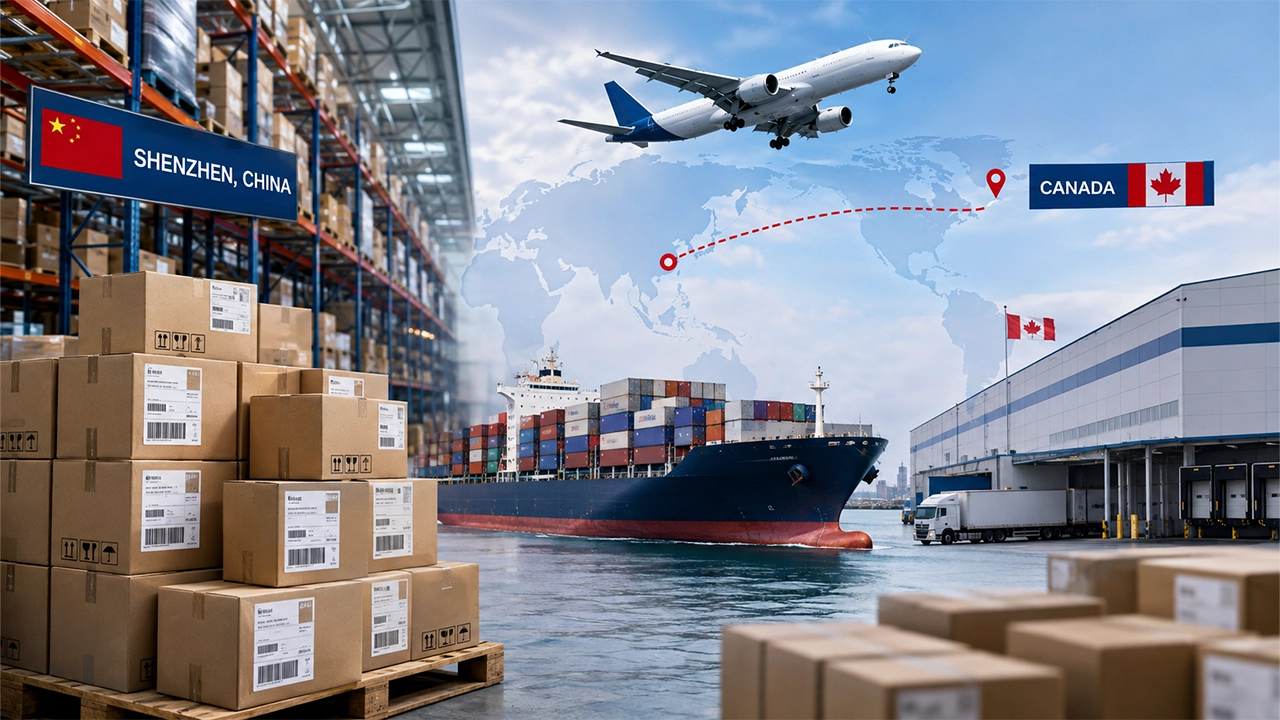
Shipping Amazon FBA inventory from China to Canada requires coordination across two different systems: international commercial importing and Amazon’s fulfilment network.
Your goods must be ready for export, accurately documented, imported under the correct Canadian customs arrangement, prepared to Amazon’s current requirements and delivered to the location assigned in your shipping workflow. A delay or error at any stage can affect receiving, inventory availability and the total landed cost of each unit.
TopShipping helps Canadian Amazon sellers coordinate supplier pickup, cargo preparation, air or sea freight, multi-supplier consolidation, customs clearance support, temporary storage and final delivery planning from China to Canada.
For a broader comparison of freight methods, customs procedures and the complete import journey, review our guide to shipping from China to Canada.
Amazon FBA Shipping at a Glance
| Decision | Practical guidance |
|---|---|
| Best option for urgent stock | Air freight or express delivery, depending on shipment size |
| Best option for planned bulk inventory | LCL or FCL sea freight |
| Best option for multiple suppliers | Consolidate the goods in China before export |
| Direct delivery to Amazon | Appropriate only when the shipment is fully prepared and the receiving plan is confirmed |
| Delivery through a Canadian 3PL | Useful for inspection, relabelling, storage or staged replenishment |
| Main customs responsibility | A qualified importer must be identified before shipment |
| Essential documents | Commercial invoice, packing list and transport document |
| Main operational risk | Shipping before labels, carton data, importer details and receiving instructions are finalized |
What Is Amazon FBA Shipping from China to Canada?
Amazon FBA shipping from China to Canada is the process of moving commercial inventory from a Chinese factory or supplier to an Amazon fulfilment destination serving the Canadian marketplace.
The final destination may be:
- An Amazon-assigned fulfilment centre
- A Canadian third-party logistics facility
- A prep centre
- A warehouse used for inspection or temporary storage
- The seller’s own commercial facility
The international freight movement is only one part of the process. Sellers must also coordinate product preparation, unit identification, export documentation, Canadian import clearance and the final domestic delivery.
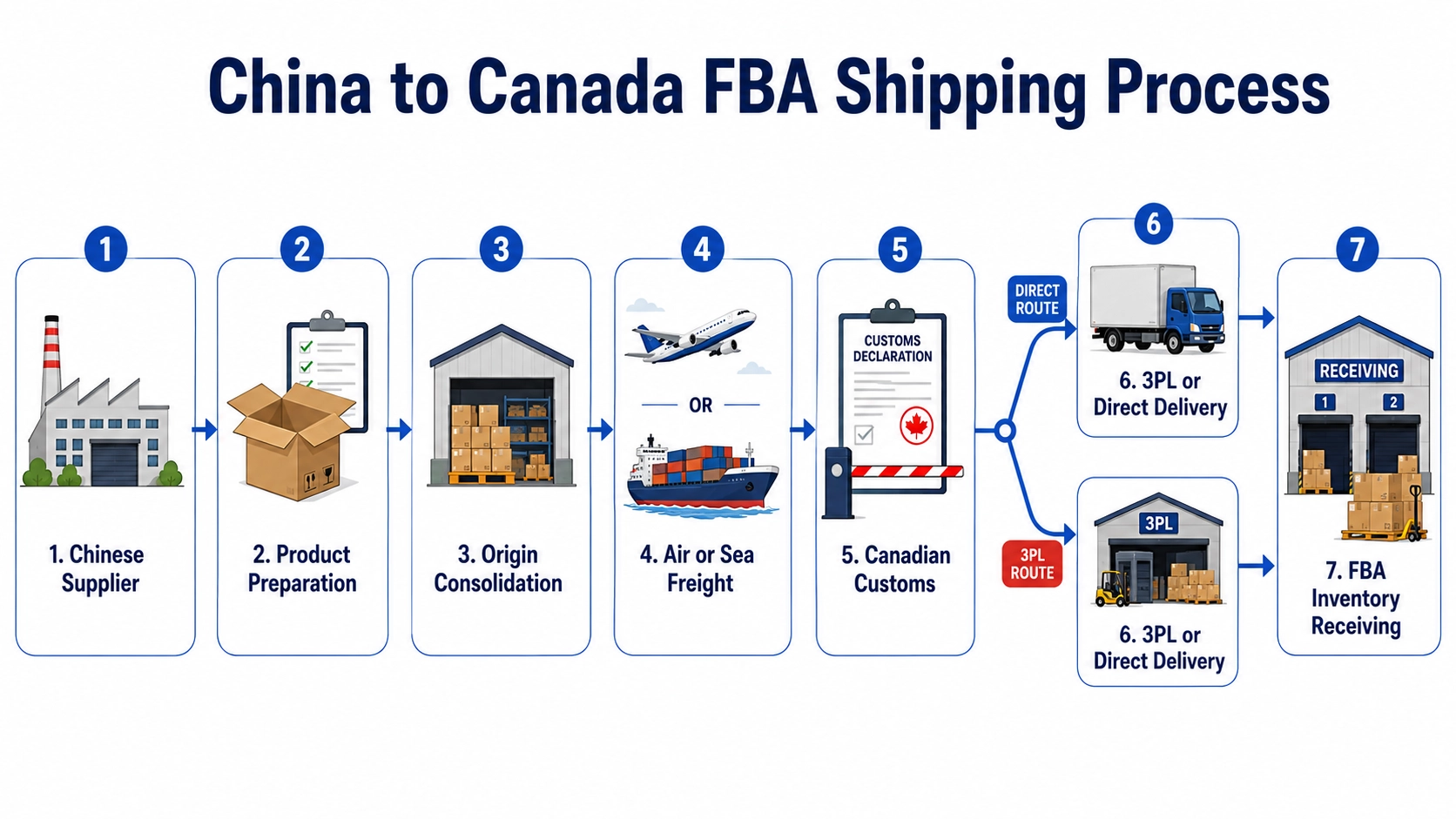
Amazon FBA handles downstream order fulfilment after eligible inventory has been accepted into its network. It does not automatically replace the seller’s responsibilities as an importer, product owner or shipment planner.
Who This Guide Is For
This guide is intended for Canadian businesses that:
- Source private-label or wholesale products from China
- Sell inventory through Amazon.ca
- Need to replenish fast-moving SKUs
- Are preparing a first commercial FBA shipment
- Purchase products from several Chinese suppliers
- Need air freight for urgent stock
- Need sea freight for planned inventory
- Want to route cargo through a Canadian warehouse or 3PL
- Require assistance coordinating freight and customs parties
It is written for commercial inventory rather than personal parcels or consumer purchases.
The Three Main Delivery Strategies
There is no single delivery model that works for every Amazon seller. The appropriate route depends on how well the shipment has been prepared, the seller’s inventory schedule and whether any work remains after customs clearance.
1. Ship Directly from China to the Assigned Amazon Destination
Under a direct-delivery model, the cargo moves from the supplier or origin facility in China through international transport and Canadian customs clearance before final delivery to the assigned Amazon location.
This model can reduce intermediate handling, but it requires careful preparation before departure.
Direct delivery is most practical when:
- Product preparation is complete
- Unit and carton labels have been verified
- Carton quantities and dimensions are accurate
- The final shipment destination has been assigned
- The importer arrangement is confirmed
- No inspection, relabelling or repacking is expected in Canada
- The final carrier can follow Amazon’s delivery instructions
Amazon states that every shipment box requires its own FBA Box ID label in addition to the applicable carrier label. Sellers should always verify the current requirements in Amazon’s shipping and routing guidance before cargo leaves China.
2. Ship Through a Canadian 3PL or Prep Facility
The cargo is first imported and delivered to a Canadian warehouse, prep centre or third-party logistics provider. It can then be inspected, stored, relabelled, repacked, palletized or divided into smaller replenishment shipments.
This model may be preferable when:
- A final quality check is needed
- Amazon destinations have not yet been confirmed
- Inventory should be released in smaller batches
- Product or carton labels may need correction
- The seller wants buffer stock outside the Amazon network
- Several sales channels share the same inventory
- The shipment contains multiple SKUs requiring sorting
- The cargo needs temporary storage before delivery
The additional handling creates another cost stage, but it can provide more control when inventory is not ready for direct admission into the Amazon network.
3. Use a Hybrid Inventory Strategy
Some sellers divide inventory between air and sea freight or between Amazon and an external warehouse.
For example, an urgent quantity may move by air to reduce stockout exposure while the larger replenishment quantity moves by sea. Another option is to deliver only part of the shipment to Amazon and hold the balance at a Canadian 3PL.
A hybrid plan may help balance:
- Inventory availability
- Freight cost
- Amazon storage exposure
- Seasonal demand
- Launch timing
- Replenishment frequency
The right split should be based on sales velocity, production readiness, lead-time variability and the financial impact of running out of stock.
Air Freight for Amazon FBA Inventory
Air freight is generally used when inventory timing has greater commercial importance than achieving the lowest transportation cost per unit.
It may be suitable for:
- Urgent replenishment
- Product launches
- Samples and pre-production units
- Compact or higher-value products
- Seasonal inventory
- Fast-selling SKUs approaching a stockout
- A limited first batch before committing to a larger sea shipment
TopShipping’s owner-provided typical estimate for coordinated door-to-door air delivery is approximately 5–7 business days. This is a planning estimate, not a guarantee. Cargo readiness, airline capacity, customs processing, product requirements and the final Canadian destination can affect total delivery time.
Air freight pricing is usually based on chargeable weight. The chargeable weight is the higher of the shipment’s actual gross weight and its calculated volumetric weight. Large, lightweight cartons can therefore cost more than sellers expect.
For a detailed explanation of chargeable weight, routing and service scope, read our air freight from China to Canada guide.
Sea Freight for Amazon FBA Inventory
Sea freight is usually more appropriate for larger, heavier or regularly planned inventory.
Sellers commonly choose ocean freight when:
- The shipment contains several pallets
- Inventory can be planned well in advance
- Lower transportation cost per unit is important
- Products are bulky or heavy
- Multiple supplier orders will be combined
- The seller operates recurring replenishment cycles
- Air freight would make the landed cost commercially impractical
LCL Shipping
Less-than-container-load shipping allows cargo to share container space with other shipments.
LCL can work well when the inventory is too large for economical air freight but does not require a full container. Sellers should account for consolidation, deconsolidation and destination handling when comparing LCL quotations.
FCL Shipping
Full-container-load shipping provides the use of a dedicated container.
FCL may be appropriate for higher-volume inventory, large product launches or recurring wholesale quantities. The container size should not be selected solely by cargo weight; volume, loading method, carton dimensions and destination handling must also be considered.
Review the complete sea freight from China to Canada guide for a detailed comparison of LCL and FCL shipping.
Air Freight vs Sea Freight for Amazon Sellers
| Factor | Air freight | Sea freight |
|---|---|---|
| Inventory urgency | Better for urgent replenishment | Better for planned replenishment |
| Shipment profile | Compact, lighter or higher-value cargo | Heavy, bulky or high-volume cargo |
| Cost per unit | Usually higher | Usually lower for suitable volumes |
| Planning requirement | Shorter forward-planning window | Longer forward-planning window |
| Common FBA use | Launches, samples and stockout recovery | Recurring inventory and bulk restocking |
| Main pricing basis | Chargeable weight | Volume, container use and shipment scope |
| Primary risk | High cost from bulky cartons | Longer and more variable total lead time |
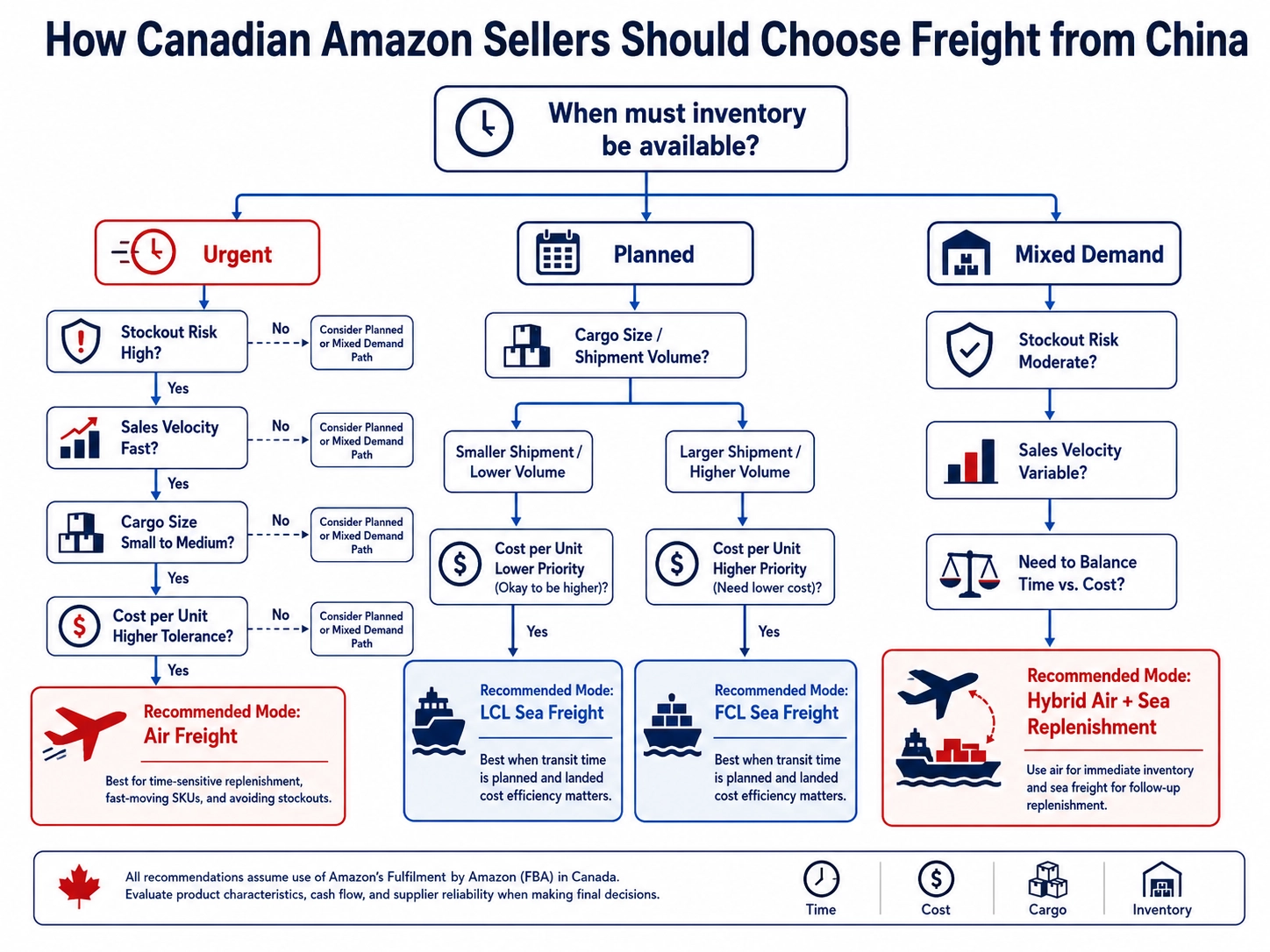
The cheapest freight rate is not always the lowest-cost business decision. A slower shipment can create lost sales or stockout exposure, while unnecessary air freight can reduce product margins.
Amazon sellers should compare transportation cost against the cost of delay, expected sales velocity and the amount of inventory already available in Canada.
FBA Preparation and Labelling Before Shipping
FBA preparation should be completed according to the current instructions generated through the seller’s Amazon workflow.
Depending on the product and shipping plan, preparation may involve:
- Product packaging
- Scannable unit identification
- FNSKU or other approved product labels
- Covering conflicting barcodes
- Poly-bagging or protective packaging where required
- Carton-level labels
- Accurate box-content information
- Pallet labels and pallet preparation
- Shipment-specific delivery documentation
Amazon’s requirements can vary by product category, shipment type and fulfilment program. The seller should use the instructions shown in Seller Central as the controlling operational reference.
Important 2026 Preparation Change
Amazon states that, starting July 1, 2026, it no longer offers prep and item-labelling services for FBA shipments in the Canada store. Sellers must therefore arrange compliant preparation and unit labelling before eligible inventory enters Amazon’s Canadian fulfilment network.
The current details should be checked directly in Amazon’s FBA prep service notice.
This change makes origin preparation and pre-shipment verification more important. Before booking freight, confirm who is responsible for:
- Preparing each unit
- Printing and applying product labels
- Applying shipment box labels
- Verifying carton quantities
- Checking label readability
- Resolving products that require special preparation
Do not assume the Chinese supplier understands Amazon Canada requirements. Instructions should be documented, shared and verified before pickup.
Direct-to-Amazon Preparation Checklist
Before releasing cargo for direct delivery, confirm the following:
| Area | What to confirm |
|---|---|
| Seller Central workflow | The shipment has been created and the destination is current |
| Unit preparation | Every unit meets the applicable packaging and preparation instructions |
| Product labels | Required product identifiers are correctly applied and scannable |
| Carton labels | Each carton carries its own shipment-specific FBA Box ID label |
| Box content | Quantities and SKU information match the shipment workflow |
| Carton details | Dimensions and weights are accurate |
| Pallet preparation | Pallet configuration and labels meet the assigned delivery method |
| Customs importer | The Canadian importer arrangement is confirmed |
| Documents | Commercial invoice and packing list are accurate |
| Final carrier | Delivery instructions and any appointment requirements are understood |
| Contingency plan | A Canadian warehouse or contact is available if delivery cannot proceed |
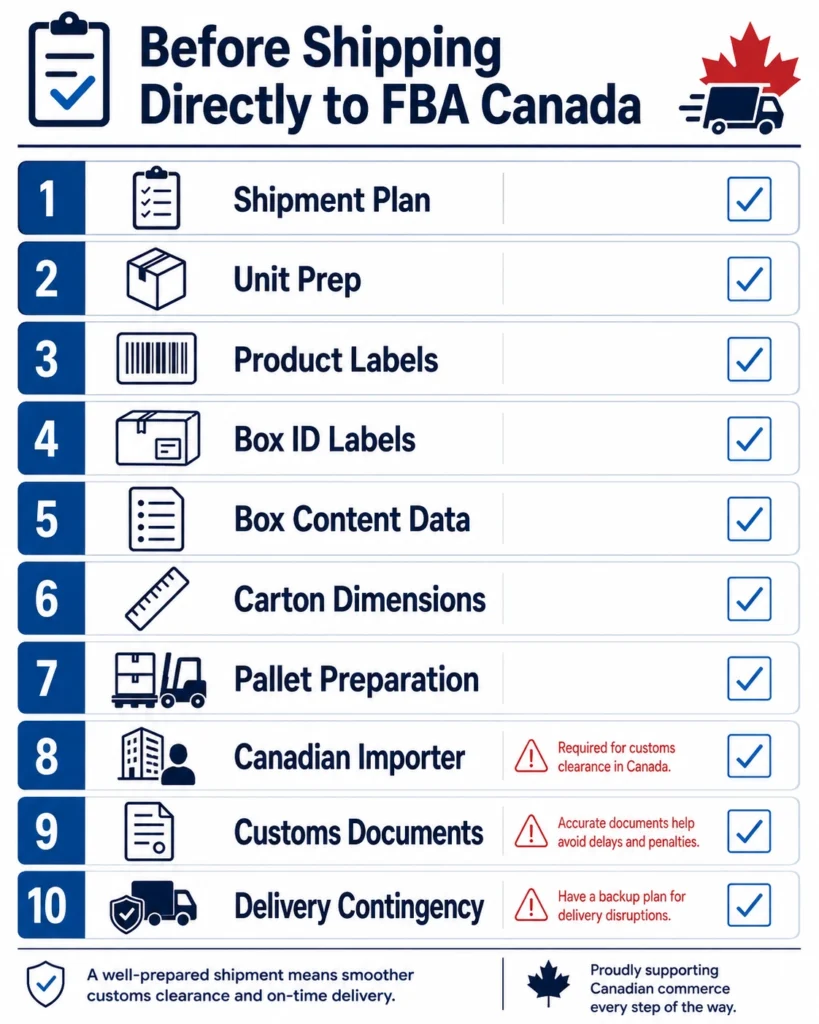
A freight forwarder can coordinate transportation, but the seller remains responsible for ensuring that the product and shipment data entered into Amazon are correct.
Canadian Importer and Customs Responsibilities
Amazon should not automatically be treated as the importer of record for inventory shipped into Canada.
Before departure, sellers should establish:
- Who will act as the commercial importer
- Which business number and import-export account will be used
- Who will submit or coordinate customs documentation
- Who is responsible for duties and taxes
- Which party will respond to customs or regulatory questions
- Whether the goods require permits, testing, certification or additional agency review
The Canada Border Services Agency states that businesses importing commercial goods need a business number and an RM import-export account. The current process is managed through the CBSA Assessment and Revenue Management system. Importers should consult the CBSA guide to importing commercial goods and the CARM Client Portal information.
TopShipping can coordinate customs clearance and work with the required customs parties. TopShipping should not be described as the importer of record or as a licensed Canadian customs broker unless a specific, verified arrangement confirms that role.
Customs Documents for FBA Inventory
The exact documentation depends on the commodity and transaction, but a commercial shipment normally requires accurate information from both the seller and supplier.
Commercial Invoice
The commercial invoice should clearly show information such as:
- Seller and purchaser details
- Importer or consignee information
- Detailed product descriptions
- Quantity and unit value
- Total transaction value
- Currency
- Country of origin
- Terms of sale
- Incoterm where applicable
Descriptions such as “accessories,” “samples” or “Amazon goods” are usually too vague for proper customs review.
CBSA publishes detailed commercial invoice requirements for goods imported into Canada.
Packing List
The packing list should describe how the cargo is physically packed, including:
- Number of cartons
- Quantity per carton
- Gross and net weight where applicable
- Carton dimensions
- Pallet count
- Product or SKU references
- Package marks and numbers
The packing list and commercial invoice should agree with the physical shipment.
Transport Document
Depending on the method, the transport document may be:
- An air waybill for air freight
- A bill of lading for sea freight
- A courier transport record for express shipments
Classification and Product Information
The importer should also be ready to provide:
- HS tariff classification
- Country of origin
- Product composition
- Intended use
- Brand or model where relevant
- Supporting certificates or permits where required
CBSA explains that tariff classification and origin affect the rate of customs duty. Sellers should not estimate duties solely from a product description or a supplier’s previous shipment.
Product Compliance Comes Before Freight Booking
Being accepted for sale on an online marketplace does not by itself confirm that a product may be legally imported and sold in Canada.
Canadian requirements can vary for:
- Consumer products
- Children’s products
- Electrical goods
- Batteries
- Cosmetics
- Food
- Medical products
- Textiles
- Wireless devices
- Pest-control products
- Products containing wood or plant materials
- Goods with bilingual labelling requirements
Health Canada notes that imported consumer products must comply with the Canada Consumer Product Safety Act and applicable regulations. Sellers should review the Government of Canada’s consumer product import guidance before production or shipment.
Regulatory questions should be resolved before inventory is manufactured in volume. Freight arrangements cannot correct a product that is prohibited, improperly labelled or missing a required authorization.
DDP Shipping for Amazon FBA Inventory
Delivered Duty Paid can provide an agreed service scope in which transportation, import formalities, duties, taxes and delivery responsibilities are allocated to the seller or service provider up to the named destination.
However, the term DDP should not be used as shorthand for “everything is included” without reviewing the quotation and importer structure.
Before selecting DDP, confirm:
- The named destination
- The importer-of-record arrangement
- Whose business number is used
- Whether duties and taxes are included
- Which products are eligible
- Whether customs examinations are included
- Whether Amazon or 3PL delivery charges are included
- What happens if the shipment is refused
- Whether storage or redelivery is excluded
- Which documents the seller must provide
DDP may be available only after the commodity, HS code, value, origin and regulatory requirements have been reviewed.
For a more detailed explanation of responsibilities and exclusions, review our DDP shipping from China to Canada guide.
Multi-Supplier Consolidation for Amazon Sellers
Private-label sellers often purchase packaging, inserts, accessories and finished goods from different suppliers.
Shipping each order separately can create:
- Repeated pickup charges
- Multiple export movements
- Separate customs entries
- Inconsistent carton data
- More supplier communication
- Higher handling cost
- Difficulty coordinating one product launch
Consolidation allows goods from several suppliers to be received at one origin facility, checked against shipment information and combined into a coordinated export movement.
A consolidation plan may include:
- Collecting cargo-ready dates from each supplier
- Receiving cartons at the origin warehouse
- Checking carton counts and external condition
- Comparing actual weights and dimensions with supplier data
- Organizing invoices and packing information
- Applying agreed shipment labels
- Combining suitable cargo for air or sea transport
- Preparing the final export shipment
Consolidation can reduce duplicated origin, handling and transportation costs depending on the shipment. It should not be described as producing a guaranteed percentage saving.
Read our freight consolidation from China to Canada guide when purchasing from multiple factories.
What Determines Amazon FBA Shipping Cost?
The cost cannot be calculated accurately from product quantity alone.
A practical quotation should account for:
- Supplier pickup city
- Number of suppliers
- Cargo-ready date
- Number of cartons or pallets
- Actual gross weight
- Carton dimensions
- Chargeable air-freight weight
- Ocean-freight volume
- Commodity and HS classification
- Cargo value
- Incoterm
- Export handling
- Canadian destination
- Customs-clearance scope
- Duties and taxes
- FBA preparation requirements
- Warehousing or relabelling
- Final delivery method
- Delivery appointment requirements
- Peak-season or capacity conditions
Sellers should compare the total landed cost per sellable unit rather than only the international freight charge.
A landed-cost calculation may include:
Product cost + origin handling + preparation + international freight + insurance + customs charges + duties and taxes + Canadian handling + storage + final delivery
For general freight-cost variables, use our shipping cost from China to Canada guide.
How to Plan Inventory Lead Time
Freight transit time and total inventory lead time are not the same.
Total lead time can include:
- Production completion
- Product inspection
- FBA preparation
- Supplier pickup
- Origin consolidation
- Export handling
- International transportation
- Customs clearance
- Canadian warehouse handling
- Final delivery
- Amazon receiving and inventory availability
A shipment may physically arrive in Canada but still not be available for sale.
Amazon sellers should therefore plan backward from the required inventory-available date rather than from the cargo departure date.
A basic replenishment calculation should consider:
- Average daily sales
- Current sellable stock
- Inventory already in transit
- Production time
- Freight lead time
- Customs and receiving buffers
- Seasonal demand
- Safety stock
Avoid using one fixed lead time for every shipment. Product readiness, freight mode, origin, destination and receiving conditions can change the schedule.
Common FBA Shipping Problems
Shipping Before the Amazon Plan Is Final
Amazon destinations and shipment instructions may change. Printing labels or dispatching cargo too early can create rework.
Prevention: Finalize and verify the shipment workflow before applying shipment-specific labels.
Inaccurate Carton Dimensions
Estimated dimensions can lead to incorrect freight pricing and inconsistent shipment data.
Prevention: Ask the supplier or origin warehouse to measure the packed cartons rather than using product dimensions.
Unclear Product Descriptions
Descriptions such as “parts,” “gift items” or “samples” can create customs questions.
Prevention: Use a precise description that identifies what the product is, what it is made from and how it is used.
Treating Amazon as the Importer
This can leave the shipment without a valid Canadian customs arrangement.
Prevention: Confirm the importer, RM account and customs process before pickup.
Missing or Incorrect Labels
Unscannable or mismatched labels can delay receiving or require relabelling.
Prevention: Use shipment-specific files from Seller Central and verify label placement before export.
Sending All Inventory Directly to FBA
This can reduce flexibility if demand changes or if the seller wants to control storage exposure.
Prevention: Consider keeping reserve stock at a Canadian warehouse and replenishing Amazon in stages.
Choosing Freight by Price Alone
The lowest freight price may come with an unsuitable schedule or incomplete service scope.
Prevention: Compare the complete route, inclusions, exclusions, inventory risk and landed cost.
Recommended Shipment Workflow
Step 1: Confirm the Product and Import Requirements
Determine whether the product is admissible in Canada and whether permits, tests, certificates or special labels are required.
Step 2: Confirm Production and Cargo Readiness
Collect the factory address, contact details, completion date, carton count, dimensions and gross weight.
Step 3: Decide Where the Inventory Should Go
Choose between direct-to-Amazon delivery, a Canadian prep centre, a 3PL or the seller’s warehouse.
Step 4: Create and Review the Amazon Shipment
Confirm the products, quantities, preparation categories, labels, assigned destination and delivery method.
Step 5: Select the Freight Method
Choose express, air, LCL or FCL based on urgency, cargo profile, inventory availability and total cost.
Step 6: Prepare and Verify the Goods
Complete product preparation, carton labelling, documentation and any origin consolidation.
Step 7: Confirm the Importer and Customs Process
Establish the importer account, customs representative and duty-and-tax responsibility.
Step 8: Move the Cargo to Canada
Coordinate pickup, export handling, international freight and shipment status updates.
Step 9: Complete Customs Clearance
Provide accurate documents and respond promptly to customs or regulatory requests.
Step 10: Arrange Final Delivery
Follow the confirmed receiving instructions for Amazon, the prep centre, 3PL or commercial warehouse.
Information Needed for an FBA Freight Quote
For a route-specific recommendation, provide:
- Supplier pickup city and address
- Number of suppliers
- Product name and material
- HS code, if known
- Number of SKUs
- Number of cartons or pallets
- Dimensions of each carton type
- Total gross weight
- Cargo value and currency
- Incoterm
- Cargo-ready date
- Canadian delivery address or postal code
- Whether the destination is Amazon, a 3PL or another warehouse
- Preferred delivery deadline
- Required preparation or labelling work
- Whether customs clearance is needed
- Whether a DDP or door-to-door option is being considered
- Any batteries, liquids, magnets, wood, food, cosmetics or regulated components
Accurate dimensions and destination details are necessary before comparing air, sea and door-to-door options.
How TopShipping Supports Amazon Sellers
Operating since 2012, TopShipping supports Canadian businesses importing commercial inventory from China.
For Amazon-related shipments, the service scope can include:
- Supplier communication in China
- Factory pickup coordination
- Cargo receiving
- Multi-supplier consolidation
- Air freight
- LCL and FCL sea freight
- Door-to-door shipment coordination
- Customs-clearance coordination
- Shipment tracking and status updates
- GTA warehousing and distribution support
- Final-delivery planning
The exact service scope depends on the product, origin, destination, importer arrangement and preparation requirements.
Request an Amazon FBA Shipping Assessment
Before recommending a freight method, TopShipping can review the cargo profile, supplier location, required delivery date, importer arrangement and final destination.
Send the product description, carton count, dimensions, gross weight, cargo-ready date and Canadian delivery details through our freight quote request.
A route-specific assessment can help determine whether the inventory should move by air, LCL, FCL or a combined replenishment plan.