
CIF vs FOB Shipping from China to Canada: Costs, Risk & Fees
CIF vs FOB shipping from China to Canada comes down to who books and pays for ocean freight, who arranges insurance, and how much control the Canadian importer has over destination charges. Under FOB (Free on Board), the seller loads the goods onto the vessel in China and the buyer arranges the main freight. Under CIF (Cost, Insurance and Freight), the seller also pays for ocean carriage and minimum cargo insurance to the named Canadian port.
Neither term means delivery to your Canadian warehouse. Under both, cargo risk generally passes to the buyer once the goods are on board the vessel in China. The better choice is therefore the one with the lower comparable delivered cost and the clearest responsibilities—not simply the lower supplier quotation.
CIF vs FOB: Key Differences for Canadian Importers
| Question | FOB | CIF |
|---|---|---|
| What does it mean? | Free on Board | Cost, Insurance and Freight |
| Named place | Chinese port of shipment, e.g., FOB Yantian | Canadian port of destination, e.g., CIF Vancouver |
| Who books and pays for ocean freight? | Buyer | Seller, to the named destination port |
| When does cargo risk transfer? | When goods are loaded on board in China | When goods are loaded on board in China |
| Who arranges cargo insurance? | Buyer, if desired | Seller must provide minimum required coverage |
| Who handles Chinese export clearance? | Seller | Seller |
| Who handles Canadian customs and duties? | Buyer | Buyer |
| Are Canadian port fees and inland delivery included? | Not automatically | Not automatically |
| Who controls the main freight provider? | Usually the buyer | Usually the seller |
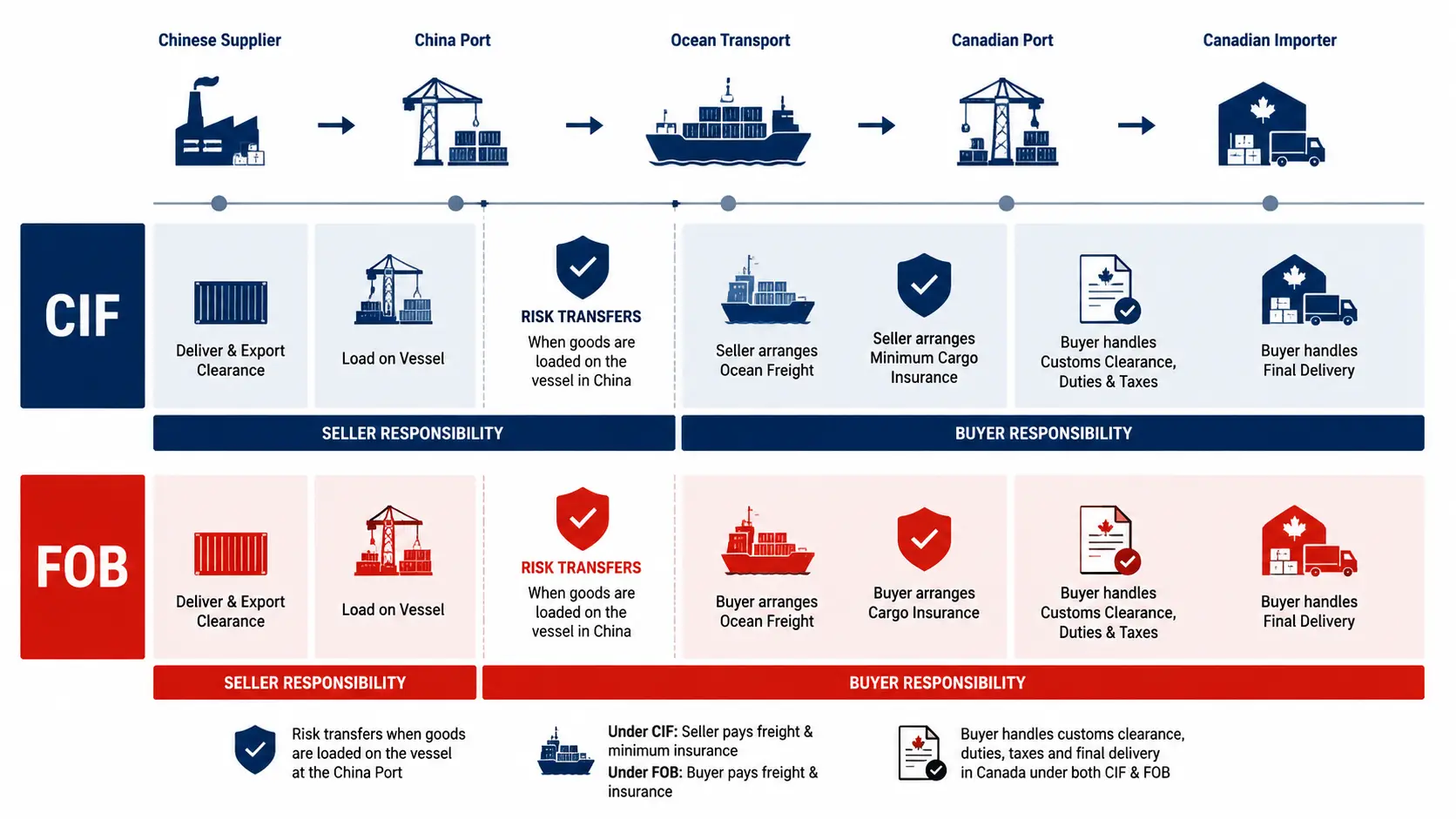
Both are maritime Incoterms. Write the exact named port and the rules version into the sales agreement: FOB Yantian, China, Incoterms® 2020 or CIF Port of Vancouver, Canada, Incoterms® 2020. The named place is not interchangeable: FOB identifies the shipment port, while CIF identifies the destination port the seller pays to reach. See the ICC’s Incoterms® 2020 guidance.
What Does FOB or CIF Actually Include?
With FOB China, the supplier completes its export obligations and delivers the cargo on board the buyer-nominated vessel at the agreed port. The importer and its freight forwarder then manage the ocean booking, insurance decision, Canadian arrival arrangements, customs clearance and onward transport. For an importer shipping regularly, this often provides better visibility over carrier schedules and local costs; it also requires a reliable freight partner.
With CIF Canada, the supplier contracts for ocean freight and minimum insurance to the named Canadian port. That is convenient when the supplier has a competitive carrier agreement, but it does not normally make the supplier responsible for the buyer’s Canadian import clearance, duties, taxes or warehouse delivery. Some unloading and destination charges depend on the carrier contract, so they must be checked rather than assumed to be included or excluded.
For either term, ask your forwarder to compare the full ocean freight and Canada-side delivery scope. A quotation labelled “CIF Vancouver” is not equivalent to a quotation delivered to a warehouse in Toronto.
Who Bears the Risk Under CIF and FOB?
Risk and freight payment are not the same thing. Under both FOB and CIF, the shipment’s risk normally transfers when the goods are placed on board the vessel in China. With CIF, the seller continues to pay for carriage to Canada, but the buyer already carries the voyage risk after loading. The buyer should not assume that a CIF seller is responsible for every loss that occurs before the cargo reaches Vancouver or Montreal.
Under Incoterms® 2020, CIF generally requires the seller to obtain minimum cargo insurance equivalent to Institute Cargo Clauses (C) or similar cover; broader protection can be agreed separately. Request the certificate, coverage clauses, insured value, exclusions and claims contact before shipment. Under FOB, the buyer can select its own insurance. For fragile or high-value goods, see the separate cargo insurance guide.
Container-shipment caveat
Hidden CIF vs FOB Costs at Canadian Ports
The cost difference often appears after the ocean freight has been quoted. These charges can arise under either term. CIF becomes difficult to compare when the supplier’s nominated carrier or destination agent has not disclosed the amounts the Canadian consignee will pay.
Destination Handling, Release and LCL Charges
Ask whether the quotation covers terminal handling, port/security charges, bill-of-lading or delivery-order release, and any destination-agent fees. For LCL cargo, the buyer may also pay CFS receiving, deconsolidation, handling and warehouse-release charges. A very low CIF LCL rate is not automatically a saving if those local charges are high. Compare a written destination tariff and the whole shipment against the LCL versus FCL decision guide.
Canadian Inland Delivery and Unloading
Neither standard FOB nor CIF includes a truck to your business by default. A shipment arriving at Vancouver may need rail, drayage, container trucking or warehouse transfers before delivery to Toronto or elsewhere in Canada. The destination address, dock availability, pallet or container unloading, appointment requirements, waiting time and empty-container return conditions can materially change the final cost. Get the same final Canadian delivery point priced for both options.
Storage, Demurrage and Detention
Missing documents, customs examinations and missed collection appointments can lead to terminal storage, demurrage or detention. Ask how much free time is allowed, who receives arrival notices, and who can secure cargo release. Under a supplier-controlled CIF shipment, make sure the Canadian destination agent and release procedure are known before sailing. The demurrage, detention and storage guide covers those charges in more detail.
Canadian Duties, Taxes and Customs Valuation
CIF does not include Canadian import duties, taxes or duty-paid delivery. The applicable charges depend on tariff classification, origin, customs value and other import rules—not simply the three-letter Incoterm. For customs valuation, an itemized CIF invoice can be important: the CBSA generally permits qualifying transportation and associated costs from the place of direct shipment to Canada to be excluded from value for duty under the applicable valuation rules, provided the amounts are supportable. Do not treat the entire CIF invoice automatically as the customs value or deduct costs without documentation. Review CBSA Memorandum D13-3-3 and consult your customs broker.
CIF vs FOB: An Example of Total Delivered Cost
Consider two fictional supplier quotations for the same goods and delivery to the same Canadian warehouse. All figures below are USD planning examples—not live freight rates or a TopShipping quote. Duties and taxes are excluded from both totals.
| Cost component (USD) | FOB quote | CIF quote |
|---|---|---|
| Supplier invoice | $25,700 | $29,100 (includes ocean freight and minimum insurance) |
| Buyer-booked ocean freight | $2,700 | Included |
| Buyer-arranged insurance | $180 | Included at CIF minimum cover |
| Canadian destination handling and release | $1,250 | $1,650 |
| Customs brokerage | $250 | $250 |
| Canadian inland delivery | $1,900 | $1,900 |
| Total before duties and taxes | $31,980 | $32,900 |
FOB costs $920 less in this illustration, but that is not a general rule. The supplier could offer a stronger CIF ocean rate, or the FOB forwarder could quote higher destination charges. A fair comparison also accounts for service level, transit reliability, free time and insurance coverage. If broader coverage is needed under CIF, price that difference too.
For shipment-wide pricing, refer to the dedicated China-to-Canada shipping cost guide; this article compares Incoterm responsibilities, not market freight-rate tables.
When Is FOB Better Than CIF for Shipping from China?
FOB is often a better fit when you import regularly, use your own trusted forwarder, consolidate cargo from several suppliers, need predictable Canadian delivery, or want to compare carrier and insurance options independently. It gives you more influence over the international movement and local-agent relationship, though your logistics provider must manage those responsibilities well.
CIF can be practical for an occasional importer when the supplier has a genuinely competitive ocean contract, gives you the destination-agent details, discloses Canada-side charges, and provides acceptable insurance documentation. It is not inherently a bad term; the problem is approving a CIF price without understanding what remains payable after arrival.
Neither term is a substitute for DDP delivery when a buyer needs a different allocation of import and delivery obligations. For the broader trade-term choice, see the separate FOB vs EXW vs DDP comparison.
What to Confirm Before Accepting a CIF or FOB Quote
Before paying the supplier or booking space, request these points in writing so the two quotations can be compared on the same basis:
- Named Incoterm and port: FOB origin port or CIF destination port, with “Incoterms® 2020” stated in the contract.
- Cargo details: product description, gross weight, CBM, carton or pallet count, container or LCL status, and cargo-ready date.
- Main carriage: carrier or consolidator, route, transit assumptions, included ocean surcharges and who controls the booking.
- Canadian destination costs: terminal, CFS, document-release and local-agent fees, including who pays each one.
- Insurance: certificate, coverage clauses, insured value, exclusions and claims procedure.
- Release and delays: bill-of-lading release method, destination contact, arrival notice, free time and applicable storage or container charges.
- Import and delivery: customs broker, invoice breakdown, duties and taxes, exact final address, unloading requirements and any extra inland fees.
If the supplier will not identify the Canadian destination agent or provide a breakdown of local charges, the quoted CIF price cannot yet be compared reliably with FOB.
Compare Your Supplier’s CIF and FOB Shipping Quotes
TopShipping can review the Chinese supplier’s proposed trade terms alongside the cargo’s actual LCL or FCL requirements, port and destination charges, customs-clearance coordination and delivery address in Canada. The aim is to identify which costs and responsibilities are included, which remain with the importer, and whether a differently structured freight quote would be clearer.
Share both supplier offers, the packing list or final cargo dimensions, origin city, cargo-ready date and Canadian delivery postal code. Request a CIF vs FOB freight quote comparison based on your shipment rather than a generic port-to-port price.
FAQ — CIF vs FOB Shipping from China to Canada: Costs, Risk & Fees
Not necessarily. CIF includes seller-booked ocean freight and minimum cargo insurance to the named Canadian port, while the buyer books the main freight under FOB. Either option can be cheaper once Canadian terminal charges, LCL handling, document release, customs brokerage and inland delivery are included. Compare two quotations to the same final destination using the same cargo dimensions and service scope, rather than comparing their supplier invoices alone.
No. Standard CIF terms do not make the seller responsible for Canadian import clearance, import duties or taxes. CIF covers the seller-arranged carriage and minimum insurance to the named destination port. Some unloading-related costs depend on the carriage contract, so local charges should be confirmed in writing. If a CIF invoice includes freight and insurance, an importer should also obtain the supporting breakdown needed for correct Canadian customs valuation.
Under both CIF and FOB Incoterms® 2020, risk generally transfers when the goods are loaded on board the vessel at the Chinese port of shipment. Under CIF, the seller still pays the ocean freight and minimum insurance to the named Canadian destination port even though the buyer bears the voyage risk after loading. The buyer should review the CIF insurance certificate and consider wider coverage where the default protection is insufficient.
FOB and CIF are sea and inland-waterway terms, not air-freight terms. For containerized shipments, the goods are often handed to a carrier at a terminal before loading on a vessel, which may not match FOB's onboard delivery point. The ICC suggests considering FCA for buyer-controlled carriage and CIP for seller-paid carriage with insurance in relevant multimodal situations. The right Incoterm depends on the agreed handover point and contract responsibilities.