

Cargo insurance for shipping from China to Canada can protect commercial goods against covered physical loss or damage during transit, but the actual protection depends on the policy wording, insured value, deductible and exclusions.
Institute Cargo Clauses (A) generally provide the broadest standard protection, while Clauses (B) and (C) cover more limited named risks. Cargo-insurance cost is shipment-specific and should not be confused with carrier liability.
Important: Coverage exists only according to the issued insurance policy or certificate; a freight quotation alone does not prove that cargo is insured.
International freight exposes commercial goods to handling, weather, theft, impact, water damage, fire, vessel casualties and other events between the supplier and the Canadian destination. The financial question for the importer is therefore not only how the cargo will move, but who carries the financial risk if the goods are physically lost or damaged during that movement.
For businesses still planning the complete route, freight method, customs process and Canadian delivery, our complete China-to-Canada shipping guide covers the broader transportation workflow. This page specifically focuses on cargo insurance, insured value, Institute Cargo Clauses, carrier liability, General Average and claims.
What Is Cargo Insurance?
Cargo insurance is insurance for goods while they are exposed to covered transportation risks.
Depending on the policy and insured transit, coverage can potentially extend across several stages of a commercial shipment, including:
- Supplier pickup
- Origin trucking
- Freight-forwarder or consolidation warehouse handling
- Port or airport handling
- International air or ocean transportation
- Transshipment
- Canadian terminal handling
- Inland rail or truck transportation
- Final delivery
Coverage does not automatically apply to every stage merely because the quotation is described as door to door. The policy must identify the insured transit and the applicable attachment and termination conditions.
Do You Need Cargo Insurance When Shipping from China to Canada?
Cargo insurance is not the same thing as customs clearance, freight forwarding or carrier liability, and there is no universal rule requiring every Canadian importer to purchase the same cargo policy.
The commercial decision becomes more important when the importer is moving:
- High-value inventory
- Electronics
- Machinery or components
- Fragile products
- Private-label inventory
- Seasonal stock
- Large LCL shipments
- Full containers
- Goods that would be difficult or expensive to replace quickly
A useful way to evaluate the decision is to ask whether the business could absorb the financial loss if the complete shipment, or an important part of it, were damaged or lost and recovery against the carrier were limited or unavailable.
Cargo Insurance vs Carrier Liability
Cargo insurance and carrier liability are fundamentally different.
| Issue | Cargo insurance | Carrier liability |
|---|---|---|
| What it protects | The insured financial interest in the cargo according to the policy | The carrier’s legal or contractual responsibility for loss or damage |
| Basis of recovery | Covered loss under the insurance wording | Carrier liability under the applicable contract and law |
| Potential limit | Subject to insured value, deductible and policy terms | May be subject to statutory or contractual liability limits |
| Need to establish carrier responsibility | Not necessarily in the same way as a carrier claim | Usually relevant to recovery from the carrier |
| General Average | Can be covered under standard cargo clauses subject to policy terms | Not replaced by ordinary carrier liability |
A China-to-Canada freight forwarder may coordinate transportation and help organize shipment information, but a freight forwarder is not automatically the insurer underwriting the cargo risk. The insurance policy or certificate should identify the insurer, assured party, insured transit, insured value, terms and applicable clauses.
Ocean Carrier Liability in Canada
For international carriage of goods by sea, Canada’s Marine Liability Act gives the Hague-Visby Rules force of law where their application requirements are satisfied.
Under the Hague-Visby limitation structure, carrier liability can generally be limited to 666.67 Special Drawing Rights per package or unit, or 2 SDR per kilogram of gross weight of the goods lost or damaged, whichever produces the higher amount, subject to the applicable rules, facts and contract of carriage.
This is one reason an importer should not assume that the carrier will automatically reimburse the full commercial invoice value of damaged cargo.
For the Canadian statutory framework, see the Marine Liability Act on the Justice Laws website.
Air Carrier Liability
International air carriage can operate under a different liability framework. Under the Montreal Convention, the international air-cargo liability limit was revised to 26 SDR per kilogram effective December 28, 2024, subject to the Convention’s application and its rules.
Again, a carrier-liability limit is not the same as purchasing cargo insurance for the shipment’s insured value.
Institute Cargo Clauses A, B and C
The Institute Cargo Clauses are widely used standard cargo-insurance wordings developed through the London insurance market.
In this article, ICC(A), ICC(B) and ICC(C) mean the Institute Cargo Clauses. They should not be confused with the International Chamber of Commerce, which is also commonly abbreviated ICC and publishes the Incoterms rules.
The 2009 Institute Cargo Clauses are dated January 1, 2009 and include three principal levels of cargo cover commonly referred to as A, B and C.
For the published Institute wordings, see the Institute Cargo Clauses reference library.
Institute Cargo Clauses (A)
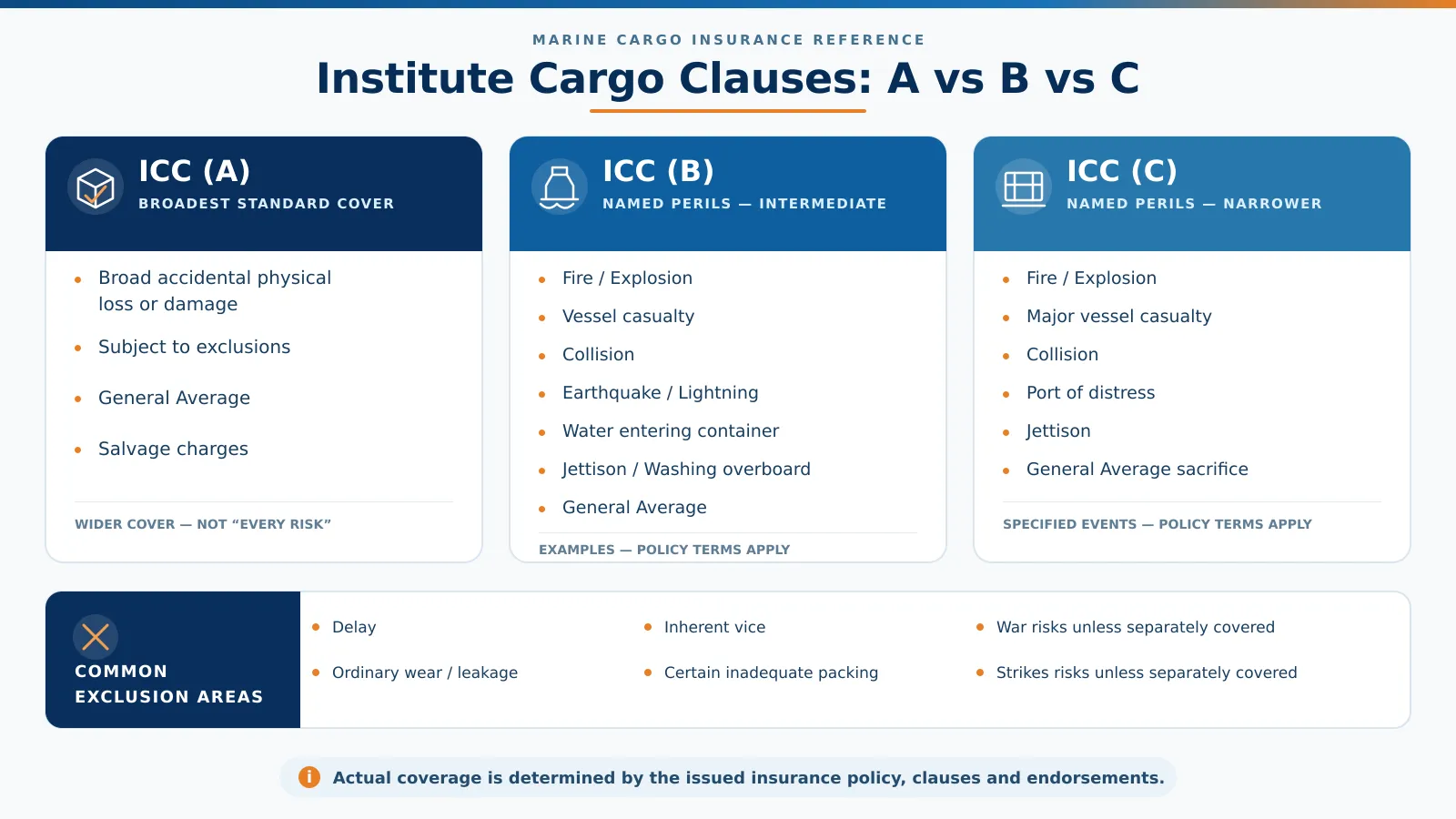
Clause A provides the broadest of the three standard levels. It is frequently described as “all risks” cover because it generally covers accidental physical loss of or damage to the insured cargo unless the cause falls within an exclusion or other policy restriction.
“All risks” does not mean every conceivable commercial loss is insured. Delay, ordinary wear, inherent vice, certain packing problems, war and strikes are examples of areas that may be excluded or require separate coverage.
Institute Cargo Clauses (B)
Clause B is a named-perils form. Instead of beginning with broad accidental physical loss or damage, it covers the listed causes specified in the wording.
Examples include certain losses associated with:
- Fire or explosion
- Vessel stranding, grounding, sinking or capsizing
- Overturning or derailment of land transport
- Collision or contact with an external object
- Earthquake, volcanic eruption or lightning
- Jettison or washing overboard
- Entry of sea, lake or river water into the vessel, container or place of storage
- Certain total losses of packages during loading or unloading
Actual coverage must always be checked against the issued wording and endorsements.
Institute Cargo Clauses (C)
Clause C is narrower than B and A and is often described as minimum or basic named-perils protection.
It focuses primarily on major transportation casualties such as:
- Fire or explosion
- Vessel stranding, grounding, sinking or capsizing
- Overturning or derailment of land transport
- Collision with an external object
- Discharge at a port of distress
- General Average sacrifice
- Jettison
ICC A vs B vs C Comparison
| Coverage feature | ICC (A) | ICC (B) | ICC (C) |
|---|---|---|---|
| Overall structure | Broad physical loss/damage cover subject to exclusions | Broader named-perils cover | Narrower named-perils cover |
| Fire / explosion | Generally covered unless excluded | Listed peril | Listed peril |
| Major vessel casualty | Generally covered unless excluded | Listed peril | Listed peril |
| Earthquake / lightning | Generally covered unless excluded | Listed peril | Not part of the core Clause C peril list |
| Water entering container | Potentially covered unless excluded | Listed peril | Not part of the core Clause C peril list |
| General Average | Covered subject to policy terms | Covered subject to policy terms | Covered subject to policy terms |
| War / strikes | Normally require separate clauses or endorsements | Normally require separate clauses or endorsements | Normally require separate clauses or endorsements |
Coverage note: This comparison is educational rather than a substitute for the actual policy wording. Endorsements, deductibles, commodity restrictions and special conditions can materially change the protection.
What Cargo Insurance Commonly Does Not Cover
The broadest cargo policy still contains exclusions.
Common exclusion areas under standard Institute Cargo Clauses can include:
- Wilful misconduct by the assured
- Ordinary leakage or ordinary loss in weight or volume
- Normal wear and tear
- Inherent vice or the natural characteristics of the cargo
- Loss caused solely by delay
- Certain inadequate or unsuitable packing situations
- Certain known vessel or container unfitness conditions
- War-related risks unless separately covered
- Strikes, riots, terrorism and related risks unless separately covered
- Nuclear and radioactive risks
Why Packaging Matters
An importer should not treat cargo insurance as a substitute for export-quality packaging.
If goods are damaged because they were inadequately protected against the ordinary conditions of the insured transit, the packing exclusion can become highly relevant depending on who packed the cargo, when it was packed and the exact policy wording.
For fragile products, machinery, electronics and high-value inventory, document the packing method before the shipment leaves the supplier.
How Much Does Cargo Insurance from China to Canada Cost?
There is no reliable universal cargo-insurance percentage that applies to every China-to-Canada shipment.
The premium is normally determined after evaluating the shipment and proposed coverage.
Important pricing factors can include:
- Insured value
- Commodity type
- New or used goods
- Packaging
- Air, LCL or FCL transportation
- Origin and destination
- Number of transshipments
- Coverage level
- Deductible
- Theft or damage exposure
- War or strike extensions
- Shipment frequency
- Claims history for annual or open policies
Cargo Insurance Premium Formula
A simple premium calculation can be expressed as:
Insurance premium = agreed insured value × quoted insurance rate
For example, assume an insurer has accepted an insured value of USD $110,000 and quoted a hypothetical rate of 0.35%:
USD $110,000 × 0.0035 = USD $385
Example note: The 0.35% figure is used only to demonstrate the calculation. It is not a TopShipping market rate and should not be used to budget an actual shipment without an insurance quotation.
Insurance premium is another component that can affect the shipment’s complete landed logistics cost. Our freight pricing and landed-cost guide covers the wider China-to-Canada cost structure.
How Should the Insured Value Be Calculated?
The sum insured should be agreed with the insurer or broker rather than assumed from the freight invoice alone.
Depending on the policy and commercial arrangement, insured value may take into account:
- Commercial invoice value
- Freight charges
- Insurance premium
- An agreed percentage for expected additional expenses or profit
The policy or insurance certificate controls the final insured amount.
Why 110% Appears in International Trade
The figure of 110% is frequently encountered because of Incoterms insurance requirements, particularly in seller-arranged insurance under applicable C-terms.
Under Incoterms 2020, CIP requires the seller to obtain insurance equivalent to Institute Cargo Clauses (A) or similar protection for at least 110% of the contract price, unless otherwise agreed.
This does not mean every independent cargo-insurance policy in every shipment must automatically use the same formula.
Cargo Insurance and Incoterms
The Incoterm helps establish where risk transfers between seller and buyer and, in two Incoterms rules, who must arrange insurance.
| Incoterm | Insurance implication |
|---|---|
| EXW | No automatic seller cargo-insurance obligation under the rule; buyer should consider cover for its risk after the agreed delivery point |
| FCA | Buyer generally considers insurance after risk transfers on delivery to the agreed carrier/place |
| FOB | Buyer bears cargo risk after the goods are loaded on board at the named shipment port |
| CIF | Seller must arrange minimum insurance broadly corresponding to Institute Cargo Clauses (C) or similar cover |
| CIP | Seller must arrange the broader Institute Cargo Clauses (A) or similar cover, normally for at least 110% of contract value |
| DAP | Seller bears transportation risk to the named destination, but the rule does not itself impose the same express insurance obligation as CIF or CIP |
| DDP | Seller bears extensive risk to the named destination, but actual insurance arrangements still need to be confirmed |
A frequent mistake is assuming that whoever pays the freight automatically carries the risk of cargo damage throughout the entire journey. Incoterms separate transportation cost from the point at which risk transfers.
For a deeper ocean-shipping example, our FOB and CIF responsibility comparison explains how freight control, insurance and risk transfer differ.
For the official rule structure, see the International Chamber of Commerce Incoterms 2020 resources.
Sea Freight Cargo Insurance
Sea freight creates several cargo-risk situations that do not exist in exactly the same way in parcel or domestic trucking.
Examples include:
- Container handling at origin and destination terminals
- LCL consolidation and deconsolidation
- Container water ingress
- Heavy-weather movement
- Fire aboard a vessel
- Collision or grounding
- Container loss overboard
- General Average
- Extended transshipment or port handling
Containerized cargo can move through several inland and marine stages before reaching the Canadian warehouse. Our ocean container and LCL freight guide explains the operational stages separately from insurance coverage.
Air Freight Cargo Insurance
Air cargo avoids many ocean-specific risks but still experiences physical handling across factories, warehouses, airport terminals, unit-load equipment, aircraft and final trucks.
Potential loss scenarios include:
- Handling impact
- Crushing
- Package loss
- Water exposure during ground handling
- Theft
- Temperature exposure for sensitive cargo
- Damage during final delivery
Air shipments may use Institute Cargo Clauses (Air) rather than the ocean-oriented A/B/C wording, depending on the policy structure.
For the transportation side of the movement, see our commercial air-cargo guide.
What Is General Average?
General Average is one of the most important reasons ocean importers should understand cargo insurance even when their own cargo has not been physically damaged.
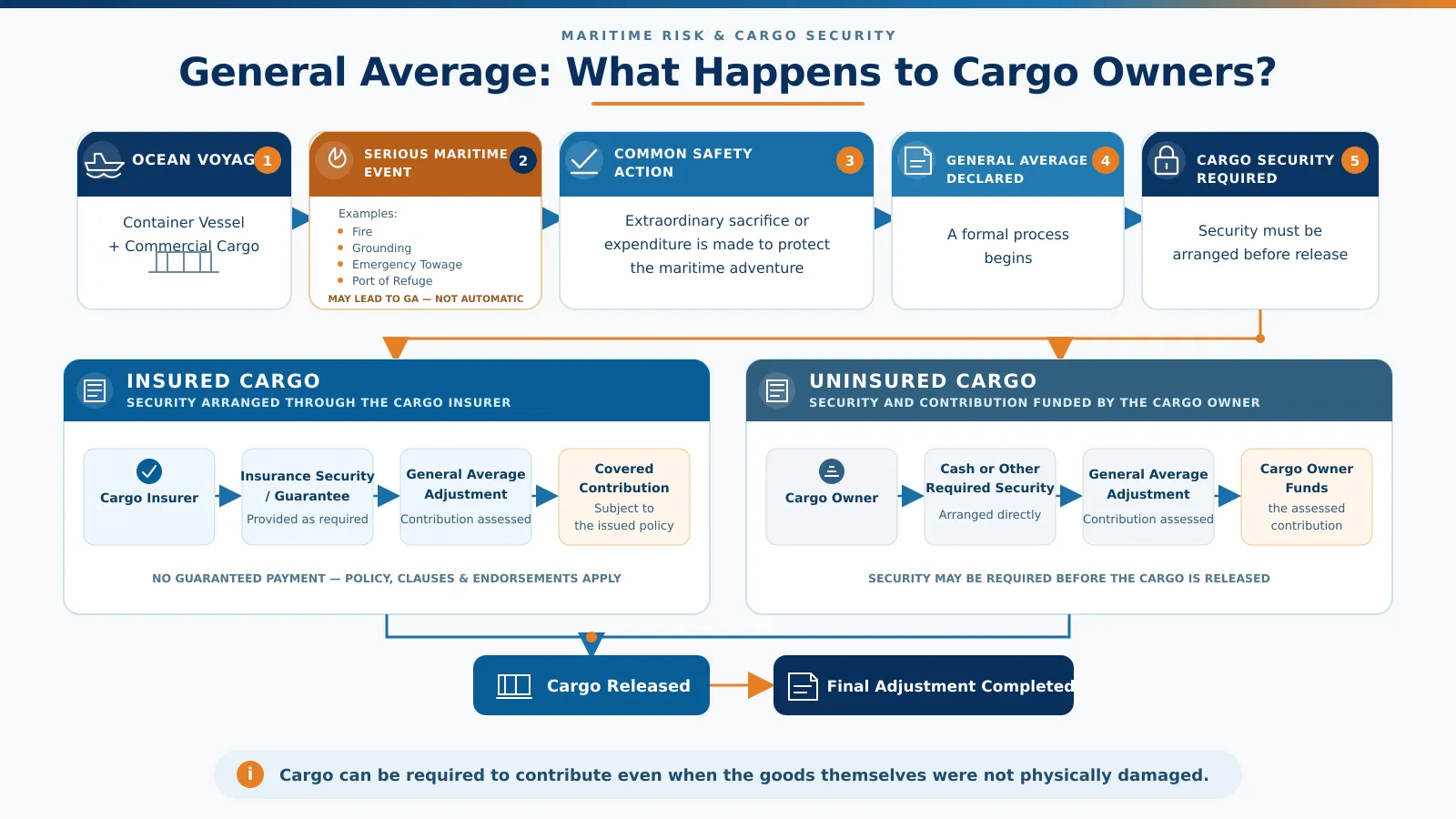
In a serious maritime emergency, an extraordinary sacrifice or expenditure can be intentionally and reasonably made for the common safety of the vessel, cargo and other property involved in the maritime adventure.
Examples may include:
- Jettisoning cargo
- Firefighting measures
- Towage
- Salvage
- Port-of-refuge expenses
- Discharging, storing and reloading cargo during an emergency
If General Average is declared, the cargo interests may be required to contribute according to the applicable adjustment.
Importantly, the cargo does not necessarily need to be physically damaged for the cargo owner to become involved in the General Average process.
General Average Example for a Canadian Importer
Assume a Canadian importer has a container of commercial inventory travelling from China to Vancouver.
A serious vessel fire requires emergency firefighting, salvage assistance and a port-of-refuge operation. The container itself survives without major physical damage.
General Average is later declared.
Before the cargo can be released, the importer may be asked to provide the required General Average security. Where suitable cargo insurance is in place, the insurer can normally become involved in providing the relevant insurance security and handling the insured General Average contribution according to the policy.
An uninsured cargo owner may need to arrange security directly and ultimately fund its assessed contribution.
The Comité Maritime International York-Antwerp Rules resources provide the principal industry framework used for General Average where incorporated into the applicable contract.
Does Cargo Insurance Cover General Average?
Standard Institute Cargo Clauses A, B and C include General Average and salvage provisions, subject to their terms and exclusions.
This makes General Average materially different from a simple cargo-damage claim: even relatively low-risk container cargo can create a substantial financial obligation if a major maritime casualty affects the voyage.
Canadian Importer Scenario: Water Damage Inside an LCL Shipment
Assume a Canadian business imports cartons from Shenzhen by LCL sea freight.
During the insured transit, seawater enters the container and damages several cartons.
The insurance outcome can differ substantially by wording:
- ICC (A) may respond to accidental physical water damage unless an exclusion applies.
- ICC (B) specifically includes certain water-entry events as named perils.
- ICC (C) does not provide the same water-entry coverage as part of its core named-perils list.
The final claim would still depend on the policy, cause of loss, packaging, evidence, deductible and other terms.
Canadian Importer Scenario: Poor Packaging
A supplier packs fragile goods in cartons that are clearly unsuitable for normal international transport. The products arrive in Canada broken even though no unusual external event occurred.
The importer should not assume that an ICC (A) policy automatically pays the loss merely because the wording is described as “all risks.”
The insufficient-packing and inherent-nature exclusions may become important depending on the facts and policy wording.
How to File a Cargo Insurance Claim
If cargo arrives damaged or a loss becomes known during transit, the importer should act quickly to preserve both the insurance claim and any recovery rights against carriers or other parties.
- Record the condition immediately. Photograph damaged cartons, pallets, seals, containers and products before altering the evidence.
- Note visible damage at delivery. Do not sign a clean delivery receipt if visible loss or damage should reasonably be recorded.
- Notify the insurer or claims contact promptly. Follow the contact method and notification requirements stated in the policy or certificate.
- Notify the freight and carrier parties. Preserve any rights of recovery against the carrier, warehouse, terminal or other responsible party.
- Prevent additional damage. Take reasonable steps to protect the remaining goods.
- Preserve packaging and damaged cargo. Do not discard important evidence before the insurer or surveyor confirms it can be released.
- Arrange a survey where requested. Higher-value or technically complex losses may require inspection by a cargo surveyor.
- Collect the commercial and transportation documents.
- Quantify the loss. Separate damaged, recoverable, repairable and salvageable goods.
- Submit the claim package. Follow the insurer’s required format and policy deadlines.
Documents Commonly Needed for a Cargo Insurance Claim
| Document | Why it may be needed |
|---|---|
| Insurance certificate or policy | Confirms the insured party, value, transit, clauses and coverage |
| Commercial invoice | Supports ownership and cargo value |
| Packing list | Identifies package quantities and shipment configuration |
| Bill of lading or air waybill | Supports the transportation record |
| Delivery receipt | Can record visible shortage or damage at delivery |
| Photographs and video | Documents physical condition and packaging |
| Survey report | Provides independent loss assessment when required |
| Repair or replacement evidence | Supports the claimed financial loss |
| Carrier correspondence | Shows notice and preservation of recovery rights |
| Claim statement | Summarizes the event and amount being claimed |
Our commercial shipping-document guide explains the invoice, packing list, bill of lading and air waybill in the wider freight process.
When Should Cargo Insurance Be Arranged?
Insurance should be considered before the insured transit begins, not after the importer learns that cargo has been damaged.
Before pickup, confirm:
- Who has the insurable interest
- Where risk transfers under the sales contract
- The pickup location
- The final insured destination
- The cargo description
- Invoice value
- Freight method
- Number of containers or packages
- Whether the goods are new or used
- Packaging method
- Required ICC clause
- Deductible
- War or strike requirements
- Any excluded commodities
Single-Shipment Insurance vs Open Cargo Policy
| Insurance structure | May suit |
|---|---|
| Single-shipment policy or certificate | Occasional importers or one-off shipments |
| Open cargo policy | Businesses importing regularly throughout the year |
Regular importers may prefer an annual or open structure because each shipment can be declared under an established insurance arrangement, subject to the policy’s declaration rules, commodity limits and geographic scope.
Questions to Ask Before Buying Cargo Insurance
| Question | Why it matters |
|---|---|
| Which Institute Cargo Clause applies? | Determines the basic scope of insured risks |
| What is the insured value? | Sets the financial basis of the policy |
| What is the deductible? | Determines the portion retained by the insured |
| Where does coverage begin? | Determines whether supplier pickup is insured |
| Where does coverage terminate? | Determines whether inland Canadian delivery is included |
| Are war and strikes covered? | These risks normally require separate clauses or endorsement |
| Are theft and pilferage covered? | Depends on wording and policy conditions |
| Are used goods covered? | Some policies impose restrictions or different valuation terms |
| Are batteries or dangerous goods accepted? | Special cargo can require additional underwriting |
| What claim documents are required? | Allows evidence to be prepared before a problem occurs |
How Cargo Insurance Fits into Freight Planning
Cargo insurance should be reviewed alongside the commercial transaction rather than added casually after the freight booking.
The importer should align:
- Incoterm
- Risk-transfer point
- Freight method
- Insured transit
- Insured value
- Cargo description
- Final Canadian destination
If these elements do not match, the business may purchase coverage for the wrong value, wrong transit or wrong party.
How TopShipping Supports Insurance-Ready Freight Planning
TopShipping coordinates commercial freight from Chinese suppliers to Canadian businesses, but cargo insurance should remain clearly distinguished from freight-forwarding and carrier services.
For a shipment where insurance is required, the freight file should contain accurate:
- Supplier and consignee information
- Product description
- Commercial invoice
- Packing list
- Package count
- Gross weight and dimensions
- Cargo value
- Incoterm
- Origin and destination
- Air waybill or bill-of-lading information
Whether insurance is arranged independently by the importer, by the seller under the applicable Incoterm, or through an authorized insurance channel, the importer should obtain and review the actual insurance certificate or policy before relying on the cover.
Cargo Insurance Checklist Before Shipping from China
- Identify who bears cargo risk during each stage of transit.
- Confirm the Incoterm and named place.
- Confirm the commercial cargo value.
- Select an appropriate insurance coverage level.
- Review policy exclusions.
- Confirm deductible.
- Confirm supplier pickup is inside the insured transit if required.
- Confirm Canadian inland delivery is inside the insured transit if required.
- Declare special or sensitive cargo accurately.
- Review packaging before pickup.
- Obtain the insurance policy or certificate.
- Store the insurer’s claims contact details.
- Keep invoice, packing list and transport documents available.