

CARM for Canadian Importers: Registration, Delegation and Release Checklist
Canadian businesses importing commercial goods must register in the Canada Border Services Agency (CBSA) Assessment and Revenue Management (CARM) Client Portal, have a valid Business Number (BN9) and an importer program account (RM), and arrange the appropriate customs accounting process. If a licensed customs broker will submit accounting declarations or manage the account on the importer’s behalf, the importer must grant the necessary Delegation of Authority (DOA) through CARM.
Importers who want their goods released before paying duties and taxes generally need to enrol in the optional Release Prior to Payment (RPP) program and provide their own financial security. Importers without RPP can still use the applicable payment-upon-release process.
Before shipping commercial cargo from China to Canada, confirm these five items:
- Your business is registered in the CARM Client Portal with the correct BN9 and importer RM account.
- A Business Account Manager (BAM) has access to the account and can manage authorizations.
- Your customs broker has the appropriate delegation, if you are using one.
- Your RPP enrolment and financial security are active if you intend to obtain release before payment.
- Your customs broker or internal customs team has the shipment documents and product information required for release and accounting.
The official CBSA guide to getting started with CARM explains the registration requirements for Canadian and non-resident businesses.
CARM Registration Checklist at a Glance
Use this table to determine which requirements apply before arranging your first commercial shipment or reviewing an existing importer account.
| Requirement | What to confirm | Responsible party | When needed |
|---|---|---|---|
| Business Number (BN9) | Correct nine-digit CRA business number | Importer | Before or during registration, depending on business eligibility |
| Importer RM Account | Valid import program account linked to the BN9 | Importer | Before commercial import accounting |
| CARM Business Registration | Business registered and accessible in the portal | Importer / BAM | Before customs transactions |
| Delegation of Authority | Customs broker has approved access for required functions | Importer / BAM or PAM | Before broker-managed accounting |
| Release Prior to Payment | RPP enrolment and adequate financial security | Importer | If requesting release before paying duties and taxes |
| Release and Accounting Data | Consistent importer, invoice, commodity and transport information | Importer with broker and logistics providers | Before the applicable release and accounting submissions |
| Payment Management | Ability to review statements and pay the CBSA on time | Importer or authorized representative | After accounting, according to the applicable payment arrangement |
Registration, broker authorization and RPP security are separate activities. Completing one does not automatically complete the others.
What Is CARM, and What Does It Change for Canadian Importers?
CARM is the CBSA’s official system for assessing and collecting duties and taxes on commercial goods imported into Canada. It became the official system of record on October 21, 2024.
Through the CARM Client Portal, an importer can manage business accounts, program enrolment, authorized service providers, Commercial Accounting Declarations (CADs), payments and other customs-related account activities.
The important operational distinction is that CARM manages customs accounting and revenue functions; it does not replace the entire cargo reporting, inspection and release process. Carriers, freight forwarders, customs brokers and importers may still perform different tasks in moving a shipment through the Canadian border.
For a broader explanation of declarations, release procedures and importer responsibilities, see our customs clearance guide for China-to-Canada shipments.
Who needs a CARM account?
Businesses importing commercial goods into Canada need the appropriate CARM registration and importer account, including Canadian resident importers and non-resident importers acting as commercial importers.
This applies to businesses importing inventory for resale, manufacturing components, equipment, wholesale merchandise and other goods for business use.
Working with a freight forwarder or customs broker does not remove the importer’s own CARM registration responsibilities. A customs broker cannot register its client’s business in CARM on the client’s behalf.
Before You Register: BN9, RM Account and Business Information
Prepare your business details before starting the portal registration process. Missing registration information or discrepancies between your business records and CBSA records can prevent successful onboarding.
1. Confirm your nine-digit Business Number (BN9)
The BN9 identifies your legal business with the Canada Revenue Agency (CRA). Many eligible Canadian resident businesses can obtain a BN9 during CARM registration, while certain business types must register with the CRA separately.
Non-resident importers must obtain their BN9 from the CRA before attempting to register their business in CARM.
2. Confirm your importer program account (RM)
The importer RM identifier consists of the letters RM followed by four digits, such as RM0001. Combined with the nine-digit Business Number, it forms a 15-character importer account identifier, commonly called a BN15.
For example, a fictional account might be displayed as 123456789RM0001.
If your business already has an RM account, have the correct account identifier available. If it does not, the importer can generally enrol in the appropriate CBSA commercial program during registration.
3. Prepare your business and account verification details
- Legal business name and registered address
- BN9 and existing RM account details, if applicable
- Contact information for the person registering the business
- Existing customs transaction or account information when requested for authentication
- Details of the customs broker or third-party service provider you intend to authorize
- Expected import activity if RPP financial security will require a new-importer estimate
Existing importers may be asked to validate transaction information using a Daily Notice or Statement of Account. If your broker has historically managed customs accounting, request the required records before attempting registration.
Registration Preparation
How to Register Your Business in the CARM Client Portal
Follow the registration sequence appropriate to your existing business number, RM accounts and importer status.
Step 1: Access the official CARM sign-in service
Start from the CBSA’s official sign-in services page and select the CARM Client Portal. Sign in using an available government-supported authentication method and complete the required multi-factor authentication.
Step 2: Create your individual user profile
Each person using CARM should have their own user profile. The first person registering the business should be an authorized representative who can manage access and maintain the business account.
Step 3: Register the business
On the first-time setup screen, choose the option to register your business. Enter the required BN9, program-account and business details for your registration scenario.
If the business has already been registered by another employee, request access to the existing business account instead of registering it again.
Step 4: Verify and complete the account setup
Follow the portal’s verification prompts, review the legal business information and complete the applicable program enrolment. Confirm that the importer RM account is associated with the correct legal entity.
Step 5: Establish account management roles
The first person who registers the business becomes its Business Account Manager (BAM). The CBSA recommends appointing a second BAM as backup to help maintain access when the primary administrator is unavailable.
Step 6: Arrange third-party authorization
If a licensed customs broker or another approved service provider needs access, complete the relevant Delegation of Authority process after the business account has been established.
Step 7: Review RPP and payment readiness
Decide whether you will apply for Release Prior to Payment. If you need this privilege, complete the required RPP enrolment and financial security process before relying on release-before-payment arrangements.
Finally, verify that the responsible employee or broker can carry out the activities needed for your upcoming import.
CARM User Roles: Who Should Control Your Importer Account?
CARM provides different roles for employees and account managers. Assign permissions according to operational need rather than giving every user unrestricted access.
| CARM Role | Typical Access | Practical Use |
|---|---|---|
| Business Account Manager (BAM) | Full business-level account management and associated programs | Primary administrator and access control |
| Program Account Manager (PAM) | Management functions for designated program accounts | Managing a particular RM account or program |
| Editor | Permitted operational transactions and actions | Employees handling customs account activities |
| Reader | View access to permitted account information | Finance, oversight or audit review |
The exact access available depends on the selected program, role and permissions. A customs broker is authorized through a separate business relationship and delegation process.
Keep access records current when employees change roles or your business appoints a new customs broker.
How to Delegate Authority to a Customs Broker in CARM
Delegation of Authority allows an importer to grant a customs broker or another eligible service provider access to specific account functions. It is essential when a broker will submit Commercial Accounting Declarations on the importer’s behalf.
Before authorization, identify the licensed brokerage business and confirm which program-account functions it needs to perform.
Step 1: Confirm your broker’s legal identity and engagement
Verify the service provider you intend to authorize and establish the appropriate written agency agreement. The CBSA maintains information about licensed customs brokers in Canada.
A general agency agreement and a CARM portal delegation serve different purposes. The written agreement establishes the agency relationship, while CARM delegation provides the relevant portal authorization. Do not assume that signing an agreement automatically grants portal access.
Step 2: Review the broker’s business relationship request
Your broker can request a business relationship through CARM. An authorized BAM or PAM can review pending third-party requests using the business relationship management functions in the portal.
Step 3: Select the appropriate account permissions
Confirm which program accounts the broker needs to access. Review the available permission type and transaction visibility settings before approving the request.
Step 4: Approve and verify the authorization
Review the final access summary and approve the request only when the broker identity, program scope and permissions are correct.

Step 5: Confirm accounting readiness with your broker
Ask the broker to verify that the delegated access supports the intended customs accounting activities. Confirm the correct importer BN15 will be used and establish who will monitor declarations, customs notices and payment obligations.
The CBSA provides an official third-party delegation tutorial. Portal labels and screens may change, so follow the current interface if it differs from the tutorial.
Importer Responsibility
Release Prior to Payment (RPP): Do You Need Financial Security?
Release Prior to Payment is an optional CBSA importer sub-program. It allows eligible importers to obtain release of goods before final accounting and payment of duties and taxes, provided the program requirements are met.
RPP is particularly relevant to businesses that regularly import commercial inventory and want to avoid paying duties and taxes individually at the time of each release.
Importing with RPP vs without RPP
| Question | With RPP | Without RPP |
|---|---|---|
| Can goods be released before duties and taxes are paid? | Yes, when RPP requirements and release conditions are satisfied | Generally no; the applicable payment-upon-release process is required |
| Does the importer need RPP financial security? | Yes | No RPP financial security is required for the payment-upon-release option |
| Are duties and taxes waived? | No | No |
| Can a customs broker assist? | Yes, with the required authorization | Yes, under the applicable customs procedures |
| Is CARM importer registration still required? | Yes | Yes, for commercial importing and the applicable accounting process |
RPP does not guarantee that an individual shipment will be released. Customs examinations, missing documentation, product restrictions and other release requirements still apply.
How much financial security does RPP require?
Under CBSA Memorandum D17-5-2, the required coverage is generally based on the importer’s highest monthly accounts receivable balance over the preceding 12 months for each RM program account.
For a written security agreement, such as an accepted non-cash bond, the required security amount is generally 50% of that reference amount, subject to a minimum of CAD 5,000 per RM business account.
For a cash security deposit, the requirement is generally 100% of the reference amount, with no fixed minimum deposit requirement. New importers without sufficient historical data must estimate the amount based on projected import activity.
| Illustrative Scenario | Written Security Agreement | Cash Security Deposit |
|---|---|---|
| Highest monthly receivable: CAD 8,000 | CAD 5,000 minimum security amount | CAD 8,000 |
| Highest monthly receivable: CAD 20,000 | CAD 10,000 security amount | CAD 20,000 |
These figures illustrate the security calculation, not the cost of purchasing a bond. A surety provider’s fees, eligibility criteria and agreement conditions are separate. Your actual requirement must be confirmed in CARM and with the appropriate security provider.
The CBSA also permits eligible combinations of security forms and reviews financial security requirements periodically. Importers must monitor account balances and maintain adequate coverage.
For the applicable rules, consult the CBSA financial security memorandum D17-5-2 and the official RPP enrolment guidance.
Can you use your customs broker’s RPP bond?
No. Importers using RPP must provide the required security for their own importer account rather than relying on the customs broker’s RPP security.
This is one of the most important checks to make if your company previously depended on broker-managed customs arrangements. Confirm the status of your own RPP privileges before a shipment needs customs release.
Commercial Shipment Release Checklist After CARM Registration
CARM registration is only one part of preparing a commercial import. The information used by your supplier, freight forwarder, customs broker and importer should be consistent before cargo reaches the Canadian border.
| Stage | Check | Why It Matters |
|---|---|---|
| Importer Setup | Correct BN15 and CARM access | Identifies the importer and its customs account |
| Broker Authorization | Appropriate delegation approved | Allows the broker to complete authorized accounting activities |
| RPP Readiness | Active RPP privilege and sufficient financial security, if used | Supports release-before-payment eligibility |
| Commercial Invoice | Consistent seller, buyer, goods description, values and transaction terms | Supports customs declarations and valuation |
| Packing List | Accurate carton quantities, weights, dimensions and product details | Helps reconcile cargo with shipment documents |
| Product Classification | Appropriate tariff classification, origin and duty treatment | Supports correct customs accounting |
| Permits and Controls | Required licences, permits or certificates identified | Prevents avoidable compliance issues |
| Transportation Details | Shipment references and transport documents shared with relevant parties | Helps align cargo reporting and release submissions |
| Release Confirmation | CBSA release status verified before unauthorized cargo delivery | Confirms customs release requirements have been met |
| Final Accounting | Correct CAD submitted within applicable requirements | Records duties and taxes for the commercial import |
| Payment | Outstanding CBSA balance paid by the required deadline | Avoids overdue balances and possible penalties |
Check documents before cargo leaves China
Request the final commercial invoice, packing list and applicable transport documentation from your supplier and shipping partners. Make sure the product descriptions, values, quantities and consignee information are consistent.

For a detailed breakdown of the paperwork typically required, use our shipping documents checklist for China-to-Canada freight.
Confirm classification and import charges
Before finalizing the customs accounting information, establish the correct tariff classification, country of origin and applicable duty and tax treatment. Imported goods may also be subject to additional measures depending on their classification and origin.
Our Canadian HS code, duties and taxes guide explains the classification and import-tax planning process in more detail.
Align customs release with freight delivery
Confirm which party submits the release request, who monitors CBSA responses and how the cargo will move after release. The timing of release, terminal availability and final delivery should be coordinated rather than assumed to happen simultaneously.
For a broader shipment preparation sequence, see the step-by-step commercial goods shipping guide.
Commercial Accounting Declarations and CARM Payments
The Commercial Accounting Declaration (CAD) is the electronic declaration used to account for imported commercial goods. It replaced the previous B3 customs accounting form and the B2 adjustment process within the CARM accounting framework.
Depending on the customs transaction and available authorization, the importer or authorized customs broker may submit the relevant CAD through supported CBSA electronic processes.
Obtaining the physical release of a shipment and completing final customs accounting are related but distinct requirements. An importer should not assume that a released shipment has automatically completed all accounting obligations.
Review your Statement of Account
The CBSA generally issues the monthly Statement of Account (SOA) on the 25th day of the month. The statement summarizes amounts payable, including applicable transactions and adjustments.
The payment due date follows the CBSA’s published billing calendar. Importers should verify the exact date, review the amounts owing and allow sufficient time for their selected payment method.
Use the official CBSA commercial import payment schedule and instructions for current deadlines and payment options.
Maintain an internal accounting control
- Reconcile customs transaction numbers with your shipment records.
- Match the declared importer, goods descriptions and reported values against approved documents.
- Review CAD transactions and applicable corrections or adjustments.
- Confirm payments have been allocated to the correct RM account.
- Retain required supporting records and investigate unexpected balances or notices.
Budget customs charges separately from freight and delivery costs. A shipment quotation may include transportation and handling services without covering every applicable duty, tax or importer payment obligation. Our shipping cost guide explains how to distinguish freight pricing from other landed-cost components.
Common CARM Registration and Release Problems
Business details do not match government records
A difference in the legal business name, address or account details can cause registration verification problems. Check the information used during onboarding against the current CRA and CBSA records.
The wrong person registered the business
The first user becomes the Business Account Manager. If the person responsible for the account is unavailable or leaves the organization, access administration can become difficult. Maintain a suitable backup BAM.
A broker has been hired but not authorized in CARM
Signing an agency agreement does not by itself grant portal permissions. An authorized BAM or PAM needs to review and approve the correct delegation.
The CBSA has specifically identified missing CARM registration and delegation as causes of missing final accounting and possible late accounting penalties.
RPP is requested without adequate security
An importer may be registered and still lack an active RPP privilege. Verify that the required financial security has been provided and remains sufficient for the account.
Import documents contain inconsistent information
Differences between invoices, packing lists, cargo records and customs declarations may trigger clarification requests or delay the shipment workflow. Review discrepancies before the cargo arrives.
DDP terms are mistaken for a customs exemption
Delivered Duty Paid (DDP) describes a contractual allocation of certain seller and buyer obligations; it does not eliminate Canadian customs compliance requirements.
If you are considering DDP shipping from China to Canada, establish who will act as importer of record, which party will manage customs declarations, and how duties, taxes and import permissions will be handled before shipment.
Customs release is treated as the end of the process
A released shipment may still require final accounting, payment, adjustments and record retention. Assign responsibility for checking CARM notices and reconciling the monthly Statement of Account.
When Should You Complete CARM Setup Before Shipping from China?
Complete importer registration, broker delegation and any required RPP arrangements before your shipment depends on customs release in Canada. Do not wait until cargo reaches a Canadian port, airport or terminal.
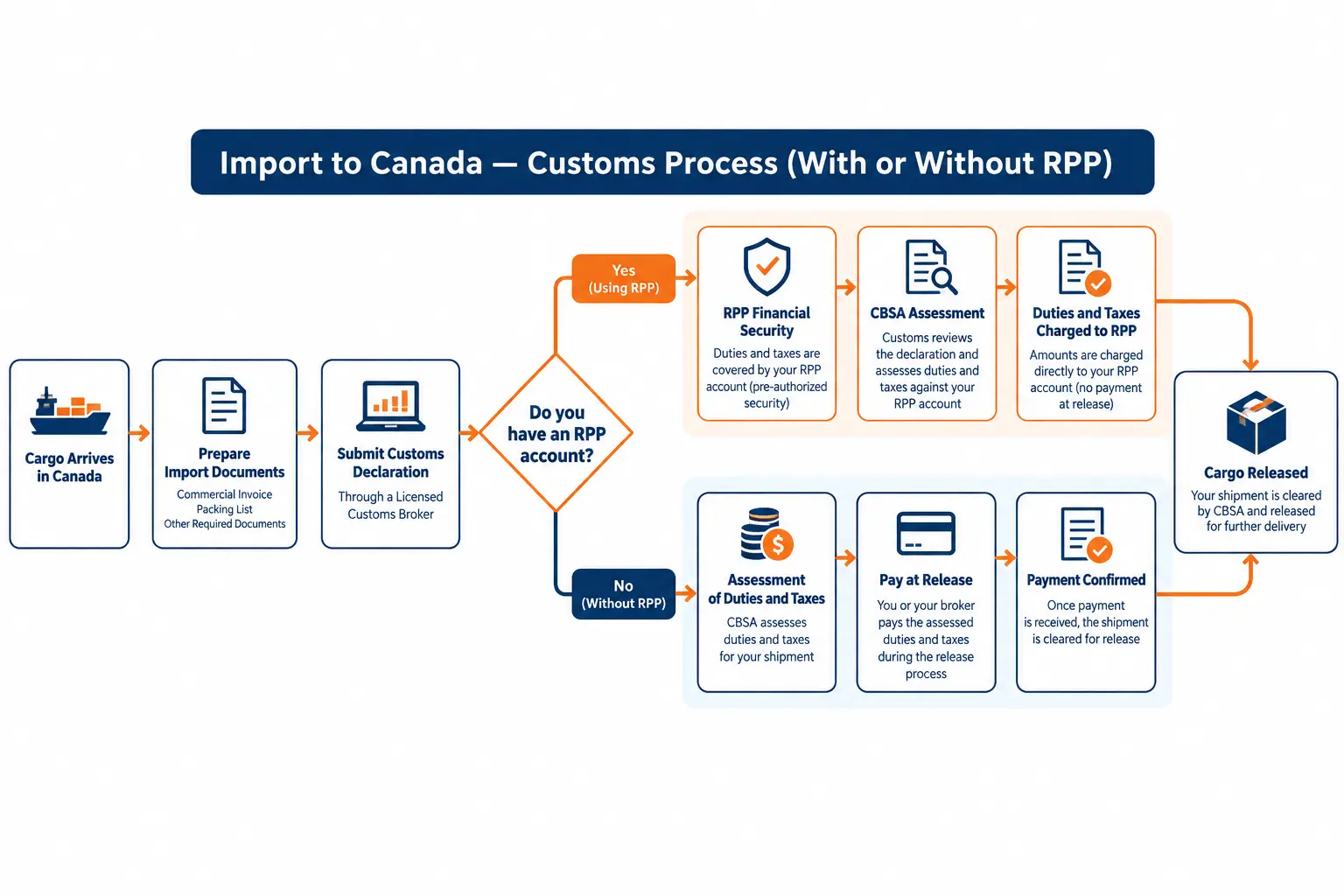
The following sequence is a practical planning workflow rather than a government processing-time guarantee:
- Before booking: Confirm the importer BN15, CARM registration and responsible account administrator.
- Before finalizing broker arrangements: Confirm the agency agreement and approved CARM delegation.
- Before relying on release-before-payment: Confirm RPP enrolment and adequate financial security.
- Before cargo departure: Reconcile product descriptions, commercial documents, classification details and shipment references.
- Before Canadian release: Verify that the responsible party has submitted the required information and is monitoring CBSA responses.
- After release: Confirm final accounting, payment scheduling, record keeping and follow-up obligations.
Actual registration or security-processing times vary by account circumstances and the type of verification required. Allow additional time when setting up a new importer, resolving business-number issues or obtaining security from a provider.
Final CARM Readiness Check for Canadian Importers
Before confirming that your business is ready for a commercial import, make sure you can answer yes to the following questions:
- Do we have a valid and correctly registered importer BN15?
- Can an authorized employee access and manage our CARM business account?
- Have we appointed an appropriate backup account manager?
- If we use a customs broker, is the required delegation approved and usable?
- If we rely on RPP, is our own financial security active and sufficient?
- Have we provided the correct invoices, shipment details and product information?
- Does someone monitor customs accounting, payment deadlines and account notices?
If one of these points remains unresolved, address it with the appropriate customs, finance or government support contact before relying on a particular release arrangement.
Planning a Commercial Shipment from China to Canada?
CARM registration and customs accounting should be coordinated with the practical shipping plan, including supplier pickup, cargo consolidation, freight method, documentation and delivery requirements.
TopShipping can help businesses organize their China-to-Canada freight planning and coordinate shipment information with the relevant logistics and customs parties. For an overview of the available transport methods and import workflow, visit our China-to-Canada shipping guide.
If you are preparing a commercial shipment, share your cargo details, pickup location, destination, preferred freight method and current customs-readiness status so the transportation requirements can be reviewed.
FAQ — CARM for Canadian Importers: Registration, Delegation and Release Checklist
Yes. Businesses importing commercial goods into Canada need the appropriate registration in the CBSA Assessment and Revenue Management (CARM) Client Portal, together with a valid business number and importer program account. This requirement applies even when a company hires a customs broker to manage its declarations. Registration allows the importer to maintain its account, authorize service providers and access customs accounting and payment information.
No. According to the CBSA, importers must register their own business in the CARM Client Portal. A customs broker can provide guidance, but cannot complete the client's business registration on its behalf. After the business account is registered, an authorized account manager can approve the broker's Delegation of Authority. This gives the broker the appropriate permissions to perform authorized customs accounting activities for the importer.
Yes. RPP is an optional program, not a universal requirement for every commercial importer. An importer without RPP must follow the applicable customs accounting and payment-upon-release procedures rather than relying on release before paying duties and taxes. For businesses importing regularly, RPP may provide operational flexibility, but enrolment requires the importer to arrange and maintain its own qualifying financial security.
The CBSA generally bases the financial security requirement on the highest monthly accounts receivable balance over the preceding 12 months for the relevant importer RM account. A qualifying written security agreement generally requires 50% of that amount, subject to a CAD 5,000 minimum. A cash security deposit generally requires 100%, with no fixed minimum. New importers use projected import activity when historical information is unavailable. Actual requirements must be verified through CARM.
Without the required CARM delegation, a customs broker cannot submit a Commercial Accounting Declaration on behalf of the importer through the CARM system. This may leave accounting obligations incomplete even if the goods have already been released. The importer should ensure that the correct business relationship and permissions are approved before relying on broker-managed accounting and should monitor outstanding declarations and deadlines.