
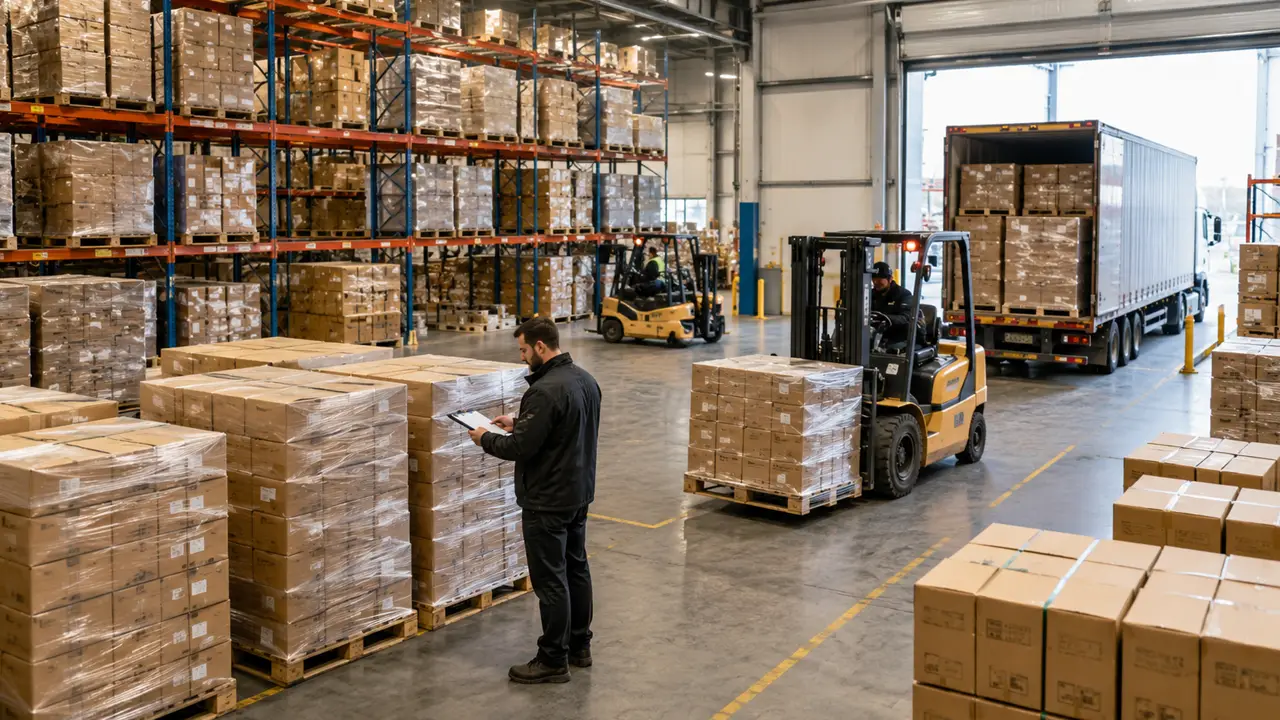
Wholesale shipping from China to Canada is best managed as a complete inventory flow rather than as a one-off freight booking. Planned bulk inventory commonly moves by LCL or FCL sea freight, urgent replenishment can move by air, and orders from several Chinese suppliers can be consolidated before export. The shipping plan should connect supplier readiness, freight cost, customs preparation, warehouse receiving and the date the inventory must actually be available for sale or distribution in Canada.
For Canadian wholesalers and distributors, the most important logistics decision is not simply finding the lowest freight rate. A reliable wholesale shipping plan should control the cost per saleable unit, reduce stockout risk, coordinate multiple purchase orders and suppliers, and prevent avoidable delays between cargo pickup in China and warehouse availability in Canada.
This guide focuses specifically on wholesale shipping management, bulk commercial inventory, recurring replenishment and warehouse delivery. For the complete China-to-Canada freight process, routes, import requirements and general shipping options, review our shipping from China to Canada guide.
Wholesale Shipping from China to Canada at a Glance
| Wholesale shipping need | Recommended starting method | Typical door-to-door planning time | Primary charging basis |
|---|---|---|---|
| Samples or small urgent wholesale parcels | Express courier | 3–7 business days | Chargeable weight |
| Urgent commercial inventory | Air freight | 5–12 business days | Chargeable weight |
| Smaller planned wholesale batches | LCL sea freight | 30–55 days | CBM or W/M |
| Larger or recurring bulk inventory | FCL sea freight | 25–50 days | Container booking |
| Orders from several Chinese suppliers | Consolidation followed by LCL, FCL or air freight | Depends on supplier readiness and selected freight method | Combined cargo profile |
| Urgent shortage plus planned inventory | Hybrid air and sea freight | Separate air and ocean timelines | Split by inventory priority |
| Wholesale inventory requiring Canadian storage | Freight plus warehouse or distribution planning | Depends on arrival gateway and receiving requirements | Freight, handling, storage and delivery scope |
Planning note: These are indicative business-planning ranges rather than guaranteed carrier schedules. Complete delivery time depends on cargo readiness, origin handling, international freight, customs release, Canadian terminal processing, inland transportation and warehouse receiving.
What Is Wholesale Shipping?
Wholesale shipping is the movement of commercial inventory between manufacturers, suppliers, importers, wholesalers, distributors, warehouses and business customers. Unlike individual consumer parcel shipping, wholesale freight commonly involves larger quantities, multiple SKUs, pallets, shared or dedicated containers, recurring purchase orders and scheduled warehouse deliveries.
For a Canadian wholesaler buying from China, wholesale shipping may connect several operational stages:
- Supplier production and cargo-ready dates
- Factory pickup in China
- Multi-supplier consolidation when required
- Carton, pallet and SKU verification
- Air, LCL or FCL freight planning
- Export documentation
- Canadian customs-clearance coordination
- Port, airport or terminal handling
- Rail or truck transportation
- Canadian warehouse receiving
- Storage, staged delivery or downstream distribution
In this guide, bulk shipment means a larger commercial inventory movement made up of cartons, pallets or containerized goods. It does not refer to dry-bulk commodities or specialist break-bulk project cargo.
Wholesale Shipping Management
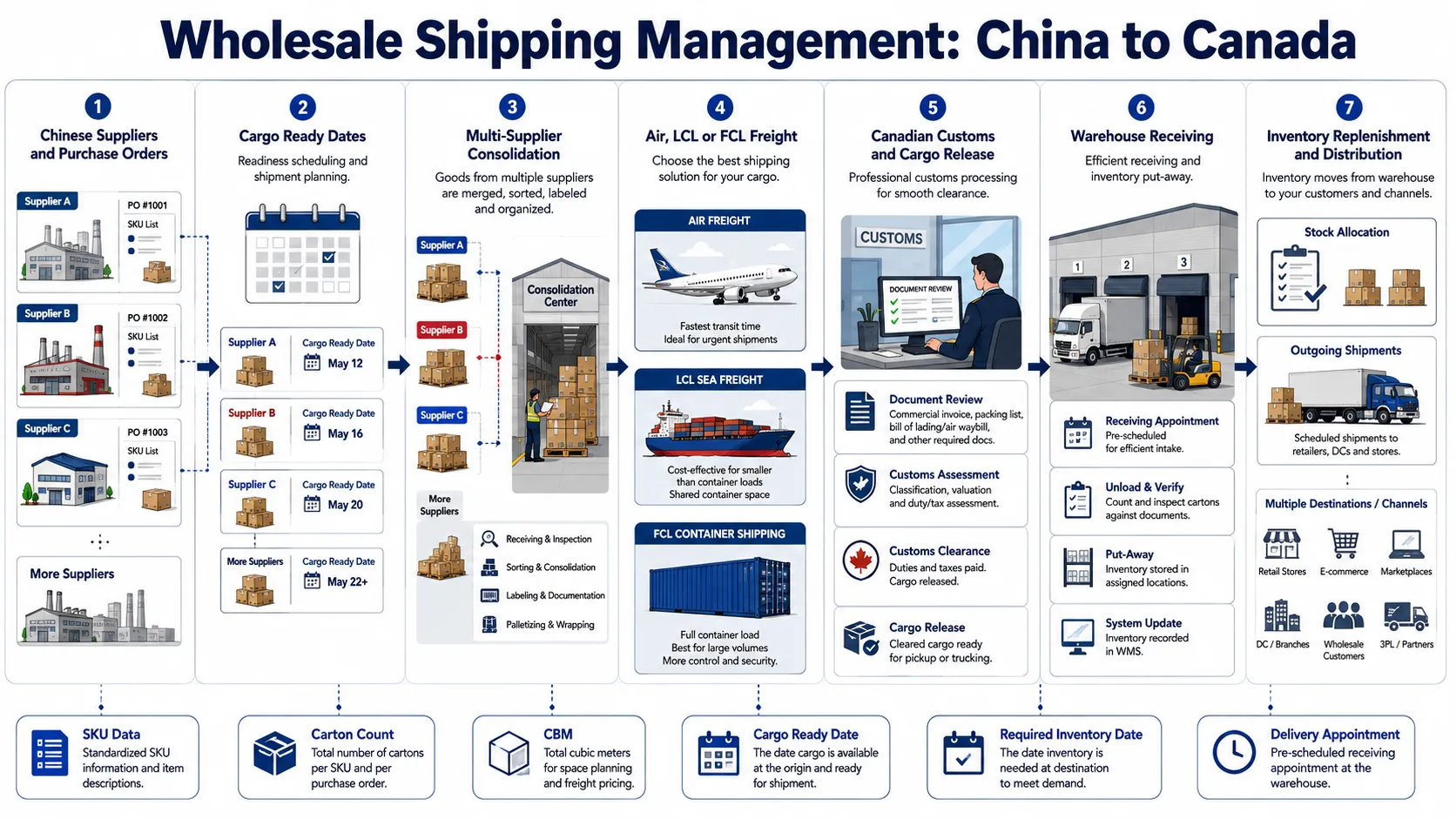
Wholesale shipping management coordinates inventory, suppliers, freight, customs and warehouse delivery as one connected process. This is especially important for wholesalers because one shipment may contain several purchase orders, many SKUs or goods collected from several factories.
| Management stage | What should be controlled | Wholesale risk if missed |
|---|---|---|
| Purchase-order planning | SKU quantities, supplier commitments and required availability dates | Inventory arrives too early, too late or in the wrong quantities |
| Supplier readiness | Production completion, packaging and cargo-ready dates | Missed bookings or incomplete consolidation |
| Cargo data | Carton count, dimensions, gross weight, CBM and pallet details | Incorrect freight quotation or capacity planning |
| Consolidation | Supplier receiving, carton identification and shipment cut-off | Orders become separated or one delayed supplier holds the complete shipment |
| Freight selection | Courier, air, LCL, FCL or hybrid strategy | Excess cost or avoidable stockouts |
| Customs preparation | Importer setup, commercial documents, HS classifications and compliance | Release delays, storage or additional costs |
| Canadian delivery | Warehouse address, appointment, dock and unloading requirements | Failed delivery or additional carrier charges |
| Inventory review | Actual landed cost and availability date | Incorrect margins or repeated planning problems |
The most effective wholesale logistics program is repeatable. After each shipment, the importer should be able to compare planned versus actual cargo-ready dates, freight costs, arrival dates, warehouse availability and cost per unit.
Who This Wholesale Freight Service Is For
This service is intended for Canadian businesses importing commercial inventory from Chinese suppliers rather than personal shipments.
- Wholesalers importing goods for resale
- Distributors supplying retailers or business customers
- Importers managing recurring bulk inventory
- Businesses purchasing from several Chinese factories
- Companies importing mixed SKUs or product ranges
- Businesses shipping cartons or palletized inventory
- Companies using LCL or FCL sea freight
- Importers using air freight for urgent replenishment
- Wholesalers delivering to Canadian warehouses or 3PL facilities
- Businesses requiring staged inventory delivery or distribution planning
Bulk Shipping for Canadian Wholesalers
Bulk shipping for wholesalers normally means moving larger quantities of commercial inventory together instead of sending many small independent shipments. The cargo may move as palletized air freight, consolidated LCL cargo or one or more full containers.
Combining compatible inventory into larger freight movements can reduce duplicated pickup, documentation and minimum freight charges. It can also simplify warehouse receiving and inventory reconciliation.
However, combining everything into one shipment is not always the best decision. If one product is urgently required or one supplier is substantially delayed, a wholesaler may benefit from splitting the inventory rather than holding the complete order.
When Bulk Shipping Makes Sense
| Inventory situation | Planning approach |
|---|---|
| Several suppliers have cargo ready within the same period | Compare supplier consolidation before export |
| Several small LCL shipments are moving separately | Review whether combined LCL or FCL reduces duplicated charges |
| A recurring product range is filling more container space | Compare FCL with the current LCL program |
| One SKU is urgent but the main order is not | Split urgent units by air and send the balance by sea |
| Inventory will be distributed from one Canadian warehouse | Plan one inbound freight movement followed by domestic distribution where appropriate |
Sea Freight for Wholesale Inventory
Sea freight is normally the main transportation method for planned, heavier or higher-volume wholesale inventory because it can provide a lower transportation cost per unit than air freight.
The two principal containerized options are LCL and FCL.
LCL Shipping for Wholesale Orders
LCL, or Less than Container Load, allows a wholesaler to use part of a consolidated ocean container. It can be suitable when the inventory does not justify reserving a complete container.
LCL is commonly considered for product launches, test orders, smaller replenishment batches, mixed supplier orders and businesses gradually increasing their import volume.
Its main limitation is that the shipment passes through consolidation and deconsolidation processes. Minimum origin and destination charges can also make very small LCL shipments disproportionately expensive.
FCL Shipping for Larger Wholesale Imports
FCL, or Full Container Load, reserves a complete container for one shipment. It is commonly used for recurring wholesale inventory, larger palletized orders, bulky products and goods requiring fewer cargo-handling stages.
A wholesaler does not need to fill every cubic metre for FCL to be commercially sensible. When cargo reaches approximately 10–18 CBM, both LCL and FCL quotations should normally be reviewed because destination charges and cargo density can change the break-even point.
For a detailed comparison of volume, handling, cost structure and container decisions, review our LCL vs FCL shipping from China to Canada guide.
For complete ocean-freight planning, see our sea freight from China to Canada guide.
Air Freight for Urgent Wholesale Replenishment
Air freight is most useful to wholesalers when the cost of running out of inventory is higher than the additional transportation cost.
Typical wholesale uses include:
- Emergency replenishment of fast-moving SKUs
- Inventory required for a confirmed buyer order
- New-product launches
- Samples and pre-production goods
- Replacement products or components
- Higher-value inventory with relatively low weight
- Units required while the main ocean shipment is still in transit
Standard commercial air freight commonly requires approximately 5–12 business days door to door when pickup, export handling, customs and final delivery are included in the planning range.
For chargeable weight, service scope and air-freight planning, review our air freight from China to Canada guide.
Hybrid Air and Sea Freight for Wholesale Inventory
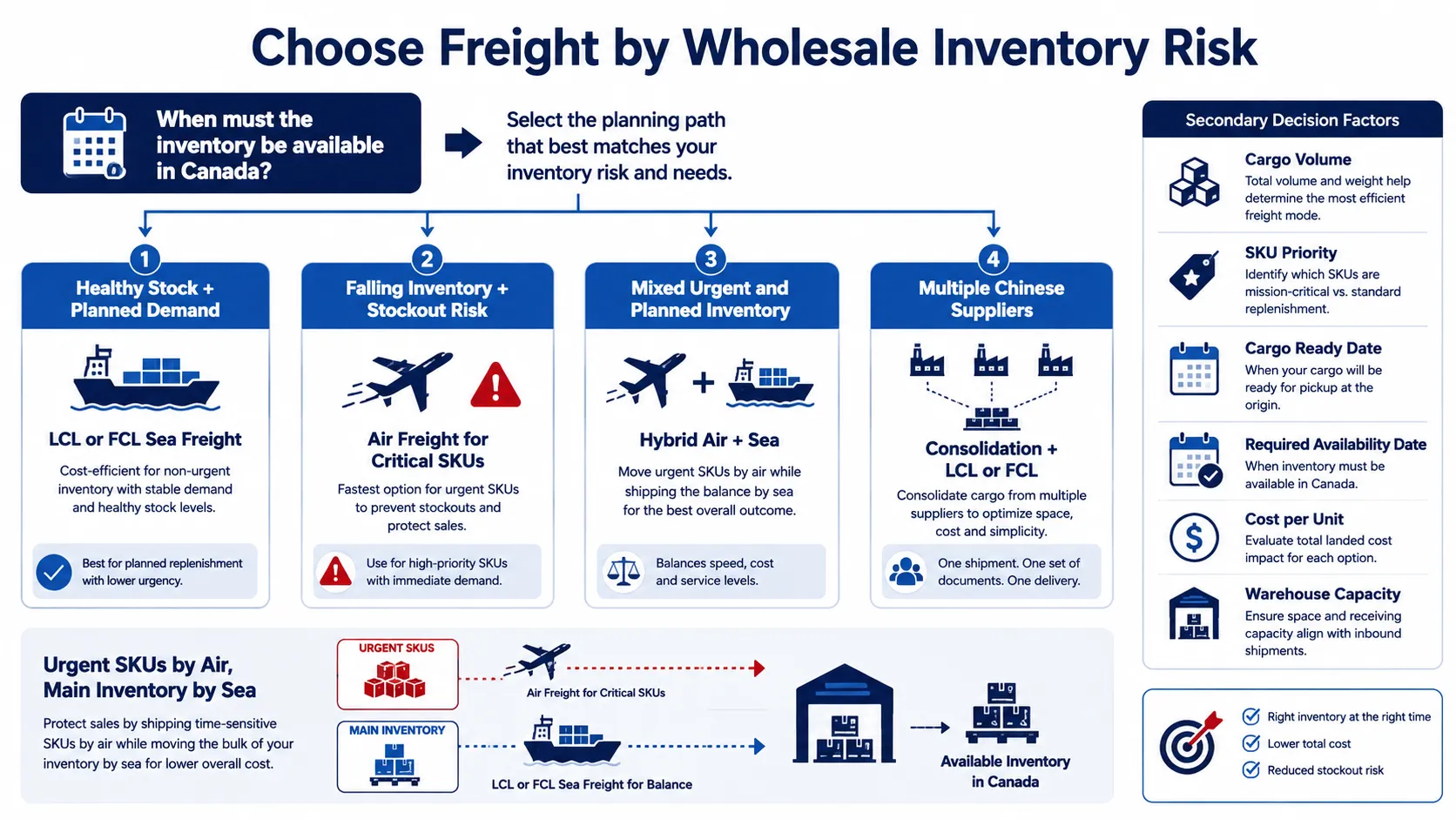
Wholesalers do not always need to choose exclusively between air and sea freight. A hybrid replenishment plan can divide one purchase order according to inventory urgency.
For example, a limited quantity of fast-moving products can be sent by air to protect sales while the majority of the order moves by sea at a lower cost per unit.
This approach can be particularly useful when:
- Demand has exceeded the original forecast
- Production finished later than planned
- A sea shipment will arrive after inventory is expected to run out
- Only several SKUs are urgent
- A confirmed customer order cannot wait for the full shipment
A hybrid plan should compare the additional air-freight expense with the commercial cost of lost sales, delayed buyer orders or production interruption.
Multi-Supplier Consolidation for Wholesale Imports
Freight consolidation allows goods from several Chinese suppliers to be collected and prepared as one coordinated international shipment. This is particularly valuable for wholesalers purchasing multiple product lines from factories located within the same sourcing region.
A consolidation warehouse may receive goods from different suppliers, record carton details, verify shipment references and prepare the combined cargo for air, LCL or FCL transportation.
What Should Be Controlled During Consolidation?
| Consolidation item | Why it matters |
|---|---|
| Supplier name and purchase order | Identifies which cartons belong to each purchase order |
| SKU and carton references | Supports inventory reconciliation and Canadian warehouse receiving |
| Cargo-ready date | Determines whether suppliers can meet the same export schedule |
| Carton count | Confirms that the complete supplier order has been received |
| Dimensions and gross weight | Determines air chargeable weight, LCL volume and container planning |
| Commercial documents | Supports export and Canadian customs preparation |
| Special cargo status | Identifies batteries, liquids, chemicals or other handling requirements |
Waiting indefinitely for one delayed supplier can eliminate the cost benefit of consolidation. The shipment cut-off should therefore be connected to the required inventory-availability date in Canada.
For a more detailed workflow, review our China freight consolidation guide.
Wholesale Inventory Replenishment Planning
Wholesale freight should be planned backwards from the date the inventory must be available in the Canadian warehouse, not only from the vessel or aircraft ETA.
A practical replenishment plan should consider:
- Current saleable inventory
- Average sales or order velocity
- Confirmed customer commitments
- Supplier production lead time
- Cargo-ready date
- Freight transit time
- Customs and terminal processing
- Canadian inland transportation
- Warehouse receiving time
- A contingency buffer for delays
Choose Freight Based on Inventory Risk
| Inventory condition | Recommended freight decision |
|---|---|
| Healthy stock and predictable demand | Prioritize planned LCL or FCL sea freight |
| Stock is decreasing faster than forecast | Review selective air replenishment |
| Only one or two SKUs are at risk | Airfreight the critical SKUs and keep the balance by sea |
| Several suppliers are producing one replenishment cycle | Coordinate cargo-ready dates and consolidation |
| Large seasonal or promotional order | Work backwards from the warehouse-availability deadline and add contingency |
| Demand is uncertain | Consider smaller replenishment batches before committing to larger inventory |
The dedicated shipping time from China to Canada guide explains the difference between main international transit and complete door-to-door availability.
Wholesale Shipping Cost and Cost per Unit
For wholesalers, the most useful cost metric is often not the total freight invoice but the landed logistics cost per saleable unit.
A shipping decision can appear inexpensive at the freight level but become costly after origin handling, destination charges, customs, inland delivery and warehousing are included.
A simple internal planning calculation is:
Total applicable logistics and import cost ÷ saleable units = estimated landed logistics cost per unit
The calculation should be applied consistently when comparing air, LCL, FCL, consolidation or different supplier terms.
What Affects Bulk Shipment Pricing?
| Cost driver | Wholesale impact |
|---|---|
| Actual and volumetric weight | Changes air-freight chargeable weight |
| CBM and cargo density | Affects LCL and container selection |
| Number of suppliers | Can create additional pickup and handling costs |
| Chinese origin locations | Changes inland pickup and consolidation requirements |
| Canadian delivery location | Changes rail, drayage and final trucking costs |
| Incoterm | Determines which logistics costs are paid by the supplier or buyer |
| Warehouse requirements | Appointments, unloading, storage or special handling can add cost |
| Urgency | Can require premium air service instead of planned sea freight |
For current freight-rate ranges, chargeable-weight calculations, LCL pricing and container costs, use our dedicated shipping cost from China to Canada guide.
Canadian Warehouse Shipping and Receiving
A wholesale shipment is not complete when the aircraft or vessel arrives in Canada; the inventory must still become available at the receiving warehouse.
Before arranging final delivery, confirm the warehouse or 3PL receiving requirements.
- Complete delivery address and postal code
- Receiving hours
- Delivery appointment requirements
- Purchase-order or reference numbers
- Pallet configuration
- Carton and pallet labels
- Advance shipment notice requirements when applicable
- Dock availability
- Liftgate requirements when there is no suitable dock
- Unloading responsibility
- Maximum pallet height or weight where applicable
- Restricted delivery dates
Providing these requirements before booking final transportation reduces the risk of failed delivery, re-delivery, waiting time or unexpected handling charges.
Delivery to a Wholesaler, 3PL or Distribution Centre
The receiving plan may differ depending on the destination. A wholesaler’s own warehouse may have flexible receiving procedures, while a third-party logistics facility, retailer or distribution centre may require specific delivery windows, labels, pallet standards or purchase-order references.
For large inbound inventory, staged delivery can also be considered where the confirmed service scope and warehouse arrangement allow it. This may help avoid receiving an entire container volume into limited warehouse space at once.
Customs Clearance for Wholesale Imports
Wholesale cargo normally involves higher commercial values, multiple SKUs and more detailed product information than a typical consumer parcel, making customs preparation an important part of the logistics plan.
Canadian commercial importers should confirm their importer setup before the shipment is dispatched. The Canada Border Services Agency guidance for importing commercial goods explains the requirements for a Business Number, RM import-export account, customs classification and other commercial-import responsibilities.
Importers should also ensure their account is correctly set up in the CBSA Assessment and Revenue Management (CARM) system, which is used to account for commercial imports and manage applicable duties and taxes.
Common shipment information includes:
- Commercial invoice
- Packing list
- Bill of lading or air waybill
- Detailed product descriptions
- HS classifications
- Country of origin
- Customs value and transaction currency
- Importer and consignee information
- Product permits or certificates where required
SKU names used internally by the wholesaler may not provide enough customs information. Product descriptions should explain what the goods are, their material or composition when relevant, and their commercial function.
For deeper import guidance, review our customs clearance from China to Canada and shipping documents from China to Canada guides.
Door-to-Door Shipping for Wholesalers
Door-to-door freight can connect supplier pickup in China with delivery to an agreed Canadian warehouse or business location.
Depending on the confirmed quotation, the service may coordinate:
- Supplier pickup
- Origin receiving or consolidation
- Export handling
- Air or ocean freight
- Canadian destination handling
- Customs-clearance coordination
- Rail or truck transportation
- Final warehouse delivery
Door-to-door does not automatically mean that every customs, tax or delivery charge is included. The quotation should identify duties, GST, brokerage, examinations, storage, delivery appointments, unloading and other exclusions.
For service-scope details, review our door-to-door shipping from China to Canada guide.
DDP Shipping for Wholesale Inventory
DDP may be considered when a wholesaler requires a wider delivered-duty-paid arrangement, but it should not be selected only because the supplier describes a quotation as “all inclusive.”
The importer structure, HS classification, customs value, duties, GST, product admissibility and final-delivery responsibilities should be confirmed before the shipment is accepted under DDP terms.
A valid DDP arrangement can simplify commercial planning when the scope is clearly defined, but it does not remove the need for accurate customs information or product compliance.
For responsibility and eligibility details, review our DDP shipping from China to Canada guide.
How to Reduce Wholesale Shipping Costs
Cost reduction should focus on the complete inventory flow rather than only negotiating a lower international freight rate.
- Confirm final carton dimensions before booking.
- Reduce unnecessary packaging volume without compromising protection.
- Consolidate compatible supplier orders.
- Avoid shipping each supplier order independently when combined freight is practical.
- Compare LCL and FCL when cargo reaches approximately 10–18 CBM.
- Use air freight selectively for urgent SKUs.
- Move planned inventory by sea whenever the replenishment schedule allows.
- Provide accurate Canadian warehouse receiving requirements before delivery.
- Compare quotations using the same Incoterm and service scope.
- Calculate freight and landed logistics cost per saleable unit.
- Avoid holding a complete consolidated shipment for one non-critical delayed supplier.
- Use realistic inventory buffers instead of relying on emergency air freight.
Common Wholesale Shipping Problems
Shipping Every Supplier Order Separately
Separate shipments can duplicate pickup, documentation, minimum freight and receiving costs. Compatible orders should be reviewed for consolidation.
Waiting Too Long for One Supplier
Consolidation can reduce costs, but holding urgent inventory while one delayed supplier completes production may create a larger commercial loss.
Choosing Freight Only by Price
The lowest transportation rate may not be the lowest landed cost after destination fees, warehouse charges and inventory delays are considered.
Using Estimated Carton Dimensions
Air chargeable weight, LCL CBM and container planning depend on final packed measurements.
Ignoring Warehouse Receiving Rules
Missing appointments, incorrect labels or unsuitable pallet configurations can delay final delivery.
Using Vessel ETA as the Inventory Availability Date
Ocean cargo may still require terminal processing, customs release, inland rail or trucking and warehouse receiving after the vessel arrives.
Sending All Inventory by Air During a Stockout
A split air-and-sea strategy may protect critical sales without paying air-freight rates for the complete purchase order.
Wholesale Shipping Workflow from China to Canada
| Step | Wholesale logistics task | Key information |
|---|---|---|
| 1 | Confirm purchase orders and inventory need | SKUs, quantities and required availability date |
| 2 | Confirm supplier readiness | Factory location and cargo-ready date |
| 3 | Collect final cargo data | Cartons, pallets, dimensions, weight and CBM |
| 4 | Plan consolidation | Number of suppliers and shipment cut-off |
| 5 | Select freight method | Air, LCL, FCL or hybrid strategy |
| 6 | Prepare customs information | Invoice, packing list, HS codes and importer details |
| 7 | Book international freight | Carrier, routing and service scope |
| 8 | Prepare Canadian warehouse delivery | Postal code, appointment, dock and receiving rules |
| 9 | Track operational milestones | Departure, arrival, customs release and availability |
| 10 | Review the completed shipment | Actual landed cost, lead time and inventory result |
Information Needed for a Wholesale Shipping Quote
A wholesale freight quotation is more reliable when the cargo, supplier and Canadian receiving information are provided together.
- Chinese supplier names and pickup addresses
- Number of suppliers
- Product names and detailed descriptions
- SKU or purchase-order references where useful
- Number of cartons, pallets or crates
- Final dimensions of each package type
- Total gross weight
- Total CBM for ocean shipments
- Cargo value and currency
- HS codes when confirmed
- Incoterm and named location
- Cargo-ready date for each supplier
- Required inventory-availability date
- Canadian warehouse address and postal code
- Receiving hours and appointment requirements
- Dock, liftgate or unloading requirements
- Warehousing or staged-distribution requirements
- Details of batteries, liquids, chemicals or regulated products
If several suppliers are involved, identify which products are urgent and which suppliers can be shipped later. This allows a consolidation or split-shipment plan to be evaluated before freight is booked.
How TopShipping Supports Canadian Wholesalers
TopShipping coordinates commercial freight for Canadian businesses purchasing wholesale inventory from suppliers across China.
Depending on the confirmed shipment scope, support may include:
- Supplier communication and cargo-ready-date coordination
- Factory pickup in China
- Multi-supplier consolidation
- Air freight for urgent wholesale inventory
- LCL sea freight
- FCL container shipping
- Export handling
- Shipping-document coordination
- Canadian customs-clearance coordination
- Shipment milestone tracking
- Canadian warehouse delivery planning
- Warehousing or distribution coordination where applicable
The objective is to select a logistics plan that supports inventory availability, landed cost and warehouse operations rather than applying the same freight method to every wholesale order.
Request a Wholesale Shipping Plan
If your business imports wholesale inventory from China, provide the supplier locations, cargo details, required inventory date and Canadian warehouse information.
TopShipping can review the available air, LCL, FCL, consolidation and door-to-door options against the actual shipment requirements.