
Import-export shipping for a Canadian importer connects two sides of the same international freight movement: export preparation and cargo handling in the origin country, followed by commercial import, customs release and delivery in Canada. For goods purchased from China, the shipment may involve supplier pickup, Chinese export handling, air or sea freight, Canadian import accounting, customs clearance, inland transportation and final warehouse delivery.
The Canadian importer should not treat international shipping as only a carrier booking. Before cargo leaves the supplier, the business should know what is being imported, who is responsible under the agreed Incoterm, whether the product is admissible in Canada, which documents are required, how the goods will be classified and valued, and where the shipment must ultimately be delivered.
TopShipping focuses on commercial freight from Chinese suppliers to Canadian businesses. In this guide, the term import-export shipping describes the connected export-side and import-side logistics process for a China-to-Canada shipment; it does not mean outbound export shipping from Canada.
For a broader comparison of freight methods, rates, transit times and routes, start with our complete China-to-Canada logistics overview. This page specifically focuses on the operational responsibilities and decisions of the Canadian importer.
Import-Export Shipping for Canadian Importers at a Glance
| Stage | Primary responsibility or decision | Key information | Main risk if missed |
|---|---|---|---|
| Commercial purchase | Confirm supplier, goods and Incoterm | Product, price, quantity and named location | Unclear cost or logistics responsibility |
| Importer setup | Prepare the Canadian commercial import account | Business Number, RM account and CARM access | Accounting or release problems |
| Product review | Confirm admissibility and classification requirements | Material, function, HS classification, permits | Unexpected duty, permit or compliance issue |
| Cargo preparation | Confirm final shipment data | Cartons, dimensions, weight, CBM and ready date | Quote change or missed booking |
| China export side | Coordinate pickup, origin handling and export movement | Supplier address, documents and carrier cut-off | Departure delay |
| International freight | Select air, LCL or FCL | Urgency, volume, handling and inventory need | Excess cost or stockout |
| Canada import side | Prepare commercial import and customs release | Importer, classification, origin, value and documents | Customs delay or reassessment |
| Final delivery | Coordinate airport, port, rail or truck movement | Postal code and warehouse requirements | Failed or delayed delivery |
| Post-import control | Retain import records and review actual landed cost | Customs, commercial and logistics records | Compliance and costing problems |
Importer note: Freight forwarders, customs brokers, carriers and suppliers can perform different parts of the process, but the Canadian importer should still understand which party is responsible for each stage and what information has been declared on its behalf.
What Does Import-Export Shipping Mean?
In an international commercial transaction, the same cargo is normally an export from the origin country and an import into the destination country.
For a shipment purchased by a Canadian business from a Chinese supplier:
- The goods leave China through the export side of the transaction.
- The goods travel internationally by air or ocean freight.
- The same goods enter Canada through the import side of the transaction.
- The Canadian shipment continues to the agreed warehouse, business or distribution location after release and availability.
The two sides are connected but they do not involve identical responsibilities.
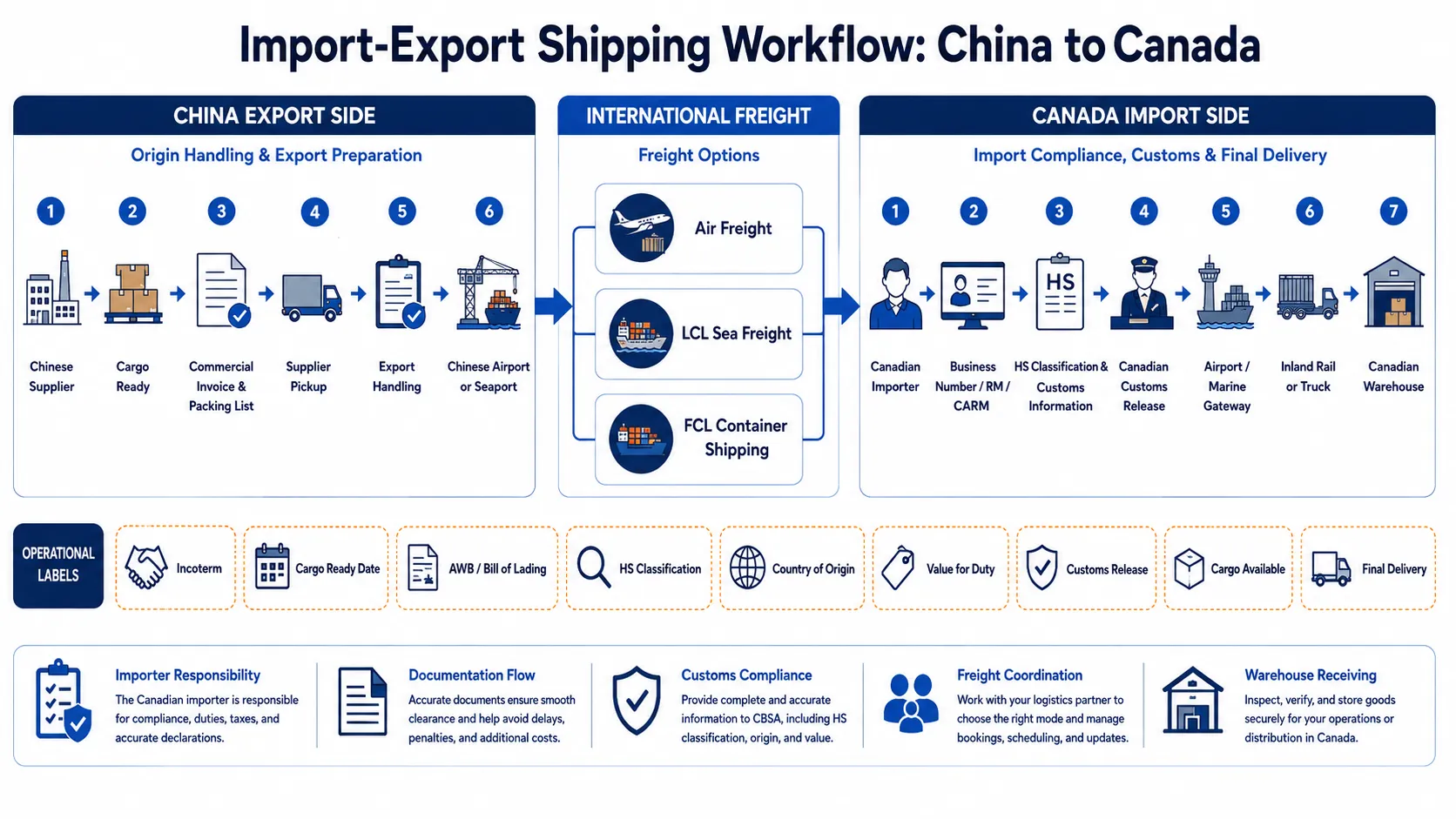
China Export Side vs Canada Import Side
| China export side | Canada import side |
|---|---|
| Supplier cargo readiness | Canadian importer setup |
| Commercial and packing information | Canadian tariff classification |
| Factory pickup | Country-of-origin review |
| Origin warehouse or terminal handling | Value-for-duty information |
| Export documentation | Duty and GST planning |
| Airline or ocean-carrier acceptance | Customs-release requirements |
| Export airport or seaport | Canadian airport or marine gateway |
| International departure | Inland rail, drayage or truck delivery |
A good freight plan connects both sides before the goods move. Discovering Canadian import requirements only after the cargo has departed can create avoidable delays and additional cost.
Who Is This Guide For?
This page is designed for Canadian businesses importing commercial goods rather than personal parcels.
- Businesses importing inventory from Chinese manufacturers
- Canadian distributors and wholesalers
- Retailers importing stock for resale
- Manufacturers importing components or equipment
- E-commerce businesses importing inventory
- Companies purchasing from several Chinese suppliers
- Importers using air, LCL or FCL freight
- Businesses delivering imports to Canadian warehouses or 3PL facilities
- Companies establishing or improving a recurring import program
Businesses moving larger recurring inventory can also review our bulk inventory and wholesale freight planning guide.
Who Does What in an Import-Export Shipment?
One of the most common causes of confusion in international shipping is assuming that the supplier, freight forwarder, customs broker, importer and consignee are interchangeable roles.
| Party | Main role | Important limitation |
|---|---|---|
| Chinese supplier or seller | Produces or supplies the goods and performs the obligations agreed under the Incoterm | Does not automatically control the Canadian import declaration |
| Exporter or shipper | Provides the cargo for export and may appear as shipper on transportation documents | May not be the same legal party as the manufacturer |
| Canadian importer | Imports commercial goods into Canada and supports the applicable customs declaration and accounting | Should not assume that a broker removes the importer’s compliance responsibilities |
| Freight forwarder | Coordinates transportation, routing, cargo handling and related logistics | Is not automatically the importer of record or customs broker |
| Customs broker | Can act as an authorized agent for customs transactions within the agreed scope | The importer still needs accurate product, origin and valuation information |
| Carrier | Physically transports the cargo by air, sea or inland mode | Does not manage every customs or commercial responsibility |
| Consignee | Party identified to receive the goods under the relevant shipment structure | May or may not be the importer of record |
| Warehouse or 3PL | Receives, stores or distributes imported inventory | Requires its own delivery and receiving instructions |
Canadian Importer Setup Before Shipping
Importer setup should be completed before the cargo is ready to arrive in Canada. The Canada Border Services Agency states that commercial importers need a Business Number and an import-export program account, commonly identified by the RM program identifier.
The CBSA Assessment and Revenue Management system, or CARM, is the current environment used for commercial import accounting and related importer-account functions.
Before the first commercial shipment, confirm:
- Business Number
- Import-export program RM account
- CARM Client Portal access where applicable
- Customs-broker delegation where a broker will act for the importer
- Importer legal name and address
- Accounting and payment arrangements
- Internal responsibility for maintaining import records
The official CBSA commercial importing resources should be used as the primary reference for current Canadian importer requirements.
Check Product Admissibility Before Freight Is Booked
A product being commercially available in China does not automatically mean that it can be imported into Canada without additional requirements.
Product-specific controls can depend on:
- Product type
- Material composition
- Intended use
- Country of origin
- Labelling
- Safety requirements
- Food or agricultural controls
- Health-related requirements
- Electrical, chemical or environmental regulations
- Permits, licences or certificates
For commodities regulated by the Canadian Food Inspection Agency, the Automated Import Reference System can be used to identify current CFIA import requirements.
Products outside CFIA jurisdiction may be regulated by other Canadian departments or agencies. The responsible program should be identified before cargo departure rather than after it reaches the border.
Classify the Goods Before They Leave China
Canadian tariff classification affects customs reporting, regular duty rates and the review of possible trade measures.
A supplier’s proposed HS code can be useful as reference information, but the Canadian importer should verify the applicable Canadian tariff classification rather than automatically copying a foreign national tariff code.
Classification should be supported by information such as:
- Exact product name
- Commercial function
- Material composition
- Technical specifications
- Model number
- Photographs or catalogue information
- Country of origin
For the complete Canadian classification structure and duty calculation process, use our Canadian tariff, duty and import-tax guide.
Understand Country of Origin and Customs Value
The country where the cargo is shipped from is not necessarily the same concept as the country of origin for customs purposes.
A product may travel through another port, airport or logistics hub without changing its manufacturing origin.
The importer should maintain information that supports:
- Where the goods were manufactured
- Material or component origins where relevant
- Applicable tariff treatment
- Purchase price and currency
- Related-party information where applicable
- Costs or assists relevant to customs valuation
These details affect customs accounting and should be resolved before the importer relies on a landed-cost estimate.
Choose the Right Incoterm Before Comparing Freight Quotes
A freight quote is difficult to compare correctly when the underlying purchase terms are different.
| Incoterm | Importer planning implication |
|---|---|
| EXW | The buyer generally takes responsibility for transportation beginning at the supplier’s premises |
| FCA | The seller delivers the goods to the named carrier or agreed location |
| FOB | For sea freight, the seller places the goods on board the vessel at the named port |
| DAP | The seller arranges transportation to the named destination while the buyer normally manages import clearance |
| DDP | The seller assumes extensive delivery and import responsibilities subject to legal and operational feasibility |
The named place is essential. Terms such as “EXW China,” “FOB China” or “DDP Canada” are not precise enough for a professional comparison.
For a deeper allocation of costs and responsibilities, review our buyer-and-seller responsibility comparison.
Choose the Freight Method Based on the Importer’s Business Need
The transportation method should be selected according to cargo characteristics and required inventory availability rather than habit.
| Importer requirement | Recommended starting method | Typical planning time | Pricing basis |
|---|---|---|---|
| Samples or very small urgent cargo | Express courier | 3–7 business days | Chargeable weight |
| Urgent commercial inventory | Air freight | 5–12 business days | Chargeable weight |
| Smaller planned ocean cargo | LCL sea freight | 30–55 days | CBM or W/M |
| Larger or recurring commercial inventory | FCL sea freight | 25–50 days | Container booking |
| Several Chinese suppliers | Consolidation plus air, LCL or FCL | Depends on supplier readiness and method | Combined cargo profile |
| Only part of the order is urgent | Hybrid air and sea | Separate air and ocean timelines | Split by inventory priority |
Planning note: These are indicative business-planning ranges rather than guaranteed carrier schedules. For current pricing use our freight-rate and landed-cost planning guide; for detailed timelines use our shipment lead-time guide.
Air Freight for Canadian Importers
Air freight is normally appropriate when inventory availability, customer commitments or production requirements justify a higher transportation cost.
Importers commonly use commercial air freight for:
- Urgent stock replenishment
- Higher-value compact goods
- Samples and prototypes
- Production-critical parts
- Launch inventory
- Seasonal merchandise
- Selected SKUs while the main shipment travels by sea
Air cargo is normally rated using chargeable weight, which considers both actual and volumetric weight. Sensitive goods such as batteries, liquids, powders, chemicals or oversized pieces should be reviewed before booking.
For cargo acceptance, weight calculations and routing, see our time-sensitive commercial air-cargo guide.
Ocean Freight for Canadian Importers
Sea freight is normally the stronger option for larger, heavier and planned commercial cargo.
LCL allows an importer to use part of a consolidated container, while FCL reserves a complete container for one shipment.
Importers should compare LCL and FCL rather than assuming that one method is always cheaper. Cargo density, destination charges, handling sensitivity and current container pricing can materially change the decision.
When cargo approaches approximately 10–18 CBM, requesting both LCL and FCL quotations is normally a useful planning step.
For container operations, CFS handling and FCL equipment, use our ocean container and shared-load shipping guide.
Import Shipping from Multiple Chinese Suppliers
Canadian importers frequently purchase one commercial order from several factories or source different product lines from different regions.
Without a coordinated plan, each supplier may have:
- A different cargo-ready date
- Different carton labels
- Different commercial documents
- Different pickup locations
- Different shipment measurements
- Different Incoterms
A buyer’s consolidation process can bring compatible supplier orders into one coordinated freight movement.
| Consolidation control | Importer benefit |
|---|---|
| Purchase-order identification | Keeps supplier cargo separated operationally while preparing one logistics plan |
| Cargo-ready-date tracking | Prevents one late supplier from unexpectedly delaying the complete shipment |
| Carton and pallet receiving | Confirms what was actually delivered to the consolidation facility |
| Weight and dimension verification | Improves freight-method and quotation accuracy |
| Document review | Reduces inconsistencies before export |
| Air/LCL/FCL selection | Allows the combined shipment to use the most practical method |
For the complete workflow, review our multi-supplier cargo coordination guide.
Import Shipping Documents
The commercial invoice and packing list are not administrative afterthoughts. They are core records connecting the supplier, cargo, freight booking and customs declaration.
| Document or information | Main purpose |
|---|---|
| Commercial invoice | Identifies the transaction, goods, values, currency and commercial terms |
| Packing list | Identifies packages, weights, dimensions and packing structure |
| Air waybill | Records the transportation details for air freight |
| Bill of lading | Records the transportation details for ocean freight |
| HS classification | Supports Canadian tariff reporting |
| Country-of-origin information | Supports tariff and trade-measure review |
| Permits or certificates | Supports regulated products where required |
| Importer information | Supports Canadian commercial import reporting |
Descriptions such as “parts,” “accessories,” “samples” or “general merchandise” may be too broad for effective customs and compliance review.
For a wider pre-shipment checklist, use our commercial import-document guide.
Canadian Customs Clearance Is More Than Paying Duty
Customs clearance is the process that allows imported commercial goods to be released from customs control after the required information and conditions have been satisfied.
The importer and its authorized parties may need to support:
- Importer identification
- Product classification
- Country of origin
- Value for duty
- Commercial invoice data
- Applicable permits or certificates
- Duty and GST accounting
- Responses to customs questions or examinations
A freight forwarder should not automatically be treated as the customs broker or importer of record.
For the release process and broker/importer responsibilities, see our Canadian customs-release workflow.
Duty, GST and Landed Cost for Canadian Importers
A supplier price and an international freight rate do not represent the complete cost of importing commercial goods.
Landed cost can include:
- Supplier purchase price
- China-side pickup
- Origin handling
- International freight
- Cargo insurance
- Regular customs duty
- GST
- Applicable surtaxes or trade-remedy duties
- Customs-brokerage costs
- Destination handling
- Storage where applicable
- Rail, drayage or trucking
- Final warehouse delivery
For an importer, the most useful number may ultimately be landed cost per saleable unit rather than freight cost alone.
Door-to-Door Import Shipping
Door-to-door shipping can coordinate the physical freight movement from a supplier or factory in China to an agreed commercial destination in Canada.
Depending on the quotation, the service may connect:
- Supplier pickup
- Origin handling
- Export preparation
- International air or sea freight
- Canadian destination handling
- Customs-clearance coordination
- Rail or truck transportation
- Final warehouse delivery
Door-to-door does not automatically mean all customs duties, GST, examinations, storage or special-delivery charges are included.
For scope boundaries and exclusions, review our supplier-to-warehouse delivery guide.
Where DDP Fits into Import-Export Shipping
DDP is a commercial delivery term rather than a separate freight mode. The underlying transportation may still be air, LCL or FCL.
A Canadian business considering DDP should confirm:
- The named delivery location
- The importer structure
- The HS classification
- The declared customs value
- Responsibility for duty and GST
- Customs representation
- Product admissibility
- Final delivery scope
- Potential examination or storage charges
For a deeper review, see our delivered-duty-paid responsibilities guide.
Canadian Warehouse Receiving Is Part of the Import Plan
The importer should prepare the final receiving location before the shipment becomes available in Canada.
Confirm:
- Complete Canadian postal code
- Warehouse receiving hours
- Delivery appointment requirements
- Purchase-order or reference number
- Carton or pallet labels
- Dock availability
- Liftgate requirements
- Unloading responsibility
- Pallet height or weight restrictions
- Advance shipment-notice requirements where applicable
- Restricted receiving dates
Arrival at a Canadian airport, port or rail terminal does not mean the inventory is ready for sale. Customs release, cargo availability and final receiving still need to occur.
Keep Commercial Import Records After Delivery
The importer’s responsibility does not end when the warehouse receives the cargo.
CBSA requires importers to maintain relevant commercial-import records for six years following importation. These records can include information relating to the purchase, origin, importation, cost, value and subsequent disposition of the goods.
The official CBSA importer recordkeeping requirements provide the detailed rules.
Businesses should therefore retain organized records such as:
- Purchase orders
- Commercial invoices
- Packing lists
- Payment information
- Transportation documents
- Tariff-classification support
- Origin records
- Customs declarations
- Broker correspondence
- Duty and tax accounting
- Product permits or certificates
- Final delivery records
Common Import-Export Shipping Mistakes
| Mistake | Why it creates problems |
|---|---|
| Booking freight before checking admissibility | The cargo may require permits, certificates or product changes |
| Using the supplier’s HS code without Canadian verification | Canadian tariff subdivisions and requirements may differ |
| Using estimated carton dimensions as final data | Air chargeable weight or ocean volume can change |
| Not defining the Incoterm location | Pickup, export and delivery responsibilities become unclear |
| Assuming the freight forwarder is the importer | Importer responsibilities may remain unresolved |
| Assuming door-to-door means all-inclusive | Duty, GST and contingent charges may still be excluded |
| Waiting until arrival to prepare customs information | Release and terminal delays become more likely |
| Ignoring warehouse receiving requirements | Delivery may fail or generate additional charges |
| Using ETA as the inventory-ready date | Customs, terminal and inland stages may remain |
| Failing to retain import records | The importer may not be able to support previous declarations |
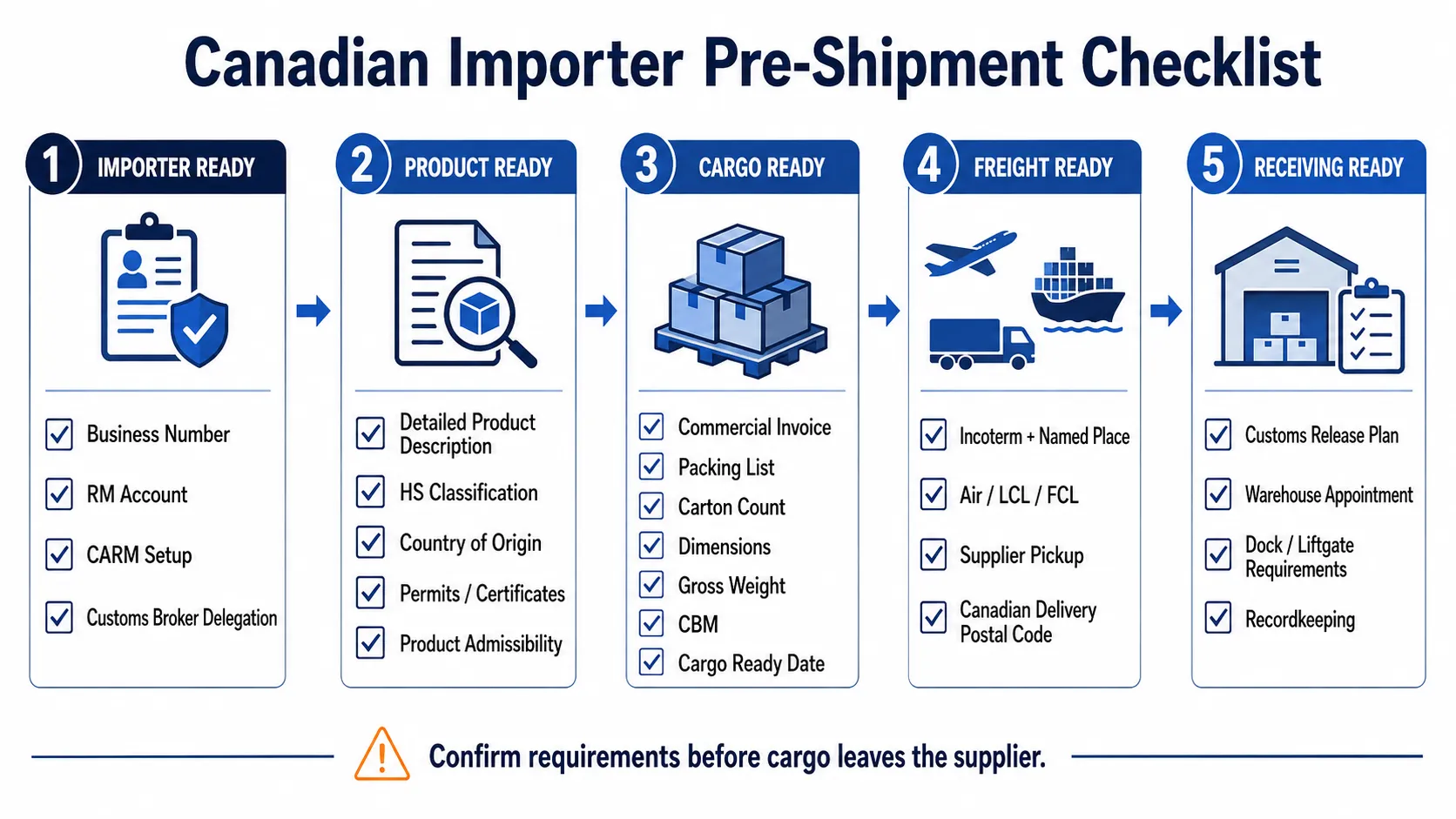
Importer Pre-Shipment Checklist
- Confirm the supplier legal and pickup details.
- Confirm the exact product and commercial use.
- Check whether the product is admissible in Canada.
- Identify permits or certificates before departure.
- Confirm the Canadian importer and RM account.
- Confirm CARM access and broker delegation where applicable.
- Review the Canadian HS classification.
- Confirm country-of-origin information.
- Establish commercial value and currency.
- Confirm the Incoterm and named location.
- Obtain the final commercial invoice.
- Obtain the final packing list.
- Confirm carton or pallet dimensions.
- Confirm total gross weight and CBM.
- Identify batteries, liquids, chemicals or restricted cargo.
- Confirm the cargo-ready date.
- Select air, LCL or FCL according to the business requirement.
- Provide the exact Canadian delivery postal code.
- Confirm warehouse receiving requirements.
- Plan how customs and import records will be retained after delivery.
Information Needed for an Import Shipping Quote
| Information | Why it matters |
|---|---|
| Supplier pickup address | Determines China-side transportation and gateway planning |
| Detailed product description | Supports freight acceptance and customs review |
| Number of cartons or pallets | Supports handling and capacity planning |
| Final package dimensions | Determines chargeable weight and volume |
| Total gross weight | Required for air and ocean planning |
| Total CBM | Supports LCL and FCL selection |
| Cargo value and currency | Supports customs and landed-cost planning |
| Incoterm and named location | Defines where logistics responsibility begins |
| Cargo-ready date | Determines available departure options |
| Required inventory date | Helps select the freight method |
| Canadian postal code | Determines final delivery requirements |
| Special-cargo information | Determines carrier acceptance and documentation needs |
How TopShipping Supports Canadian Importers
TopShipping coordinates commercial freight from Chinese suppliers to Canadian businesses.
Depending on the confirmed shipment scope, support may include:
- Supplier communication and cargo-ready-date coordination
- Factory pickup in China
- Multi-supplier consolidation
- Commercial air freight
- LCL sea freight
- FCL container shipping
- Export-handling coordination
- Commercial document coordination
- Customs-clearance coordination
- Shipment milestone tracking
- Canadian inland transportation planning
- Warehouse and final-delivery coordination
The objective is to connect the export side in China with the Canadian import and delivery side in one practical logistics plan while keeping each party’s responsibilities clear.
Request Import Shipping Support
If your business imports commercial goods from China, provide the supplier location, product details, package information, cargo-ready date and Canadian destination.
TopShipping can review the freight method, origin coordination, customs-related shipment information and final delivery requirements for the planned import.