
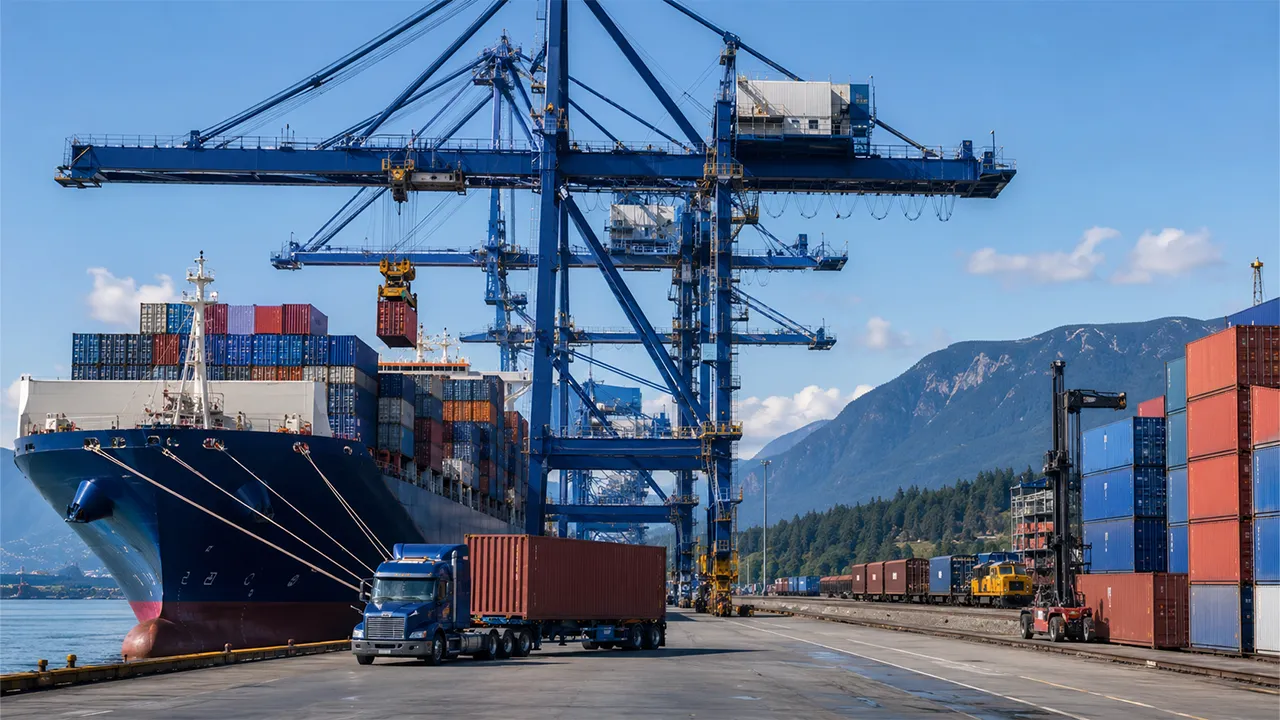
Sea freight from China to Canada is a commercial shipping service for palletized stock, machinery, furniture and other non-urgent inventory. TopShipping coordinates LCL ocean freight and FCL container shipping, with the origin handoff, carrier booking, shipping documentation and agreed Canadian delivery planned around your actual cargo. The right ocean-freight booking is determined by the supplier location, receiving cut-offs, packed dimensions, cargo handling limits and inland delivery requirements—not by container price alone.
The starting point is a practical shipment assessment: where the goods are ready in China, how they are packed, whether multiple suppliers are involved, what container capacity is required and where the cargo must be delivered in Canada. This page focuses on the operational sea freight service. For the overall air-versus-sea decision and import journey, use our shipping from China to Canada guide.
Commercial Ocean Freight Services: What Can Be Coordinated?
For a business importing from China, ocean freight involves more than reserving space on a vessel. The shipment plan must establish where responsibility starts, who hands the cargo over in China, which ocean service accepts it and how it will reach the Canadian consignee after release.
| Service component | Practical booking question |
|---|---|
| Supplier pickup or origin receiving | Is the cargo collected at EXW premises, delivered under an agreed FOB arrangement, or received at a CFS? |
| LCL or FCL ocean booking | Will the shipment use shared CFS space or a dedicated container, and what is the actual accepted loading plan? |
| Documentation and export coordination | Are shipping instructions, invoice and packing information, cut-offs and applicable VGM ready? |
| Destination release | Who coordinates carrier/CFS release, importer-broker instructions and charge settlement? |
| Canadian inland delivery | Does the quote include rail, drayage or truck delivery to the consignee’s postal code and unloading conditions? |
TopShipping reviews the required stages for a commercial shipment and confirms the activities and exclusions in the quotation. Customs brokerage, duties and taxes, cargo insurance and specialized cargo handling must be expressly included when applicable; they should not be assumed from the term “sea freight.”
LCL and FCL Sea Freight Services from China to Canada
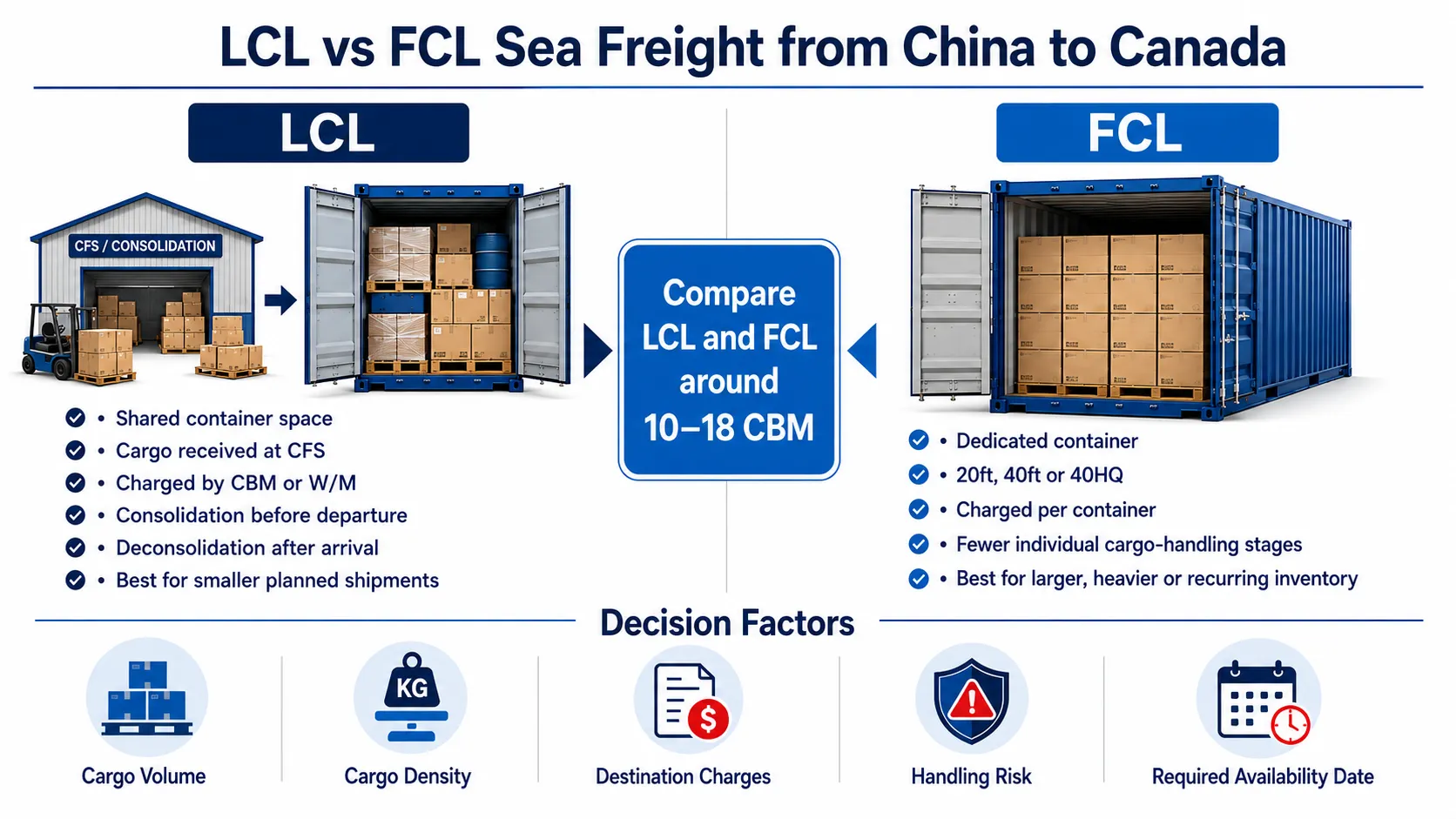
Ocean shipments can be arranged as a shared-container LCL shipment or as a dedicated FCL container. The operational difference matters: LCL moves through consolidation and deconsolidation facilities, whereas FCL uses a container reserved for the shipment, with container-loading and empty-return responsibilities to plan.
LCL Ocean Freight for Pallets and Smaller Commercial Orders
LCL sea freight allows compatible cargo from separate shippers to share container space. Goods are received at an origin container freight station (CFS), grouped for export, transported by vessel and separated again after arrival before individual shipments can be released. It may work for several pallets, smaller wholesale orders, regular replenishment in limited batches or collections from more than one supplier.
The key service questions are whether the CFS will accept the package size and weight, whether the cargo can be stacked, what export cut-off applies and when the destination CFS will make the consignment available. LCL requires deliberate packaging and shipment identification because it encounters additional cargo-handling stages.
FCL Container Shipping for Larger and Recurring Imports
FCL sea freight reserves a complete container for the consignment. Typical choices include 20ft, 40ft and 40ft high-cube (40HQ) dry containers. The service may include arranging the empty container, moving it for loading, checking cargo-loading readiness, coordinating export terminal delivery, booking the vessel and arranging the container’s onward movement and empty return in Canada.
FCL may suit larger purchase orders, dense machinery, wholesale stock, fragile goods that benefit from fewer separate handling steps or repeat shipments that need a consistent loading plan. A dedicated container does not automatically make the shipment all-inclusive or guarantee a particular vessel departure.
Choosing LCL or FCL for a Sea Freight Booking
The right choice depends on packed CBM, gross weight, cargo characteristics, destination handling and the complete service scope rather than a single volume threshold.
| Operational factor | LCL | FCL |
|---|---|---|
| Space allocation | Shared container space | Dedicated container |
| Origin handling | CFS receiving and consolidation | Container positioning and shipment loading |
| Arrival handling | Destination CFS deconsolidation and individual release | Container terminal release and onward container transport |
| Cargo considerations | Stackability, carton condition and handling limits | Payload, weight distribution, securing and unloading |
| Useful starting scenario | Smaller palletized commercial consignments | Higher-volume, heavier or repeat commercial loads |
| What to compare | CFS and destination charges as well as freight | Equipment, inland transport and empty-return conditions |
For example, an importer combining several suppliers into one shipment should first confirm the final packed volume and whether all cargo can be received before the origin cut-off. A supplier’s factory dimensions are not a substitute for the final measured pallet or crate dimensions. You can prepare the shipment measurements with the CBM calculator, then compare service options for the same origin and Canadian destination.
If you are specifically deciding which method is more economical at a given load size, our LCL versus FCL comparison guide goes into the break-even considerations in more depth.
How TopShipping Coordinates Commercial Ocean Freight
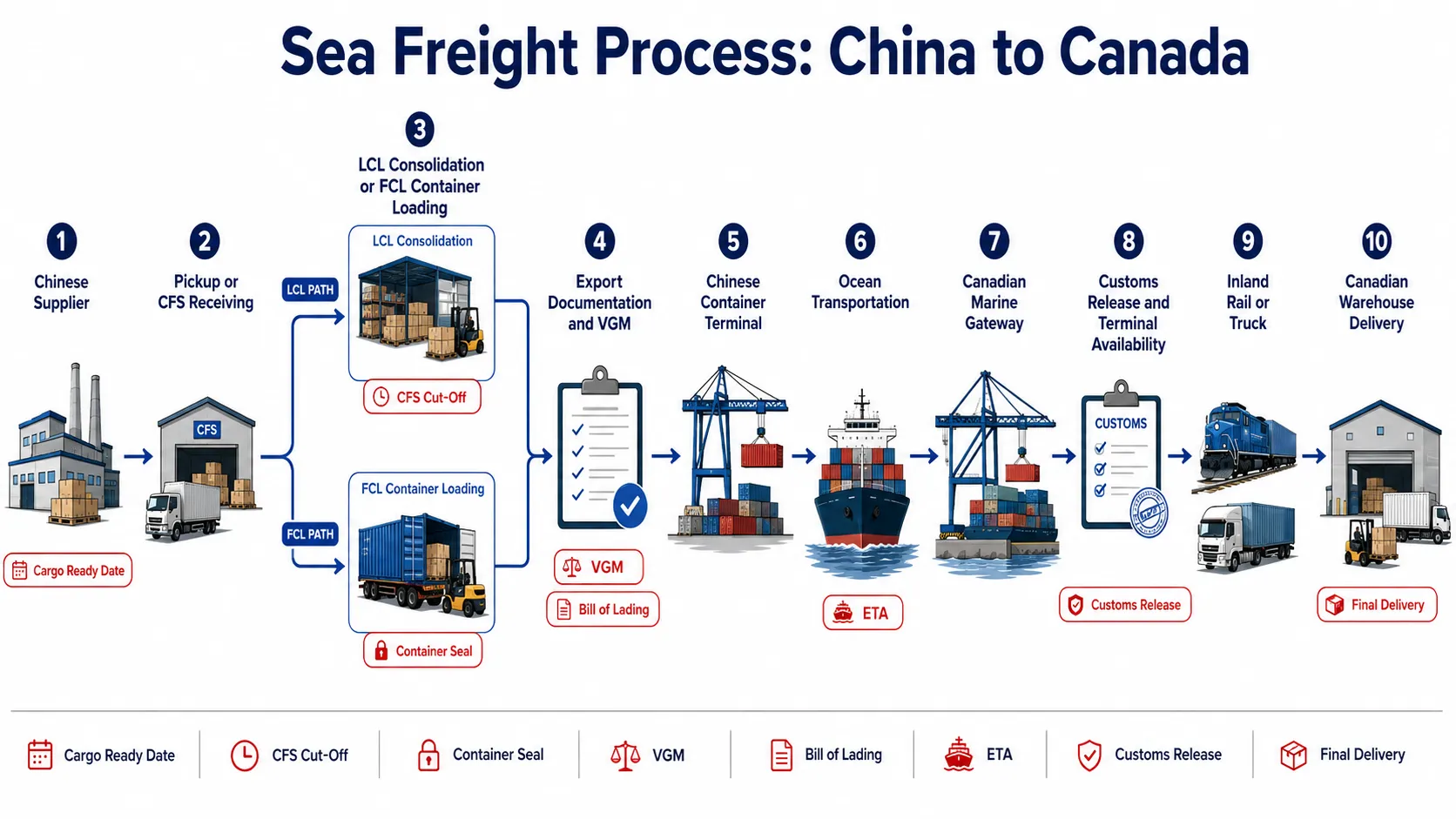
A reliable booking starts before cargo reaches the port. Depending on the shipment scope agreed with TopShipping, the work is coordinated through these practical stages.
- Cargo and destination review: confirm the supplier address, package count, final dimensions, gross weight, products, import requirements, cargo-ready date and Canadian delivery location.
- LCL or FCL plan: select the receiving arrangement, container type, origin gateway and requested delivery scope; identify non-stackable or special cargo in advance.
- Supplier pickup or delivery: coordinate collection, warehouse receiving or container loading, including multiple factories when applicable.
- Export and vessel cut-off: align booking details, shipping instructions, export documents, VGM for applicable packed containers and terminal or CFS deadlines.
- Ocean shipment and milestone updates: monitor the planned departure, actual departure, transshipment if applicable and Canadian arrival milestones.
- Arrival and release coordination: align carrier or CFS availability, destination charges, importer or broker information, customs release and terminal conditions.
- Canadian inland delivery: coordinate rail, drayage or trucking where included, verify the receiving appointment and handle container empty-return or LCL pickup requirements.
Service boundaries must be confirmed in the quotation: coordinating customs documentation is not the same as acting as the importer of record or guaranteeing customs release, and a port arrival is not the same as delivery to the final warehouse.
Container Equipment, Loading and Cargo Protection
20ft, 40ft and 40HQ Dry Containers
A 20ft dry container can be appropriate for heavier, denser loads where payload and axle limits are important. A 40ft container offers more space for regular commercial inventory, while a 40HQ provides additional internal height for bulky goods. There is no single safe loading quantity for every shipment: gross weight, packing dimensions, floor loading and Canadian inland road restrictions can limit what can actually be carried.
The practical distinctions between standard dry containers are explained in our 20ft, 40ft and 40HQ container guide. This service page focuses on equipment availability, safe loading, carrier acceptance and the transport responsibilities in the quote.
Before booking, the loading plan should record pallet or crate footprints, whether cartons can be stacked, the required securing method, the equipment used to unload in Canada and any loading-dock constraints. For machinery, clarify lifting points, centre of gravity and the ability to load and secure the cargo safely.
Special Equipment and Non-Standard Cargo
Some shipments may require reefer, open-top or flat-rack equipment rather than a standard dry container. Temperature-controlled cargo needs a confirmed temperature profile and monitoring arrangement; oversized machinery needs reliable dimensions, weight, lifting instructions and carrier acceptance. Availability, pricing and acceptance are route- and cargo-specific, so these services are assessed individually rather than promised for every port pair.
LCL Packaging and Handling
LCL cargo should be packed for CFS transfers and mixed-container movement. Reinforced pallets or crates, moisture-resistant protection, appropriate marks and accurate weights help reduce avoidable handling problems. Disclose unstable, non-stackable or fragile loads before acceptance rather than assuming a shared container can accommodate them without restrictions.
Supplier Pickup and Multi-Supplier Consolidation in China
Canadian importers often purchase from factories in different Chinese cities. Sea freight can be coordinated around those purchases, but the cargo-ready dates, pickup arrangements and paperwork must be aligned before the shipment cut-off.
- Confirm the finished and packed cargo-ready date for each supplier.
- Collect the correct address, contact, packing list and purchase-order reference.
- Measure the actual received packages and investigate any discrepancies.
- Check whether separate products can be packed or consolidated compatibly.
- Identify which supplier delay could jeopardize the booked sailing.
- Keep documentation traceable to the importer, even when cargo is combined.
Consolidation can simplify coordination for repeat wholesale imports, but it is not automatically cheaper or faster. A practical plan may ship ready cargo separately when waiting for one supplier would miss an important delivery requirement.
When the importer is purchasing from several factories, the booking should show who is responsible for each pickup and which facility will receive the loads. A single late supplier can miss a container cut-off or add warehouse costs. The freight consolidation from China to Canada guide covers buyer’s consolidation, receiving controls and multi-supplier scheduling in detail.
Ports in China and Delivery Gateways in Canada
Common departure areas for commercial ocean cargo include Shenzhen/Yantian, Guangzhou/Nansha, Ningbo-Zhoushan, Shanghai, Qingdao and Tianjin. The appropriate gateway depends on supplier location, cargo handling, service schedules and the final Canadian destination—not just the shortest distance to a port.
For Canada-bound containers, Vancouver and Prince Rupert are important West Coast gateways, with rail and truck connections supporting inland markets. Montreal and Halifax may be relevant for selected eastern routings. Toronto, Brampton and Markham are inland destinations, not ocean ports; sea freight serving those locations normally includes an onward rail or trucking leg from the marine gateway.
| Planning situation | What the shipment team should confirm |
|---|---|
| Factories near Shenzhen or Dongguan | Origin pickup, terminal/CFS receiving, cut-off and the selected South China sailing |
| Multiple factories across China | Consolidation site, last cargo-ready date, documentation consistency |
| Import into British Columbia | Port availability, release conditions and final drayage requirements |
| Delivery to Greater Toronto Area | Marine arrival plus inland rail/truck, last-mile unloading and appointment requirements |
| Oversized or special cargo | Origin handling capacity, equipment acceptance and inland route restrictions |
When a quotation names only a Canadian port, verify whether the price also covers inland movement to the actual receiving address.
Direct vessel calls and transshipment options change with the carrier’s schedule, so port selection must be based on an actual bookable service. A Shenzhen-area supplier may use a South China gateway; a Shanghai-area supplier may have different origin CFS and terminal options. Our Shanghai-to-Canada route guide provides the origin-specific planning considerations without turning this service page into a route article.
For inland delivery, the operational handoff matters as much as the ocean leg: confirm the discharge terminal, whether rail movement is required, who can collect the container or CFS cargo, the receiving dock appointment and who manages the empty return. A port-to-port quotation does not automatically cover a Toronto or Markham delivery.
Ocean Shipping Documents, VGM and Vessel Cut-offs
For ocean shipping, the transport documents must match the goods actually received and loaded. The service team typically needs a commercial invoice, packing list, shipper and consignee details, freight-booking instructions, and the final ocean bill of lading or sea waybill information. Product-specific licences or certificates are handled according to the goods and the relevant import rules.
Bill of Lading and Release Instructions
The bill of lading identifies key transport particulars. Before shipment, confirm the names of the shipper and consignee, cargo description, package count, gross weight, container and seal details where applicable, and the intended release arrangement. A document discrepancy may complicate cargo release even if the vessel arrives as planned.
Verified Gross Mass for Packed Containers
For packed containers subject to the SOLAS requirements, the shipper must provide a Verified Gross Mass (VGM) sufficiently early for vessel stowage planning. The International Maritime Organization states that a packed container without the required VGM cannot be loaded onto the ship under the applicable rule. See the official IMO VGM guidance.
VGM does not replace the carrier’s container payload limits, road weight restrictions or the need for safe load securing. Terminal delivery, document submission and VGM cut-offs should be confirmed for the specific sailing.
For importer and supplier teams preparing the paperwork, the separate China-to-Canada shipping documents checklist provides a more complete reference. The sea freight service itself requires document consistency, timely carrier instructions and a workable cargo-release arrangement.
Canadian Customs Release and Inland Delivery
After arrival, a sea-freight shipment must meet the relevant release and terminal conditions before cargo can move to the agreed destination. Canadian commercial importers are responsible for appropriate importer registration, declarations and applicable duties and taxes; a customs broker may be authorized to assist, but the precise responsibilities depend on the arrangement.
Importers comparing port-to-door with full origin-to-destination coordination can review our door-to-door shipping service. The sea freight quote should identify the specific Canadian delivery address and whether unloading, delivery appointments and container-return arrangements are part of the work.
The CBSA commercial import guide explains the official import requirements, including importer setup, shipping, release and accounting. For the sea-freight service, the essential coordination points are correct arrival details, customs-release status, terminal or CFS availability, delivery orders where needed, and inland transportation instructions.
FCL Release and Container Return
FCL requires coordination of terminal availability, any rail movement, container pickup or drayage, warehouse unloading and return of the empty equipment. Verify demurrage, detention and applicable free-time terms in the booking and delivery arrangement.
LCL Deconsolidation and Cargo Availability
LCL cargo is normally deconsolidated at a destination CFS. Vessel arrival by itself does not mean each individual pallet is ready for pickup or delivery. Check the CFS release notice, charges, handling status and cargo-availability appointment before arranging the receiving truck.
If you are using LCL, review the Canadian LCL destination charges guide before approving the quotation. Destination handling and deconsolidation can affect total landed cost even when the base ocean rate appears competitive.
Sea Freight Transit, Schedules and Operational Milestones
A quoted vessel schedule is a planning milestone, not a guaranteed warehouse-receipt date. Relevant milestones include cargo-ready date, warehouse or terminal cut-off, estimated and actual departure (ETD/ATD), estimated and actual arrival (ETA/ATA), customs release, CFS availability where applicable, inland transportation and final delivery.
As a common planning reference, main ocean movement for LCL is 20–40 days and a comparable FCL planning window is 16–30 days. Complete door-to-door planning is 30–55 days for LCL or 25–50 days for 20ft FCL, where the relevant scope is confirmed. Main movements and ocean delivery ranges use calendar days; all are estimates rather than sailing or delivery guarantees.
For detailed route timing, port-to-port versus door-to-door interpretation, delay analysis and inventory buffers, see the shipping time from China to Canada guide.
What Is Included in a Sea Freight Quote?
The cheapest visible ocean rate is not necessarily the lowest delivered cost. LCL quotes may be based on chargeable weight/measurement (W/M) and may involve CFS receiving or destination handling; FCL quotes are container-based but may exclude origin trucking, container positioning, destination rail, drayage, demurrage, detention or empty return.
Published LCL and container prices are indicative planning references and may exclude origin services, Canadian terminal/CFS handling, customs charges and inland delivery. The separate China-to-Canada shipping cost guide is responsible for current rate ranges, pricing units and landed-cost examples; a sea freight booking requires a fresh, scoped quotation.
The specialized China-to-Canada shipping cost guide explains W/M, container rates and how to compare landed costs without mixing different quotation scopes.
To prevent unnecessary destination costs, confirm the importer and broker are ready, the consignee can receive the shipment, documents are complete, CFS or terminal fees are understood, and the return instructions for FCL equipment are clear. Cargo insurance, customs exams and unexpected storage should be considered separately when applicable.
Sea Freight Quote Comparison Checklist
Before authorizing a booking, compare quotations on the same cargo dimensions, origin, Canadian destination and service boundaries. Confirm the following items in writing, rather than relying only on a headline LCL W/M or FCL container figure.
| Item | Confirm before accepting |
|---|---|
| Origin scope | Pickup address, EXW/FOB named place, receiving or container positioning, export handling and cut-off responsibilities |
| Ocean scope | LCL CFS or FCL equipment, port pair, direct/transshipment routing where known and carrier-related surcharges |
| Destination scope | Port/CFS charges, release requirements, brokerage coordination, inland rail/truck, delivery appointment and unloading |
| Time and exceptions | Cargo-ready date, booking validity, free time, demurrage/detention, storage, exams, cargo insurance and any excluded costs |
Example: two quotes for the same 12-CBM shipment are not comparable if one ends at the arrival CFS and the other includes delivery to a Greater Toronto Area warehouse. Evaluate the documented total scope and the service handoffs before selecting LCL or FCL.
Which Commercial Shipments Benefit Most from TopShipping Sea Freight?
TopShipping focuses on coordinating commercial cargo for businesses importing from China. The proposed service is tailored to actual cargo details rather than offered as a one-size-fits-all container booking.
- Wholesale and distributor replenishment: align container space, supplier readiness and warehouse delivery with a repeat purchase schedule.
- Machinery, equipment and dense cargo: assess container payload, securing, loading and receiver-unloading requirements before booking.
- Furniture and bulky packaged goods: compare suitable equipment, stackability and transport to the Canadian commercial destination.
- Multiple suppliers: coordinate origins and consolidated receiving where it is operationally sensible.
- Mixed urgency: identify which inventory must travel sooner while keeping the principal replenishment shipment on an ocean schedule.
Depending on the confirmed service agreement, support may cover supplier communication, pickup arrangements, LCL and FCL coordination, shipping documentation, customs-release coordination, shipment milestones and onward delivery. Actual availability and responsibility for each activity are confirmed before booking.
Request an LCL or FCL Sea Freight Quote
To prepare an actionable commercial ocean-freight assessment, provide the supplier or pickup city, Canadian delivery city and postal code, product description, number of suppliers, final carton/pallet/crate dimensions, package count, gross weight, estimated CBM, cargo-ready date, Incoterm and named place. Indicate batteries, regulated goods, oversized or non-stackable cargo and any receiving-equipment restrictions.
Request a sea freight quote with these details. TopShipping can then review the appropriate LCL or FCL arrangement, origin and Canadian delivery scope, and the operational conditions that need to be confirmed before booking.
For an effective initial assessment, tell us whether you need port-to-port, door-to-port or delivery to a named Canadian business address. This helps distinguish the ocean booking from optional inland, customs and delivery work before a formal quotation is prepared.
FAQ — Sea Freight from China to Canada
Yes. TopShipping coordinates commercial LCL ocean freight and FCL container shipping, including suitable 20ft, 40ft and 40HQ equipment. Carrier acceptance, cargo handling, origin services and Canadian delivery are confirmed for each quotation.
LCL cargo typically undergoes destination CFS deconsolidation before the individual shipment becomes available. The importer or authorized broker must satisfy the relevant customs requirements, and CFS release, destination charges and delivery arrangements must also be completed. A vessel ETA is not the same as cargo availability.
For eligible commercial shipments, inland rail, drayage or truck delivery can be coordinated when included in the quoted scope. Confirm the receiving postal code, warehouse appointment, unloading conditions and any container-return responsibilities before booking.
Provide the supplier or origin pickup address, product description, carton or pallet count, actual dimensions, gross weight, total CBM, cargo-ready date, Incoterm with named place and Canadian delivery address. Declare any regulated, hazardous, oversized or non-stackable cargo.
No. A base ocean rate may exclude supplier pickup, terminal or CFS charges, customs brokerage, duties, GST, inland rail or trucking, unloading and unexpected storage or exam costs. The quotation must specify what is included and excluded.
Plan the next shipment
Review your China-to-Canada freight requirements
Share the supplier city, cargo details, cargo-ready date and Canadian destination so the practical air, LCL, FCL or delivered-service options can be reviewed.