

E-commerce shipping from China to Canada is the movement of commercial online-store inventory from Chinese suppliers to a Canadian warehouse, 3PL, fulfilment location or other business receiving point. The most practical freight method depends on how quickly the inventory is needed, the number of SKUs, shipment weight and volume, supplier readiness, Canadian customs requirements and the seller’s replenishment strategy.
For September 2026 planning, standard commercial air freight is approximately USD $6.00–$8.50 per chargeable kilogram, coordinated door-to-door air freight approximately USD $7.50–$12.00 per chargeable kilogram, LCL sea freight approximately USD $150–$220 per chargeable CBM or W/M, a 20ft FCL container approximately USD $6,500–$8,000, and a 40ft or 40HQ container approximately USD $7,200–$9,000.
Typical door-to-door planning time is approximately 5–12 business days by air, 25–50 days by FCL sea freight and 30–55 days by LCL. These are business-planning ranges rather than guaranteed carrier rates or schedules.
This guide focuses specifically on online-seller inventory, stock replenishment, SKU planning, multi-supplier coordination and delivery to Canadian warehouses or 3PL facilities. For the complete country-to-country freight picture, review our China-to-Canada commercial shipping overview.
E-commerce Shipping from China to Canada: September 2026 Snapshot
| E-commerce shipping need | Recommended starting method | September 2026 planning cost | Typical door-to-door planning time |
|---|---|---|---|
| Samples and very small urgent inventory | Express courier | Shipment-specific | 3–7 business days |
| Urgent restocking or launch inventory | Air freight | USD $6.00–$8.50 per chargeable kg | 5–12 business days |
| Coordinated supplier-to-warehouse air freight | Door-to-door air | USD $7.50–$12.00 per chargeable kg | 5–12 business days |
| Smaller planned e-commerce inventory | LCL sea freight | USD $150–$220 per chargeable CBM or W/M | 30–55 days |
| Higher-volume or recurring inventory | 20ft FCL | USD $6,500–$8,000 per container | 25–50 days |
| Bulky or higher-volume inventory | 40ft or 40HQ FCL | USD $7,200–$9,000 per container | 25–50 days |
| Urgent SKUs plus planned inventory | Hybrid air + sea | Split by shipment method | Separate air and ocean timelines |
September 2026 planning note
Rates are in US dollars and represent indicative September 2026 planning ranges. Depending on the quotation, supplier pickup, origin handling, customs brokerage, duties, GST, examinations, destination charges, storage and final delivery may be additional.
For detailed rate calculations and landed-cost components, use our current China-to-Canada freight cost guide. For detailed delivery timelines, see our inventory transit and lead-time guide.
What Is E-commerce Shipping?
E-commerce shipping in this guide means the commercial freight process used by an online seller to move inventory from a supplier in China into Canada before the products are sold and fulfilled to customers.
The international freight movement may connect:
- Chinese manufacturer or supplier
- Supplier pickup or consolidation
- Export warehouse or terminal
- Air, LCL or FCL international freight
- Canadian customs release
- Airport, port or inland terminal
- Canadian warehouse or 3PL
- Inventory available for online-order fulfilment
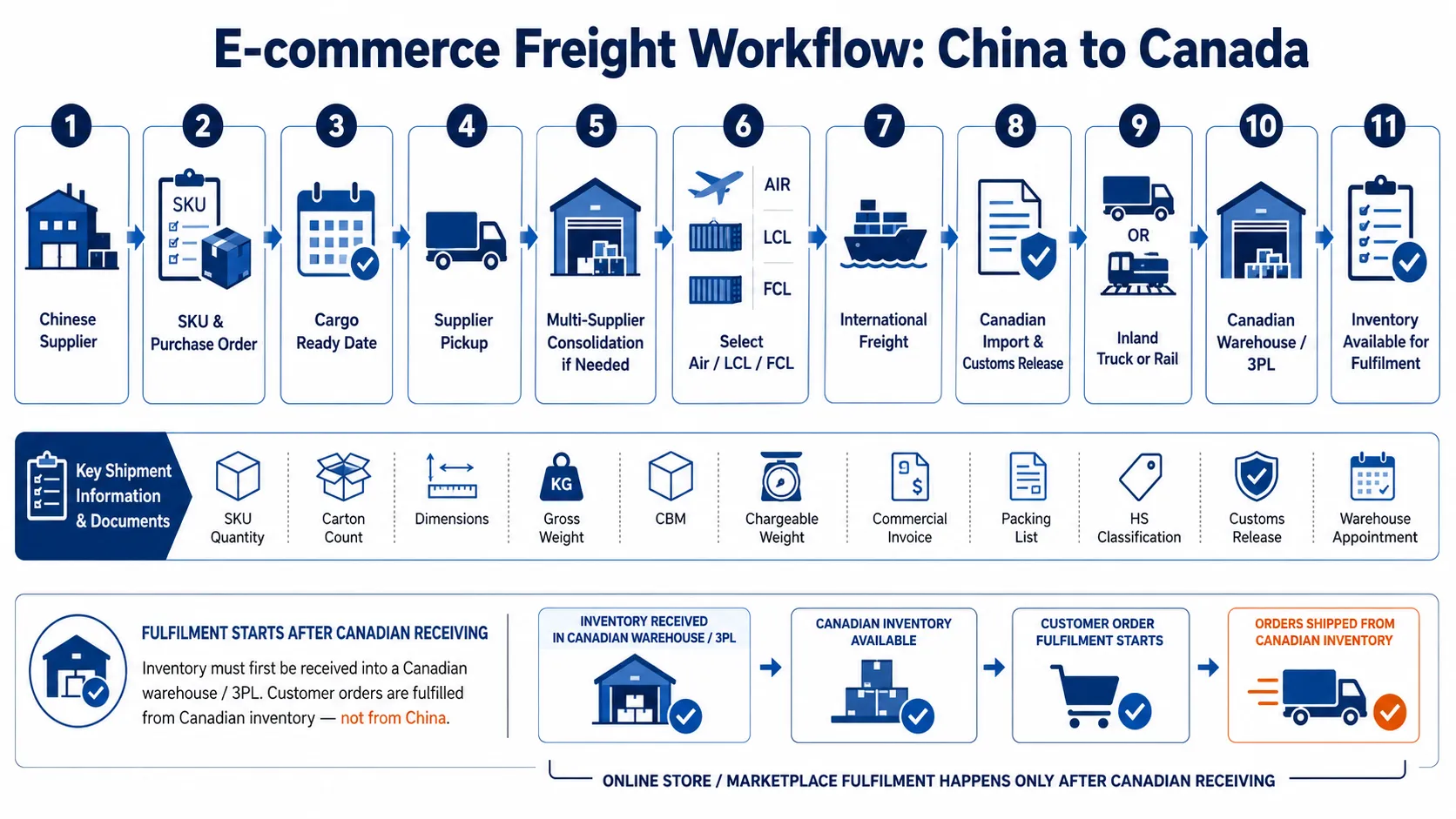
This is different from sending individual consumer orders directly from a Chinese marketplace to Canadian shoppers. TopShipping’s e-commerce freight service focuses on commercial inventory imported by businesses, not personal Taobao purchases or individual cross-border parcel orders.
Who This E-commerce Freight Guide Is For
This shipping model is designed for businesses that sell products online and import inventory in commercial quantities.
- Shopify and independent online-store operators
- Direct-to-consumer brands
- Private-label e-commerce sellers
- Marketplace sellers importing commercial inventory
- Online retailers using Canadian 3PL facilities
- Brands managing recurring replenishment
- Sellers purchasing several SKUs from one supplier
- Businesses purchasing from multiple Chinese factories
- Online sellers importing launch or seasonal inventory
- Growing e-commerce companies moving from parcel shipments to commercial freight
Amazon sellers with FBA-specific receiving, prep and delivery requirements should use our dedicated Amazon inventory freight and FBA delivery guide.
E-commerce Freight Is an Inventory Decision, Not Just a Shipping Decision
For an online seller, the best freight method is not always the cheapest shipment or the fastest shipment. The better decision is the one that protects inventory availability while keeping the landed cost commercially sustainable.
The seller should consider:
- Current available inventory
- Average SKU sales velocity
- Confirmed promotions and campaigns
- Supplier production time
- Cargo-ready date
- International freight time
- Customs and destination handling
- Canadian warehouse receiving time
- Safety stock
- Cost of a potential stockout
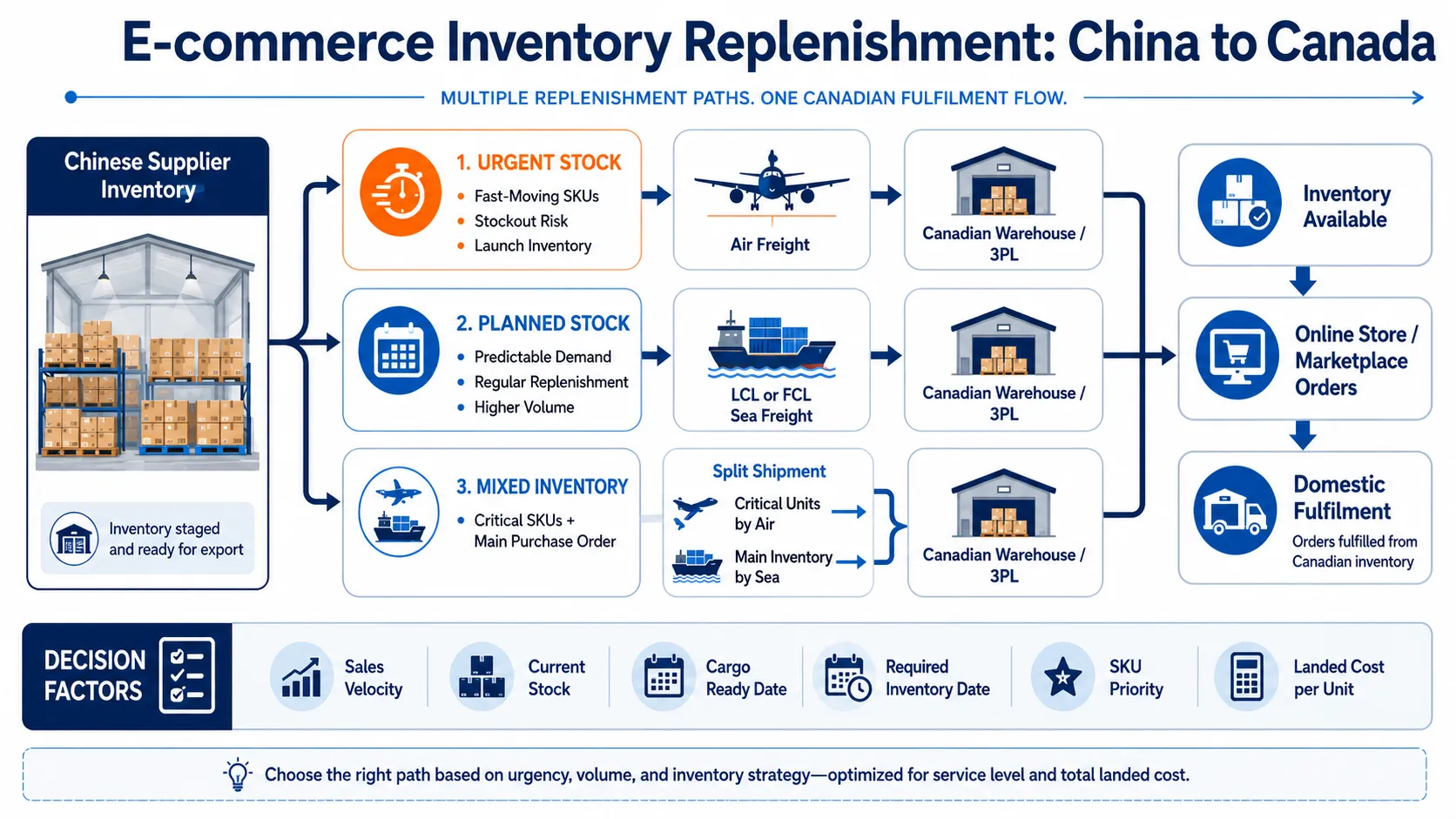
Match the Freight Method to Inventory Risk
| Inventory condition | Recommended starting strategy |
|---|---|
| Healthy inventory and predictable sales | Plan replenishment primarily by LCL or FCL sea freight |
| Stock is declining faster than forecast | Review air freight for priority SKUs |
| Only several SKUs are approaching stockout | Ship the critical quantity by air and leave the main order by sea |
| New product with uncertain demand | Consider a smaller launch quantity before committing to a large inventory position |
| Confirmed promotional or seasonal demand | Work backwards from the required warehouse-availability date |
| Recurring high-volume products | Evaluate regular FCL or planned LCL replenishment cycles |
Air Freight for E-commerce Inventory
Air freight is most useful when inventory availability is worth more to the seller than the additional transportation cost.
Typical e-commerce uses include:
- Urgent stock replenishment
- Product-launch inventory
- Samples and prototypes
- Replacement products
- Seasonal merchandise with a fixed sales window
- High-value compact inventory
- Critical SKUs while the main order moves by sea
Standard commercial air freight commonly requires approximately 5–12 business days door to door after pickup, export handling, air transportation, customs processing and final delivery are included.
Air freight is commonly rated using chargeable weight, which compares actual gross weight with volumetric weight. Bulky but lightweight e-commerce products can therefore be more expensive to ship by air than their physical weight suggests.
For chargeable weight, airline routing and cargo-acceptance requirements, review our commercial air-cargo planning guide.
Sea Freight for Planned E-commerce Stock
Sea freight is generally the stronger option when inventory can be planned earlier and the seller is moving larger or heavier quantities.
It can be useful for:
- Regular replenishment inventory
- Bulky consumer products
- Apparel and retail goods
- Home and lifestyle inventory
- Multiple pallets
- Higher-volume private-label orders
- Recurring product lines
LCL for Smaller E-commerce Batches
LCL, or Less than Container Load, allows an online seller to use part of a consolidated ocean container rather than reserving an entire container.
It can be practical for smaller planned replenishment orders and brands that are not yet moving enough volume for regular FCL shipments.
FCL for Growing E-commerce Inventory
FCL reserves a complete container for one shipment and can become increasingly practical as the seller’s order volumes grow.
Once cargo reaches approximately 10–18 CBM, both LCL and FCL should normally be quoted because container pricing, cargo density, handling and Canadian destination charges can move the break-even point.
For a deeper container comparison, see our shared-container vs full-container decision guide.
For complete ocean-freight operations, review our commercial sea-freight guide.
Use Air and Sea Together for E-commerce Replenishment
An e-commerce seller does not always need to choose one freight method for the entire purchase order.
A split-shipment strategy can send the most urgent inventory by air while the majority moves by sea at a lower transportation cost.
This can be useful when:
- A best-selling SKU is approaching stockout.
- A promotion begins before the ocean shipment will arrive.
- A supplier completed production later than expected.
- Only part of the purchase order is immediately required.
- A new product needs a limited launch quantity first.
- The seller wants to protect cash flow while maintaining inventory availability.
Example E-commerce Split Strategy
| Inventory group | Freight method | Reason |
|---|---|---|
| Fast-moving SKU | Air freight | Protect sales and reduce stockout risk |
| Normal replenishment stock | Sea freight | Lower transportation cost per unit |
| Low-demand SKU | Next planned sea shipment | Avoid unnecessary inventory and freight expense |
| Product samples | Courier or air freight | Receive approval units quickly |
Shipping Inventory from Multiple Chinese Suppliers
E-commerce brands frequently purchase products, packaging, inserts or accessories from several suppliers. Shipping each factory order separately can create duplicated pickup, documentation and minimum freight charges.
Multi-supplier consolidation can bring compatible orders into one coordinated shipment before export.
What Should Be Controlled During Consolidation?
| Item | Why it matters for an online seller |
|---|---|
| Supplier name | Identifies where each inventory group originated |
| Purchase-order reference | Links received cartons to the correct order |
| SKU reference | Helps warehouse and inventory reconciliation |
| Cargo-ready date | Determines whether several suppliers can meet one departure |
| Carton count | Confirms the supplier delivered the expected quantity |
| Final dimensions | Determines air chargeable weight or ocean volume |
| Gross weight | Supports pricing and capacity planning |
| Commercial documents | Supports export and Canadian import preparation |
Consolidation should not automatically delay the complete order. If one non-critical supplier is late while important inventory is ready, a split shipment may be commercially better.
For the complete process, review our multi-supplier cargo consolidation guide.
Private-Label E-commerce Shipping
Private-label sellers have additional pre-shipment considerations because the inventory may use custom packaging, printed cartons, inserts, labels or branded retail presentation.
Before freight is booked, confirm:
- Final product version
- Correct SKU or model
- Retail packaging
- Outer-carton labels
- Barcode requirements where applicable
- Carton quantity by SKU
- Country-of-origin marking where required
- Packaging dimensions
- Product compliance requirements
- Canadian warehouse receiving requirements
A freight-forwarding warehouse can verify cargo information, but product-branding and marketplace requirements should be confirmed before production is finalized.
Shopify and Independent Online-Store Shipping
The e-commerce platform used to sell the products does not determine the international freight method. A Shopify or independent-store seller may still use courier, commercial air freight, LCL or FCL depending on the inventory profile.
The more important logistics decision is where inventory will be held after importation.
Common models include:
- Seller-operated Canadian warehouse
- Third-party logistics provider
- Retail distribution facility
- Marketplace fulfilment network
- Combination of 3PL and marketplace inventory
This page covers inbound commercial inventory logistics. Store software, shopping-cart integrations and domestic order-management integrations are separate from the international freight process.
Shipping to a Canadian 3PL or Fulfilment Warehouse
The shipment should be planned around the actual receiving requirements of the Canadian warehouse or 3PL.
Before cargo reaches Canada, confirm:
- Complete warehouse address and postal code
- Receiving hours
- Delivery appointment requirements
- Purchase-order or inbound reference
- SKU or carton labels
- Pallet configuration
- Maximum pallet height or weight where applicable
- Advance shipment notice requirements where applicable
- Dock availability
- Liftgate requirements
- Unloading responsibility
- Restricted receiving dates
A shipment can be customs-released but still fail final delivery if the warehouse has not approved the appointment or receiving instructions.
Own Warehouse vs 3PL vs Marketplace Fulfilment
| Destination model | Primary logistics consideration |
|---|---|
| Seller’s own warehouse | Receiving capacity, dock access and internal inventory handling |
| Canadian 3PL | Inbound references, appointments, pallet and carton requirements |
| Marketplace fulfilment location | Platform-specific inbound rules and receiving instructions |
| Multiple fulfilment destinations | Whether cargo should be divided before or after Canadian import |
If Amazon FBA is the primary destination, use the dedicated Amazon FBA freight, prep and delivery guide rather than treating the general e-commerce page as the owner of Amazon-specific requirements.
Customs Planning for E-commerce Inventory
E-commerce inventory imported for resale is commercial cargo and should be prepared as a commercial import rather than treated as a series of personal consumer purchases.
Importers should confirm:
- Canadian Business Number and applicable RM account
- CARM setup and customs-broker delegation where required
- Detailed product descriptions
- Canadian HS tariff classification
- Country of origin
- Commercial value
- Applicable duty and GST
- Product-specific permits, certificates or licences
The Canada Border Services Agency commercial importing resources provide the official framework for businesses importing commercial goods into Canada.
The CBSA Assessment and Revenue Management system, or CARM, is used for commercial import accounting and applicable duties and taxes.
For the release workflow, review our Canadian customs preparation guide. For classification, duty and GST planning, use our Canadian tariff and import-tax guide.
Product Compliance for Products Sold Online in Canada
Selling a product through an online store does not remove Canadian product-compliance requirements.
Requirements can vary according to the product category and may involve safety, labelling, ingredients, electrical standards, food regulations, health-product requirements or other federal and provincial rules.
Health Canada publishes guidance for the commercial importation of consumer products and cosmetics. Sellers should confirm the requirements for the actual product before cargo leaves the supplier.
Review Health Canada’s commercial consumer-product import guidance.
Shipping Documents for E-commerce Inventory
| Document or information | Main purpose |
|---|---|
| Commercial invoice | Identifies the transaction, products, values and commercial terms |
| Packing list | Identifies cartons, SKU quantities, weights and packing details |
| Air waybill | Records air-freight transportation information |
| Bill of lading | Records ocean-freight transportation information |
| HS classification | Supports Canadian tariff classification |
| Country-of-origin information | Supports customs and trade-measure review |
| Product certificates or permits | Required where the product category is regulated |
| Warehouse receiving information | Supports successful final delivery |
SKU names used internally in an online store may not be adequate customs descriptions. A product listed in a store as “Classic Black,” “Model A” or “Accessory Kit” still requires a commercially meaningful description for customs and transportation purposes.
For a complete checklist, review our import-document preparation guide.
DDP Shipping for E-commerce Sellers
DDP can be considered when a seller wants a broader delivered-duty-paid arrangement, but it should not be selected solely because a supplier describes the quote as “all inclusive.”
Before accepting DDP, confirm:
- Who will act as importer of record
- Canadian tariff classification
- Declared customs value
- Country of origin
- Who pays duty and GST
- Customs-brokerage arrangement
- Final delivery destination
- Potential examination or storage charges
The underlying transportation may still be air freight, LCL or FCL. DDP does not create a separate transportation speed.
For detailed responsibilities, see our delivered-duty-paid shipping guide.
Door-to-Door Shipping for Online Sellers
Door-to-door freight connects supplier pickup in China with an agreed business, warehouse or fulfilment destination in Canada.
Depending on the confirmed scope, it can coordinate:
- Supplier pickup
- Origin receiving or consolidation
- Export handling
- Air or ocean freight
- Canadian destination handling
- Customs-clearance coordination
- Rail or truck transportation
- Final warehouse delivery
Door-to-door describes the transportation scope; it does not automatically mean duty, GST, examinations or every contingent charge is included.
For detailed service boundaries, see our door-to-door shipping from China to Canada guide.
How to Calculate E-commerce Landed Cost
For an online seller, freight cost per kilogram or per container is not the final number that determines profitability.
A more useful planning metric is:
Total applicable product, import and logistics cost ÷ saleable units = estimated landed cost per unit
Depending on the shipment, landed cost can include:
- Supplier product cost
- Packaging and labelling
- China-side pickup
- Origin handling
- International freight
- Cargo insurance
- Customs duty
- GST
- Brokerage
- Destination handling
- Canadian inland transportation
- Warehouse inbound charges
The same SKU can have different landed costs when shipped by air and sea. Sellers should therefore track freight method and landed cost by replenishment cycle rather than using one permanent cost assumption.
Inventory Replenishment Planning for Online Sellers
A practical replenishment plan works backwards from the date inventory needs to be available for sale rather than from the carrier’s estimated departure date.
Track These Dates
- Purchase order issued
- Production start
- Supplier cargo-ready date
- Pickup date
- Origin warehouse received date
- International departure
- Estimated arrival
- Actual arrival
- Customs release
- Cargo availability
- Warehouse delivery
- Inventory available for fulfilment
The last date is the one that matters most for sales planning. Aircraft or vessel arrival does not automatically mean the inventory can be sold or fulfilled.
How Much Inventory Should Be Sent by Air?
There is no fixed percentage that applies to every e-commerce business.
A useful planning approach is to identify the minimum quantity required to protect sales until the planned sea shipment becomes available.
The seller can consider:
- Average daily sales by SKU
- Current available units
- Confirmed promotional demand
- Air-freight lead time
- Ocean-freight lead time
- Safety-stock target
- Gross margin
- Cost of lost sales
Airfreighting the entire order during a temporary shortage can unnecessarily reduce product margin. Sending only the critical units can be more efficient.
Seasonal and Launch Inventory
E-commerce products linked to holidays, campaigns or seasonal demand require a different freight plan from evergreen inventory.
For a fixed selling window:
- Set the required Canadian warehouse-availability date.
- Work backwards through final delivery and customs.
- Add a contingency buffer.
- Confirm the supplier’s production completion date.
- Select the freight method before the shipment becomes urgent.
- Consider air freight for a limited launch quantity if required.
The cheapest sea-freight shipment can become commercially expensive if the products arrive after the main sales period.
Common E-commerce Shipping Problems
Running Out of Inventory Before the Next Sea Shipment
This usually indicates that replenishment timing, supplier lead time and freight lead time were not connected closely enough.
Sending Every Restock by Air
Air freight can protect urgent inventory but can significantly reduce margin when it becomes the default method for predictable replenishment.
Ordering Too Much Inventory Too Early
Lower freight cost per unit does not automatically justify excess stock. Storage cost, cash tied up in inventory and changing product demand should also be considered.
Using Estimated Carton Dimensions
Final packed dimensions influence air chargeable weight, LCL volume and container planning.
Shipping Every Supplier Separately
Multiple small shipments can create repeated pickup, documentation and minimum freight costs.
Ignoring 3PL Receiving Rules
A customs-released shipment may still be delayed if the fulfilment warehouse requires an appointment or specific inbound reference.
Using Store SKU Names as Customs Descriptions
Internal catalogue names are not always detailed enough to identify the goods for Canadian import purposes.
Treating ETA as the Restock Date
Customs release, cargo availability and final warehouse receiving may still occur after international arrival.
How to Reduce E-commerce Shipping Costs Without Creating Stockouts
- Forecast replenishment earlier.
- Use sea freight for predictable inventory.
- Reserve air freight for high-priority SKUs.
- Use a split air-and-sea strategy when appropriate.
- Consolidate compatible supplier orders.
- Obtain final package dimensions before booking.
- Reduce unnecessary packaging volume without reducing product protection.
- Compare LCL and FCL at higher cargo volumes.
- Provide the exact Canadian warehouse postal code.
- Confirm 3PL receiving requirements before departure.
- Compare landed cost per saleable unit rather than freight cost alone.
- Track actual transit and supplier performance after each replenishment cycle.
E-commerce Pre-Shipment Checklist
- Confirm supplier and purchase-order details.
- Confirm final SKU quantities.
- Confirm the cargo-ready date.
- Confirm the product description and Canadian HS classification.
- Review product admissibility and compliance requirements.
- Prepare the commercial invoice and packing list.
- Confirm carton count and SKU distribution.
- Obtain final carton or pallet dimensions.
- Confirm total gross weight and CBM.
- Identify batteries, liquids, chemicals or sensitive products.
- Confirm the Incoterm and named location.
- Select courier, air, LCL or FCL according to inventory need.
- Decide whether urgent SKUs should be split from planned inventory.
- Confirm the Canadian importer setup.
- Confirm customs-broker arrangements where required.
- Provide the final Canadian warehouse or 3PL address.
- Confirm receiving hours and appointments.
- Confirm labels and inbound references.
- Build a contingency buffer before the stockout date.
Information Needed for an E-commerce Freight Quote
| Information | Why it matters |
|---|---|
| Supplier pickup address | Determines China-side pickup and gateway planning |
| Number of suppliers | Determines whether consolidation should be reviewed |
| Product description | Supports cargo acceptance and customs preparation |
| SKU quantities | Supports split shipment and inventory planning |
| Carton or pallet count | Supports handling and receiving planning |
| Final package dimensions | Determines air chargeable weight and ocean volume |
| Total gross weight | Supports freight pricing and capacity planning |
| Total CBM | Supports LCL/FCL comparison |
| Cargo value and currency | Supports customs and landed-cost planning |
| Cargo-ready date | Determines possible departure schedules |
| Required inventory date | Helps select the appropriate freight method |
| Canadian warehouse postal code | Determines final delivery planning |
| Warehouse or 3PL instructions | Reduces final-delivery failures |
| Special-cargo information | Determines carrier acceptance and documentation requirements |
How TopShipping Supports E-commerce Sellers
TopShipping coordinates commercial inventory freight from Chinese suppliers to Canadian online sellers and brands.
Depending on the confirmed shipment scope, support may include:
- Supplier communication and cargo-ready-date coordination
- Factory pickup in China
- Multi-supplier consolidation
- Air freight for urgent inventory
- LCL sea freight
- FCL container shipping
- Export handling
- Commercial document coordination
- Customs-clearance coordination
- Shipment milestone tracking
- Canadian 3PL or warehouse delivery planning
- Final commercial delivery
The objective is not to apply the same freight method to every purchase order. The shipping plan should reflect the seller’s inventory position, SKU priorities, supplier readiness, landed cost and required warehouse-availability date.
Request an E-commerce Shipping Assessment
If you sell online and import commercial inventory from China, provide the supplier locations, SKU quantities, carton details, final dimensions, gross weight, cargo-ready date and Canadian warehouse destination.
TopShipping can review air, LCL, FCL, consolidation and split-shipment options based on the actual inventory requirement.